Learn how to file Alberta's WCB Employer Report of Injury (C040) within 72 hours, meet OHS Act Section 33 requirements, and build a compliant reporting process.
When something goes wrong on a job site in Alberta, the clock starts ticking. You have got 72 hours to file with WCB, a separate call to make to OHS, and penalties that can hit $25,000 if you miss the window. At Safety Evolution, we help contractors across Alberta get their reporting right the first time so a bad day on site does not turn into a compliance nightmare.
⚡ Quick Answer: Alberta Incident Reporting at a Glance
WCB report: File the Employer's Report of Injury (Form C040) within 72 hours of learning about any injury requiring more than first aid.
OHS report: Call the OHS Contact Centre at 1-866-415-8690 as soon as possible for fatalities, hospitalizations, explosions, fires, floods, or structural collapses.
Investigation: The employer (or prime contractor) must investigate and prepare a written report under Section 33 of the OHS Act.
Retention: Keep investigation reports readily available for at least 2 years.
An incident report in Alberta is a formal record of a workplace injury, illness, or dangerous incident. Alberta employers deal with two separate reporting systems: the Workers' Compensation Board (WCB-Alberta) for compensation claims, and Occupational Health and Safety (OHS) under Part 4 of the OHS Act for regulatory compliance. Filing with one does not satisfy the other, and missing either deadline puts your company at risk of fines, delayed claims, and regulatory scrutiny.
This guide walks you through both systems: when each report is triggered, how to file, what the deadlines are, and what happens if you don't comply. If you're a contractor running crews in Alberta, this is the reporting process your supervisors need to know.
What triggers a WCB incident report in Alberta?
Under Alberta's Workers' Compensation Act, you must submit a report to WCB-Alberta any time a workplace injury or illness results in (or is likely to result in):
Lost time or the need to modify work beyond the date of the accident
Death or permanent disability (amputation, hearing loss, etc.)
A disabling or potentially disabling disease or condition caused by occupational exposure (including mental health concerns, poisoning, respiratory disease, dermatitis)
Medical treatment beyond first aid (assessment by a physician, psychologist, physiotherapist, chiropractor, or mental health provider)
Medical aid expenses (dental treatment, eyeglass repair, prescription medications)
Most contractors think they only need to report lost-time injuries. They're wrong. That chiropractor visit your worker booked on their own? That's a reportable event. The prescription the walk-in clinic wrote? Reportable. If it goes beyond your crew's first aid kit, WCB needs to know.
📹 Watch: How to Write an Incident Report — 7 Essential Elements
How to file the WCB Employer's Report of Injury (Form C040)
Stop Treating Near Misses as "No Big Deal"
Every near miss is a free warning. Download our free Incident Investigation Kit to capture the details before it turns into a recordable accident.
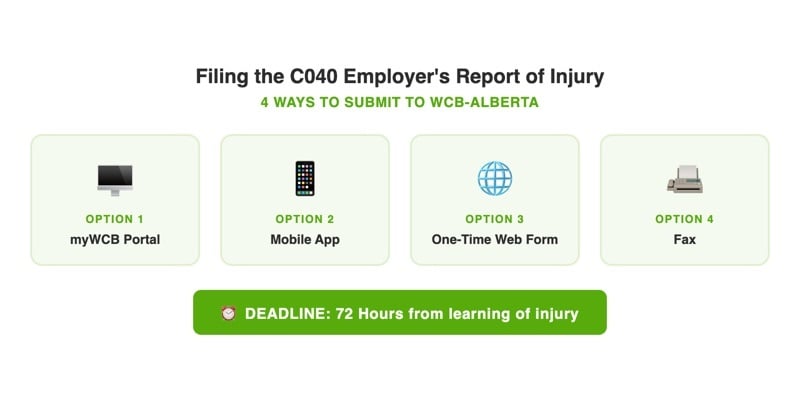
The C040 is WCB-Alberta's official incident report form for employers. It was last revised in October 2025, and you have four ways to submit it:
Option 1: Online through myWCB (recommended). Log in at my.wcb.ab.ca, and the system walks you through each field with built-in help prompts. This is the fastest method and gives you instant confirmation. Option 2: myWCB Employer mobile app. Available on iPhone and Android. Handy if you're filing from the field, which, let's be honest, is where most of your injuries happen. Option 3: One-time online report. If you don't have a myWCB account, you can submit a single report at rr.wcb.ab.ca/public/employer/create. No login required. Option 4: Fax. Download the paper C040 form from wcb.ab.ca and fax it to 780-427-5863 (or toll-free 1-800-661-1993). This is the slowest option and leaves no digital trail for your COR records.
What the C040 form requires
The form collects three categories of information:
Employer details: Your WCB account number, business name, work site address, and contact information
Worker details: Name, social insurance number, date of birth, job title, and employment information
Incident details: Date and time of injury, location, description of how the injury occurred, body parts affected, first aid provided, medical treatment sought, and whether the worker lost time or is on modified duties
Here's a blunt truth most contractors learn the hard way: WCB doesn't just want a vague description like "worker hurt his back." They want specifics. What task was being performed? What equipment was involved? What was the mechanism of injury? The more detail you provide up front, the faster the claim processes and the less likely WCB follows up with questions that slow everything down.
What triggers an OHS report in Alberta?
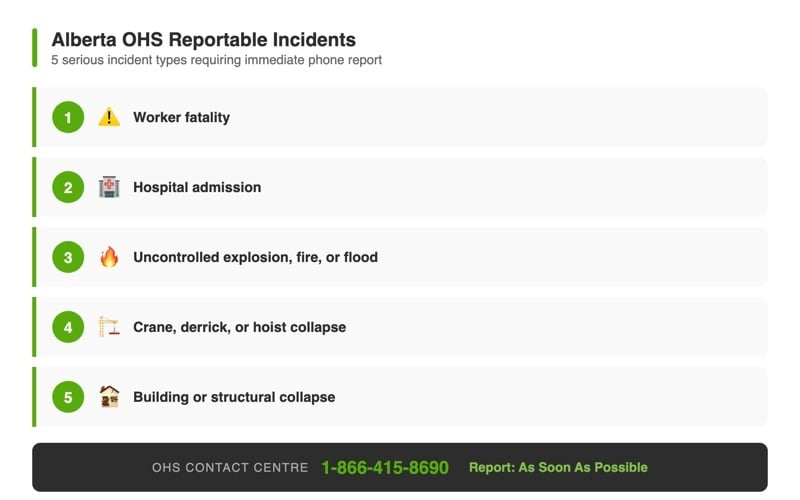
This is where it gets more serious. Under Section 33 of Alberta's Occupational Health and Safety Act, the prime contractor (or the employer, if there's no prime contractor) must call the OHS Contact Centre as soon as possible when:
A worker has died at a work site or from a work-connected illness
A worker has been, or will be, admitted to a hospital (not just treated in an emergency room or urgent care)
There's been an unplanned or uncontrolled explosion, fire, or flood that caused, or could have caused, a serious injury or illness
A crane, derrick, or hoist has collapsed or upset
Any component of a building or structure has collapsed or failed
Call the OHS Contact Centre at 780-415-8690 (Edmonton) or 1-866-415-8690 (toll-free, 24 hours, every day of the year).
You also need to report potentially serious incidents (PSIs) online at oirportal.labour.alberta.ca after your investigation is complete. A PSI is any incident that had a likelihood of causing serious injury or illness and where corrective action may be needed, even if nobody actually got hurt.
Think of it this way: that scaffold plank that fell two storeys and landed where your crew was standing five minutes earlier? That's a PSI. No injury, but someone easily could have been killed.
Do not disturb the scene
This catches contractors off guard every time. Under the OHS Act, you cannot disturb the scene of a serious reportable incident. That means you cannot alter, move, or remove equipment, documents, or anything related to the injury or incident in the immediate area.
The only exceptions:
Attending to someone who is ill, injured, or killed
Preventing further injuries or incidents
Protecting property endangered by the incident
An OHS officer or police officer gives you permission
As of April 2025, a previous Director Order that allowed some exceptions for non-injury incidents (certain explosions, crane collapses, structural failures) was revoked. The scene preservation rules are now back to the original, stricter requirements. If you're unsure whether you can touch anything, call the OHS Contact Centre first.
How does Alberta's OHS investigation work?
Once you report a serious incident to OHS, your investigation obligations kick in under Section 33. The prime contractor (or employer) must:
Investigate the incident thoroughly, including the circumstances and root causes
Prepare a written report outlining what happened and what corrective actions were taken
Share the report with your joint health and safety committee or health and safety representative. If you don't have one, make the report available to workers
Provide the report to an OHS officer on request
Keep a copy readily available for at least 2 years
Your investigation should follow the hierarchy of controls outlined in Section 9 of the OHS Code when developing corrective actions: elimination, substitution, engineering controls, administrative controls, and PPE, in that order.
For a detailed walkthrough of building an investigation process that actually prevents repeat incidents, see our guide on the 7 essential elements of an incident report.
A 12-person mechanical contractor in Red Deer learned this the hard way after a worker fell through an unguarded floor opening. They filed the WCB report on time but never completed the OHS investigation report. When an OHS officer showed up two weeks later asking for documentation, they had nothing. The administrative penalty and follow-up inspection cost them far more than the 30 minutes it would have taken to write the report.
WCB vs. OHS reporting: what's the difference?
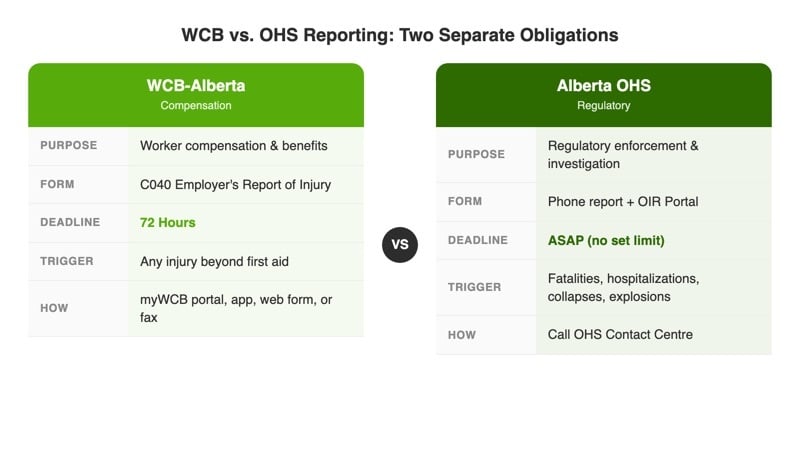
This is the most common source of confusion for Alberta contractors. Here's how the two systems differ:
WCB-Alberta (Workers' Compensation Board): Handles the insurance and compensation side. The C040 form triggers the claims process so your injured worker gets benefits. You file within 72 hours of learning about the injury. Every injury beyond first aid gets reported. Alberta OHS (Occupational Health and Safety): Handles the regulatory and enforcement side. Serious incidents get reported by phone as soon as possible. Investigations and PSI reports get submitted online. Not every injury triggers an OHS report, only the serious ones listed in Section 33.
A worker who sprains their wrist and sees a physiotherapist? WCB report, yes. OHS report, no (unless they're hospitalized). A scaffold collapse with no injuries? OHS report and PSI, yes. WCB report, no (nobody was hurt).
If you're building or maintaining a COR (Certificate of Recognition) program through a certifying partner like the Alberta Construction Safety Association (ACSA) or Energy Safety Canada, your incident reporting process needs to satisfy both WCB and OHS requirements. COR auditors look for documented evidence that you're reporting, investigating, and following up on incidents, and that your workers know the process. Gaps in your incident documentation are one of the most common audit findings, especially in the health and safety management system elements that deal with incident investigation.
If your current process involves paper forms stuffed in a binder, before your next audit.
What are the penalties for not reporting in Alberta?
Failing to report to WCB can result in fines up to $25,000 per incident under the Workers' Compensation Act. But the financial hit isn't limited to the fine itself. Late reporting delays your worker's claim, which delays their treatment, which extends their recovery time, which increases your claim costs, which drives up your WCB premium rate.
On the OHS side, administrative penalties for failing to report serious incidents or failing to investigate range from $500 to $10,000 per contravention, depending on severity. OHS can also issue stop-work orders, compliance orders, and refer files to Alberta Justice for prosecution in serious cases.
For contractors carrying COR certification, failure to report and investigate can trigger findings during your maintenance audit that put your COR certification at risk. And losing COR means losing your WCB premium discount, which for most Alberta contractors runs 10% to 20% off annual premiums.
How to build a compliant incident reporting process
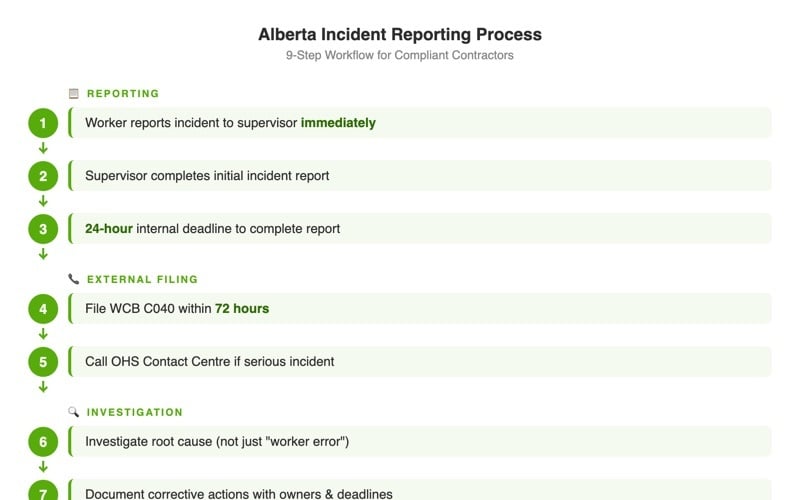
If you're an Alberta contractor with 10 to 100 employees working construction or oil and gas, here's what a solid reporting process looks like in practice:
Train every worker to report incidents to their supervisor immediately, no matter how minor
Equip your supervisors with a simple, consistent report form (digital is better for COR records) that captures what happened, when, where, who was involved, and what immediate actions were taken
Set a 24-hour internal deadline for the supervisor to complete the initial report and notify you as the employer
File the WCB C040 within 72 hours of becoming aware of any injury beyond first aid
Call OHS immediately for any serious incident that meets the Section 33 criteria
Investigate every reportable incident using root cause analysis, not just "worker error"
Document corrective actions with specific responsibilities and deadlines
Share investigation findings with your health and safety committee (or your workers, if you don't have one)
Follow up to verify corrective actions were actually implemented
Digital incident reporting tools make this process dramatically easier. Instead of chasing paper forms, your crew reports from the field, your supervisors review and escalate in real time, and your investigation records are automatically organized for your COR audit.
Stop Blaming "Worker Error"
If your investigations always end with 'the worker needs to be more careful', you are missing the root cause. Get our free Incident Investigation Kit to use the 5-category framework and uncover the real issues.
The C040 is WCB-Alberta's official Employer Report of Injury or Occupational Disease. Employers must submit this form within 72 hours of learning about a workplace injury that requires more than first aid, results in lost time, or involves modified duties. You can file it online through myWCB, the myWCB employer app, a one-time web form, or by fax.
How long do I have to file a WCB report in Alberta?
You have 72 hours after becoming aware of the injury or illness to submit the Employer's Report of Injury (C040) to WCB-Alberta. For serious incidents that must be reported to OHS (fatalities, hospitalizations, explosions, collapses), you must call the OHS Contact Centre as soon as possible, with no specific hour limit.
What is the penalty for not reporting a workplace injury to WCB-Alberta?
Employers can face fines up to $25,000 for failing to report a workplace injury to WCB-Alberta. Beyond the fine, late reporting delays your worker's claim and treatment, increases claim costs, and can drive up your WCB premium rate. For COR-certified contractors, reporting failures can also trigger audit findings that put your certification at risk.
What incidents must be reported to Alberta OHS?
Under Section 33 of the OHS Act, you must report: worker fatalities, injuries or illnesses resulting in hospital admission (beyond emergency treatment), unplanned or uncontrolled explosions, fires, or floods that caused or could have caused serious harm, crane/derrick/hoist collapses, and building or structural failures. Additionally, potentially serious incidents (near misses with potential for serious harm) must be reported online after your investigation is complete.
What is a potentially serious incident (PSI) in Alberta?
A potentially serious incident under Alberta's OHS Act is any workplace event where: (1) the incident had a likelihood of causing a serious injury or illness, and (2) there is reasonable cause to believe corrective action may be needed to prevent it from happening again. PSIs are reported online at oirportal.labour.alberta.ca after your investigation is complete. They don't require an actual injury to be reportable.
How long must I keep incident investigation reports in Alberta?
Under Alberta's OHS Act, you must keep a copy of your incident investigation report readily available for at least 2 years after the incident. For COR-certified contractors, many certifying partners recommend retaining records for at least 3 years to cover your full audit cycle.