Last updated: March 2026
You have 50 chemicals on site, a binder of Safety Data Sheets that nobody has opened since orientation, and a crew that thinks WHMIS training is something you "get a card for" once and forget. Then an auditor or inspector shows up and starts asking questions. That is the moment most employers realize their WHMIS program has holes.
At Safety Evolution, we build WHMIS programs for contractors across Canada every week. We handle the SDS management, deliver the training, and make sure the documentation holds up when an auditor pulls a random chemical off the shelf and starts tracing the paper trail. Here is what you need to know.
⚡ Quick Answer: What Is WHMIS?
- What: WHMIS (Workplace Hazardous Materials Information System) is Canada's national system for communicating hazard information about dangerous products used in workplaces
- 3 main components: Labels, Safety Data Sheets (SDS), and worker education and training
- Hazard groups: 2 groups (physical hazards and health hazards) covering 31 hazard classes
- Key deadline: The supplier compliance deadline (December 14, 2025) has passed. All labels and SDSs should now reflect the amended regulations
- Who enforces: Health Canada sets supplier rules; provincial/territorial OHS agencies enforce in workplaces
🎬 Watch: Free WHMIS Training Course
Our complete WHMIS training video covers all 10 pictograms, labels, Safety Data Sheets, and your rights as a worker. Use it for crew onboarding or as a refresher.
What Is WHMIS and What Is Its Purpose?
WHMIS (Workplace Hazardous Materials Information System) is Canada's national hazard communication standard that ensures workers who handle or are exposed to hazardous products receive consistent, accurate information about the dangers and safe handling procedures for those products. The WHMIS definition covers the entire system: hazard classification by suppliers, standardized labelling, Safety Data Sheets, and mandatory worker education and training.
The WHMIS purpose is straightforward: every worker in Canada who touches a hazardous product should know what it can do to them and how to protect themselves. Before WHMIS existed, a painter in Edmonton might get a technical data sheet with one set of hazard symbols while a painter in Vancouver got a completely different format for the same product. No consistency. No standard. No way for a worker to walk onto a new site and immediately understand the hazard information.
WHMIS Canada is not optional. It applies to every workplace in the country where hazardous products are used, stored, or handled. If you have a single container of solvent, adhesive, compressed gas, or cleaning chemical that meets the criteria for a hazard class, WHMIS applies to you. Not sure where your program stands? Safety Evolution helps track your WHMIS documentation and tell you exactly what needs fixing.
When Was WHMIS Created and How Has It Changed?
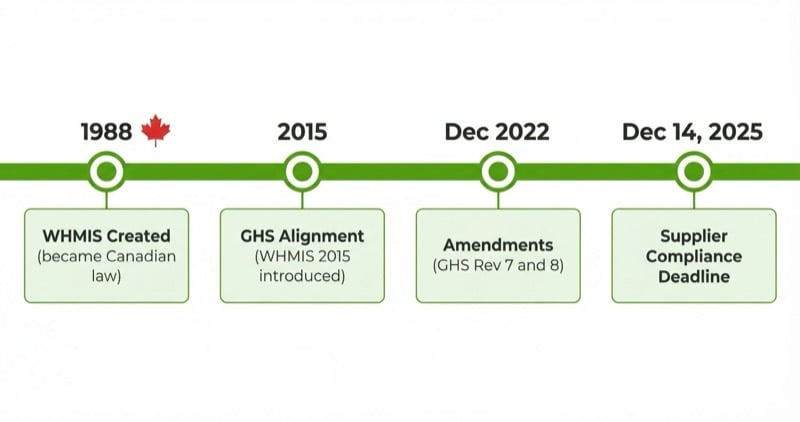
WHMIS first became law on October 31, 1988, through a coordinated set of federal, provincial, and territorial legislation. That original system (now called WHMIS 1988) introduced three key elements: cautionary labelling, Material Safety Data Sheets (MSDS), and worker education programs. It was groundbreaking at the time, but the system was uniquely Canadian. The rest of the world used different hazard communication systems, which created confusion for companies importing, exporting, or operating across borders.
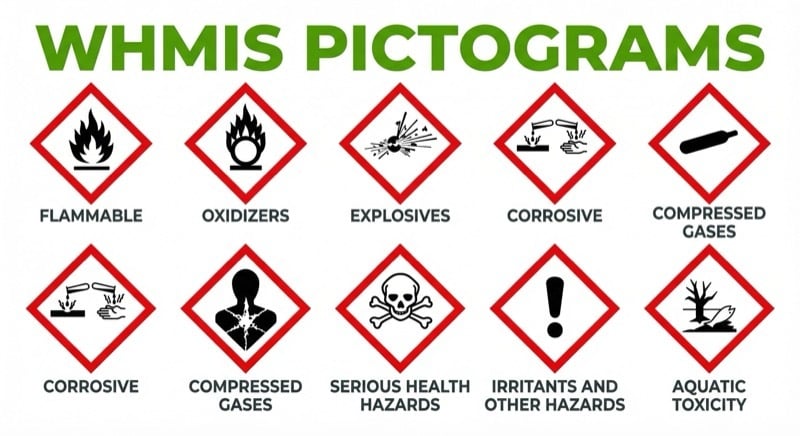
In 2015, Canada aligned WHMIS with the Globally Harmonized System of Classification and Labelling of Chemicals (GHS). This update, known as WHMIS 2015, replaced the old MSDS with the standardized 16-section Safety Data Sheet (SDS) and introduced the now-familiar red-bordered diamond pictograms. The WHMIS GHS alignment means that a worker trained in Canada can recognize the same hazard symbols used in over 70 countries worldwide.
The most recent changes came in December 2022 when amendments to the Hazardous Products Act and Hazardous Products Regulations came into force. Suppliers were given a 3-year transition period that ended December 14, 2025. All product classifications, Safety Data Sheets, and labels should now comply with the amended regulations.
What Are the 3 Components of WHMIS?
The WHMIS 3 main parts (also called the WHMIS 3 components) that most workers and employers interact with daily are:
- Labels on hazardous product containers
- Safety Data Sheets (SDS) providing detailed hazard and handling information
- Worker education and training on how to read labels, use SDS, and work safely with hazardous products
Some references describe the 4 elements of WHMIS, which adds hazard classification as the foundation that makes the other three possible. Suppliers must classify their products against the criteria in the Hazardous Products Regulations before they can create proper labels and SDS. For employers, classification is mostly handled upstream by your suppliers, but if you produce hazardous products in your own workplace (mixing chemicals, for example), you take on that classification responsibility yourself.
Think of it this way: classification tells you what the hazard is. Labels communicate it at the point of use. SDS provides the full technical detail. Training ensures your crew can actually use all of that information. The WHMIS 3 main elements that you manage daily are labels, SDS, and training. Classification is the engine running underneath.
What Are the WHMIS Hazard Classes?
Most contractors think WHMIS is just about reading pictogram stickers on chemical containers. They are wrong. The classification system underneath those stickers is what determines how dangerous a product actually is, and it is far more detailed than most employers realize.
WHMIS hazard groups include two major categories: physical hazards and health hazards. The GHS also defines an environmental hazards group, but Canada did not adopt it under WHMIS (environmental hazards are covered by other Canadian legislation).
WHMIS Physical Hazards
Physical hazard classes cover the product's physical and chemical properties. These include:
- Flammable gases, liquids, and solids
- Oxidizing gases, liquids, and solids
- Gases under pressure
- Self-reactive substances and mixtures
- Pyrophoric liquids and solids
- Self-heating substances and mixtures
- Substances that emit flammable gases in contact with water
- Organic peroxides
- Corrosive to metals
- Combustible dusts
- Simple asphyxiants
- Chemicals under pressure (new class added in 2022 amendments)
WHMIS Health Hazards
Health hazard classes cover the product's ability to cause health effects:
- Acute toxicity
- Skin corrosion/irritation
- Serious eye damage/eye irritation
- Respiratory or skin sensitization
- Germ cell mutagenicity
- Carcinogenicity
- Reproductive toxicity
- Specific target organ toxicity (single and repeated exposure)
- Aspiration hazard
- Biohazardous infectious materials
So how many WHMIS classes are there? In total, WHMIS covers 31 hazard classes across the two hazard groups. Each class is further divided into WHMIS hazard categories (numbered 1, 2, 3, etc.) where Category 1 is typically the most severe. The WHMIS categories matter because they determine which pictogram, signal word, and hazard statements appear on the label.
What Is a WHMIS SDS and Why Does It Matter?
A WHMIS SDS (Safety Data Sheet) is a standardized document that provides detailed information about a hazardous product's properties, hazards, protective measures, and emergency procedures. When WHMIS was updated in 2015, the SDS replaced the old MSDS (Material Safety Data Sheet) from the 1988 system. If you still hear people say "WHMIS MSDS," they are referring to the same concept, but the format and requirements have changed significantly.
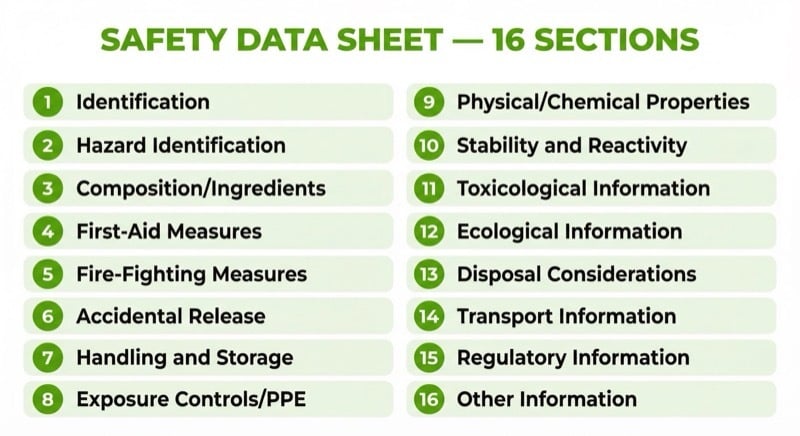
The old MSDS had 9 sections and no standardized order. Different suppliers organized them differently, which made it harder to find critical information in an emergency. The WHMIS SDS follows a mandatory 16-section format that is consistent globally:
- Identification
- Hazard identification
- Composition/information on ingredients
- First-aid measures
- Fire-fighting measures
- Accidental release measures
- Handling and storage
- Exposure controls/personal protection
- Physical and chemical properties
- Stability and reactivity
- Toxicological information
- Ecological information
- Disposal considerations
- Transport information
- Regulatory information
- Other information (including date of last revision)
As an employer, your obligations are clear: maintain current SDS for every hazardous product in your workplace, make them readily accessible to workers (not locked in an office), and update them when suppliers issue new versions. "Readily accessible" means a worker can get to the SDS within minutes, not hours. A binder in the foreman's truck that is on another site does not count.
Is Your WHMIS Program Scattered Across Spreadsheets?
Managing safety data sheets in a dusty binder and tracking training on an Excel file is a massive compliance risk. Bring your entire chemical management system into one centralized digital platform.
30-Day Free Trial
What Do WHMIS Labels Require?
WHMIS labels are the first line of defence. They sit on the container at the point of use, which means they are the hazard communication tool your crew actually sees every day.
There are two types of WHMIS labels:
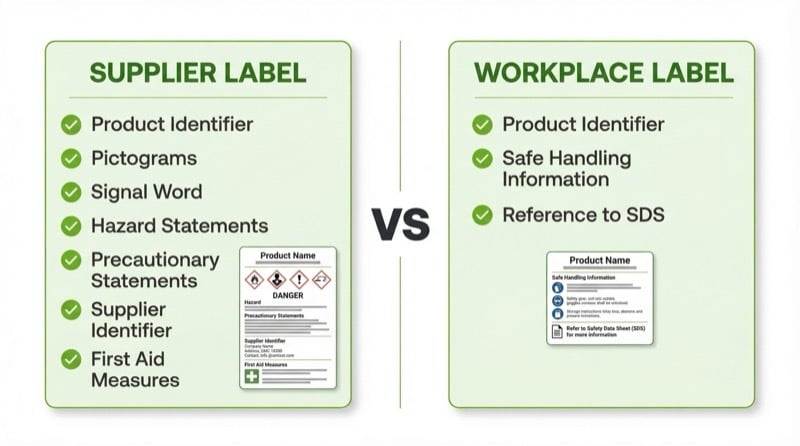
Supplier labels come pre-applied on products from the manufacturer or distributor. They are required to include:
- Product identifier (the WHMIS product identifier is the name the supplier uses for the hazardous product)
- Supplier identifier (name, address, phone number)
- Pictogram(s)
- Signal word ("Danger" or "Warning")
- Hazard statement(s)
- Precautionary statement(s)
- Supplemental label elements (if applicable)
Workplace labels are required when a hazardous product is transferred to a new container, when a supplier label is missing or illegible, or when you produce a hazardous product on site. Workplace labels must include the product identifier, safe handling information, and a reference to the SDS.
Here is the blunt truth: label compliance is where most employers fail an audit. Not because they do not have labels, but because they have containers without labels, labels that are faded and unreadable, or decanted products sitting in unlabelled spray bottles. An inspector does not care that "everyone knows what's in that bucket." If there is no label, you have a non-compliance.
For a complete breakdown of label elements and examples, read our WHMIS labels explained guide. To understand the pictograms that appear on those labels, see WHMIS pictograms explained. For details on signal words and hazard statements, see WHMIS signal words and hazard statements.
What Are WHMIS Employee Responsibilities and Training Requirements?
WHMIS training has two distinct parts, and confusing them is one of the most common mistakes employers make.
General WHMIS education covers the fundamentals: how WHMIS works, what pictograms mean, how to read a label, how to find and use a SDS. This is the "generic" training that online courses provide, and it gives workers a baseline understanding of the system.
Workplace-specific training covers the actual hazardous products at your site: where they are stored, how they are used, what PPE is required for each one, what to do if there is a spill, and how to access the SDS binder or digital system. This training must be delivered by the employer and must be specific to the products and conditions at your workplace.
WHMIS employee responsibilities include understanding the hazard information provided through labels and SDS, following safe work procedures, wearing required PPE, participating in training, and reporting any unsafe conditions or missing/damaged labels to their supervisor.
Here is what trips up most employers: an online WHMIS certificate does not satisfy your legal obligation. It covers general education only. You still need to deliver workplace-specific training on the actual chemicals your crew handles, document that training, and refresh it when conditions change (new products introduced, new processes, role changes). A WHMIS certificate from a training provider is a starting point, not the finish line.
For the full breakdown of training frequency, documentation requirements, and how to structure a compliant program, see our WHMIS training requirements guide. Safety Evolution also offers WHMIS training courses with instant certificates and expiry tracking built in.
What Changed in WHMIS 2015 and the 2022 Amendments?
WHMIS 2015 was the biggest overhaul since the system was created in 1988. It aligned Canada with the Globally Harmonized System (GHS) and introduced several major changes that employers needed to adapt to. For a deeper dive into WHMIS fundamentals, see our guide on what is WHMIS. For the full history of the 2015 update, see WHMIS 2015 explained.
The key changes from WHMIS 1988 to WHMIS 2015 included:
- MSDS replaced by the 16-section SDS
- Old WHMIS symbols replaced by GHS pictograms
- New hazard classification criteria aligned with international standards
- Addition of signal words ("Danger" and "Warning") on labels
- Standardized hazard and precautionary statements
Is WHMIS international? Not exactly. WHMIS is Canada's national system, but because it is aligned with GHS, it shares the same classification criteria, pictograms, and SDS format used by countries around the world. A worker trained under WHMIS will recognize the same hazard symbols used in the United States, the European Union, Japan, Australia, and dozens of other GHS-adopting nations.
The December 2025 Supplier Deadline
The December 2022 amendments introduced new hazard classes (including "chemicals under pressure"), updated classification criteria for flammable gases, renamed "Flammable Aerosols" to "Aerosols" (with a new Category 3 for non-flammable aerosols), and updated SDS Section 9 requirements. The supplier transition period ended December 14, 2025. All product classifications, SDS, and labels should now be in full compliance with the amended regulations.
What does this mean for employers? You should now be receiving updated SDS and labels from your suppliers. As they arrive, you need to:
- Replace outdated SDS in your system
- Verify that new labels are applied on incoming products
- Update your workplace-specific training to cover any new hazard information
- Review your hazardous product inventory for any reclassified products
If your supplier has not updated their SDS by the deadline, that is their compliance issue. But if you are still using outdated SDS in your workplace and have not trained your workers on the changes, that becomes your compliance issue. Provincial inspectors do not care about your supplier's transition timeline; they care about what is in your workplace right now.
How Do You Build a WHMIS Program That Passes an Audit?
This is where the rubber meets the road, and where most employers go from "we have WHMIS training" to actually having a WHMIS program that holds up under scrutiny.
If your company holds or is pursuing COR (Certificate of Recognition) or SECOR certification, your WHMIS program is an auditable element. Auditors will check that your hazard communication system works in practice, not just on paper. They will pull a random chemical off the shelf, ask a worker what it does, ask to see the SDS, and check whether the training records match the products on site.
A WHMIS program that passes an audit includes:
- Current hazardous product inventory. A complete list of every hazardous product on site, updated when products are added or removed. This is the foundation everything else builds on.
- Accessible, current SDS. Every product on your inventory has a matching SDS that is readily available to workers. Digital SDS systems beat paper binders because they are searchable, automatically track versions, and are accessible from mobile devices on site.
- Proper labelling. Every container has a compliant label. Workplace labels are in place for decanted products, products produced on site, and any container where the supplier label is missing or damaged.
- Documented training records. Records showing each worker completed general WHMIS education and workplace-specific training on the products they actually handle. Training dates, topics covered, worker signatures.
- Process for handling new products. A documented procedure for what happens when a new hazardous product arrives on site: obtain SDS, update inventory, apply labels, train affected workers.
- Regular reviews. Annual review of the program to ensure SDS are current, training is up to date, and the inventory matches what is actually on site.
We have seen contractors in Alberta scramble to build this from scratch two weeks before a COR audit. It never goes well. The companies that pass consistently are the ones who treat WHMIS as an ongoing system, not a box to check once a year. If your WHMIS program needs work, Safety Evolution can build and maintain the entire program for you, from SDS management to training delivery to audit-ready documentation.
Your employee orientation and onboarding package should include WHMIS training as a core component. Every new worker should complete WHMIS education and workplace-specific training before they touch a hazardous product on your site.
Stop Fearing the OHS WHMIS Audit
Failing an inspection because you couldn't produce an updated SDS fast enough is completely preventable. Digitize your WHMIS program and have your compliance data ready at the click of a button.
30-Day Free Trial
Frequently Asked Questions About WHMIS
What are the 3 components of WHMIS?
The 3 main components of WHMIS are labels, Safety Data Sheets (SDS), and worker education and training. Labels communicate hazards at the point of use. SDS provide detailed technical information about each hazardous product (see our guide to Safety Data Sheets for a full breakdown). Worker education and training ensure employees understand how to read labels, use SDS, and handle hazardous products safely in their specific workplace.
How many WHMIS classes are there?
WHMIS covers 31 hazard classes divided into two hazard groups. The physical hazards group contains 19 classes (including flammable gases, liquids, solids, oxidizers, gases under pressure, and more). The health hazards group contains 12 classes (including acute toxicity, carcinogenicity, respiratory sensitization, and others). Each class is further divided into categories that indicate the severity of the hazard.
Is WHMIS international?
WHMIS itself is Canada's national hazard communication system, not an international standard. However, WHMIS is aligned with the Globally Harmonized System (GHS), which is used by over 70 countries worldwide. This means the pictograms, SDS format, and classification criteria used in WHMIS are recognized internationally. A worker trained under WHMIS will recognize the same hazard symbols used in the United States, Europe, and other GHS-adopting nations.
Who enforces WHMIS in Canada?
WHMIS is enforced at two levels. Health Canada enforces supplier obligations (classification, labelling, and SDS requirements) through the Hazardous Products Act and Hazardous Products Regulations. Provincial and territorial occupational health and safety agencies enforce WHMIS in workplaces. For example, WorkSafeBC enforces WHMIS in British Columbia, while Alberta OHS enforces it in Alberta. Federally regulated workplaces fall under the Canada Labour Code.
What are the 4 elements of WHMIS?
The 4 elements of WHMIS are hazard classification, labels, Safety Data Sheets (SDS), and worker education and training. Hazard classification is the foundation: suppliers must classify their products against regulatory criteria before creating compliant labels and SDS. The other three elements (labels, SDS, and training) are the components that workers and employers interact with daily.
When was WHMIS created?
WHMIS was created in 1988, becoming law on October 31, 1988, through complementary federal, provincial, and territorial legislation. It was significantly updated in 2015 to align with the Globally Harmonized System (GHS), and further amended in December 2022. The supplier transition period ended December 14, 2025. All product classifications, SDSs, and labels should now reflect the latest amendments.
What materials are exempt from WHMIS?
Products exempt from WHMIS include consumer products (as defined by the Canada Consumer Product Safety Act), cosmetics, drugs, food, medical devices, explosives, pest control products, nuclear substances, hazardous waste, manufactured articles, tobacco products, and wood or products made from wood. These products are regulated under their own specific legislation. However, if any of these products are used in a workplace in a manner not consistent with their normal consumer use, WHMIS requirements may still apply.
Get Weekly Safety Insights
Regulation updates, toolbox talk ideas, and compliance tips. One email per week.