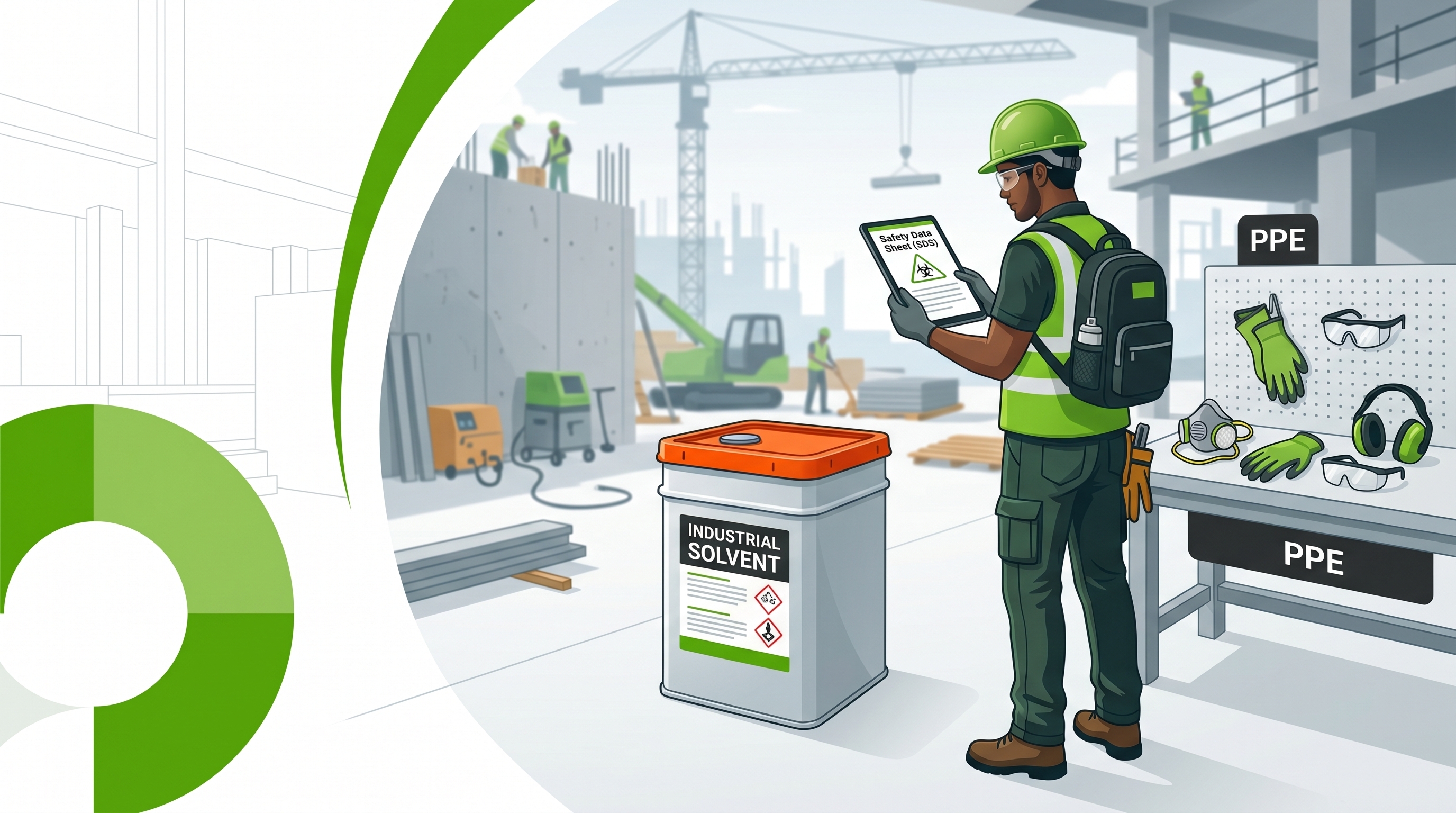
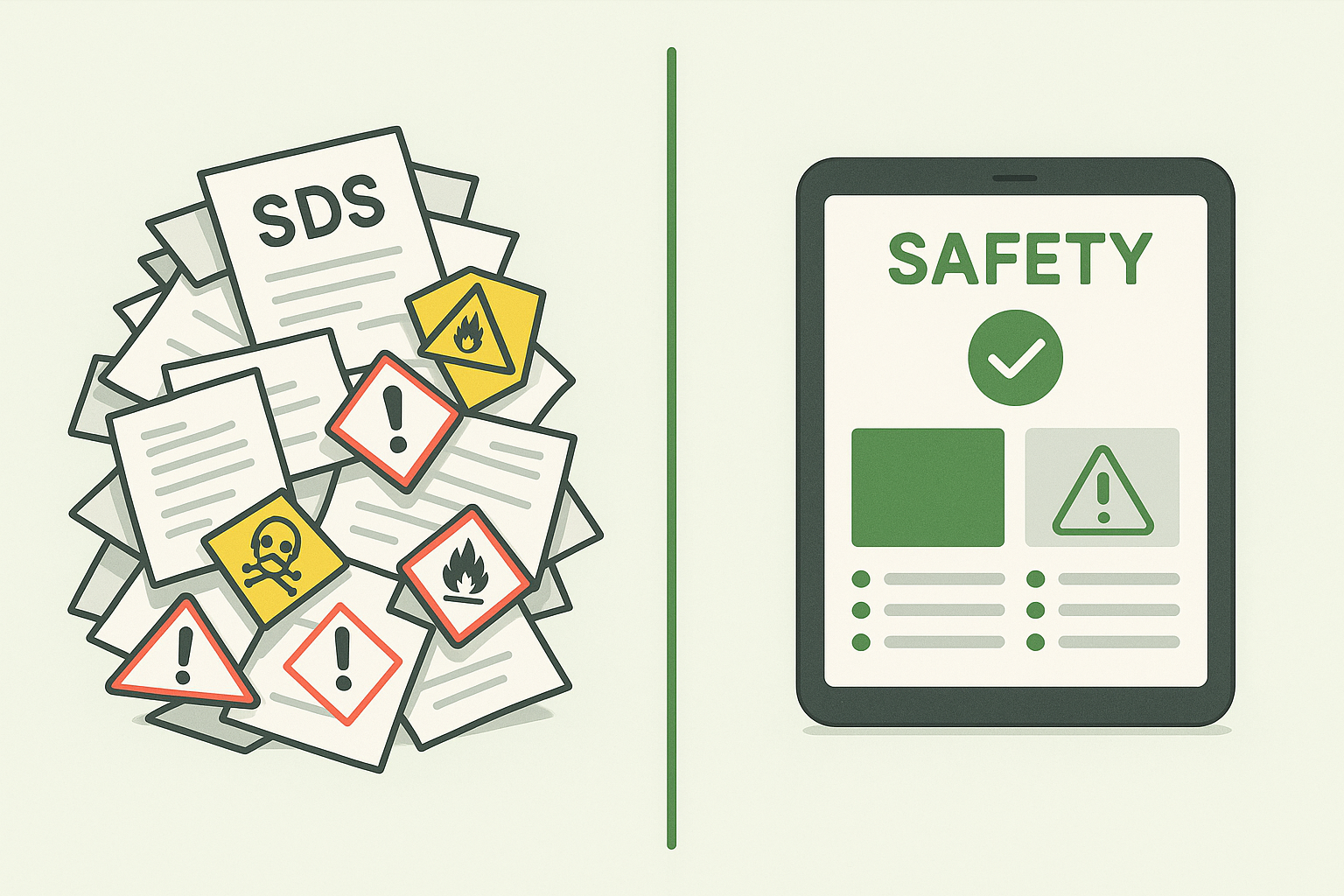
Your crew grabs a chemical product at 6:15 AM, sees a red diamond on the label, and asks, "Where is the SDS?" If the answer is "somewhere in the site trailer," your WHMIS process is fragile. In a spill, burn, or inhalation event, delayed SDS access becomes delayed response.
A Safety Data Sheet (SDS) is not paperwork for auditors. It is the operating manual for hazardous products. This guide explains what SDSs mean, what all 16 sections include, and how Canadian employers can use SDSs to protect workers and stay compliant.
⚡ Quick Answer
An SDS (Safety Data Sheet) is a 16-section document that explains a hazardous product's risks, safe handling, PPE requirements, first aid, and emergency response steps.
Under WHMIS, workers must have access to SDS information before handling hazardous products.
The most operationally critical sections for crews are Section 2 (Hazards), Section 4 (First Aid), Section 7 (Handling and Storage), and Section 8 (Exposure Controls and PPE).
If your team still depends on paper binders, response time during incidents is slower and compliance gaps are harder to catch.
30-Day Free Trial to digitize SDS access and WHMIS records across every site.
🎬 Watch: Free WHMIS Training Course
This training walks through WHMIS labels, pictograms, and SDS use on real worksites.
What Is a Safety Data Sheet (SDS)?
An SDS is a standardized technical document prepared by the supplier or manufacturer of a hazardous product. It tells employers and workers what the product is, what can go wrong, and exactly how to work with it safely.
In Canada, SDS use is part of WHMIS requirements. Labels give quick hazard signals. SDSs provide the full operating detail behind those signals. If you need a complete framework view, read our WHMIS complete guide.
Think of it this way. A label warns you there is a risk. The SDS tells you what PPE to wear, what ventilation is required, what to do if exposure occurs, and how to store and dispose of the product safely.
What Are the 16 SDS Sections and Why Do They Matter?
SDSs follow a fixed 16-section format. That consistency is what makes them useful during high-pressure situations.
Section
What It Covers
Why Crews Care
1. Identification
Product and supplier details
Confirms you are reading the right SDS
2. Hazard Identification
Hazard classes, pictograms, signal words
Fast risk scan before use
3. Composition
Ingredients
Critical for exposure and medical support
4. First Aid
Immediate treatment guidance
Used during real incidents
5. Fire-Fighting Measures
Extinguishing methods and hazards
Supports emergency response planning
6. Accidental Release
Spill cleanup procedures
Reduces secondary exposure risk
7. Handling and Storage
Safe handling and incompatibilities
Prevents avoidable incidents
8. Exposure Controls and PPE
Exposure limits and PPE requirements
Directly impacts worker protection
9-16
Physical properties, stability, toxicology, disposal, transport, regulatory, other info
Supports supervisors, planners, and compliance teams
Still Relying on SDS Binders in the Trailer?
When a worker needs first aid instructions, searching through paper binders wastes critical time. Give your crews instant mobile SDS access and keep your records synchronized across every project.
How Workers Should Use an SDS Before Starting Work
Most SDS failures are process failures, not document failures. Teams either do not know where the SDS is, or they skip review because the process is too slow.
Use this 60-second pre-task SDS routine:
Confirm product identity in Section 1 before opening the container.
Check hazard severity in Section 2, including pictograms and signal words.
Confirm PPE and controls in Section 8 before task start.
Review first aid and spill response in Sections 4 and 6 if exposure risk is high.
Verify storage and incompatibilities in Section 7 for end-of-shift handling.
This workflow is also where WHMIS training should be evaluated. If workers have WHMIS certificates but cannot navigate an SDS quickly, the training did not stick. Our WHMIS training requirements guide breaks down what employers must reinforce on site.
Common SDS Compliance Mistakes on Canadian Worksites
Outdated SDSs still in circulation after supplier updates.
No clear SDS access point for field crews and subcontractors.
Mismatched product names between container labels and SDS library records.
No ownership for quarterly SDS review and inventory reconciliation.
Training disconnected from actual products used at each location.
These gaps are expensive. They lead to inspection findings, delayed incident response, and predictable confusion during high-risk tasks.
How to Build an SDS System That Survives Audits
If you want an SDS process that actually works in the field:
Centralize your chemical inventory by site.
Attach the current SDS to each product record and date-stamp updates.
Assign ownership for monthly SDS and label checks.
Embed SDS checks into pre-task routines and toolbox talks.
Track WHMIS training and SDS access together so compliance evidence is audit-ready.
Spreadsheets, shared drives, and paper binders create hidden risk. Run your chemical inventory, SDS documents, and training records in one system so your crews have fast answers when it matters most.
SDS stands for Safety Data Sheet. It is a standardized 16-section document that explains hazardous product risks, handling requirements, PPE, first aid, and emergency controls.
What replaced MSDS in Canada?
MSDS was replaced by SDS under WHMIS 2015 alignment with GHS. The new SDS format uses a consistent 16-section structure for better hazard communication.
Who is responsible for providing an SDS?
Suppliers and manufacturers provide SDSs for hazardous products. Employers are responsible for ensuring workers can access current SDS information for products used on site.
How often should SDSs be reviewed?
Review SDS libraries regularly and whenever products, suppliers, or hazard classifications change. Many contractors run monthly inventory checks and quarterly SDS audits to avoid stale records.
Which SDS sections matter most for workers?
For field crews, the most used sections are Section 2 (Hazards), Section 4 (First Aid), Section 6 (Accidental Release), Section 7 (Handling and Storage), and Section 8 (Exposure Controls and PPE).