WHMIS Signal Words, Hazard & Precautionary Statements
Learn the two WHMIS signal words, what hazard statements and precautionary statements mean on labels, and how to read them. Guide for Canadian contractors.
Your crew just cracked open a new drum of solvent on site. Someone glances at the label, sees a wall of tiny text, and shrugs. "It's probably fine." Two hours later, someone has a chemical burn because nobody noticed the one word on that label that should have changed everything: Danger.
At Safety Evolution, we help contractors build safety programs that actually hold up on site, not just on paper. We see WHMIS gaps on almost every initial assessment we run. And signal words are where most of those gaps start. 30-Day Free Trial can show you exactly where your program stands.
⚡ Quick Answer
What: WHMIS signal words are "Danger" and "Warning," printed on labels and Safety Data Sheets to indicate hazard severity
Danger: Used for the most severe hazards (fatal, toxic, corrosive)
Warning: Used for less severe but still significant hazards (harmful, irritant)
Hazard statements: Standardized H-code phrases that describe the specific nature of each hazard (e.g., "Fatal if inhaled," "Causes skin irritation")
Precautionary statements: Standardized P-code phrases that tell you what to do about the hazard (prevention, response, storage, disposal)
Why it matters: Missing a signal word can mean the difference between wearing splash goggles and needing a full face respirator
🎬 Watch: Free WHMIS Training Course
Our complete WHMIS training video covers all 10 pictograms, labels, Safety Data Sheets, and your rights as a worker. Use it for crew onboarding or as a refresher.
What Are WHMIS Signal Words?
WHMIS signal words are standardized terms printed on hazardous product labels and Safety Data Sheets (SDSs) that instantly communicate the severity of a hazard. Canada's Workplace Hazardous Materials Information System uses exactly two signal words: "Danger" and "Warning." No other words are used. No substitutes. No variations.
This system is part of Canada's alignment with the Globally Harmonized System of Classification and Labelling of Chemicals (GHS), which means these same two words appear on chemical labels around the world. If your crew has worked with hazardous products anywhere in Canada (or internationally), these are the words they need to recognize instantly.
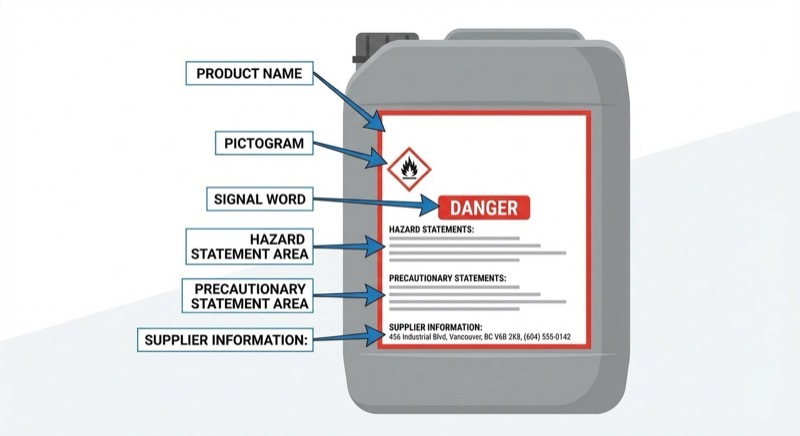
Signal words sit on the WHMIS supplier label alongside pictograms, hazard statements, precautionary statements, and product identifiers. They are the fastest piece of safety information on the label: one word that tells you how seriously to take what you're handling.
What Is the Difference Between "Danger" and "Warning"?
Here is where most people get it wrong. They treat both words the same. They are not the same.
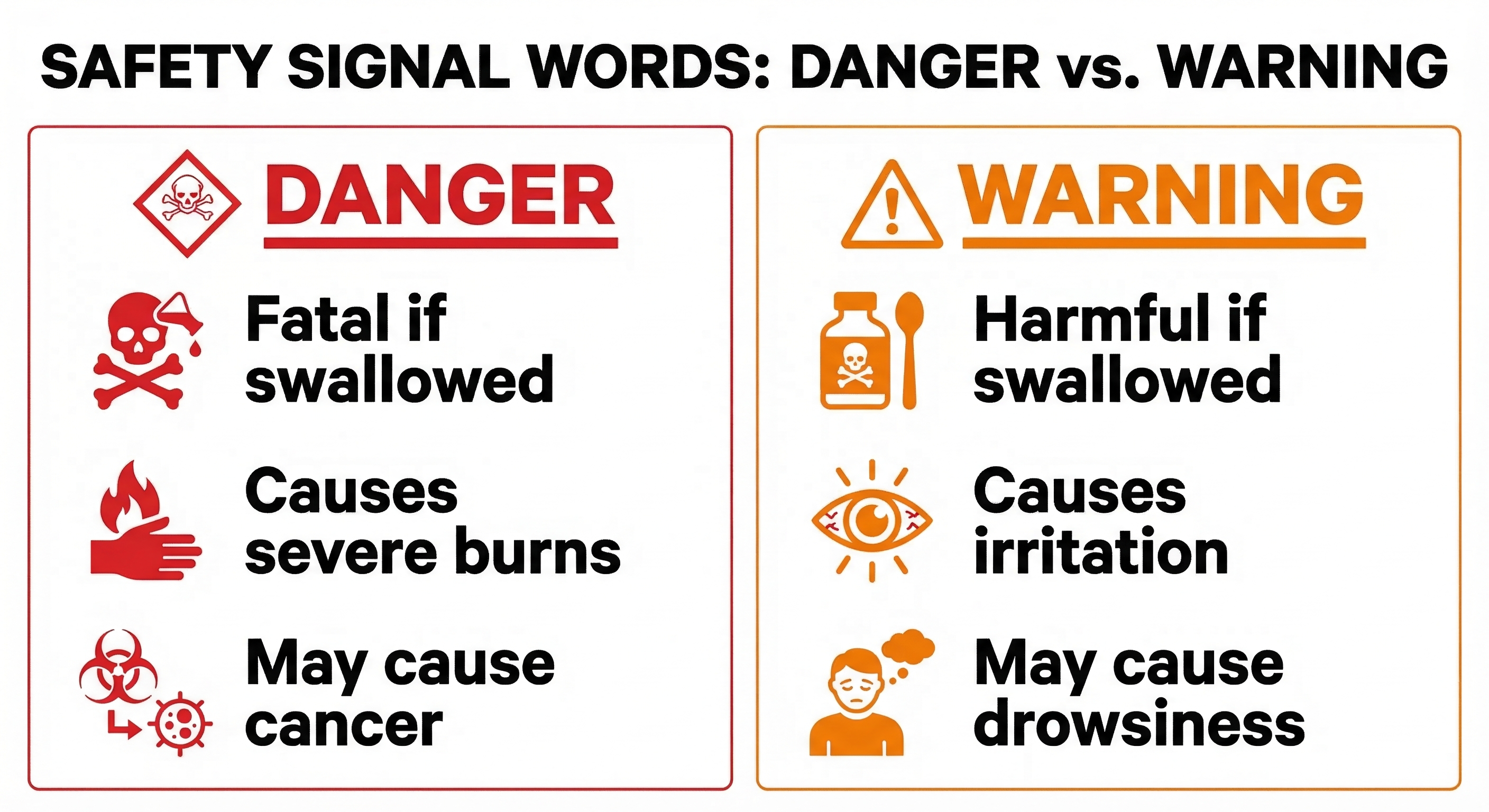
"Danger" is reserved for the most severe hazard categories. The product can kill you, cause permanent damage, or create an immediate life-threatening situation. Think: fatal if swallowed, causes severe skin burns, may cause cancer. This is a "get this wrong and someone goes to the hospital" situation.
"Warning" is used for less severe hazard categories. Still harmful. Still requires precautions. But typically not immediately life-threatening. Think: causes skin irritation, may cause drowsiness, harmful if swallowed.
The critical rule most people miss: when a product qualifies for both signal words, only "Danger" appears. The more protective word always wins. You will never see both on the same label.
Some hazard classes and categories do not require any signal word at all. No signal word does not mean "safe." It means the hazard did not meet the threshold for either word, but the product is still classified as hazardous.
What Are WHMIS Hazard Statements?
Hazard statements are standardized phrases that describe the specific nature and severity of a hazardous product's risks. While signal words give you a quick severity rating ("how bad?"), hazard statements tell you exactly what the hazard is ("bad how?").
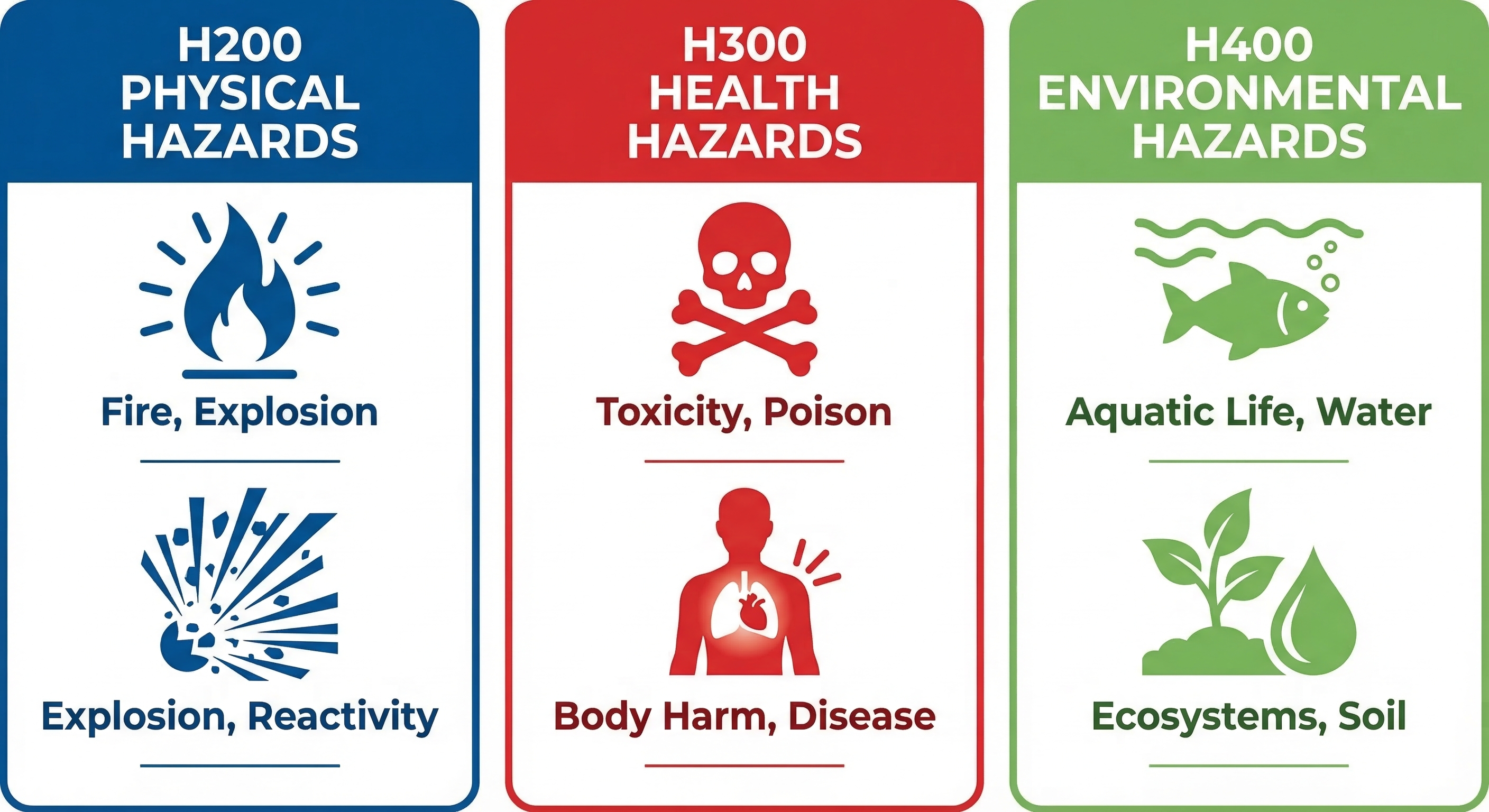
Every hazard statement is assigned an H-code, organized into three series:
H300 series: Health hazards (toxicity, burns, cancer). Example: "H300: Fatal if swallowed."
H400 series: Environmental hazards (aquatic toxicity). Example: "H400: Very toxic to aquatic life."
The language is deliberate. "Fatal if swallowed" and "Harmful if swallowed" are not interchangeable. "Fatal" means exactly that. The wording maps directly to the hazard category, based on toxicity data and testing thresholds.
On a WHMIS label, you see the hazard statement text. On the Safety Data Sheet, you see both the text and the H-code in Section 2 (Hazard Identification). Your crew needs to recognize the text on labels; your safety coordinator needs to understand the codes on the SDS.
For a deeper dive into how to read a full Safety Data Sheet, check out our complete guide to Safety Data Sheets (linked below).
How Do Signal Words and Hazard Statements Work Together on a Label?
Think of a WHMIS label like a layered alert system:
Pictograms catch your eye first: the red diamond border tells you the type of hazard.
Signal word tells you how severe it is.
Hazard statements tell you exactly what the hazard does.
Precautionary statements tell you what to do about it.
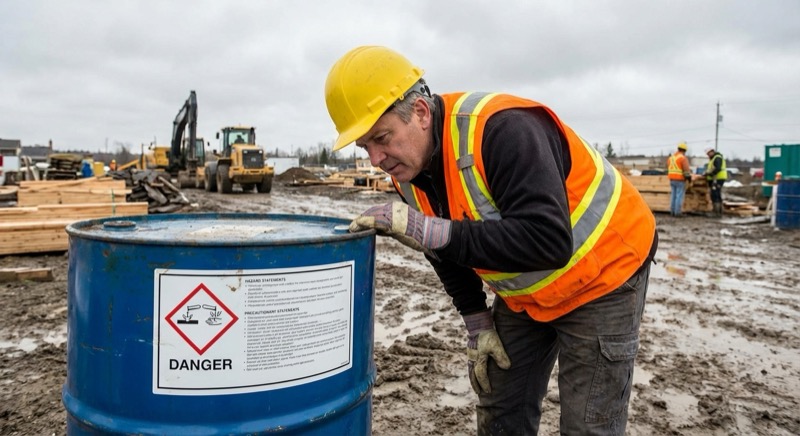
Real example: a drum of hydrochloric acid arrives on your site. The label reads:
Pictogram: Corrosion
Signal word: Danger
Hazard statement: "H314: Causes severe skin burns and eye damage"
Every element tells you something the others do not. Skip one and you have a gap. That is where injuries happen.
If the label layout feels overwhelming, our WHMIS labels explained guide breaks down every element with visual examples.
💡 Not sure your team can read a WHMIS label correctly?
That is one of the most common gaps we find during safety assessments. 30-Day Free Trial analyses your current WHMIS records and shows you exactly where the gaps are.
Do Your Workers Freeze When They Read WHMIS Labels?
If your crew cannot quickly tell the difference between "Danger" and "Warning", you have a serious training gap. Standardize your WHMIS process and track real compliance in the field, not just certificates in a folder.
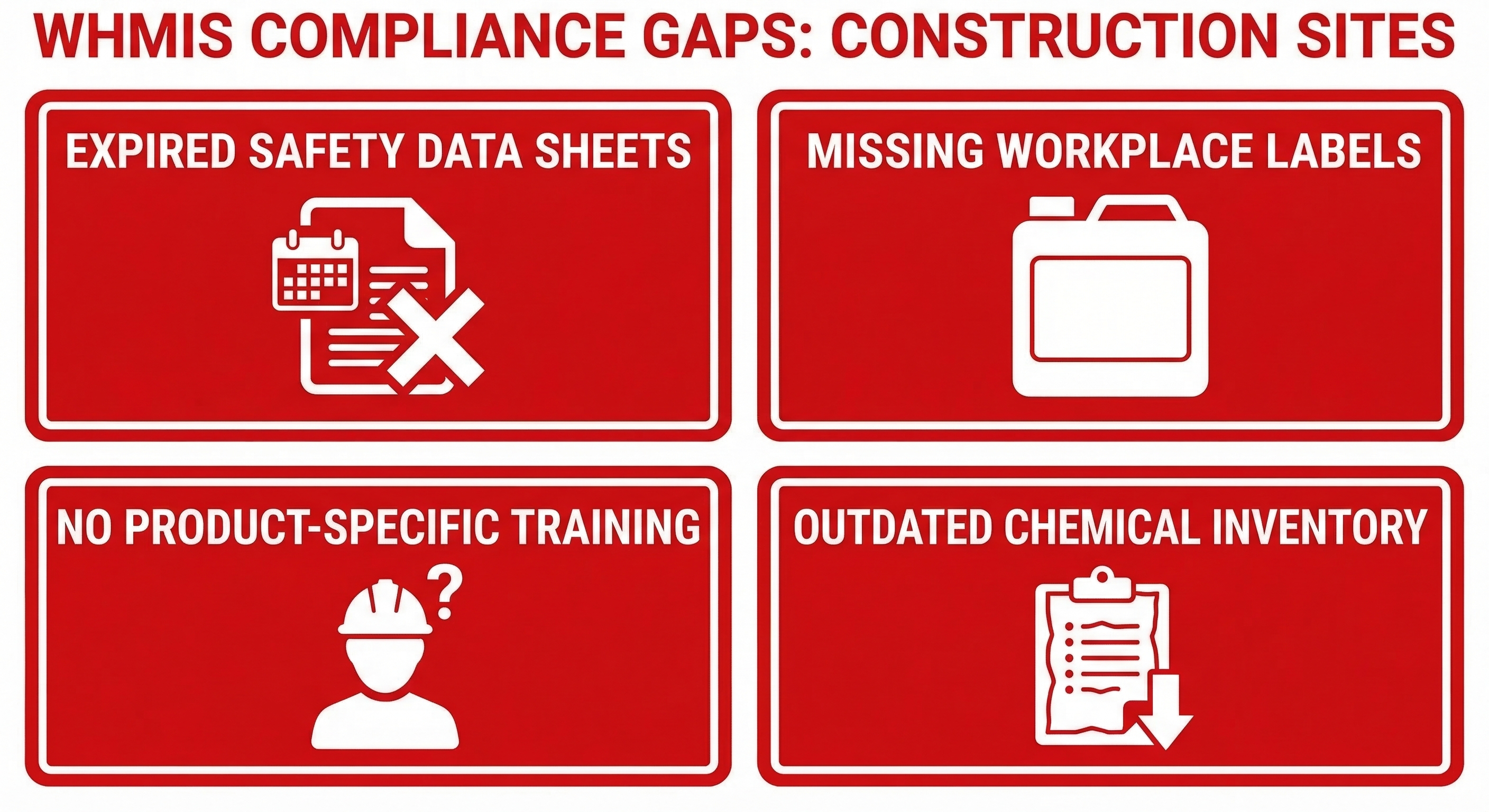
Most contractors think WHMIS training is a checkbox. Get the certificate, file it, move on. 30-Day Free Trial goes beyond the certificate by checking whether your training records, SDS files, and label audits are actually current. Here is the problem: a certificate does not mean your crew actually reads labels on site.
We have walked onto sites where experienced workers could not tell us the difference between "Danger" and "Warning." Not because they are careless, but because their WHMIS training was a one-hour online module three years ago that covered everything at 10,000 feet and nothing at ground level.
The blunt truth: generic WHMIS training teaches people to pass a test, not to read a label. Your crew needs to know what to do differently when they see "Danger" versus "Warning" on the product they are about to open. That means hands-on, product-specific training with the actual chemicals on your site. Not a slideshow about theoretical hazard classes.
This is also where workplace-specific safety training makes the difference. Federal regulations require it. Your provincial OHS legislation requires it. And it is the only kind that actually changes behaviour on site.
WHMIS training does not have a formal expiry date under federal legislation. But best practice across Canadian provinces is to refresh training annually, or whenever new hazardous products arrive on site, procedures change, or you discover that your crew has gaps in understanding. Our full guide to WHMIS training requirements covers exactly what you need. If you have not reviewed your WHMIS program since before December 2025, you are likely out of date.
What Changed with the 2022 WHMIS Amendments?
Health Canada amended the Hazardous Products Regulations in December 2022, with a three-year supplier transition period that ended December 14, 2025. That deadline has passed. Here is what it means for you:
New hazard class: "Chemicals Under Pressure" is now recognized with its own label elements and SDS requirements.
Reclassifications: Some products may have changed signal words or hazard statements. A product that was "Warning" before could now be "Danger."
SDS updates: If you have SDSs older than December 2025 on site, they may not be compliant.
Check that your chemical inventory, SDSs, and workplace labels are current. 30-Day Free Trial flags when SDS expiry dates are approaching and when your chemical inventory needs updating. Building a system to keep this updated is part of what a solid health and safety management system looks like. That is exactly why Safety Evolution builds audit-ready programs for contractors: we handle the document control so you can focus on running your crew.
What Are Common WHMIS Hazard Statement Examples?
Here are hazard statements your crew is most likely to encounter on construction and industrial sites:
H-Code
Hazard Statement
Signal Word
H220
Extremely flammable gas
Danger
H225
Highly flammable liquid and vapour
Danger
H300
Fatal if swallowed
Danger
H314
Causes severe skin burns and eye damage
Danger
H350
May cause cancer
Danger
H226
Flammable liquid and vapour
Warning
H302
Harmful if swallowed
Warning
H315
Causes skin irritation
Warning
H332
Harmful if inhaled
Warning
Notice the pattern. "Fatal" and "Causes severe" always pair with "Danger." "Harmful" and "Causes irritation" pair with "Warning." The language is precise on purpose.
What Should You Actually Do When You See "Danger" on a Label?
You are on site. A new product arrives. The label says "Danger." What do you do?
Stop and read the full label. "Danger" tells you it is serious. The hazard statements tell you what kind of serious.
Check the SDS. Section 2 gives you the complete hazard picture. Section 8 tells you exactly what PPE is required.
Verify your PPE matches. "Causes severe skin burns" requires chemical-resistant gloves, face shield, and protective clothing. Standard work gloves will not cut it.
Brief your crew. Anyone handling or working near this product needs to know the hazards. This is a toolbox talk topic, not an email.
Update workplace labels. Decanted into a smaller container? It needs a workplace label with the product name and SDS reference.
For "Warning" products, the same steps apply with less urgency. But the mistake is treating "Warning" as "optional." It is not optional. It is less severe, not non-hazardous.
🔧 Building a WHMIS program that works on site, not just on paper?
Safety Evolution builds done-for-you safety programs for contractors across Canada. We handle your chemical inventory, SDS management, training records, and workplace labels so your crew knows exactly what they are working with. 30-Day Free Trial to see where your program stands.
What Are WHMIS Precautionary Statements?
A WHMIS precautionary statement is a standardized phrase on a label or Safety Data Sheet that tells you what to do about a hazard: how to prevent exposure, how to respond if something goes wrong, how to store the product, and how to dispose of it safely. While hazard statements describe the danger ("what can hurt you"), precautionary statements describe the protective action ("what to do about it").
Every precautionary statement is assigned a P-code, organized into five types:
The 5 Types of Precautionary Statements
Type
P-Code Series
Purpose
Example
General
P100s
General information
P103: Read label before use
Prevention
P200s
How to avoid exposure
P210: Keep away from heat, sparks, open flames. No smoking.
Response
P300s
What to do if exposure occurs
P301+P310: IF SWALLOWED: Immediately call a POISON CENTER
Storage
P400s
How to store safely
P403: Store in a well-ventilated place
Disposal
P500s
How to dispose of the product
P501: Dispose of contents and container in accordance with local regulations
Your crew does not need to memorize P-codes. But they need to read the precautionary statements before handling any hazardous product. This is where the label tells them which gloves to wear, what ventilation is required, and what to do if someone gets a chemical splash in their eyes.
Where Do Precautionary Statements Appear?
Precautionary statements show up in two places:
On the supplier label: printed alongside the signal word, hazard statements, and WHMIS pictograms. The label includes the most critical precautionary statements for that product.
On the Safety Data Sheet (SDS): Section 2 (Hazard Identification) lists all precautionary statements with their P-codes. Sections 4 through 7 expand on first aid measures, fire-fighting, accidental release, and handling and storage in detail.
A single product can have a dozen or more precautionary statements. The label shows the most important ones; the SDS has the complete list. If your crew only reads the label, they get the basics. If they check the SDS, they get the full picture.
How Precautionary Statements Differ from Hazard Statements
Think of it this way: hazard statements tell you "this product will burn your skin." Precautionary statements tell you "wear chemical-resistant gloves, and if it contacts your skin, rinse immediately with water for 15 minutes." One describes the risk. The other describes the action. Both are required on every WHMIS label, and both appear in Section 2 of the SDS.
What Happens If Your WHMIS Program Has Gaps?
A 12-person drywall crew in Calgary. New adhesive shows up on site. The label says "Danger" with "H334: May cause allergy or asthma symptoms or breathing difficulties if inhaled." The foreman does not read past the product name. Crew works in an enclosed space without respirators. Two workers end up in the hospital with respiratory distress.
That scenario plays out across Canadian job sites more often than anyone wants to admit. It is almost always preventable if someone reads the label.
Under the federal Hazardous Products Act, fines can reach $5 million. Provincially, OHS penalties vary: $2,000 to $10,000 per contravention in Alberta, up to $500,000 for individuals in Ontario. But the real cost is the worker who got hurt.
If your WHMIS program is a one-time online course and a binder of SDSs collecting dust, you have a compliance gap an inspector will find. 30-Day Free Trial analyses your entire WHMIS program and tells you what is current and what needs attention. A proper program includes workplace-specific training, current SDSs, workplace labels on every decanted container, and a system to update it all when products change. That is what Safety Evolution builds for contractors every week. Our training platform handles WHMIS training delivery and record-keeping so you can prove compliance when it matters.
Turn WHMIS Labels into Real Site Behavior
Stop relying on one-time WHMIS courses and outdated binders. Give your crews site-specific hazard workflows, live SDS access, and audit-ready records in one system.
The two WHMIS signal words are "Danger" and "Warning." "Danger" is used for the most severe hazard categories (fatal, toxic, corrosive), while "Warning" is used for less severe but still significant categories (harmful, irritant). These are the only two signal words in WHMIS, aligned with the Globally Harmonized System (GHS).
What is a hazard statement in WHMIS?
A hazard statement is a standardized phrase on a WHMIS label or Safety Data Sheet describing the nature and degree of hazard. They use H-codes: H200 series for physical hazards, H300 series for health hazards, and H400 series for environmental hazards. Examples: "H300: Fatal if swallowed" and "H225: Highly flammable liquid and vapour."
Can a WHMIS label have both "Danger" and "Warning"?
No. When a hazardous product is classified in multiple hazard categories that would require both signal words, only "Danger" (the more protective word) appears on the label. "Warning" is omitted. You will never see both signal words on the same WHMIS label.
How often does WHMIS training need to be renewed?
Federal WHMIS legislation does not set a specific expiry date. However, best practice is to refresh training annually. Training must also be updated whenever new hazardous products are introduced, procedures change, or worker knowledge gaps are identified. Most employers and COR auditors expect annual renewal.
What is the difference between hazard statements and precautionary statements?
Hazard statements (H-codes) describe the nature of the hazard: what the danger is and how severe it is. For example, "Fatal if inhaled." Precautionary statements (P-codes) describe the protective measures: what to do about the hazard. For example, "Wear respiratory protection" or "Store in a well-ventilated place." Both appear on WHMIS labels and in Section 2 of the Safety Data Sheet.
What happens if an employer does not comply with WHMIS requirements?
Under the federal Hazardous Products Act, fines can reach $5 million. Provincial OHS penalties vary: $2,000 to $10,000 per contravention in Alberta, up to $500,000 for individuals in Ontario. Non-compliance can also result in stop-work orders, product seizure, and criminal liability if a worker is injured.
What are the 5 types of precautionary statements?
The five types of WHMIS precautionary statements are: General (P100s, e.g., "Read label before use"), Prevention (P200s, e.g., "Keep away from heat, sparks, open flames"), Response (P300s, e.g., "IF SWALLOWED: Immediately call a POISON CENTER"), Storage (P400s, e.g., "Store in a well-ventilated place"), and Disposal (P500s, e.g., "Dispose of contents in accordance with local regulations"). They appear on supplier labels and in Section 2 of the Safety Data Sheet.
Where do signal words appear on WHMIS labels?
Signal words appear on the WHMIS supplier label, typically near the pictograms and product identifier. They are also listed in Section 2 (Hazard Identification) of the Safety Data Sheet. Only two signal words exist: "Danger" for the most severe hazards and "Warning" for less severe but still significant hazards. Workplace labels (used for decanted products) do not include signal words; they reference the SDS instead.
What does the signal word "Danger" versus "Warning" mean?
"Danger" is reserved for the most severe WHMIS hazard categories: products that can kill, cause permanent damage, or create immediately life-threatening situations (e.g., "Fatal if swallowed," "Causes severe skin burns"). "Warning" is used for less severe but still significant hazards (e.g., "Harmful if swallowed," "Causes skin irritation"). When a product qualifies for both, only "Danger" appears on the label. The more protective word always wins.
Get Your WHMIS Program Right
Signal words and hazard statements are the foundation of WHMIS. For a complete overview of every WHMIS component, see our WHMIS basics guide. "Danger" and "Warning" are not suggestions. They are standardized alerts backed by toxicity data and federal regulation.
If your crew cannot tell you the difference between the two, you have a gap. Gaps in chemical safety send people to the hospital.
Safety Evolution builds complete WHMIS programs for contractors across Canada: training, SDSs, workplace labels, and chemical inventory management.
30-Day Free Trial and let your safety data show you exactly where the gaps are. Compliance status, training records, SDS management: answered in seconds.
Get Weekly Safety Insights
Regulation updates, toolbox talk ideas, and compliance tips. One email per week.