Last updated: March 2026
You just got a stack of new Safety Data Sheets from a supplier, and nothing looks the same. The old class letters are gone. The symbols have changed. Half your crew is asking why their WHMIS training from two years ago already feels outdated. WHMIS 2015 is Canada's updated Workplace Hazardous Materials Information System, redesigned to align with the Globally Harmonized System of Classification and Labelling of Chemicals (GHS). It replaced the original WHMIS 1988 framework with a new classification system, new labels, new pictograms, and standardized Safety Data Sheets. If your workplace handles hazardous products, you need to understand what changed and why it matters for your crew, your compliance, and your next audit.
Safety Evolution helps contractors across Canada build and maintain WHMIS programs that actually hold up during audits. We see the confusion firsthand every week.
Quick Answer: What Is WHMIS 2015?
- What: WHMIS 2015 is Canada's national hazard communication system, updated from the 1988 version to align with the GHS used internationally
- Key changes: Old classes A through F replaced by 2 hazard groups (physical and health) with 31 specific hazard classes; MSDS replaced by 16-section SDS; new GHS pictograms replaced old WHMIS symbols
- Who it applies to: Every Canadian workplace that uses, stores, handles, or disposes of hazardous products
- Deadline: The supplier transition period for the December 2022 amendments ended December 14, 2025. Full compliance is now mandatory
- Why it matters: Non-compliant workplaces risk fines, failed audits, and putting workers at risk with outdated hazard information
🎬 Watch: Free WHMIS Training Course
Our complete WHMIS training video covers all 10 pictograms, labels, Safety Data Sheets, and your rights as a worker. Use it for crew onboarding or as a refresher.
Why Was WHMIS Revised in 2015?
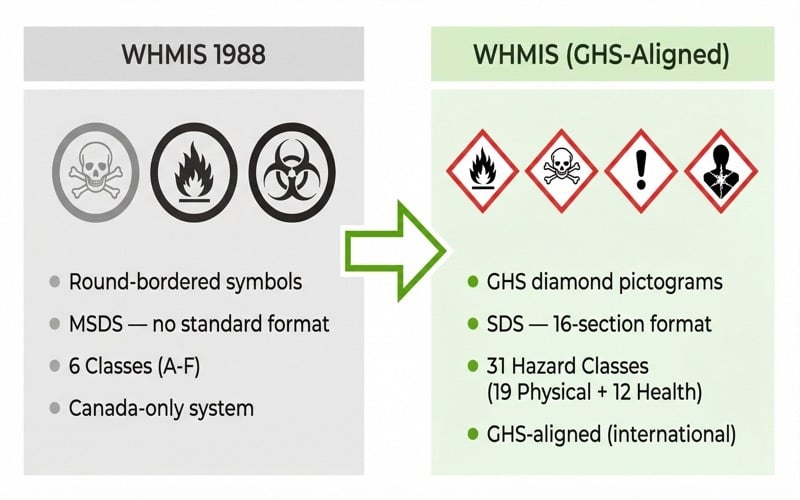
The original WHMIS came into effect in 1988. For over 25 years, it was the backbone of chemical hazard communication in every Canadian workplace. But it was a uniquely Canadian system. A product classified as "Class D: Poisonous and Infectious Material" in Canada might carry a completely different label crossing the border into the United States or arriving from a European supplier. Every country had its own rules, its own symbols, its own data sheet format.
That created real problems. A safety coordinator at a 30-person mechanical contractor in Edmonton told us she spent hours cross-referencing American supplier sheets against Canadian WHMIS requirements because the formats never matched. Multiply that across every company importing chemicals, and you get an enormous amount of wasted time and genuine confusion about what a product can actually do to your crew.
The United Nations developed the Globally Harmonized System (GHS) to fix this. The GHS created one universal set of hazard classifications, pictograms, labels, and safety data sheet formats that countries around the world could adopt. Canada officially adopted the GHS through WHMIS 2015, joining the United States, the European Union, Australia, Japan, China, and dozens of other nations.
Most contractors think WHMIS 2015 was just a cosmetic update: new symbols, same system. They are wrong. The entire classification logic changed. The way hazards are grouped, the way severity is ranked, the information on your labels, and the structure of your safety data sheets are all fundamentally different. If your program still references the old Class A through F system, you are not compliant.
On February 11, 2015, the Government of Canada published the Hazardous Products Regulations (HPR) in the Canada Gazette, aligning WHMIS with GHS. Then in December 2022, further amendments updated classification criteria to reflect the 7th revised edition of the GHS. Suppliers were given until December 14, 2025 to bring their product classifications, Safety Data Sheets, and labels into full compliance. That deadline has passed, and all suppliers must now comply with the amended regulations.
Who Does WHMIS 2015 Apply To?
WHMIS 2015 applies to every employer, worker, and supplier in Canada who manufactures, imports, sells, distributes, or uses hazardous products in the workplace. That includes construction sites, manufacturing plants, oil and gas operations, trades shops, laboratories, and warehouses.
Specifically:
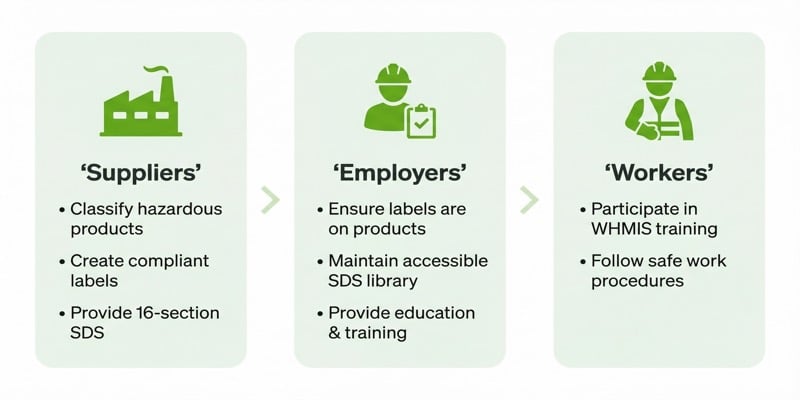
- Suppliers (manufacturers and importers) must classify their hazardous products, create compliant labels, and provide 16-section Safety Data Sheets
- Employers must ensure all hazardous products in the workplace have proper labels and accessible SDSs, and must provide WHMIS education and training to workers
- Workers must participate in WHMIS education and training and follow safe work procedures for hazardous products
Federal legislation (the Hazardous Products Act) sets the supplier requirements nationally. Each province and territory then enforces WHMIS in the workplace through their own occupational health and safety legislation. In Alberta, that is OHS Code Part 29. In British Columbia, WorkSafeBC enforces it through OHS Regulation Part 5. The requirements are based on a common model, but small variations between jurisdictions can exist. If you are unsure whether your specific province has additional requirements, check with your provincial regulator or 30-Day Free Trial against your province's specific requirements.
Are Old WHMIS 1988 Labels Still Hiding on Your Site?
If you are still finding outdated MSDS sheets or black-and-white circle labels in your storage lockers, you are out of compliance with WHMIS 2015 rules. Streamline your inventory audits digitally.
30-Day Free Trial
How Does WHMIS 2015 Classify Hazardous Chemicals?
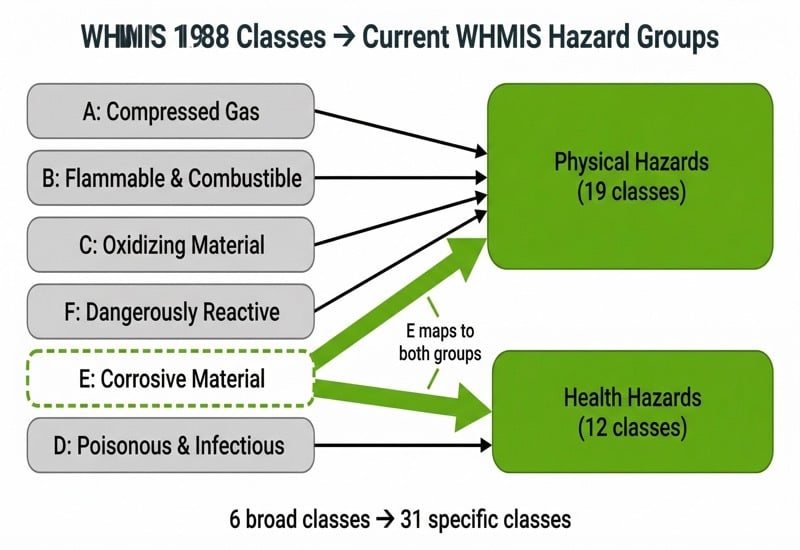
This is where the biggest change happened. Under the old WHMIS 1988, hazardous products were sorted into six classes labelled A through F:
- Class A: Compressed Gas
- Class B: Flammable and Combustible Material
- Class C: Oxidizing Material
- Class D: Poisonous and Infectious Material
- Class E: Corrosive Material
- Class F: Dangerously Reactive Material
That system was simple, but it was limited. A product that caused cancer and a product that irritated your skin were both lumped into "Class D." There was no way to distinguish severity within a class.
Under WHMIS 2015, hazardous chemicals are sorted by two major hazard groups: physical hazards and health hazards. Within those two groups, there are 31 specific hazard classes: 19 physical hazard classes and 12 health hazard classes. Each class is further divided into categories that indicate severity, with Category 1 typically being the most severe.
WHMIS 2015 hazard categories include numbered severity rankings within each class. For example, "Flammable Liquids" has four categories (1 through 4), where Category 1 catches fire most easily and Category 4 has the highest flash point. This granularity means your crew gets specific information about how dangerous a product actually is, not just a broad class letter.
Physical Hazard Classes
Physical hazards are based on the product's physical or chemical properties. The 19 physical hazard classes include flammable gases, aerosols, oxidizing gases, gases under pressure, flammable liquids, flammable solids, self-reactive substances, pyrophoric liquids, pyrophoric solids, self-heating substances, water-reactive substances, oxidizing liquids, oxidizing solids, organic peroxides, corrosive to metals, combustible dusts, simple asphyxiants, chemicals under pressure, and physical hazards not otherwise classified.
Health Hazard Classes
Health hazards are based on the product's ability to cause a health effect. The 12 health hazard classes include acute toxicity, skin corrosion/irritation, serious eye damage/eye irritation, respiratory or skin sensitization, germ cell mutagenicity, carcinogenicity, reproductive toxicity, specific target organ toxicity (single exposure), specific target organ toxicity (repeated exposure), aspiration hazard, biohazardous infectious materials, and health hazards not otherwise classified.
WHMIS hazard groups include only physical and health hazards. The GHS also defines an environmental hazards group, but Canada did not adopt that group as mandatory under WHMIS. You may still see environmental hazard information on some SDSs and labels, as suppliers are allowed to include it voluntarily.
The "chemicals under pressure" class was one of the notable additions in the December 2022 amendments, covering liquids or gases that are kept under pressure in a container but do not meet the criteria for other gas-related classes. For a complete overview of the full WHMIS system and how all the pieces fit together, see our WHMIS basics guide.
What Are the WHMIS 2015 Pictograms?
Under the old system, WHMIS 1988 used distinctive round-bordered symbols unique to Canada. You will not see those anymore. WHMIS 2015 replaced them with GHS-aligned pictograms: red-bordered diamonds on a white background, each containing a black symbol.
There are 9 GHS pictograms used in WHMIS 2015 (plus the Canada-specific biohazardous infectious materials symbol, for 10 total), and they are the same pictograms used by GHS-adopting countries around the world. That means a compressed gas cylinder pictogram on a product from Germany means the same thing as one from a Canadian supplier. For a detailed breakdown of what each pictogram means and when you will encounter it on site, see our guide to WHMIS pictograms.
Here is the blunt truth: most workers cannot name more than three or four of the ten pictograms when asked. If your crew has not reviewed them recently, they are reading labels without understanding them. That is a compliance gap and a safety risk.
How Did Safety Data Sheets Change Under WHMIS 2015?
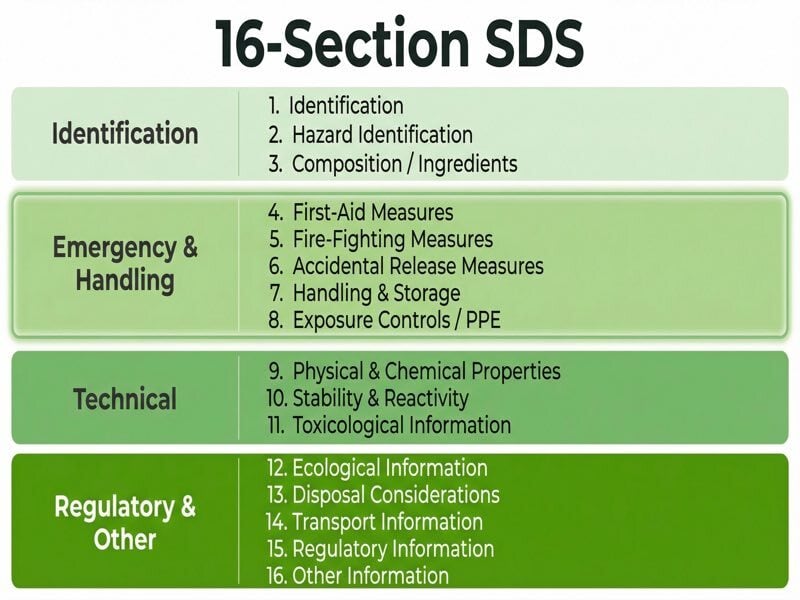
Material Safety Data Sheets (MSDS) are gone. Under WHMIS 2015, they are replaced by Safety Data Sheets (SDS) with a mandatory 16-section format. The old MSDS had no standardized structure. One supplier might list first aid information in section 3; another might put it in section 8. That made it genuinely difficult to find critical information in an emergency.
The 16-section SDS follows this order every time:
- Identification
- Hazard identification
- Composition/information on ingredients
- First-aid measures
- Fire-fighting measures
- Accidental release measures
- Handling and storage
- Exposure controls/personal protection
- Physical and chemical properties
- Stability and reactivity
- Toxicological information
- Ecological information
- Disposal considerations
- Transport information
- Regulatory information
- Other information
If you still have binders of old MSDSs on site, those are no longer compliant. Every hazardous product in your workplace needs a current SDS in the 16-section format. For a deeper look at reading and managing your SDS library, visit our guide to Safety Data Sheets.
What Changed with WHMIS 2015 Labels?
Labels got a complete overhaul. Under WHMIS 2015, supplier labels on hazardous products must include:
- Product identifier (name)
- Initial supplier identifier (name, address, phone number)
- GHS pictogram(s) applicable to the product
- Signal word ("Danger" for more severe hazards or "Warning" for less severe)
- Hazard statement(s) describing the nature of the hazard
- Precautionary statement(s) describing protective measures
- Supplemental label information (if required)
The signal word system is new. Under WHMIS 1988, there was no equivalent. Now, "Danger" tells your crew the hazard is more severe within its class, and "Warning" indicates a less severe hazard. It is a quick severity check before you even read the hazard statements.
Workplace labels (the ones your employer creates for decanted or secondary containers) are still required but have slightly different rules. For the full breakdown of both supplier and workplace label requirements, see our WHMIS labels guide.
What Does WHMIS Education Refer To?
This is one of the most commonly searched WHMIS questions, and getting the answer right matters for compliance.
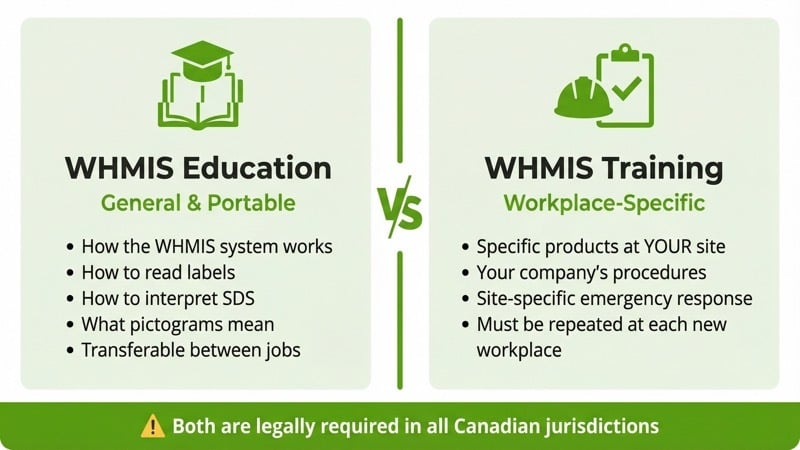
WHMIS education refers to general, portable instruction about how the WHMIS system works. It covers the hazard classes, how to read labels, how to find and interpret Safety Data Sheets, and what the pictograms mean. WHMIS education is not specific to any one workplace or product. It teaches workers the foundational knowledge they need to understand hazard communication across any job site.
WHMIS training, on the other hand, is workplace-specific. Training covers the exact hazardous products used at your site, your company's procedures for storage, handling, use, disposal, and emergencies, and what to do if a spill or exposure occurs with a specific product in your specific workplace.
Both are legally required. All Canadian jurisdictions require employers to provide WHMIS education and training programs. A worker who only completes generic online WHMIS education has not met the full requirement. They also need site-specific training delivered by their employer that addresses the actual products and procedures at their workplace.
This distinction trips up a lot of contractors. They send their crew through an online WHMIS course and check the box. Then an auditor asks, "Show me your site-specific WHMIS training records," and the box is suddenly empty. Safety Evolution delivers both WHMIS education and workplace-specific training through our training courses with instant certificates and expiry tracking built in.
For a complete breakdown of who needs what training and how often, see our WHMIS training requirements guide.
What Does the December 2025 Deadline Mean for Employers?
In December 2022, Canada updated the Hazardous Products Regulations to align with the 7th revised edition of the GHS. These amendments came into force immediately, but suppliers were given a three-year transition period that ended December 14, 2025. All product classifications, SDSs, and labels should now reflect the updated requirements.
What does this mean for you as an employer?
- Review your SDS library. The December 14, 2025 deadline has passed. All supplier-provided SDSs should now reflect the updated classification criteria. If you are still receiving SDSs that reference the older format, contact your supplier.
- Check your labels. Products with labels that do not include the required GHS elements (pictograms, signal words, hazard statements) are non-compliant.
- Update your WHMIS training. If your training materials still reference the old system or pre-2022 classification criteria, your workers may not recognize the current hazard information on newer products.
- Audit your inventory. Walk your site and verify that every hazardous product has a current, compliant SDS and proper labelling.
Non-compliance can result in orders from provincial regulators, fines, and failed COR/SECOR audits. If you are using Safety Evolution's orientation and onboarding package, WHMIS education is already built into the onboarding process for new workers.
Turn GHS Rules into Field Reality
Knowing the WHMIS 2015 regulations is one thing; getting your crew to actually read the SDS and follow the new hazard classifications is another. Embed the correct safety steps directly into their daily digital workflows.
30-Day Free Trial
Frequently Asked Questions About WHMIS 2015
Under WHMIS 2015, how are hazardous chemicals sorted?
Under WHMIS 2015, hazardous chemicals are sorted into two major hazard groups: physical hazards and health hazards. Physical hazards include 19 classes based on a product's physical or chemical properties (such as flammability or reactivity). Health hazards include 12 classes based on the product's ability to cause health effects (such as carcinogenicity or acute toxicity). Within each class, products are assigned categories that indicate severity, with Category 1 generally being the most dangerous.
What does WHMIS education refer to?
WHMIS education refers to general, portable instruction about how the WHMIS system works. It covers hazard classes, how to read labels, how to interpret Safety Data Sheets (SDS), and what pictograms mean. WHMIS education is not specific to any one workplace. It is different from WHMIS training, which is workplace-specific and covers the exact hazardous products, procedures, and emergency plans at a particular job site. Both education and training are required by law in all Canadian jurisdictions.
How many WHMIS 2015 classes are there?
As of the December 2022 amendments, WHMIS includes 31 hazard classes: 19 physical hazard classes and 12 health hazard classes. This is a significant increase from the original WHMIS 1988 system, which used only 6 broad classes labelled A through F. The expanded classification provides much more specific information about the type and severity of each hazard. For a complete overview, see our What is WHMIS guide.
Will WHMIS exist after GHS?
WHMIS is not being replaced by the GHS. Instead, WHMIS has been updated to incorporate GHS standards. WHMIS is Canada's national framework for hazard communication, and the GHS provides the international classification and labelling standards that WHMIS now follows. As the GHS continues to evolve (it is updated approximately every two years), Canada will continue to update the Hazardous Products Regulations to stay aligned. WHMIS will remain Canada's system; it simply uses GHS as its foundation. As of 2026, what was called "WHMIS 2015" is increasingly referred to simply as "WHMIS."
Why was WHMIS revised in 2015?
WHMIS was revised in 2015 to align Canada's hazard communication system with the Globally Harmonized System (GHS) endorsed by the United Nations. The original WHMIS 1988 was a uniquely Canadian system, which created confusion when products crossed international borders because other countries used different classification systems, symbols, and data sheet formats. By adopting the GHS, Canada joined the United States, the European Union, Australia, Japan, and many other countries in using a single, consistent standard for classifying and communicating chemical hazards.
What do WHMIS 2015 hazard categories include?
WHMIS 2015 hazard categories include numbered severity rankings within each hazard class. For example, Flammable Liquids has four categories (1 through 4), where Category 1 is the most easily ignited and Category 4 has the highest flash point. Category 1 is typically the most severe across all hazard classes. The category determines which pictogram, signal word, and hazard statements appear on the label.
Get Weekly Safety Insights
Regulation updates, toolbox talk ideas, and compliance tips. One email per week.