You just got asked if your crew has WHMIS training, and you're not even sure what the letters mean. Or maybe you're filling out a safety form and the acronym keeps showing up. Either way, you need a straight answer.
Here it is: WHMIS stands for the Workplace Hazardous Materials Information System. It is Canada's national system for communicating information about hazardous products used in workplaces. If your crew handles chemicals, solvents, fuels, or cleaning products on site, WHMIS applies to you.
We help Canadian contractors and employers build safety programs every week, and WHMIS questions are some of the most common ones we hear. This guide breaks down the WHMIS meaning, what it covers, and why it matters for your business.
⚡ Quick Answer: What WHMIS Stands For
WHMIS full form: Workplace Hazardous Materials Information System
What it does: Provides health and safety information on hazardous products in Canadian workplaces
Four main parts: Classification, labels, Safety Data Sheets (SDS), and worker training
Is it law? Yes. WHMIS has been Canadian law since 1988, enforced through federal and provincial legislation
Who needs it: Every Canadian workplace that uses, stores, or handles hazardous products
🎬 Watch: Free WHMIS Training Course
Our complete WHMIS training video covers all 10 pictograms, labels, Safety Data Sheets, and your rights as a worker. Use it for crew onboarding or as a refresher.
What Does WHMIS Stand For?
WHMIS stands for the Workplace Hazardous Materials Information System. Each letter in the WHMIS acronym represents a piece of the system's purpose:
Workplace: it applies to work environments, not consumer products at home
Hazardous: it covers products that pose health or physical hazards
Materials: chemicals, solvents, compressed gases, and other substances
Information: the system exists to communicate hazard information clearly
System: it is a structured, standardized framework, not a single rule or form
The WHMIS meaning comes down to one idea: workers have the right to know what hazardous products they are working with and how to protect themselves. Before WHMIS existed, there was no standard way for employers and suppliers to share that information. A chemical that was labeled one way in Ontario might show up with completely different warnings in Alberta. Workers were guessing, and people got hurt.
WHMIS solved that by creating a single, Canada-wide system. Every hazardous product gets classified the same way, labeled the same way, and documented the same way, no matter where in the country it is used.
What Is the Full Meaning of WHMIS?
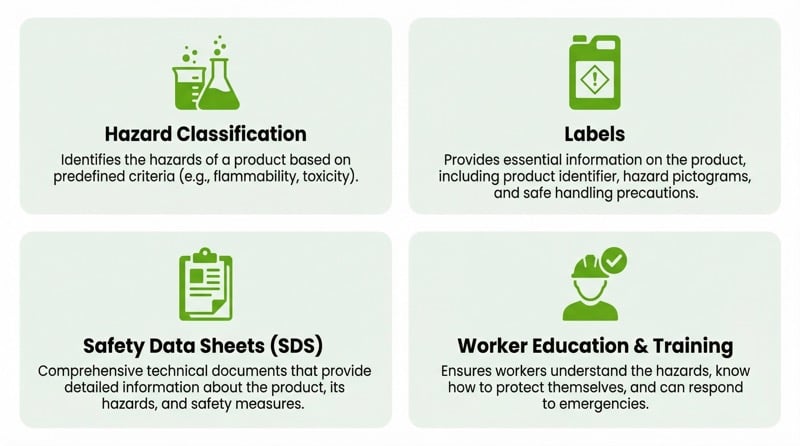
The full meaning of WHMIS goes beyond the acronym. While WHMIS stands for Workplace Hazardous Materials Information System, the system itself is a complete framework with four interconnected parts that work together to protect workers from hazardous products.
The WHMIS full form tells you the name, but here is what the system actually encompasses:
Hazard classification: Every hazardous product sold or used in Canada is classified into hazard classes and categories based on its physical and health properties. Suppliers are responsible for classifying their products correctly under the Hazardous Products Regulations.
Labels: Standardized labels on every hazardous product container communicate the hazard type, pictograms, signal words, and precautionary measures. Both supplier labels and workplace labels are part of the system.
Safety Data Sheets (SDSs): Detailed 16-section documents that provide comprehensive information about each hazardous product, from first aid measures to storage requirements.
Worker education and training: Two-part training requirement covering generic WHMIS education plus workplace-specific training on the actual products workers handle.
When someone asks "what does the WHMIS acronym mean?" they are usually looking for the letters. But the real meaning of WHMIS is the system behind those letters: a structured, legally enforced framework that gives workers the right to know what they are handling and how to protect themselves. For a full breakdown of how all four parts work together, see our complete WHMIS basics guide.
Why Does Canada Have WHMIS?
In the 1980s, Canadian workers had no consistent way to find out what chemicals they were handling on the job. Suppliers used their own labeling systems. Safety data was scattered or missing. A painter working with industrial solvents might have no idea what was in the can or what to do if it splashed in their eyes.
The federal, provincial, and territorial governments worked together to fix this. In 1988, WHMIS became law. The goal was simple: give workers the right to know about every hazardous product in their workplace.
Here is the part most people get wrong: WHMIS is not a single piece of legislation. It is a coordinated system backed by multiple laws at the federal and provincial level. At the federal level, the Hazardous Products Act (HPA) and Hazardous Products Regulations (HPR) set the rules for suppliers. At the provincial and territorial level, occupational health and safety laws set the rules for employers. Health Canada oversees the supplier side. Your provincial OHS regulator (like WorkSafeBC in BC or Alberta OHS) enforces the workplace side.
This means WHMIS requirements are consistent across Canada, but enforcement happens at the provincial level. If an inspector shows up on your site in Edmonton and your crew cannot explain the hazard symbols on a chemical container, the fine comes from Alberta OHS, not Ottawa.
Basic WHMIS Awareness Doesn't Stop Spills
Your crew might know what the acronym stands for, but do they know exactly where to find the SDS when a solvent leaks? Put your complete SDS library directly on their mobile devices for instant emergency access.
WHMIS is built on four pillars. Each one exists to make sure hazard information actually reaches the worker on the ground. Here is a quick overview (for the full breakdown, see our complete WHMIS basics guide):
1. Hazard Classification
Every hazardous product gets classified into hazard classes and categories based on its properties. Is it flammable? Toxic? Corrosive? The classification determines everything else: what goes on the label, what appears in the SDS, and what workers need to know during training. Suppliers are responsible for classifying their products correctly.
2. Labels
WHMIS labels are the first thing a worker sees when they pick up a container. Labels include the product name, hazard pictograms (the diamond-shaped symbols), signal words, hazard statements, and precautionary statements. If a product does not have a proper WHMIS label, it should not be on your site. For a deeper look at what each element means, see our guide to WHMIS labels explained.
3. Safety Data Sheets (SDS)
An SDS is a detailed document with 16 sections covering everything about a hazardous product: what it is, how it can harm you, how to handle it safely, what to do in an emergency, and how to store and dispose of it. Employers must make sure current SDS documents are available for every hazardous product in the workplace. If you want to learn how to read an SDS, check out our guide to Safety Data Sheets.
4. Worker Education and Training
This is where most employers either get it right or fall apart. WHMIS training has two parts: general education (how WHMIS works, how to read labels and SDS) and workplace-specific training (the actual hazardous products your crew works with on the job). Both parts are required. A generic online certificate alone does not meet the requirement if the worker has not been trained on the specific products at your worksite. WHMIS education should be part of your employee orientation and onboarding process. For more on what is required, see our WHMIS training requirements guide.
What Is WHMIS Called Now?
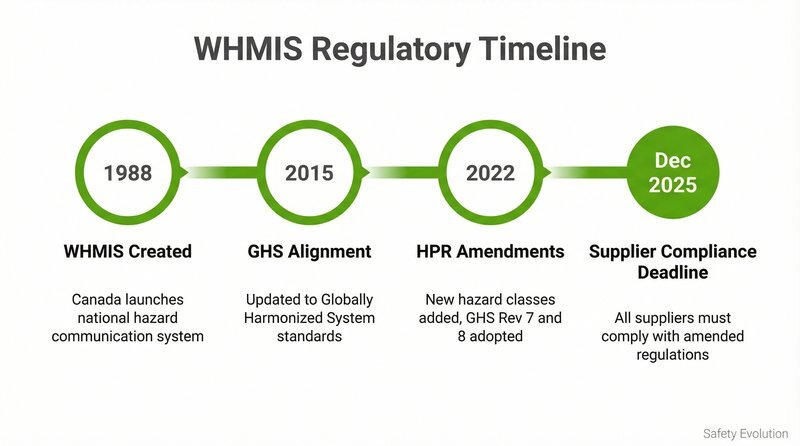
You might hear people refer to "WHMIS 2015" or ask what is WHMIS called now. The short answer: it is still called WHMIS. The system was updated in 2015 to align with the Globally Harmonized System of Classification and Labelling of Chemicals (GHS), an international standard used by countries around the world. That update is often referred to as "WHMIS 2015" to distinguish it from the original 1988 version.
The key changes in 2015 included new hazard pictograms (replacing the old circular symbols with diamond-shaped ones), a standardized 16-section SDS format, and updated hazard classification criteria. In December 2022, further amendments aligned Canada with GHS Revisions 7 and 8, adding new hazard classes (including Chemicals Under Pressure) and renaming "Flammable Aerosols" to "Aerosols." The supplier transition period ended December 14, 2025, and full compliance is now mandatory.
So WHMIS is still WHMIS. The name has not changed. The system under it has evolved to match international standards. For the full story on what changed and why, see our WHMIS 2015 explained guide.
WHMIS in 2026: What's Current
WHMIS has evolved significantly since its creation in 1988, and 2026 marks a turning point for compliance. If you are wondering whether your WHMIS program is up to date, here is what you need to know right now.
The biggest recent milestone: the three-year transition period for the December 2022 amendments ended on December 14, 2025. That means every supplier in Canada must now comply with the updated Hazardous Products Regulations, which align WHMIS with Revisions 7 and 8 of the Globally Harmonized System (GHS). All product labels and Safety Data Sheets arriving at your site should already reflect the changes.
Here is what changed and what is now fully in effect:
New hazard class: "Chemicals Under Pressure" was added as a new physical hazard class, bringing the total to 10 pictograms used under WHMIS
"Flammable Aerosols" became "Aerosols": A new Category 3 now covers non-flammable aerosols, which means some products your crew uses may appear in the WHMIS system for the first time
Flammable Gases subcategorized: Category 1 was split into 1A and 1B, with pyrophoric gases folded into Category 1A
Updated SDS requirements: Section 9 now includes additional physical and chemical properties data points
The system is no longer called "WHMIS 2015." It is simply WHMIS. The 2015 GHS alignment is now the established standard, and the December 2022 amendments are the latest layer on top. If your training materials still reference "WHMIS 2015" as something new or upcoming, they are outdated. For the full history of what changed in 2015 and why, see our WHMIS 2015 explained guide.
Bottom line: if you have not reviewed your WHMIS program since before 2023, your training content, product inventory, and SDS library all need a refresh. The transition period is over. Regulators expect compliance now, not "we're getting around to it."
Why Is WHMIS Important?
Most contractors think WHMIS is just another box to check. Get the certificates, file them, move on. That mindset is exactly how people end up in the emergency room.
WHMIS exists because hazardous products can kill you, and the only defence is information. A worker who does not know that the solvent they are using is flammable, or that the cleaning agent they just mixed produces toxic gas, is one mistake away from a serious incident. WHMIS is the system that puts that information in their hands before something goes wrong.
Here is the blunt truth: if you run a crew and cannot show that every worker has been trained on the specific hazardous products at your worksite, you are exposed. Not just to fines (though those are real), but to liability if someone gets hurt. An OHS inspector does not care that your workers completed an online WHMIS quiz last year. They want to see that your workers know the products on your site, know where to find the SDS, and know what to do if something goes sideways.
Why WHMIS is important goes beyond avoiding penalties. It is about making sure your crew goes home at the end of the day. That is not a slogan. It is what happens when a 22-year-old apprentice reads a label correctly and puts on the right respirator instead of guessing.
Yes, the WHMIS acronym and the system itself are uniquely Canadian. No other country uses "WHMIS" by name. However, since 2015, WHMIS has been aligned with the Globally Harmonized System (GHS), which is used by countries around the world, including the United States, the European Union, Australia, Japan, and many others.
This alignment means that the hazard pictograms, SDS format, and classification criteria used in Canada are now very similar to what you would see in the US or Europe. In fact, Canada and the US cooperated to ensure that a single label and SDS can meet both WHMIS and US HazCom requirements for most products.
So while WHMIS is Canadian, the language it speaks is international. If you work on cross-border projects or handle products imported from the US, the symbols and data sheets will look familiar.
Turn WHMIS from Paperwork into Protection
Don't treat WHMIS as just a box to check during orientation. Digitize your chemical management to track inventory, automate training renewals, and keep your job site genuinely safe.
WHMIS stands for the Workplace Hazardous Materials Information System. It is Canada's national system for providing health and safety information on hazardous products used in workplaces. The system includes hazard classification, product labels, Safety Data Sheets (SDS), and worker education and training.
Is WHMIS a law?
Yes. WHMIS has been Canadian law since 1988. It is enforced through a combination of federal legislation (the Hazardous Products Act and Hazardous Products Regulations) and provincial/territorial occupational health and safety regulations. WHMIS is not a single law but a coordinated system backed by multiple laws at different levels of government. Employers who fail to comply can face fines and enforcement action from their provincial OHS regulator.
Is WHMIS only in Canada?
Yes, WHMIS is uniquely Canadian. However, since 2015 it has been aligned with the Globally Harmonized System of Classification and Labelling of Chemicals (GHS), an international standard adopted by many countries including the US, EU members, Australia, and Japan. The hazard pictograms, SDS format, and classification criteria used in WHMIS are now consistent with global standards.
What is the difference between WHMIS 1988 and WHMIS 2015?
WHMIS 2015 updated the original 1988 system to align with the Globally Harmonized System (GHS). Key changes included replacing the old circular hazard symbols with standardized diamond-shaped pictograms, adopting a 16-section SDS format, and updating hazard classification criteria. Further amendments in December 2022 aligned Canada with GHS Revisions 7 and 8. The supplier transition period ended December 14, 2025, and all product classifications, SDSs, and labels should now reflect the updated requirements.
Who needs WHMIS training?
Every worker in Canada who uses, handles, stores, or may be exposed to hazardous products in the workplace needs WHMIS training. This includes full-time employees, part-time workers, and temporary staff. Training must include both general WHMIS education and workplace-specific training on the actual products present at the worksite. Employers are responsible for providing and documenting this training. Safety Evolution offers WHMIS training courses with instant certificates and expiry tracking.
What are WHMIS pictograms?
WHMIS pictograms are standardized diamond-shaped symbols with red borders that appear on hazardous product labels. Each pictogram represents a specific type of hazard, such as flammability, toxicity, corrosion, or health hazards. There are 10 pictograms in total: 9 red-bordered GHS diamonds covering physical and health hazards, plus 1 Canada-specific biohazard symbol. Learning to recognize these symbols is one of the most practical parts of WHMIS training.
What is WHMIS called now?
WHMIS is still called WHMIS. The 2015 update aligned the system with the Globally Harmonized System (GHS), and further amendments in December 2022 updated classification criteria. The system is sometimes called "WHMIS 2015" to distinguish it from the original 1988 version, but the official name remains the Workplace Hazardous Materials Information System (WHMIS).
Get Weekly Safety Insights
Regulation updates, toolbox talk ideas, and compliance tips. One email per week.