Last updated: April 2026
Ask a safety professional "where does your company sit on the Bradley Curve?" and most can answer. Ask "what are you specifically doing to move to the next stage?" and most cannot. A safety culture framework gives you a structured approach to understanding where your organization stands today, what maturity looks like, and what specific changes move you forward. Without a framework, culture improvement is guesswork.
This guide covers the most widely used safety culture frameworks, how they apply to construction and industrial contractors, and how to choose the right one for your operation.
⚡ Quick Answer
- Most used: The Bradley Curve (DuPont, 1995) maps 4 stages: Reactive, Dependent, Independent, Interdependent. It is the industry standard for safety culture maturity.
- Academic standard: The 5-level Safety Culture Maturity Model (emerging, managing, involving, cooperating, continuous improvement) provides more granularity.
- Regulatory frameworks: OSHA's 7 core elements (US) and COR audit standards (Canada) provide structured assessment and measurement criteria.
- Best approach: Use the Bradley Curve as your high-level diagnostic, then layer specific metrics from the OSHA or COR framework to target improvements.
What Is a Safety Culture Framework?
A safety culture framework is a structured model that describes the stages of safety culture maturity. It gives you a common language for discussing where your organization stands, a roadmap for improvement, and specific criteria for measuring progress.
Without a framework, "improve safety culture" means different things to different people. The safety coordinator thinks it means more training. The project manager thinks it means fewer incidents. The owner thinks it means lower WCB premiums. A framework aligns everyone on what maturity actually looks like and what the next step is.
Most frameworks share a common structure: they describe levels or stages of maturity, from reactive (safety is an afterthought) to proactive (safety is embedded in operations). The differences are in granularity, terminology, and emphasis.
The Bradley Curve: 4 Stages of Safety Culture
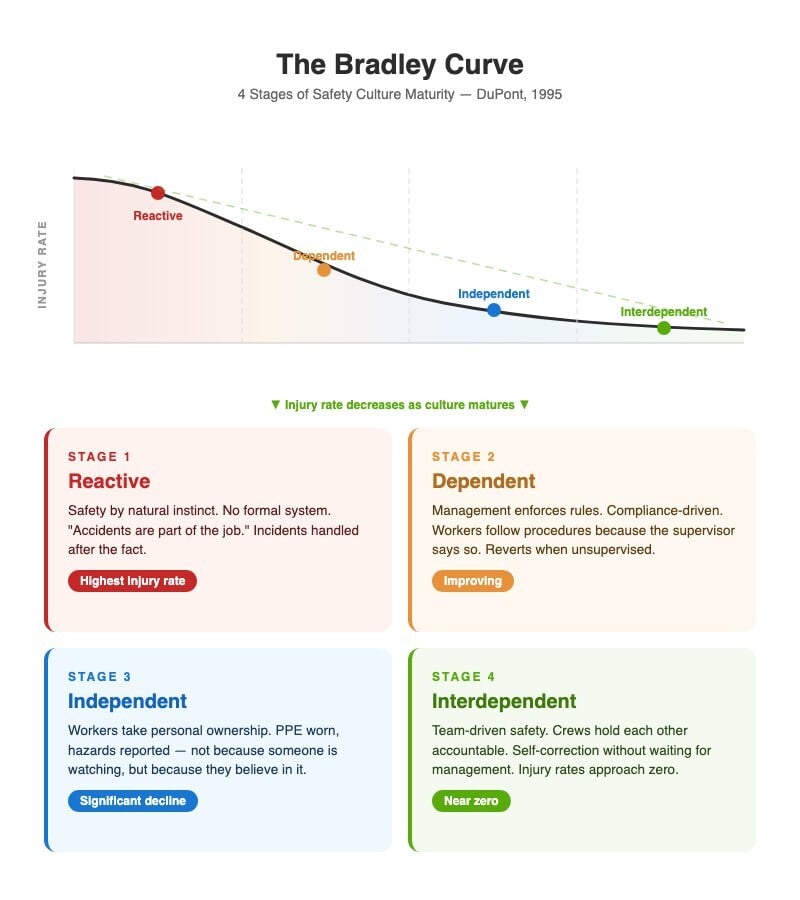
The Bradley Curve was developed by Vernon Bradley at DuPont in 1995. It is the most widely used safety culture framework in industry, particularly in construction, oil and gas, and manufacturing. The curve maps four stages against injury rates, showing that as culture matures, injuries decline.
Stage 1: Reactive. Safety is driven by natural instinct. There is no formal system. Incidents are dealt with after they happen, usually by blaming the worker. The prevailing attitude is "accidents are part of the job." Most startups and very small contractors begin here.
Stage 2: Dependent. Management implements rules and enforces them. Safety is supervised and compliance-driven. Workers follow procedures because the supervisor tells them to. This stage represents a major improvement over Reactive, but the system depends on specific people. When the safety coordinator is off-site, behaviour often reverts.
Stage 3: Independent. Individual workers take personal ownership of their safety. They wear PPE, follow procedures, and report hazards not because someone is watching, but because they have internalized the value. This requires sustained training and leadership modelling. The gap between Dependent and Independent is where most culture improvement efforts stall.
Stage 4: Interdependent. Safety becomes team-driven. Workers hold each other accountable. A pipefitter points out a missing guardrail to the electrician. A labourer stops work because a crane load path crosses a foot traffic area. The crew self-corrects without waiting for management. Injury rates at this level approach zero.
Practical application: Walk your sites with the Bradley Curve in mind. What stage describes your crew's actual behaviour (not your written program)? Most contractors who think they are at Stage 3 are at early Stage 2. The curve is useful because it gives you an honest benchmark and a clear next target.
The 5-Level Safety Culture Maturity Model
The academic Safety Culture Maturity Model, synthesized from research literature, provides more granularity than the Bradley Curve with five levels:
Level 1: Emerging. Safety is treated as an external requirement. The organization does the minimum to comply with regulations. No formal safety management system exists beyond what is mandated.
Level 2: Managing. A formal safety management system is in place. Roles and responsibilities are defined. Procedures are documented. This corresponds roughly to the Dependent stage of the Bradley Curve, but with an emphasis on the existence of systems rather than their effectiveness.
Level 3: Involving. Workers are actively involved in safety decision-making. Safety committees function (not just on paper). Near-miss reporting is encouraged and acted upon. This is the transition zone between Dependent and Independent.
Level 4: Cooperating. Cross-functional collaboration on safety. Lessons from one project are systematically applied to others. Safety culture assessments drive continuous improvement. Workers and management share ownership of safety outcomes.
Level 5: Continuous Improvement. Safety is fully integrated into business operations. Innovation in safety practices is ongoing. The organization actively seeks better methods rather than maintaining the status quo. This corresponds to the Interdependent stage of the Bradley Curve, with the addition of explicit improvement mechanisms.
The 5-level model is particularly useful for organizations that have reached the Dependent stage on the Bradley Curve and need more specific guidance on what "getting to Independent" actually involves.
Not Sure Which Framework Fits Your Operation?
Read about the Bradley Curve but not sure where your operation actually sits? SE AI maps your current safety maturity and shows you what the next stage requires.
Get Early Access to SE AI →
OSHA's 7 Core Elements (US Framework)
OSHA's Recommended Practices for Safety and Health Programs provide a practical, action-oriented framework built around 7 core elements. While not labelled as a "culture" framework, these elements describe the operational infrastructure that supports a strong safety culture:
- Management leadership: Visible commitment, resource allocation, accountability
- Worker participation: Voice in safety decisions, safety committees, reporting mechanisms
- Hazard identification and assessment: Systematic processes (FLHAs, JHAs, inspections, BBS observations)
- Hazard prevention and control: Hierarchy of controls, stop-work authority
- Education and training: Safety culture training, toolbox talks, competency tracking
- Program evaluation and improvement: Audits, leading indicators, corrective action tracking
- Communication and coordination: Safety meetings, incident debriefs, lessons learned
The strength of the OSHA framework is its practicality. Each element translates directly into daily operations. For contractors, it provides a checklist of capabilities to build and maintain.
COR Audit Framework (Canadian Framework)
In Canada, the Certificate of Recognition (COR) program provides a structured assessment framework that functions as a de facto safety culture measurement tool. COR audits evaluate your safety management system against established standards, covering elements that parallel OSHA's framework:
- Management commitment and leadership
- Hazard identification and assessment
- Hazard control
- Ongoing inspections
- Qualifications, orientation, and training
- Emergency response planning
- Incident investigation
- Program administration
While COR audits focus on system compliance rather than culture directly, companies that consistently maintain high COR scores and close audit findings promptly tend to have stronger safety cultures. The audit process forces regular self-examination, which is the starting point for culture improvement.
COR/SECOR certified companies in Alberta earn WCB premium refunds of up to 20% through the Partnerships in Injury Reduction (PIR) program. This creates a financial incentive that reinforces the cultural investment.
How to Choose and Apply a Framework
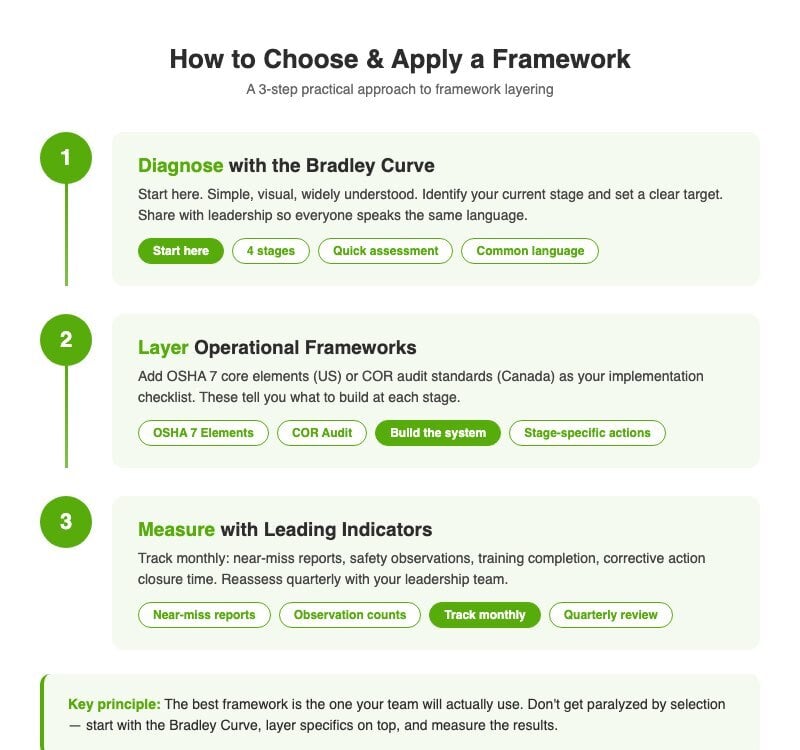
Do not get paralyzed by framework selection. The best framework is the one your team will actually use. Here is a practical approach:
Start with the Bradley Curve. It is simple, visual, and widely understood. Use it to establish your current stage and set a target. Share it with your leadership team and site supervisors so everyone has a common reference point.
Layer operational frameworks on top. Use the OSHA 7 core elements (US) or COR audit elements (Canada) as your implementation checklist. These tell you what to build at each stage. A Reactive company needs to build basic systems (OSHA elements 1-4). A Dependent company needs to build worker participation and training (elements 2 and 5). An Independent company moving to Interdependent needs to strengthen communication and program evaluation (elements 6 and 7).
Measure with leading indicators. Whatever framework you choose, track leading indicators monthly: near-miss reports, safety observations, training completion, corrective action closure time. These are the metrics that tell you whether your framework is actually driving change. See our guide to improving safety culture for specific measurement strategies.
Reassess quarterly. Run a brief Bradley Curve self-assessment with your leadership team every quarter. Are you moving forward, stalling, or sliding back? Culture is not static. Without regular measurement, it drifts.
Get a Structured Path to Safety Culture Maturity
Picked a framework but struggling to turn it into changes your crews actually feel on site? SE AI bridges the gap between maturity models and daily operations.
Get Early Access to SE AI →
Frequently Asked Questions
What is the Bradley Curve?
The Bradley Curve is a safety culture maturity framework developed by Vernon Bradley at DuPont in 1995. It maps four stages of organizational safety culture (Reactive, Dependent, Independent, Interdependent) against injury rates, showing that as an organization's safety culture matures, injuries and incidents decline. It is the most widely used safety culture framework in construction and industrial settings.
What are the 5 levels of safety culture maturity?
The 5-level Safety Culture Maturity Model describes: Emerging (minimum compliance), Managing (formal systems in place), Involving (worker participation in safety), Cooperating (cross-functional collaboration and shared ownership), and Continuous Improvement (safety innovation and integration into all operations). These levels provide more granularity than the 4-stage Bradley Curve, which is useful for organizations targeting specific improvements.
How do you measure safety culture maturity?
Safety culture maturity is measured through a combination of: Bradley Curve self-assessment (qualitative diagnostic), leading indicator tracking (near-miss rates, observation counts, training completion), employee perception surveys, and formal audit scores (COR in Canada, VPP in the US). The most effective approach uses all four methods together because each captures different aspects of culture that no single measure can assess alone.
What is the difference between the Bradley Curve and OSHA's safety management framework?
The Bradley Curve is a diagnostic tool that tells you where you are and where you need to go (maturity stages). OSHA's 7 core elements framework is an implementation guide that tells you what to build (specific program components). They complement each other: use the Bradley Curve to set your target, then use the OSHA elements to build the capabilities needed to reach that target.
Which safety culture framework is best for construction companies?
For construction companies, the Bradley Curve is the most practical starting point because it is visual, widely understood, and directly relatable to site behaviours. Layer it with OSHA's 7 core elements (US) or COR audit standards (Canada) for implementation specifics. The 5-level Maturity Model adds value when you need more granularity between stages. The best framework is the one your leadership team and supervisors will actually reference and use.
Get Weekly Safety Insights
Regulation updates, toolbox talk ideas, and compliance tips. One email per week.