Last updated: April 2026
Your crew aced the last COR audit. Every FLHA is signed, every toolbox talk is documented, every harness is inspected. Then a worker drops a wrench from the third level and nobody reports it because "nobody got hurt." That gap between your written program and what your crew actually does when the GC walks away? That is your safety culture. And in 2024, 1,032 construction and extraction workers died on the job in the United States (BLS). Safety culture is the shared values, attitudes, and behaviours that determine how your people approach safety on site, beyond just following the rules.
This guide covers what safety culture actually means for contractors, why it directly affects your bottom line, how to figure out where your company stands today, and what it takes to build a crew that self-corrects.
⚡ Quick Answer
- What: Safety culture is how your crew approaches safety when nobody is watching. It goes beyond compliance to include shared values, leadership commitment, and peer accountability.
- Why it matters: In 2024, construction was the deadliest occupation category in the US with 1,032 fatalities (BLS). In Canada, construction time-loss claims run 24% higher than the average for all sectors (WorkSafeBC/AWCBC).
- Business impact: COR/SECOR certified companies earn WCB premium refunds of up to 20% in Alberta. In the US, your safety record directly affects your EMR score and your ability to prequalify on ISNetworld and Avetta.
- The 4 stages: The Bradley Curve maps safety culture maturity from Reactive (safety by instinct) to Dependent (management-driven), Independent (personal ownership), and Interdependent (team-driven).
What Is Safety Culture?
Safety culture is not your safety manual. It is not your COR certificate on the wall or the number of toolbox talks you ran last quarter. Those are outputs. Safety culture is the invisible operating system underneath: the shared beliefs, attitudes, and unwritten rules that drive how your people actually behave around hazards.
OSHA frames it as making safety a "core value", not just a priority. Priorities change with deadlines and budgets. A core value does not. When a concrete crew refuses to pour in high winds because "that is how we do things here," that is culture working. When a new hire reports a near miss on day two because the foreman told them "we want to hear about it," that is culture working.
The difference between compliance and culture shows up in one question: What does your crew do when the supervisor is not on site? If the answer changes depending on who is watching, you have compliance. If it stays the same, you have culture.
Why Safety Culture Matters for Contractors
Safety culture is not a soft skill or an HR initiative. It is a financial and operational reality that affects every bid, every premium payment, and every project you run.
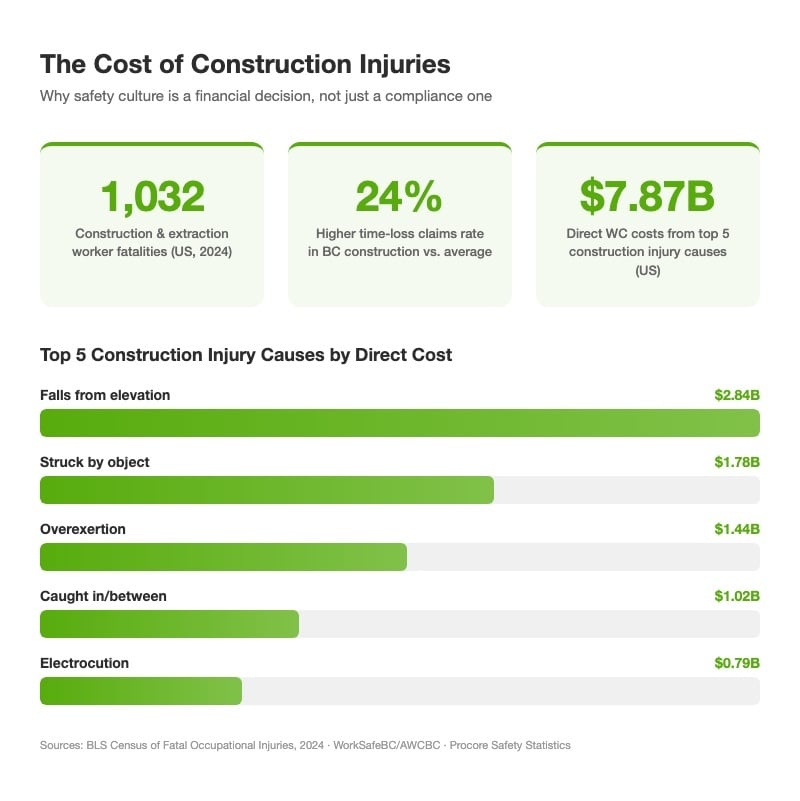
In the US, employers reported 2.5 million injury and illness cases in private industry in 2024, and construction workers' compensation direct costs from the top five injury causes hit $7.87 billion. Those costs get passed directly to contractors through higher premiums and reduced bid competitiveness.
In Canada, the numbers tell a similar story. British Columbia's construction sector has a time-loss claims rate 24% higher than the provincial average for all sectors (WorkSafeBC/AWCBC). In Saskatchewan, workplace injury rates hit historic lows in 2024 at 3.91 per 100 workers, proving that sustained investment in safety programs and culture pays off.
Here is where it gets concrete for your business:
- WCB premium refunds: In Alberta, COR and SECOR certified companies earn refunds of up to 20% of their industry-rated premium through the Partnerships in Injury Reduction (PIR) program.
- EMR and prequalification: In the US, your Experience Modification Rate (EMR) is a direct reflection of your injury history. An EMR above 1.0 makes you more expensive to insure and can disqualify you from bidding on work through ISNetworld, Avetta, and similar prequalification platforms.
- Bid eligibility: Prime contractors and project owners increasingly require subcontractors to demonstrate a safety management system. No culture, no system. No system, no bid.
- Crew retention: Workers notice when safety is real versus performative. Companies with strong safety cultures have lower turnover, which reduces the constant cost of onboarding and retraining.
Most contractors think of safety spending as a cost. The ones winning bids treat it as an investment that directly reduces their per-project risk exposure.
The 4 Stages of Safety Culture (Bradley Curve)
The Bradley Curve is the most widely used framework for understanding safety culture maturity. Developed by Vernon Bradley at DuPont in 1995, it maps four stages of organizational safety culture against injury rates. As a company moves through the stages, injuries decline.
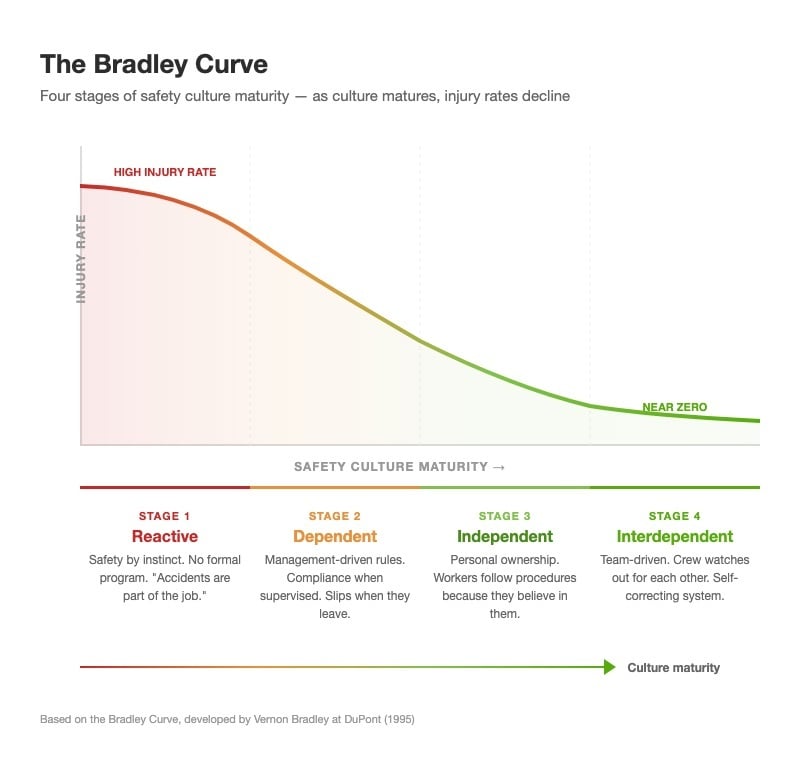
Here is what each stage looks like in practice for a contractor:
Stage 1: Reactive. Safety happens by instinct. There is no formal program. Incidents get dealt with after they happen. The attitude is "accidents are part of the job." A reactive company investigates a fall from height, writes up the worker, and moves on. No root cause analysis, no systemic change.
Stage 2: Dependent. Safety is driven by management and supervision. Rules exist and are enforced. Workers follow procedures because the supervisor tells them to. This is where most small contractors sit after getting their first COR or implementing a written safety program. The limitation: safety relies on one or two people pushing it. When the safety coordinator is on vacation, behaviour slips.
Stage 3: Independent. Individual workers take personal ownership of their own safety. They wear PPE correctly, follow procedures, and speak up about hazards not because someone is checking, but because they have internalized it. This requires real training and consistent leadership modelling.
Stage 4: Interdependent. The crew watches out for each other. A scaffold builder points out a missing guardrail to the electrician. A labourer stops a task because they see an unsafe condition affecting someone else. Safety is a shared responsibility, not an individual one. Injury rates at this level are near zero because the system is self-correcting.
Where does your company sit? Be honest. If safety conversations only happen during audits or after incidents, you are likely Reactive or early Dependent. If your workers follow procedures but only when supervised, you are Dependent. If individuals own their safety but do not intervene with coworkers, you are Independent. Most contractors who reach Interdependent have been investing in culture for 3-5 years consistently.
Not Sure Where Your Safety Culture Stands?
Not sure where your safety culture actually stands? SE AI analyzes your program and shows you the gaps your crew already sees.
Get Early Access to SE AI →
7 Components of a Strong Safety Culture
OSHA's Recommended Practices for Safety and Health Programs outline seven core elements that make up an effective program. These are not abstract principles. For contractors, they translate directly into daily operations.
1. Management commitment. The owner or GC visibly participates in safety. Not just signing off on policies, but showing up at toolbox talks, reviewing FLHAs, and allocating real budget for training and equipment. When the crew sees leadership treating safety as non-negotiable, behaviour follows.
2. Worker participation. Workers have a voice in safety decisions. This means functioning safety committees (or Joint Health and Safety Committees in Canadian jurisdictions), near-miss reporting without retaliation, and a culture where the newest apprentice can stop a task without fear. If your reporting system only captures incidents, your workers are telling you they do not trust the system with near misses.
3. Hazard identification and assessment. Systematic processes for finding hazards before they cause injuries. Field Level Hazard Assessments (FLHAs), Job Hazard Analyses (JHAs), regular site inspections, and behavioural based safety observations (BBS/BBO). The goal is proactive, not reactive.
4. Hazard prevention and control. Once identified, hazards need to be controlled using the hierarchy of controls: elimination, substitution, engineering controls, administrative controls, and PPE as the last line. Stop-work authority for every worker on site is a hallmark of strong culture.
5. Education and training. Regular toolbox talks, site-specific orientations for every new worker, competency tracking for tickets and certifications, and refresher training that is not just a checkbox exercise. Training builds the "Independent" stage of the Bradley Curve.
6. Program evaluation and improvement. COR and SECOR audits in Canada provide a structured framework for evaluating your safety management system. In the US, OSHA's Voluntary Protection Programs (VPP) serve a similar function. Beyond formal audits, track leading indicators: near-miss report rates, safety observation counts, training completion, corrective action closure times.
7. Communication and coordination. Regular safety meetings, post-incident debriefs, lessons learned shared across crews and projects, and clear communication with subcontractors about site-specific hazards. Use your incident investigation process not just for compliance, but as a learning tool for the whole team.
How to Build Safety Culture on Site
Building safety culture is not a one-time project. It is a continuous process that starts with leadership and compounds over time. Here is a practical starting sequence for contractors who want to move beyond compliance.
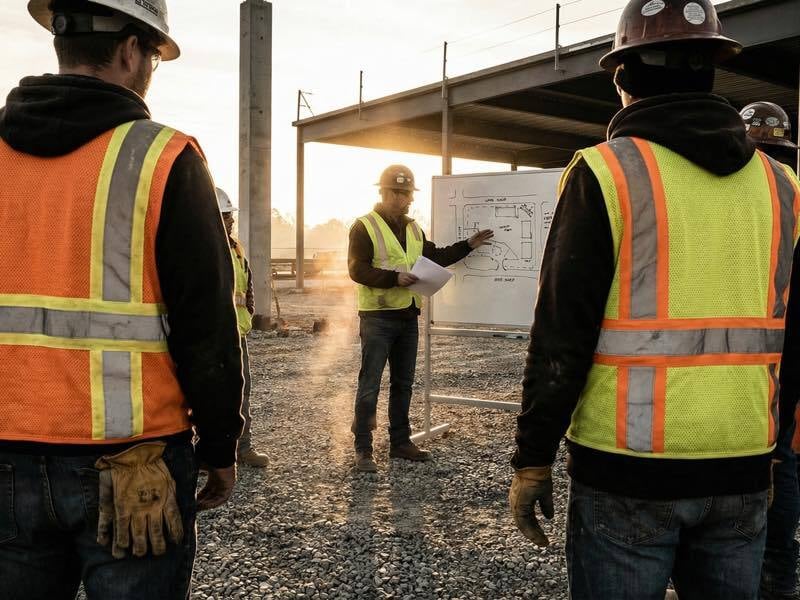
Start with leadership. If the owner or project manager treats safety as a cost centre, the crew will too. Leaders set the tone by how they respond to near misses, how they allocate time for safety activities, and whether they follow the same rules they enforce. Strong safety leadership is the single biggest predictor of culture change.
Assess where you are today. Before you can improve, you need an honest baseline. Run a safety culture survey. Walk your sites with fresh eyes. Check your near-miss reporting rates: if they are near zero, that does not mean your sites are safe. It means your crew does not trust the reporting system. A safety culture assessment gives you the data to target your investment.
Build systems, not just rules. Rules without systems produce compliance, not culture. Implement daily FLHAs, weekly toolbox talks, monthly safety inspections, and quarterly management reviews. Make these operational habits, not paperwork exercises. Digital tools can help: mobile FLHA completion, automated toolbox talk distribution, and real-time reporting dashboards.
Train for behaviour, not just knowledge. A worker can pass a test about fall protection and still not tie off consistently. Safety culture training goes beyond knowledge transfer to address attitudes, peer accountability, and the skills to intervene when they see something unsafe.
Measure what matters. Lagging indicators (injury rates, lost-time claims) tell you what already went wrong. Leading indicators (near-miss reports, safety observation counts, training completion rates, corrective action closure times) tell you what is about to go wrong. Track both. Use a safety culture framework to organize your measurement approach.
Cross-market note: In Canada, the COR/SECOR certification process provides a built-in framework for assessing and improving your safety management system. Your annual COR audit is essentially a safety culture health check. In the US, OSHA's VPP program provides recognition for employers who go beyond compliance, and the SE AI platform can help contractors in both countries build and maintain their programs.
Safety Culture vs Safety Compliance
This is a distinction that trips up a lot of contractors. Compliance and culture are not the same thing, and having one does not guarantee the other.
Compliance is meeting the minimum legal standard. You have the required written program, the mandated training records, the PPE that meets the regulation. You pass inspections. This is necessary, but it is the floor, not the ceiling.
Culture is what happens beyond the minimum. Your crew ties off on a 6-foot wall even though the regulation only requires it above 10 feet. A worker stops a task because the conditions changed, even though the FLHA was already signed. A supervisor redesigns a procedure after a near miss, not because a regulator told them to, but because they do not want their people getting hurt.
Here is the blunt truth: companies with strong compliance programs and weak cultures still have serious injuries. The paperwork looks great. The audit scores are high. But the crew knows the difference between what the manual says and what actually happens on site. If your workers see safety as "something we do for the auditor," you have compliance without culture.
The goal is both. Compliance provides the structure. Culture provides the engine.
Ready to Move Beyond Compliance?
Tired of safety programs that look good on paper but do not change what happens on site? SE AI shows you what to fix first.
Get Early Access to SE AI →
Frequently Asked Questions
What is safety culture in the workplace?
Safety culture is the shared values, attitudes, and behaviours that determine how people approach safety in your organization. It goes beyond regulatory compliance to include leadership commitment, worker participation, peer accountability, and a willingness to report hazards and near misses without fear of retaliation. A strong safety culture means your crew makes safe decisions even when nobody is watching.
What are the 4 stages of safety culture?
The Bradley Curve identifies four stages of safety culture maturity: Reactive (safety by instinct, incidents dealt with after the fact), Dependent (safety driven by management enforcement and rules), Independent (individual workers take personal ownership of their safety), and Interdependent (teams actively watch out for each other and safety is self-sustaining). Most small contractors start between Reactive and Dependent.
How do you measure safety culture?
Effective measurement combines leading and lagging indicators. Leading indicators include near-miss reporting rates, safety observation counts, training completion rates, and corrective action closure times. Lagging indicators include injury rates, lost-time claims, and workers' compensation costs. In Canada, COR and SECOR audit scores provide a structured assessment. Employee safety perception surveys also capture the human side of culture that numbers alone miss.
What is the difference between safety culture and safety climate?
Safety culture refers to the deep, shared values and assumptions about safety that have developed over time in your organization. Safety climate is a snapshot of workers' current perceptions about safety at a specific point in time. Think of culture as the foundation and climate as the weather: climate surveys tell you how people feel today, while culture is the long-term pattern of beliefs and behaviours that drives those perceptions.
How long does it take to change safety culture?
Meaningful safety culture change typically takes 2 to 5 years of sustained effort. You can see behavioural shifts within 6 to 12 months with consistent leadership commitment and visible changes to systems and processes. Moving from Reactive to Independent on the Bradley Curve requires sustained investment in training, leadership development, and worker engagement. Companies that pursue COR certification often accelerate this because the audit framework provides structure and accountability.
Get Weekly Safety Insights
Regulation updates, toolbox talk ideas, and compliance tips. One email per week.