Last updated: April 2026
Your COR audit score says 85%. Your safety binder is current. Your TRIR is below industry average. But when you walk the site at 3 PM on a Friday, the scaffolding crew is not wearing harnesses and the excavation team skipped the pre-dig FLHA. A safety culture assessment measures the gap between your written safety program and what actually happens on your sites. Most contractors have no idea how big that gap is until something goes wrong.
This guide covers the tools, methods, and metrics you need to honestly assess your safety culture and identify exactly where to invest your improvement efforts.
⚡ Quick Answer
- What: A safety culture assessment evaluates the shared beliefs, attitudes, and behaviours around safety in your organization, not just your written program or audit scores.
- Methods: Safety perception surveys, leading indicator analysis, near-miss ratio tracking, management/worker gap analysis, and the Bradley Curve diagnostic.
- Key metric: Healthy operations generate 10 to 30 near-miss reports for every recordable incident. If your ratio is near zero, your culture has a reporting problem.
- In Canada: COR/SECOR audits provide a structured baseline. In the US, OSHA VPP status and the OSHA self-inspection checklists serve a similar role.
What Is a Safety Culture Assessment?
A safety culture assessment is not another audit. Audits check whether your systems exist and your documentation is current. A safety culture assessment checks whether those systems actually work in practice.
The distinction matters. Your hazard assessment program might be fully compliant, but if workers rush through FLHAs because they see them as paperwork instead of hazard identification tools, your system is not working. A culture assessment surfaces these disconnects by measuring what people actually believe, do, and experience on site.
Culture assessments typically combine quantitative data (safety metrics, reporting rates, training completion) with qualitative data (surveys, interviews, observations). The combination gives you a picture that no single metric can provide on its own.
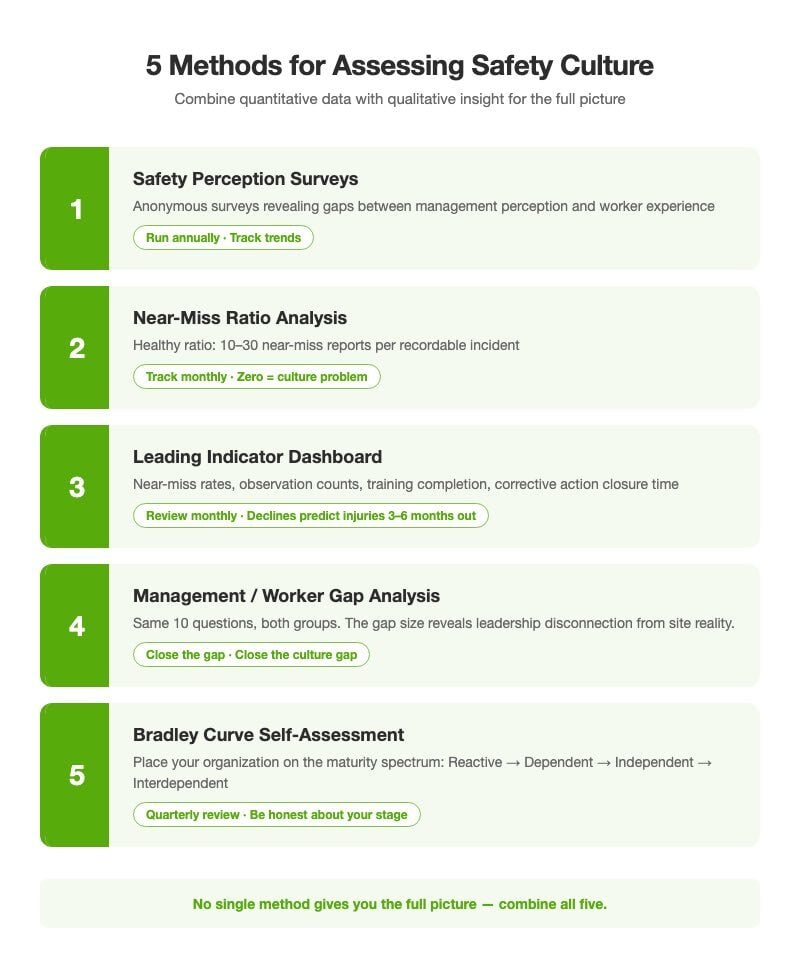
5 Methods for Assessing Safety Culture
1. Safety Perception Surveys
Anonymous surveys that ask workers about their experience with safety on site. Not satisfaction surveys. Culture surveys. The questions that reveal the most include: "Would you feel comfortable stopping a task you believe is unsafe?" and "Do you believe management prioritizes safety over production when they conflict?" and "When you report a hazard, does something actually change?"
The power of perception surveys is in the gaps they reveal: between management's perception and workers' experience, between policy and practice, between what people say in safety meetings and what they actually do on site. Run them annually and track the trends.
2. Near-Miss Ratio Analysis
The ratio of near-miss reports to recordable incidents is one of the most reliable indicators of safety culture health. Industry research consistently suggests a healthy ratio is 10:1 to 30:1 (near misses to recordable incidents). If your ratio is lower, or if your near-miss count is near zero, your workers are either not recognizing hazards or not reporting them. Both are culture problems, not compliance problems.
Track this monthly. When the ratio improves (more near misses reported relative to incidents), it usually means trust is building and workers feel safe reporting. When it drops, something has changed in the social environment on your sites.
3. Leading Indicator Dashboard
Build a dashboard of leading indicators that predict safety performance before incidents happen:
- Near-miss reports per worker-month: Target increasing trend
- Safety observation count: How many behavioural based observations are being completed
- Training completion rate: Percentage of workers current on all required training
- Corrective action closure time: Days from identification to resolution (target under 14 days)
- Toolbox talk attendance: Not just the form signatures, but who was actually present and engaged
- FLHA completion quality: Are hazards being identified specifically, or are workers copying yesterday's FLHA?
When leading indicators decline, injuries follow 3 to 6 months later. The dashboard gives you early warning to intervene.
4. Management/Worker Gap Analysis
Ask management and frontline workers the same 10 questions about safety culture. Compare the answers. In almost every organization, management rates the culture higher than workers do. The size of that gap tells you how disconnected your leadership is from the site reality.
Common disconnects: management believes workers feel comfortable reporting hazards (workers do not). Management believes near misses are tracked (workers know they go unreported). Management believes safety is prioritized over production (workers have been told to "just get it done" during schedule pressure). Close the gap and you close the culture gap.
5. Bradley Curve Self-Assessment
Use the Bradley Curve framework to place your organization on the maturity spectrum. For each stage (Reactive, Dependent, Independent, Interdependent), list the behaviours you see on your sites:
- Reactive: Safety discussed only after incidents. No formal near-miss program. "Accidents happen" attitude.
- Dependent: Rules exist and are enforced. Compliance is good when supervised. Behaviour slips when supervision is absent.
- Independent: Workers take personal ownership. PPE is worn correctly without prompting. Hazards are reported proactively.
- Interdependent: Workers correct each other. Safety is peer-driven, not management-driven. Stop-work authority is used regularly.
Be honest. Most contractors who think they are at Independent are at Dependent. The assessment only has value if it reflects reality.
Want a Data-Driven Assessment of Your Safety Culture?
Running safety surveys but not getting data you can act on? SE AI turns your assessment results into prioritized actions your PMs can execute.
Get Early Access to SE AI →
Safety Culture Assessment in Canada vs the US
The tools and frameworks are largely the same across both countries. The regulatory structures that support assessment differ.
In Canada, the COR (Certificate of Recognition) and SECOR (Small Employer Certificate of Recognition) audit frameworks provide a structured assessment of your safety management system. While COR audits focus on system compliance rather than culture specifically, the audit process surfaces many of the same gaps. Companies with COR/SECOR certification in Alberta earn WCB premium refunds of up to 20%, which creates a financial incentive to maintain and improve your assessment scores. Provincial variations exist: Alberta uses ACSA, BC uses BCCSA, and other provinces have their own certifying partners.
In the US, OSHA's Voluntary Protection Programs (VPP) recognize employers who go beyond compliance to establish effective safety management systems. The OSHA Recommended Practices provide a self-assessment framework built around 7 core elements. While VPP recognition is less common in construction than in manufacturing, the self-assessment tools apply to any industry. ISNetworld, Avetta, and similar prequalification platforms also assess safety program effectiveness, creating indirect culture pressure through bid eligibility.
What to Do With Your Assessment Results
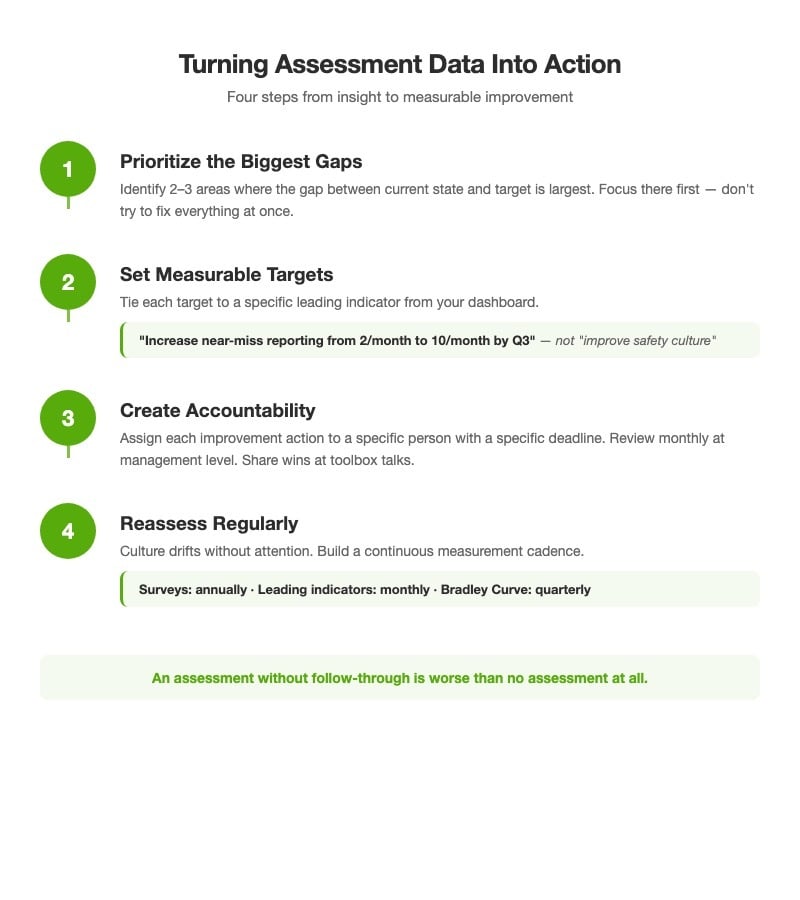
An assessment without follow-through is worse than no assessment at all. It tells your workers that management asked, heard the answers, and did nothing. Here is how to turn assessment data into action.
Prioritize the biggest gaps. Do not try to fix everything at once. Identify the 2 to 3 areas where the gap between your current state and your target state is largest. Focus there first.
Set measurable targets. "Improve safety culture" is not a target. "Increase near-miss reporting from 2 per month to 10 per month by Q3" is a target. Tie each target to a specific leading indicator from your dashboard.
Create accountability. Assign each improvement action to a specific person with a specific deadline. Review progress monthly at the management level and share wins with the full team at toolbox talks.
Reassess regularly. Run perception surveys annually. Review leading indicators monthly. Redo the Bradley Curve self-assessment quarterly. Culture is not static; it drifts without attention. Use the results to drive your safety culture improvement strategy.
Stop Guessing. Start Measuring.
Have a stack of near-miss reports and survey results but no clear next step? SE AI connects the patterns and tells you what is actually driving your incidents.
Get Early Access to SE AI →
Frequently Asked Questions
What is the best way to assess safety culture?
The most effective approach combines quantitative data (near-miss ratios, leading indicator dashboards, training completion rates) with qualitative data (anonymous perception surveys, management/worker gap analysis). No single method gives you the full picture. Use the Bradley Curve as an overall maturity framework and layer specific metrics on top of it.
How often should you assess safety culture?
Run perception surveys annually. Review leading indicator dashboards monthly. Do a formal Bradley Curve self-assessment quarterly. In Canada, COR/SECOR audits provide an annual structured assessment. The key is creating a regular cadence so you can track trends rather than getting a single snapshot.
What does a healthy near-miss ratio look like?
Industry research suggests a healthy ratio is 10 to 30 near-miss reports for every recordable incident. If your ratio is lower, especially if near-miss reports are near zero, it indicates a reporting culture problem, not safe sites. A high near-miss ratio means workers trust the system and are actively identifying hazards before they cause injuries.
What is the difference between a safety audit and a safety culture assessment?
A safety audit checks whether your safety management system exists and meets regulatory requirements: policies, procedures, training records, equipment inspections. A safety culture assessment measures whether those systems actually influence behaviour on site. You can pass an audit with flying colours and still have a weak safety culture if workers treat the system as paperwork rather than a genuine safety tool.
Does COR certification reflect safety culture?
COR (Certificate of Recognition) audits assess your safety management system against established standards. While they do not measure culture directly, they surface many of the same gaps: weak hazard identification, incomplete training, poor incident investigation processes. Companies that consistently score well on COR audits and maintain the discipline to address audit findings tend to have stronger safety cultures than those that treat the audit as a checkbox exercise.
Get Weekly Safety Insights
Regulation updates, toolbox talk ideas, and compliance tips. One email per week.