Last updated: April 2026
You've got a crew starting on a new site next week, and half of them need fall protection training. You're staring at two options: a $50 online course they can finish tonight, or a $195 in-person class that burns a full day of productivity. The online option looks tempting. But will it actually satisfy your OHS requirements?
After helping hundreds of contractors sort through this exact decision, here's what we've learned: a fall protection online course covers the theory component of working safely at heights, including hazard identification, equipment types, legislation, and fall physics. It's a legitimate part of a training program. But it's almost never the complete picture.
The answer to "is online enough?" depends on your province, your industry, and what your workers actually do on site. Here's how to make that call without guessing.
Quick Answer: Online vs. In-Person Fall Protection Training
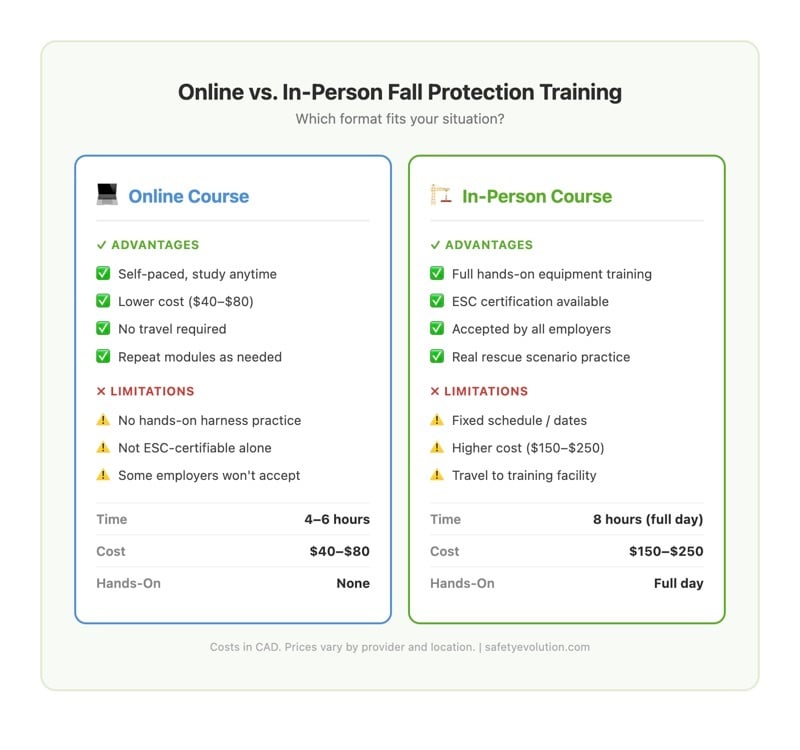
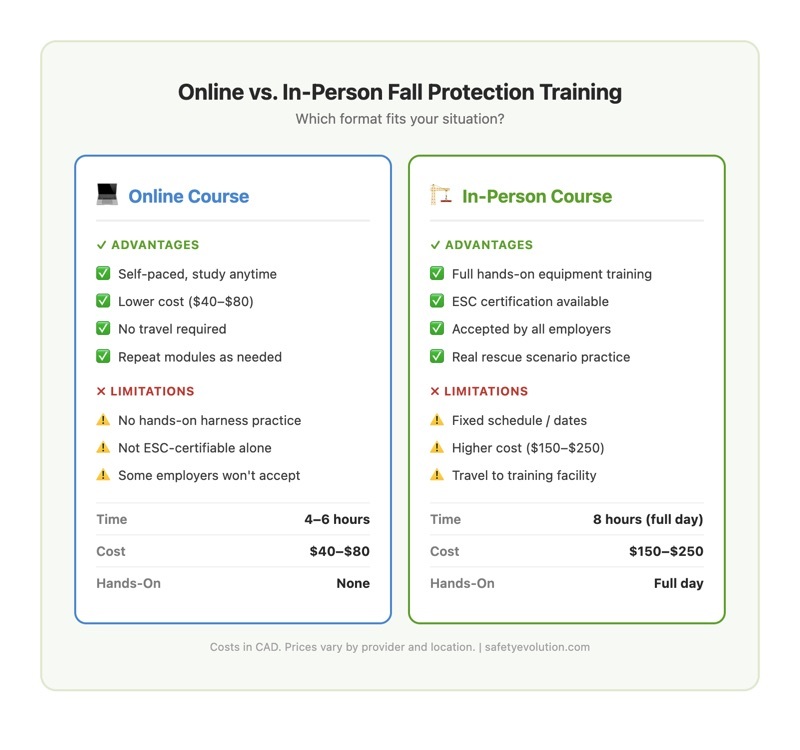
A fall protection online course delivers theory training (typically $40 to $55, 1 to 4.5 hours) covering hazard identification, legislation, equipment types, and fall clearance calculations. Most Canadian provinces accept online delivery for the theory component. However, if your workers physically tie off on site, you still need a hands-on practical session for harness fitting, equipment inspection, and rescue planning. In-person courses with practical components run $99 to $195. Ontario construction workers must complete a CPO-approved Working at Heights program, which requires the practical module to be done in person.
What Does a Fall Protection Online Course Actually Cover?
A solid online fall protection training course covers the knowledge your crew needs before they ever touch a harness. The typical curriculum includes:
- Worker rights, obligations, and employer responsibilities under OHS legislation
- Identifying fall hazards on site (open edges, floor holes, scaffolding, rooftop work)
- The hierarchy of fall protection controls (elimination, guardrails, travel restraint, fall arrest)
- Types of fall protection equipment: full-body harnesses, lanyards, SRLs, anchor points
- Fall clearance calculations and swing fall hazards
- Pre-use equipment inspection procedures
- Suspension trauma risks and rescue planning basics
That's real, useful training. A worker who completes a quality online course understands why fall protection matters and what the systems do.
Here's what online courses cannot teach:
- How a properly adjusted harness actually feels on your body
- The physical process of donning and doffing a harness correctly
- Inspecting real equipment for wear, damage, and defects by touch
- Connecting components to anchor points under realistic conditions
- What suspension in a harness feels like (and why rescue planning isn't optional)
This gap is the reason most provinces require more than a certificate from an online course. The theory matters. But fall protection is a physical skill, and physical skills require practice with real equipment.
When Is an Online Course Enough?
Most GCs assume an online fall protection certificate checks the compliance box. It doesn't, at least not if your crew is physically tying off at height.
An online-only course is typically sufficient when:
- Awareness training for supervisors who oversee work at heights but don't personally use fall protection equipment
- Safety coordinators and office staff who need to understand fall protection for program development, not field application
- COR documentation where the audit requires evidence of general fall protection awareness across all employees
- Workers in low-risk roles who don't access areas where fall protection is required
You need in-person practical training when:
- Workers physically wear harnesses and connect to fall arrest or restraint systems
- Your site operates in oil and gas (ESC certification required at most sites)
- You're working on Ontario construction projects (CPO-approved Working at Heights required)
- Your employer's fall protection plan specifies competency demonstration, not just course completion
- Workers need to perform pre-use equipment inspections as part of their daily routine
The real question isn't "is the online course valid?" It's "what does my crew actually do on site?" If the answer involves harnesses, lanyards, and anchor points, the online theory is step one, not the finish line.
Provincial Rules for Online Fall Protection Training
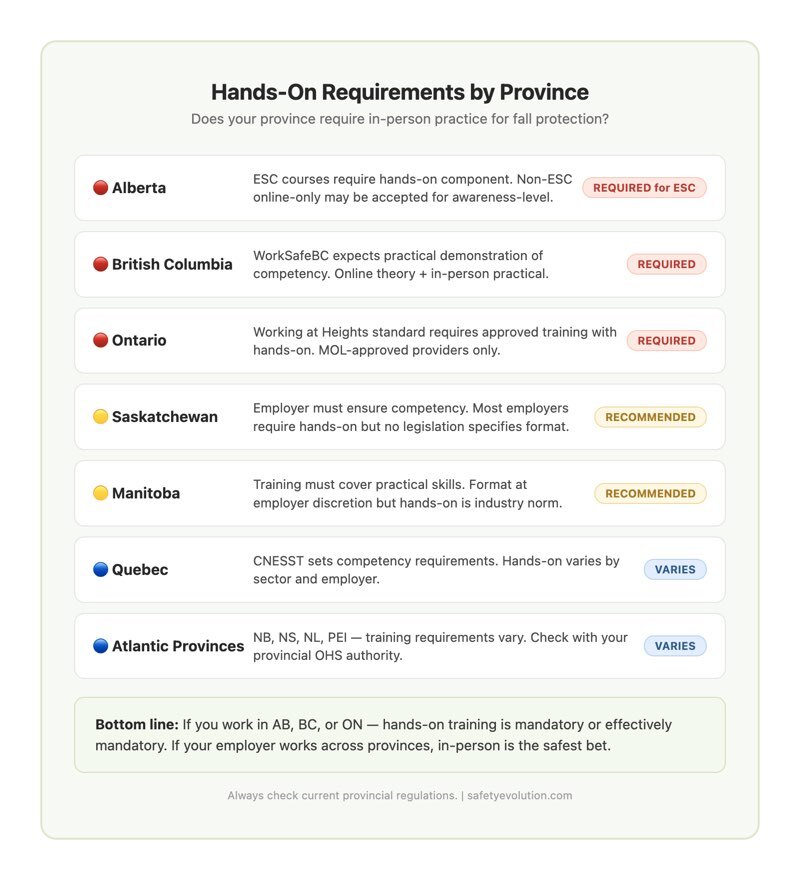
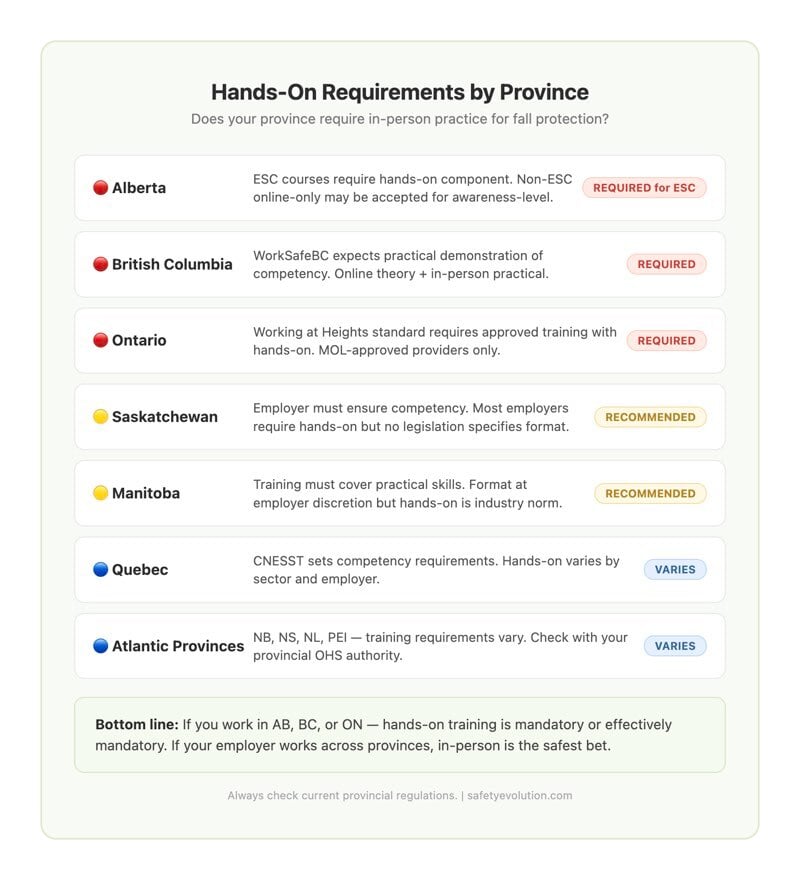
Fall protection training requirements vary by province. Here's what matters for the three provinces where most of our clients operate.
Alberta
Alberta's OHS Code Part 9, Section 141 requires employers to train workers in the safe use of fall protection systems before use. The legislation lists specific training topics: legislation review, fall protection plan, hazard identification, anchor selection, equipment use, fall effects on the body, pre-use inspection, emergency response procedures, and practice.
That last word, "practice," is key. Alberta doesn't mandate a specific course provider or delivery method. Online training satisfies the theory requirements. But the word "practice" in the legislation means your workers need hands-on time with actual equipment. Most employers combine an online course for theory with a shorter on-site practical session to meet the full requirement.
For a deeper look at Alberta's requirements, see our complete fall protection training requirements guide.
British Columbia
WorkSafeBC's OHS Regulation Part 11, Section 11.2 requires employers to ensure workers are "instructed in the fall protection system and the procedures to follow" before entering an area with fall risk. The instruction must be specific to the work area and the particular work procedures at that site.
BC doesn't prescribe a mandatory certification body or course format. Online courses can satisfy general fall protection theory. But WorkSafeBC's guidelines emphasize that generic training alone isn't sufficient. Your instruction needs to address the specific hazards, equipment, and anchor points at each job site. That site-specific piece almost always requires an in-person component.
Ontario
Ontario has the strictest rules. Construction project workers must complete a CPO-approved Working at Heights (WAH) program under O.Reg. 297/13. The program standard has two modules:
- Basic Theory: Can be completed via eLearning (approximately 3.5 hours). Must include instructor interaction, even in the online format.
- Practical: Must be completed in person. No exceptions. Workers demonstrate harness donning, equipment inspection, and safe work procedures with real equipment.
This means a fully online fall protection course is not valid for Ontario construction workers. Blended learning (theory online + practical in person) is accepted, but only through CPO-approved providers.
For workers in non-construction sectors in Ontario, fall protection training requirements are less prescriptive. Employers determine the appropriate level of training based on workplace hazards.
Not sure where your fall protection program is exposed?
See missing training, inspections, and corrective actions before they become stop-work or audit issues.
Start Your 30-Day Free Trial →What About ESC Fall Protection? Can You Do It Online?
No. The Energy Safety Canada (ESC) Fall Protection course cannot be completed online. This is one of the most common questions we hear, and the answer is clear: ESC requires instructor-led training with a mandatory practical component.
The ESC course is a full 8-hour day that includes:
- Theory: fall hazard identification, hierarchy of controls, equipment types, fall clearance calculations, legislative responsibilities
- Practical: inspecting real equipment for defects, correctly donning and adjusting a full-body harness using the buddy system, connecting to anchor points, and being suspended from a tripod to experience harness loading
The certificate is valid for 3 years and requires a minimum 70% score on the exam. Typical cost through authorized providers ranges from $175 to $225 per person.
If a training provider tells you they offer ESC fall protection online, walk away. ESC requires hands-on demonstration of competency. There are no shortcuts, and a certificate from a non-authorized provider won't be accepted at most oil and gas or industrial sites in Western Canada.
One more detail that catches people: the ESC fall protection course is not valid for Ontario construction projects. Ontario construction workers need a CPO-approved Working at Heights program, which is a separate certification entirely.
How Much Does Fall Protection Training Cost?
Here's an honest cost comparison based on current pricing from Canadian training providers (all prices in CAD, before tax):
| Training Type | Cost Per Person | Duration | What You Get | Certificate Validity |
|---|
| Online only | $37 to $55 | 1 to 4.5 hours | Theory: legislation, hazards, equipment, fall physics | 3 years |
| In-person classroom | $99 to $149 | 8 hours | Theory + hands-on practical | 3 years |
| On-site group training | ~$150/person (min. 10) | 8 hours | Theory + practical at your location | 3 years |
| ESC fall protection | $175 to $225 | 8 hours | Theory + practical, oil & gas standard | 3 years |
| Ontario WAH (blended) | ~$165 | 3.5 hrs online + half-day in person | CPO-approved theory + practical | 3 years |
For a 10-person crew: Online-only runs $370 to $550 total. In-person classroom costs $990 to $1,490. On-site group training at your location costs roughly $1,500 and saves the travel time. For oil and gas sites requiring ESC, expect $1,750 to $2,250 for the crew.
The price gap between online and in-person is real. But consider what you're actually paying for: the practical component is where workers build the muscle memory that prevents falls. A $50 savings per worker isn't worth much if your crew can't properly inspect their harness before tying off 30 feet up.
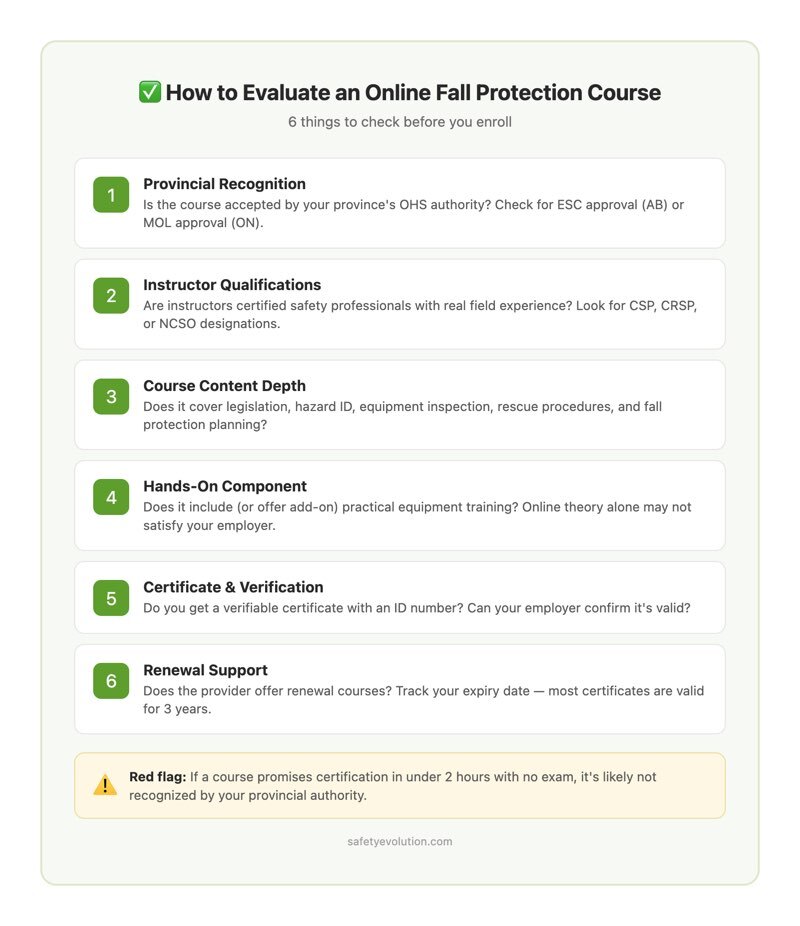
How to Choose the Right Online Course
If you've determined that an online course fits your training needs (for theory, awareness, or as the first step before a practical session), here's what to look for:
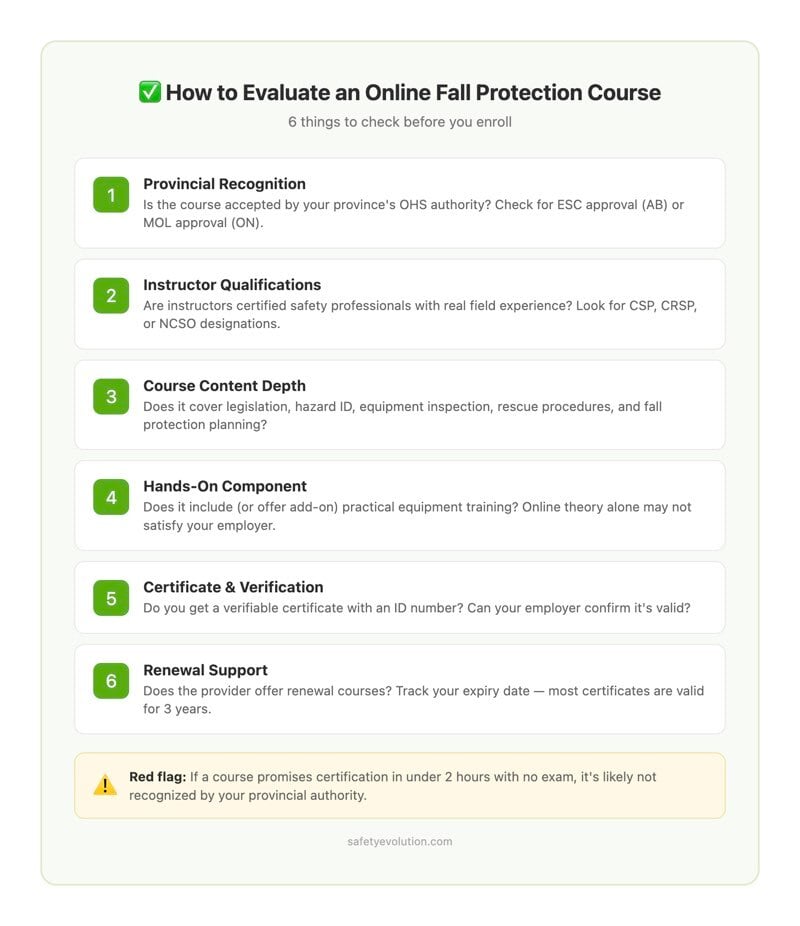
- Provincial compliance: Does the course cover your province's specific OHS code? Alberta Part 9, BC Part 11, and Ontario O.Reg requirements are different. A generic "Canadian" course may miss jurisdiction-specific details.
- CSA Z259 alignment: The course should reference CSA Z259 standards for fall protection equipment. This is the Canadian standard. Courses referencing only OSHA or ANSI are built for the US market.
- Certificate format: Look for digital, printable, and wallet card options. Your workers need something they can carry on site. Verify the certificate includes the worker's name, course date, provider name, and expiry date.
- Employer management tools: If you're enrolling a full crew, check for bulk enrollment, progress tracking, and training record exports. These save hours during COR audits.
- Exam standards: A legitimate course requires 70% or higher to pass. Unlimited exam attempts are fine (people learn from retaking), but the course should require completing the content before the exam.
What Employers Need to Document
Getting your crew trained is only half the job. We've seen COR auditors specifically ask for competency records that go beyond the certificate itself, and an OHS inspector on a site visit will want to see your documentation is current and complete.
Keep records of:
- Certificate copies for every worker, with dates and expiry tracking
- Training provider details (name, accreditation, course curriculum)
- Supplementary practical training documentation if you paired an online course with on-site hands-on sessions
- Site-specific fall protection plan that references the training requirements for that project
- Competency assessments beyond the certificate, showing each worker demonstrated safe use of the specific equipment at your site
Set a 3-year renewal calendar for your entire crew. Stagger recertification dates if possible so you're not pulling 10 workers off a project at the same time.
A well-organized orientation and onboarding process makes this easier by building training tracking into your hiring workflow from day one. And if your team uses regular toolbox talks, you can reinforce fall protection concepts between formal training cycles.
If you're building or upgrading your safety program, Safety Evolution's safety services can help you set up training tracking, compliance documentation, and audit-ready records.
Still chasing fall protection evidence across files and inboxes?
Centralize corrective actions and proof so your next review is predictable.
Start Your 30-Day Free Trial →
Frequently Asked Questions
How long is a fall protection online course?
Most fall protection online courses take between 1 and 4.5 hours to complete, depending on the provider and depth of content. Shorter courses (1 to 1.5 hours) cover basic awareness. More comprehensive courses (3 to 4.5 hours) cover the full theory curriculum including legislation, equipment, fall clearance calculations, and rescue planning.
Does fall protection certification expire?
Yes. Fall protection certification in Canada is typically valid for 3 years. After that, workers must complete a recertification course. Some employers and site operators require more frequent retraining, so check your company's safety policy and any site-specific requirements.
Can I get ESC fall protection certification online?
No. Energy Safety Canada (ESC) requires the fall protection course to be instructor-led with a mandatory hands-on practical component. The 8-hour course includes equipment inspection, harness fitting, and suspension exercises that cannot be replicated online. You must attend in person through an ESC-authorized training provider.
Is fall protection the same as working at heights?
They're related but not identical. "Fall protection" is the broader category of systems and training for preventing falls. "Working at Heights" (WAH) refers specifically to Ontario's CPO-approved training program mandated for construction workers under O.Reg. 297/13. If you work on construction projects in Ontario, you need the WAH certification specifically. In other provinces, fall protection training covers similar ground but follows different standards.
Is an online fall protection course valid in Alberta?
Online fall protection courses can satisfy the theory requirements under Alberta's OHS Code Part 9, Section 141. However, the legislation also requires "practice" as part of the training. This means an online certificate alone may not meet the full training requirement if your workers physically use fall protection equipment. Most Alberta employers pair an online theory course with an on-site practical session to meet the complete requirement.
Get Weekly Safety Insights
Regulation updates, toolbox talk ideas, and compliance tips. One email per week.