BC employers must file WorkSafeBC Form 7 within 72 hours. Learn the reporting steps, investigation timelines, and record retention rules for your workplace.
If a worker just got hurt on your BC job site, you are probably trying to figure out what to file, who to call, and how fast you need to do it. The short version: you have got two separate obligations, WorkSafeBC Form 7 and a workplace investigation, and missing either one can cost you. At Safety Evolution, we help BC contractors navigate this process so nothing slips through the cracks.
⚡ Quick Answer
What to file: WorkSafeBC Form 7 (Employer's Report of Injury or Occupational Disease)
When: Within 72 hours of the incident if the worker missed time or needed medical treatment beyond first aid. Serious incidents require immediate notification by phone.
How: Online through WorkSafeBC's reporting portal (fastest), or by phone/fax
Investigation deadlines: Preliminary report within 48 hours; full investigation report within 30 days
Retention: Keep incident investigation records and Form 7 documentation for at least 3 years
Incident reporting in British Columbia is governed by the Workers Compensation Act and WorkSafeBC's OHS Regulation. When a worker is injured on a BC job site, employers face two obligations: filing WorkSafeBC's Form 7 for compensation purposes, and conducting a workplace investigation under the Regulation for any incident that could have caused serious injury.
This guide covers both requirements: when to file, what forms to use, investigation timelines, record retention rules, and what happens if you miss a deadline. If you're a BC contractor running crews on construction, industrial, or oil and gas sites, these are the reporting rules your supervisors need to know.
What Triggers a WorkSafeBC Incident Report?
Not every scrape or bruise triggers a formal report. But the threshold is lower than most employers think.
Under the BC Workers Compensation Act (WCA), you must report a workplace injury or disease to WorkSafeBC if the worker:
Missed time from work (beyond the day of injury), OR
Required medical treatment beyond first aid in the workplace
That includes visits to a doctor, hospital, physiotherapist, or any other qualified practitioner. If your worker went to a walk-in clinic after a fall on site, you are filing Form 7.
Here is where most BC contractors trip up: filing Form 7 is separate from reporting a serious incident. They are two different obligations, and one does not satisfy the other.
When You Must Report Immediately
Section 68 of the WCA requires employers to immediately notify WorkSafeBC by calling the Prevention Information Line (604-276-3100 or 1-888-621-7233) when any of these occur:
Stop Treating Near Misses as "No Big Deal"
Every near miss is a free warning. Download our free Incident Investigation Kit to capture the details before it turns into a recordable accident.
A worker suffers a serious injury or is killed on the job
A major structural failure or collapse (building, bridge, tower, crane, hoist, temporary construction support, or excavation)
A major release of a hazardous substance
A dangerous fire or explosion with potential for causing serious injury
A blasting incident resulting in injury
"Serious injury" means life-threatening or likely to cause permanent impairment. Major fractures, amputations, serious burns, chemical exposures, and heat or cold stress that could result in life-threatening conditions all qualify.
Call first. Then file Form 7. The phone call does not replace the form, and the form does not replace the phone call.
📹 Watch: How to Write an Incident Report — 7 Essential Elements
How to File WorkSafeBC Form 7: Step by Step
Filing online through WorkSafeBC's portal is the fastest method. Here is the process:
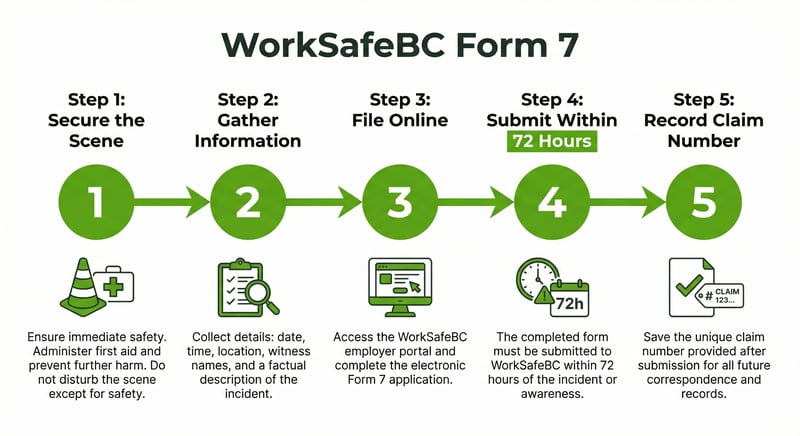
Step 1: Secure the scene. Address any hazardous conditions. Make sure injured workers receive first aid and medical treatment. Do not disturb the incident scene unless necessary to prevent further harm. Step 2: Gather the required information. You will need:
Your company information and WorkSafeBC account number
The worker's contact details, job title, and hire date
Details of the incident: what happened, where, when
Days or shifts missed due to the injury
The worker's work schedule and rate of pay
Gross earnings for the previous 12 weeks (if the worker missed time)
Any transitional or modified work options you can offer
Step 3: File online at WorkSafeBC's reporting portal. You can file with or without an online services account. The system lets you update reports later if additional information comes in. Step 4: File within 72 hours. This is not optional. The WCA requires employers to report within 72 hours of the incident, or within 72 hours of when you first became aware of the injury. Step 5: Record the claim number. WorkSafeBC assigns a claim number when they receive your report. Share this with the worker and any health care providers treating the injury.
Not reporting an injury is an offence under the Workers Compensation Act and can result in fines. Coercing a worker not to report is also an offence under Section 73 of the WCA.
When Does WorkSafeBC Require an Incident Investigation?
Filing Form 7 handles the claims side. But the WCA also requires employers to conduct a formal investigation for specific incident types. Under Section 69, you must investigate any incident involving:
Serious injury to a worker or a worker's death
Injury requiring medical treatment
Minor injury or no injury, but the incident had potential for causing serious injury (near misses)
Major structural failure or collapse
A major release of a hazardous substance
A diving incident as defined by the OHS Regulation
A dangerous incident involving explosive materials
A blasting incident causing personal injury
That near-miss clause catches a lot of employers off guard. If a load falls from a crane and nobody gets hurt, you still need to investigate.
Investigation Timelines
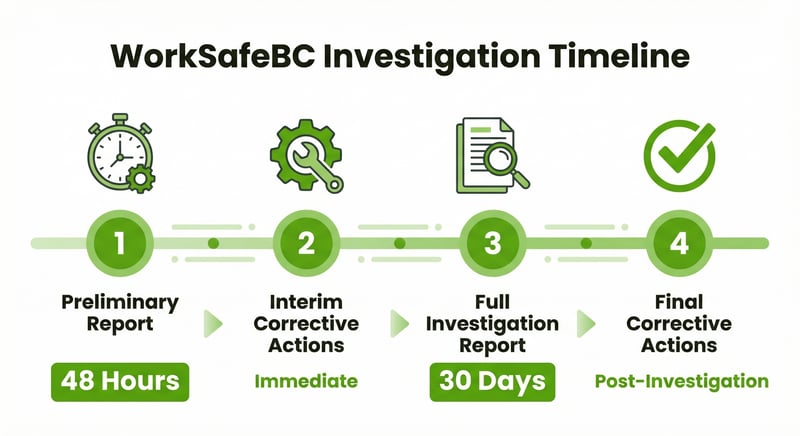
BC employers must follow a four-stage investigation process:
1. Preliminary investigation and report (within 48 hours)
Identify the immediate unsafe conditions, acts, or procedures. Document the facts: who was involved, what happened, and what sequence of events led to the incident. List recommended corrective actions.
Keep a copy. Provide one to your joint health and safety committee or worker health and safety representative. No committee or rep? Post it at the workplace.
2. Interim corrective actions (immediately)
Take all steps reasonably necessary to prevent the incident from recurring while the full investigation is underway. This might mean shutting down part of the site, pulling equipment out of service, or reassigning workers.
3. Full investigation report (within 30 days)
Determine root causes. Look beyond the immediate trigger: what systemic factors, management system gaps, or procedural failures made the incident possible? This report must be submitted to WorkSafeBC and shared with your joint committee or worker rep.
4. Final corrective actions (after full investigation)
Prepare a corrective action report describing the unsafe conditions, the corrective actions required, and your implementation plan.
WorkSafeBC provides a PDF template (Form 52E40) and an online reporting tool for investigations. You can use your own format, but it must include everything required under Prevention Policy Items P2-71-1 and P2-72-1.
How Long Should Incident Reports Be Kept in BC?
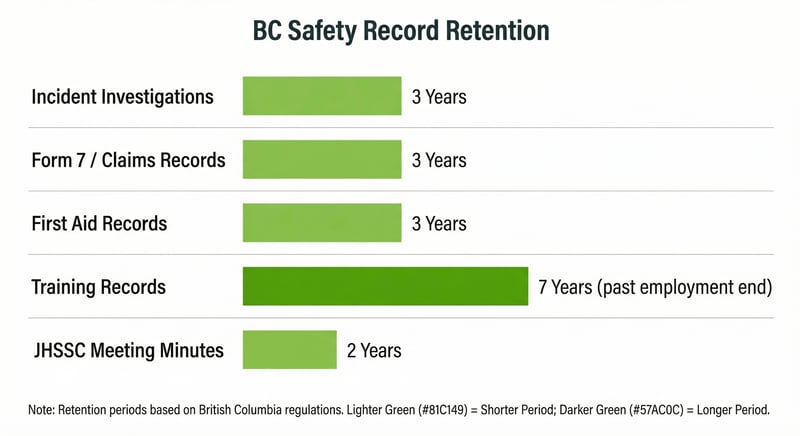
BC employers should keep incident investigation records, Form 7 documentation, and corrective action reports for a minimum of 3 years from the date of the incident. This aligns with the retention timeline for claims management records under BC's OHS framework. First aid records also carry a 3-year retention requirement.
However, 3 years is the floor, not the ceiling. Here is the practical reality for BC contractors:
Limitation periods for WCA claims can extend well beyond 3 years in cases involving occupational diseases or latent injuries
WorkSafeBC can investigate past incidents when a pattern emerges, and having records strengthens your position
COR and SECOR audits may request incident investigation documentation from the past 3 years
Our recommendation: keep incident reports for at least 5 years. Storage is cheap. Defending yourself without records is expensive.
A BC contractor running a 50-person crew told us they kept "the important ones" and shredded the rest after a year. When a latent injury claim surfaced 28 months later, they had nothing to show WorkSafeBC. The investigation that followed cost them significantly more in time and penalties than a filing cabinet would have.
For a full breakdown of what every incident report should include, see our guide on the [7 essential elements of an incident report](/blog/7-essential-elements-of-an-incident-report-and-a-free-guide). You can also download our free Incident Report and Investigation Kit for ready-to-use templates that align with WorkSafeBC requirements.
What Happens if You Do Not Report?
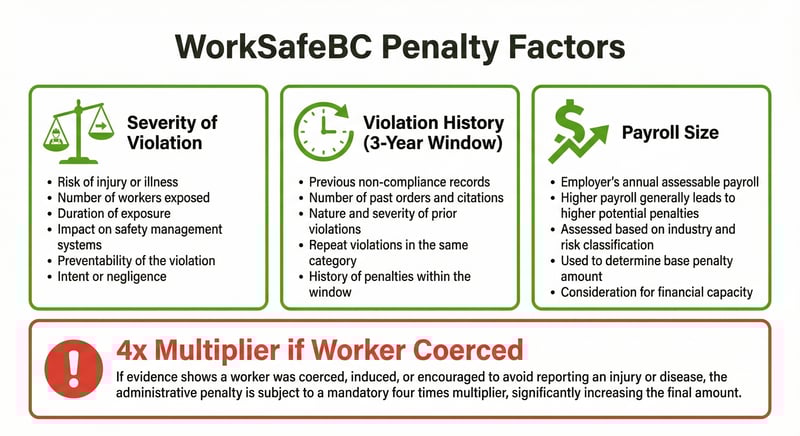
WorkSafeBC does not play favourites. Administrative penalties are calculated based on three factors:
The nature and severity of the violation (failing to report a fatality carries more weight than a late Form 7)
Your company's violation history (repeat offences within 3 years escalate the penalty)
Your company's payroll size (larger payroll = larger penalty)
WorkSafeBC applies a multiplier of 4 for high-risk violations where the employer also attempts to prevent a worker from reporting. The largest single fine on record exceeded $1 million when combined with a claims cost levy.
For a 30-person contracting company, even a first-time failure to report can mean thousands of dollars in penalties, plus the reputational damage of appearing in WorkSafeBC's public penalty database, which anyone (including your GCs) can search.
Beyond penalties, not reporting creates a gap in your safety management system. If you are pursuing or maintaining a COR or SECOR certification, auditors will look at your incident reporting records. Gaps raise red flags.
BC Incident Reporting Resources
Here are the key WorkSafeBC resources every BC employer should bookmark:
Form 7 (Employer's Report of Injury or Occupational Disease): Available online through WorkSafeBC's reporting portal or as a PDF download
Form 52E40 (Employer Incident Investigation Report): Template for documenting your investigation
Prevention Information Line: 604-276-3100 (Lower Mainland) or 1-888-621-7233 (toll-free) for immediate incident reporting
Reference Guide for Employer Incident Investigations: WorkSafeBC's detailed workbook for conducting compliant investigations
Workers Compensation Act, Part 2, Division 10 (Sections 68-73): The legal framework for employer reporting and investigation obligations
If you are not sure whether an incident requires reporting, call the Prevention Information Line. It is better to report something that did not need reporting than to skip one that did.
Need a system to track incidents, investigations, and corrective actions across your crew? Safety Evolution's platform handles digital incident reporting, investigation workflows, and records retention so nothing falls through the cracks.
Looking for incident report requirements in another province? Check out our guides for [Ontario (WSIB reporting)](/blog/ontario-workplace-incident-report-wsib-guide) and [Alberta (WCB reporting)](/blog/alberta-wcb-incident-report-guide).
Stop Blaming "Worker Error"
If your investigations always end with 'the worker needs to be more careful', you are missing the root cause. Get our free Incident Investigation Kit to use the 5-category framework and uncover the real issues.
How long do you have to file a WorkSafeBC incident report?
Employers must file WorkSafeBC Form 7 within 72 hours of the incident, or within 72 hours of first becoming aware of the injury. Serious incidents (fatalities, major structural failures, hazardous substance releases, dangerous fires or explosions) require immediate notification by calling the WorkSafeBC Prevention Information Line at 1-888-621-7233.
How long should incident reports be kept in BC?
BC employers should keep incident investigation records and Form 7 documentation for a minimum of 3 years from the date of the incident. This covers claims management records, first aid records, and corrective action reports. However, many safety professionals recommend retaining records for at least 5 years to protect against latent injury claims and future audits.
What is WorkSafeBC Form 7?
WorkSafeBC Form 7 is the Employer's Report of Injury or Occupational Disease. BC employers must complete this form whenever a worker has a work-related injury or disease that requires medical treatment from a doctor or other qualified practitioner, or when the worker misses time from work beyond the day of injury. It can be filed online through WorkSafeBC's reporting portal or submitted by phone or fax.
What incidents require a WorkSafeBC investigation?
Under Section 69 of the BC Workers Compensation Act, employers must investigate any incident involving: serious injury or death, injury requiring medical treatment, near misses with potential for serious injury, major structural failure or collapse, major release of a hazardous substance, diving incidents, dangerous incidents with explosives, or blasting incidents causing injury. A preliminary investigation report is due within 48 hours, and a full investigation report within 30 days.
What happens if a BC employer does not report a workplace injury?
Failing to report a workplace injury is an offence under the BC Workers Compensation Act. WorkSafeBC can impose administrative penalties based on the severity of the violation, the employer's history, and payroll size. Coercing a worker not to report an injury is also an offence with an escalated penalty multiplier. Penalties are published in WorkSafeBC's public database, which general contractors and other employers can search.
Can you file a WorkSafeBC incident report online?
Yes. WorkSafeBC's online reporting portal is the fastest way to file Form 7. You can file with or without an online services account. The online system also allows you to update reports later if you receive additional information about the incident or the worker's condition.
Get Weekly Safety Insights
Regulation updates, toolbox talk ideas, and compliance tips. One email per week.
 BC employers should keep incident investigation records, Form 7 documentation, and corrective action reports for a minimum of 3 years from the date of the incident. This aligns with the retention timeline for claims management records under BC's OHS framework. First aid records also carry a 3-year retention requirement.