Are incident reports confidential in Canada? Learn about retention periods, court admissibility, mandatory reporting rules, and document management by province.
Most contractors know they need to file an incident report after a workplace injury. What catches them off guard is who else gets to see it, how long they are legally required to keep it, and how it can be used against them in court. At Safety Evolution, we work with contractors across Canada who are dealing with exactly these questions, often after something has already gone sideways.
⚡ Quick Answer
Confidential? Partially. Personal health details are protected, but regulators and joint committees can access reports.
How long to keep them? At minimum 3 years in most provinces, but best practice is 5+ years (or longer for asbestos/hazardous substance exposure).
Mandatory? Yes. Serious injuries and incidents must be reported in every province. Requirements vary by severity.
Court admissible? Yes. Incident reports can be used as evidence in regulatory prosecutions, civil litigation, and WCB disputes.
Best protection? File reports promptly, store them securely, follow your province's retention rules, and keep them organized.
Incident reports in Canada are not just paperwork. They are legal records that regulators, WCB boards, courts, and joint health and safety committees can all access. Most contractors know they need to file reports after a workplace injury, but few understand who can see those reports, how long they must be kept, or how they can be used against you in legal proceedings.
This guide covers the legal side of incident reporting across Canadian provinces: confidentiality rules, mandatory reporting thresholds, retention requirements, and how reports are used in court. If you run crews in Alberta, BC, or Ontario, this is what you need to know to protect your company.
Are Incident Reports Confidential in Canada?
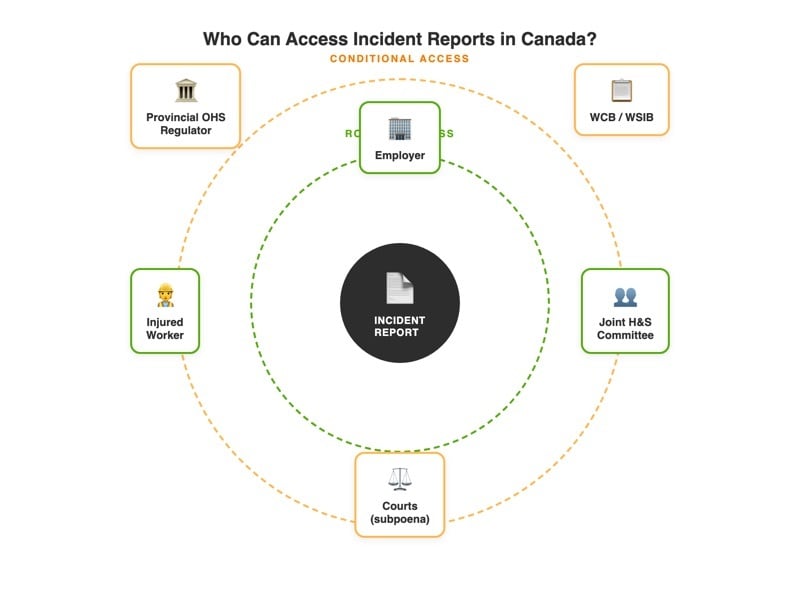
The short answer is: not entirely. Incident reports are internal business records, not privileged documents. In most Canadian provinces, several parties have a legal right to access them:
The employer who created the report
The injured worker (for their own records and WCB claim)
Joint health and safety committees or worker representatives. Most provinces require employers to share investigation reports with the committee
Provincial regulators (WorkSafeBC, Alberta OHS, Ontario's MOL): inspectors can request incident reports during an investigation or audit
WCB / WSIB: boards can access reports as part of claims processing
What IS Protected?
Personal medical details within an incident report are protected under provincial privacy legislation (such as Alberta's *Health Information Act* or Ontario's *Personal Health Information Protection Act*). That means:
Stop Treating Near Misses as "No Big Deal"
Every near miss is a free warning. Download our free Incident Investigation Kit to capture the details before it turns into a recordable accident.
A worker's specific medical diagnosis or treatment details should be kept separate from the general incident report where possible
You can share the facts of what happened without disclosing protected health information
Witness statements are generally treated as confidential during an investigation, though employers may be required to share summaries
The practical takeaway for contractors: Write your incident reports with the assumption that they will be seen by regulators, your joint health and safety committee, and potentially a court. Stick to objective facts. Keep personal medical details in a separate, access-restricted file.
📹 Watch: How to Write an Incident Report — 7 Essential Elements
Are Incident Reports Mandatory?
Yes, but the threshold for mandatory reporting varies by province and by incident severity. Every province requires employers to report serious injuries and fatalities. Where it gets nuanced is what counts as a "reportable" incident.
British Columbia
Under the BC *Workers Compensation Act* (Section 68), employers must immediately notify WorkSafeBC when:
A worker is seriously injured or killed
There is a major structural failure or collapse
There is a major release of a hazardous substance
A fire or explosion had potential for causing serious injury
Employers must also investigate incidents under Sections 69-72 of the Act and prepare an investigation report with corrective actions.
For more on BC-specific requirements, see our full guide to [WorkSafeBC incident reports](/blog/worksafebc-incident-report-bc).
Alberta
Under Section 33 of the Alberta *OHS Act*, the prime contractor (or employer if there is no prime contractor) must report serious injuries and incidents to an OHS Director *as soon as possible*. This includes:
Worker fatalities
Injuries requiring hospitalization
Uncontrolled explosions, fires, or floods
Collapse of structures, cranes, or temporary support systems
Release of hazardous substances
Alberta OHS operates a 24/7 Contact Centre for incident reporting.
For Alberta-specific requirements, see our guide to [WCB incident reports in Alberta](/blog/wcb-incident-report-alberta).
Ontario
Under Sections 51-53 of the *Occupational Health and Safety Act* (OHSA), Ontario employers must:
Immediately notify the Ministry of Labour (MOL) and the joint committee/union for fatalities and critical injuries
Submit a written report within 48 hours for fatalities/critical injuries
Submit a written notification within 4 days when a worker is disabled from usual work or requires medical attention
Report certain incidents at construction sites, mines, and diving operations within 2 days, even if no one is injured
A critical injury in Ontario includes injuries placing life in jeopardy, producing unconsciousness, resulting in substantial blood loss, or involving fractures of a leg or arm (not a single finger or toe).
For Ontario-specific guidance, see our [Ontario workplace incident report guide](/blog/workplace-incident-report-ontario).
Federally Regulated Workplaces
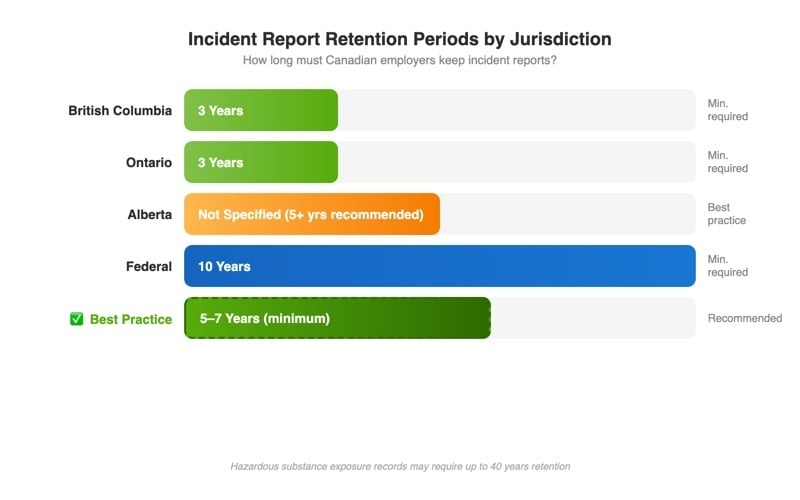
Under Part II of the *Canada Labour Code* and the COHS Regulations, federally regulated employers must report hazardous occurrences and keep all records for a minimum of 10 years.
Incident reports in Canada are not just paperwork: they are legal records that regulators, WCB boards, courts, and joint health and safety committees can all access. Most contractors know they need to file reports after a workplace injury, but few understand who can see those reports, how long they must be kept, or how they can be used against you in court.
This guide covers the legal side of incident reporting across Canadian provinces: confidentiality rules, mandatory reporting thresholds, retention requirements, and how reports are used in legal proceedings. If you run crews in Alberta, BC, or Ontario, this is what you need to know to protect your company.
How Long Should Incident Reports Be Kept?
Retention periods are one of the most-searched questions in Canadian workplace safety, and the answer depends on your province. Here's what we've confirmed from official sources:
Province-by-Province Retention Requirements
Province
Minimum Retention
Legal Source
British Columbia
3 years (incident investigation reports and first aid records)
BC *Workers Compensation Act*; go2HR industry guidance
Ontario
3 years for written reports under Sections 51-53 OHSA (effective July 2021 via O. Reg. 420/21)
Ontario.ca official reporting page
Alberta
Not explicitly specified for general incident reports under the OHS Act. Legislation requires records to be kept but does not prescribe a minimum period for most records
OHS Insider cross-Canada analysis
Federal
10 years for all hazardous occurrence records, including investigation reports and minor injury logs
Canada.ca - ESDC
Serving It Right (BC Food Service)
A common exam question for BC's Serving It Right program asks how long incident reports should be kept. The answer referenced in the program is typically 3 years, consistent with BC's broader OHS record-keeping requirements under the *Workers Compensation Act*.
What About Hazardous Substance Exposure?
For incidents involving worker exposure to hazardous substances (asbestos, silica, chemical spills), retention requirements can be significantly longer: up to 40 years in some jurisdictions, depending on the substance and exposure type. Always check the specific regulation for the substance involved.
Best Practice: Keep Them Longer Than Required
Even where legislation says 3 years, most safety professionals and legal advisors recommend keeping incident reports for a minimum of 5 to 7 years: and potentially indefinitely for serious injuries or fatalities. Here's why:
Limitation periods for civil lawsuits in most provinces are 2 years from discovery, but occupational disease claims can surface decades later
WCB claims can be reopened , having the original incident report strengthens your position
Audits and certifications (COR, SECOR) may require historical incident data
Digital storage is cheap. There's minimal cost to keeping records longer
Can Incident Reports Be Used in Court?
Yes. Under Section 30 of the *Canada Evidence Act*, a record made in the usual and ordinary course of business is admissible as evidence in legal proceedings. Incident reports created as part of your regular safety program qualify as business records.
Incident reports can appear in:
Regulatory prosecutions. Alberta OHS can refer investigation files to Alberta Justice for prosecution. Ontario's MOL can lay charges under the OHSA. Fines for OHS violations can be substantial, up to $1.5 million for a corporation in Ontario, and up to $500,000 per count in Alberta.
Civil lawsuits. If a worker or third party sues for negligence, your incident reports become discoverable evidence
WCB/WSIB disputes. Reports can be used to support or challenge a compensation claim
Coroner's inquests. In fatality cases, incident reports form part of the investigative record
How This Affects Your Report Writing
Because incident reports can end up in court, write them carefully:
Stick to objective facts. What happened, when, where, who was involved, what conditions existed.
Avoid speculative language. Don't write "the worker was being careless." Write "the worker was not wearing fall protection at the time of the incident."
Don't include legal conclusions. Don't write "we were at fault." Document the facts and let investigators draw conclusions.
Complete reports promptly. Reports completed days or weeks after an incident carry less weight than those completed within 24 hours.
For a step-by-step guide on writing effective reports, see [How to Write an Incident Report [+ Free Template]](/blog/7-essential-elements-of-an-incident-report-and-a-free-guide).
When Should Incidents Be Reported?
Timing matters, both for legal compliance and for the quality of your investigation.
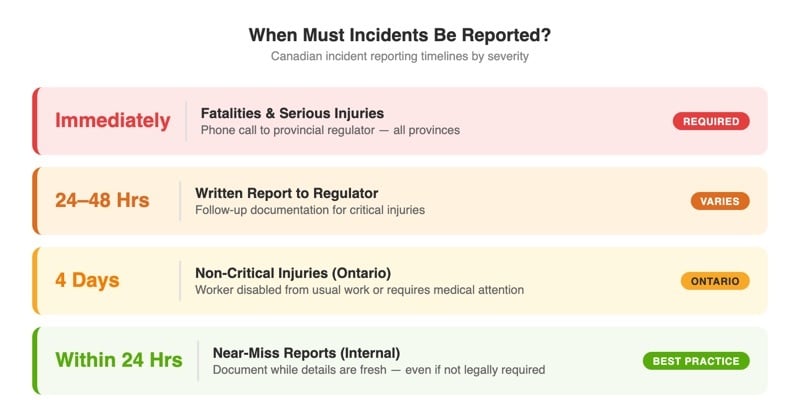
Immediately: Fatalities and serious injuries must be reported to your provincial regulator immediately (by phone) in all provinces
Within 24-48 hours: Written reports for critical injuries in most provinces (48 hours in Ontario)
Within 4 days: Non-critical injuries requiring medical attention or causing lost work time (Ontario)
As soon as practicable: Near-misses and minor incidents should be documented internally as part of your safety program, even where not legally required
Best practice for contractors: Report all incidents: including near-misses, within 24 hours. It builds a culture of reporting, creates a paper trail for due diligence, and gives you the freshest, most accurate account of what happened.
For more on building an effective reporting culture, see our guide to [effective workplace incident reporting](/blog/effective-workplace-incident-reporting).
Practical Document Management for Contractors
If you're running a 15-person crew and juggling safety paperwork alongside production, here's a practical system for staying compliant:
Standardize your forms. Use a consistent incident report template across all job sites. Download our free [Incident Report & Investigation Kit](/incident-report-investigation-guide) to get started.
Go digital. Paper forms get lost, damaged, and misfiled. A digital incident reporting system creates automatic timestamps, backups, and retrieval.
Separate personal health information. Keep medical details in a restricted file, separate from the general incident report that gets shared with your committee.
Set retention reminders. Create a calendar reminder at the 3-year mark to review records, but default to keeping them unless you have a clear policy to the contrary.
Back up everything. Cloud storage with version history protects you from accidental deletion and provides an audit trail.
Know who has access. Limit incident report access to management, your safety coordinator, and your joint health and safety committee. Don't share broadly unless required by regulation.
Stop Blaming "Worker Error"
If your investigations always end with 'the worker needs to be more careful', you are missing the root cause. Get our free Incident Investigation Kit to use the 5-category framework and uncover the real issues.
Incident reports are not fully confidential. While personal medical information is protected by privacy legislation, the reports themselves can be accessed by regulators, joint health and safety committees, WCB/WSIB, and courts. Write them with the assumption they will be reviewed by multiple parties.
How long should incident reports be kept in BC?
In BC, incident investigation reports should be kept for a minimum of 3 years under the *Workers Compensation Act*. Best practice is 5-7 years or longer, especially for serious injuries or hazardous substance exposure.
Can incident reports be used in court?
Yes. Under the *Canada Evidence Act*, business records, including incident reports, are admissible as evidence in regulatory prosecutions, civil lawsuits, WCB disputes, and coroner's inquests.
Is an incident report a legal document?
Not in the formal sense (like a contract), but it carries significant legal weight. Incident reports can be subpoenaed, used in regulatory proceedings, and reviewed during WCB claims. Treat every report as if it may end up in a legal proceeding.
Are incident reports mandatory in Canada?
Yes. Every province requires employers to report serious injuries, fatalities, and certain dangerous incidents to their provincial regulator. Thresholds and timelines vary by province.
When should an incident report be completed?
Serious incidents must be reported immediately by phone, with written reports following within 24-48 hours. Best practice: document all incidents (including near-misses) within 24 hours while details are fresh.
How long should incident reports be kept for Serving It Right in BC?
The Serving It Right program references a 3-year retention period, consistent with BC's OHS record-keeping requirements.
Who has access to workplace incident reports?
The employer, the injured worker, joint health and safety committees, provincial OHS regulators, WCB/WSIB, and, through legal discovery, courts. Personal medical details should be kept in a separate, restricted file.
Get Weekly Safety Insights
Regulation updates, toolbox talk ideas, and compliance tips. One email per week.