Ontario employers must file WSIB Form 7 within 3 business days. Learn the reporting steps, critical injury rules, and MLITSD requirements for your workplace.
Something happened on your Ontario job site and now you need to figure out who to report it to and how fast. The answer is not simple because Ontario has two separate agencies, WSIB and the Ministry of Labour, each with their own forms, timelines, and penalties. At Safety Evolution, we help Ontario contractors cut through this process so you file the right reports with the right people before the deadlines hit.
⚡ Quick Answer
What: Ontario employers must file WSIB Form 7 (Employer's Report of Injury/Disease) any time a worker needs health care, loses time, or requires modified work beyond 7 days
Deadline: 3 business days after learning of the reporting obligation
Critical injuries: Immediate phone call to the Ministry of Labour at 1-877-202-0008, plus a written report within 48 hours
Penalties: $250 late filing fee (WSIB), up to $1,000 if filed 30+ days late; OHSA violations can reach $2,000,000 for corporations
Key law: Occupational Health and Safety Act (OHSA), O. Reg. 420/21, and the Workplace Safety and Insurance Act (WSIA)
An incident report in Ontario is a formal written record of a workplace event that caused (or could have caused) injury, illness, or property damage. In Ontario, incident reporting involves two separate obligations: reporting to the Workplace Safety and Insurance Board (WSIB) for workers' compensation purposes, and reporting to the Ministry of Labour, Immigration, Training and Skills Development (MLITSD) under the Occupational Health and Safety Act.
Who Regulates Workplace Incident Reporting in Ontario?
Ontario employers answer to two agencies, and each has its own forms, timelines, and penalties.
Workplace Safety and Insurance Board (WSIB)
The WSIB administers workers' compensation in Ontario. When a worker is injured or becomes ill due to work, the WSIB manages the claim, provides benefits, and tracks employer reporting compliance. The primary form is the Form 7 (Employer's Report of Injury/Disease).
Ministry of Labour, Immigration, Training and Skills Development (MLITSD)
The MLITSD enforces the Occupational Health and Safety Act (OHSA). For critical injuries, fatalities, and certain other incidents, employers must notify the Ministry directly. The Ministry can dispatch inspectors, issue orders, and lay charges.
Joint Health and Safety Committee (JHSC) or Health and Safety Representative
Under the OHSA, employers must also notify the workplace JHSC or health and safety representative (and the trade union, if applicable) about reportable incidents.
Most Ontario contractors think they only need to deal with one agency. They're wrong. The WSIB and the MLITSD operate independently. Filing a Form 7 with the WSIB does not satisfy your obligation to notify the Ministry of Labour about a critical injury. Miss either one, and you're exposed.
📹 Watch: How to Write an Incident Report — 7 Essential Elements
When Do You Need to File WSIB Form 7?
You must file a Form 7 with the WSIB when you learn that a worker has been injured or become ill due to work AND any of the following applies:
Stop Treating Near Misses as "No Big Deal"
Every near miss is a free warning. Download our free Incident Investigation Kit to capture the details before it turns into a recordable accident.
The worker requires health care (anything beyond basic first aid, including a doctor's visit, prescription medication, or hospital treatment)
The worker is absent from regular work
The worker earns less than regular pay (such as reduced hours)
The worker requires modified work at less than regular pay
The worker requires modified work at regular pay for more than 7 calendar days after the date of the accident
You do NOT need to file if the worker received only first aid (cleaning a minor cut, applying a bandage, or an ice pack) and returned to regular duties within 7 days.
Here's where contractors get tripped up: a worker who goes to a walk-in clinic for what turns out to be nothing still triggers the Form 7 requirement. The moment a doctor or nurse practitioner provides treatment, it crosses from "first aid" into "health care" under WSIB policy. A tetanus shot after a minor cut? That's health care. File the Form 7.
WSIB Form 7: Step-by-Step Filing Process
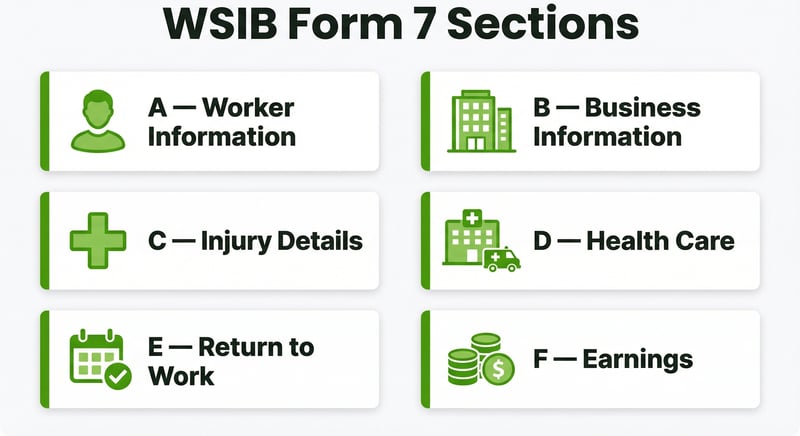
Filing a Form 7 is straightforward if you have the information ready. Here's what each section requires:
Section A: Worker Information
Name, address, date of birth, job title, Social Insurance Number, and employment details (hire date, regular work schedule).
Section B: Business Information
Your WSIB account number, business name, address, and contact information for the person filing the report.
Section C: Injury/Illness Dates and Details
Date and time of the accident. Where exactly it happened. What the worker was doing. What happened and how. What body part was injured.
Section D: Health Care
Name and address of the health care provider who treated the worker. Whether the worker went to a hospital.
Section E: Absence and Return to Work
Whether the worker missed time, the date they stopped working, and when they returned (or are expected to return). Details on any modified duties.
Section F: Earnings Information
The worker's pay rate, hours, and earnings details so the WSIB can calculate benefits.
How to submit:
Online through the WSIB's eServices portal at wsib.ca (fastest method)
Fax to 416-344-4684 or 1-888-313-7373
Mail to WSIB, 200 Front Street West, Toronto, ON M5V 3J1
You must give the injured worker a copy of the completed Form 7.
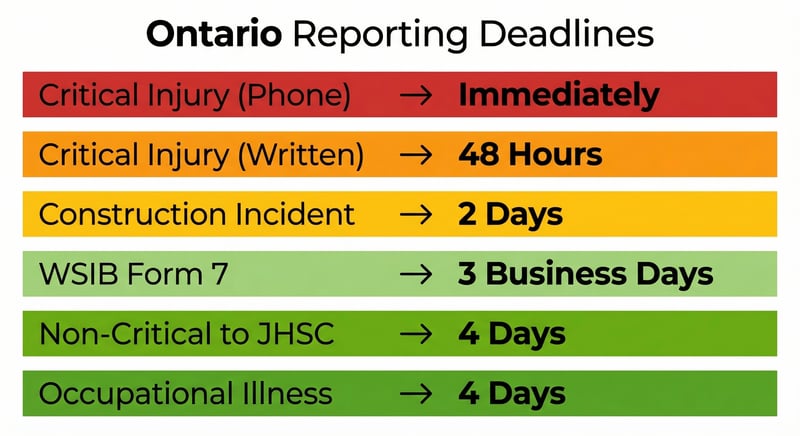
Ontario Employer Reporting Deadlines: The Timeline That Matters
This is where Ontario gets unforgiving. Every deadline is firm.
Situation
Who to Notify
Deadline
Worker needs health care or misses time
WSIB (Form 7)
3 business days after learning of the obligation
Critical injury or fatality
MLITSD (phone)
Immediately (call 1-877-202-0008, available 24/7)
Critical injury or fatality
MLITSD (written report)
48 hours
Critical injury or fatality
JHSC/representative and union
Immediately (verbal), then written within 48 hours
Worker unable to do usual work or requires medical attention (non-critical)
JHSC/representative and union
4 days
Occupational illness
MLITSD, JHSC/representative, and union
4 days after being advised
Construction site incident (no injury, but reportable)
MLITSD, JHSC/representative, and union
2 days
The 3-business-day WSIB deadline was updated in October 2023 (previously it was 7 days). Business days means Monday to Friday, excluding statutory holidays. If your worker gets hurt on a Friday afternoon and you learn about it Monday morning, your clock starts Monday. Penalties for late WSIB reporting:
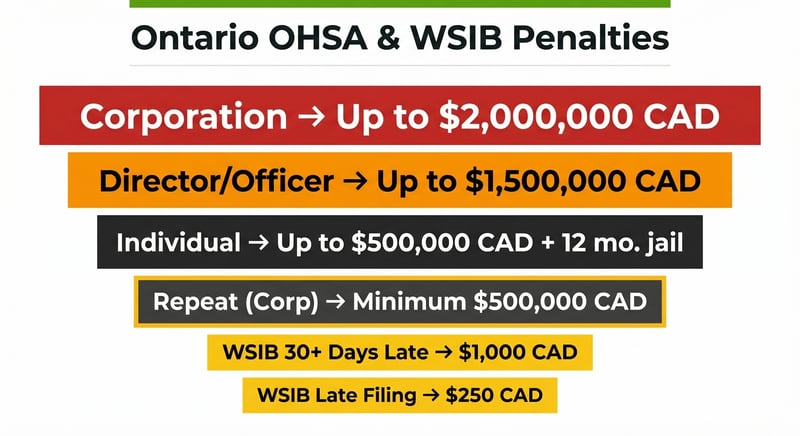
$250 if filed after the 3-business-day window
$1,000 if filed more than 30 calendar days late
These are automatic administrative penalties, charged directly to your WSIB account.
What Counts as a "Critical Injury" in Ontario?
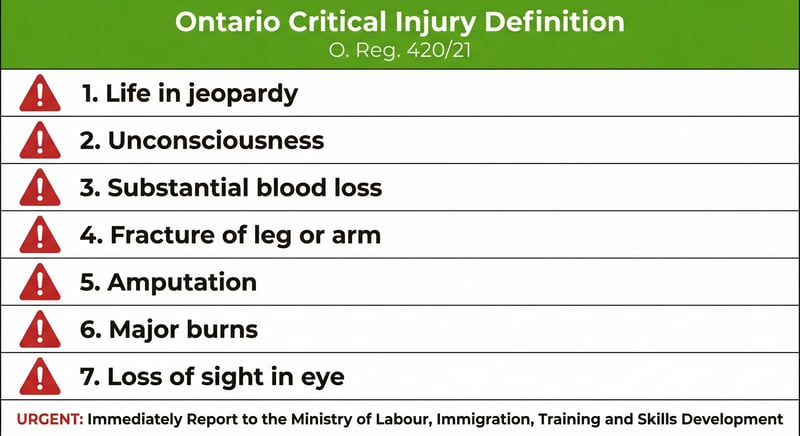
Under O. Reg. 420/21, a critical injury is an injury of a serious nature that:
Places life in jeopardy
Produces unconsciousness
Results in substantial loss of blood
Involves the fracture of a leg or arm (but not a single finger or toe)
Involves the amputation of a leg, arm, hand, or foot (but not a single finger or toe)
Consists of burns to a major portion of the body
Causes the loss of sight in an eye
The Ministry considers the "leg" to include ankle and foot, and "arm" to include wrist and hand. Also important: a fracture or amputation of more than one finger or toe IS considered critical.
When a critical injury or fatality occurs, you must:
Call 911 if it's an emergency
Call the MLITSD at 1-877-202-0008 immediately
Secure the scene and do not disturb anything (OHSA s. 51(2))
Notify the JHSC or health and safety representative and the union
Submit a written report to the MLITSD within 48 hours (use the Ontario government form available at forms.mgcs.gov.on.ca)
File WSIB Form 7 within 3 business days
You can only disturb the accident scene to save a life, relieve human suffering, maintain essential public utilities, prevent unnecessary property damage, or if a Ministry inspector gives permission.
One blunt truth: most small contractors have never actually called the Ministry of Labour hotline. They don't have 1-877-202-0008 saved in their phone. They find out they were supposed to call "immediately" when the inspector shows up asking why they didn't. By then, the scene has been cleaned up, witnesses have gone home, and you're explaining yourself in a situation where silence would have been better. Post that number in your site trailer today.
OHSA Penalties for Non-Compliance
Ontario now carries the highest workplace safety penalties in Canada as of the Working for Workers Four Act, 2024:
Corporations: Up to $2,000,000 per offence
Directors and officers: Up to $1,500,000 personally
Individuals: Up to $500,000 and/or up to 12 months imprisonment
Repeat corporate offences resulting in death or serious injury within 2 years: minimum fine of $500,000
These are OHSA prosecution penalties, separate from WSIB administrative fines. They apply when the Ministry lays charges for failing to report critical injuries, disturbing accident scenes, or other OHSA violations.
What Information Should Your Internal Incident Report Include?
Beyond the mandatory government forms, smart contractors maintain their own internal incident reports. Your internal report should capture everything the government forms ask for, plus:
Photos and diagrams of the scene before anything is moved
Witness statements collected the same day
Root cause analysis identifying what went wrong and why
Corrective actions taken to prevent recurrence
Training records confirming the worker was trained on the task
A thorough internal report protects you in three ways: it feeds accurate information into the Form 7, it gives you documentation if the Ministry investigates, and it drives real safety improvements for your crew. Our 7 essential elements of an incident report guide breaks down what to include in detail.
If your investigations always end with 'the worker needs to be more careful', you are missing the root cause. Get our free Incident Investigation Kit to use the 5-category framework and uncover the real issues.
How long do I have to file WSIB Form 7 in Ontario?
You must file WSIB Form 7 within 3 business days after learning of your reporting obligation. Business days are Monday to Friday, excluding Ontario statutory holidays. As of October 2023, this deadline was shortened from the previous 7-day window. Late filing results in an automatic $250 penalty, increasing to $1,000 if filed more than 30 days late.
What triggers a Ministry of Labour investigation in Ontario?
A critical injury or fatality at the workplace triggers an immediate Ministry of Labour investigation. Under Ontario's OHSA, critical injuries include those that place life in jeopardy, produce unconsciousness, result in substantial blood loss, involve fractures of a leg or arm, amputations, burns to a major portion of the body, or loss of sight in an eye. Employers must call 1-877-202-0008 immediately and preserve the scene.
What is the difference between WSIB Form 7 and reporting to the Ministry of Labour?
WSIB Form 7 is filed with the Workplace Safety and Insurance Board for workers' compensation purposes whenever a worker needs health care or misses work due to a workplace injury. Reporting to the Ministry of Labour (MLITSD) is a separate obligation under the Occupational Health and Safety Act, required for critical injuries, fatalities, and occupational illnesses. Filing one does not satisfy the other. Both may be required for the same incident.
Do I need to report a workplace injury in Ontario if the worker only needed first aid?
No. If a worker receives only first aid (such as cleaning a minor cut, applying a bandage, or using an ice pack) and does not require health care from a medical practitioner, you do not need to file WSIB Form 7. However, you should still document the incident in your internal records. If the worker later seeks medical treatment or requires modified work beyond 7 days, the filing requirement is triggered at that point.
What are the maximum fines for OHSA violations in Ontario?
Ontario has the highest workplace safety fines in Canada. As of 2024, corporations face up to $2,000,000 per offence, directors and officers up to $1,500,000 personally, and individuals up to $500,000 and/or 12 months imprisonment. For repeat corporate offences resulting in death or serious injury within a two-year period, the minimum fine is $500,000.
Do Ontario construction employers have additional reporting requirements?
Yes. Under O. Reg. 420/21 and the Construction Projects regulation (O. Reg. 213/91), constructors must report certain incidents to the MLITSD within 2 days, even if no one was injured. These include: a worker falling 3 metres or more, a fall arrested by a fall arrest system, accidental contact with energized electrical equipment, structural failures, and any explosion, fire, flood, or cave-in on the construction project.