Last updated: March 2026
An incident report is a written record of any workplace event that caused, or could have caused, injury, illness, or property damage. It captures what happened, who was involved, and what conditions led to the event. If you run a construction crew and someone gets hurt on site, this document is the first thing your WCB board, your GC, and your auditor will ask for.
Most contractors know they need to file incident reports. The problem is that nobody taught them how to write one that actually holds up. A vague, half-finished report is worse than no report at all because it creates a paper trail full of holes. This guide walks you through the process, step by step, with real examples from construction sites.
⚡ Quick Answer
- When to write: Immediately after any incident, near miss, or injury on site
- Who writes it: The supervisor or worker who witnessed the event, with support from the safety coordinator
- How long: A solid report takes 20 to 45 minutes. Rushing it costs you later.
- Key rule: Stick to facts. No opinions, no blame, no guessing.
- Reporting deadlines: Vary by province. Alberta requires WCB notification within 72 hours. Ontario requires immediate notification for critical injuries, written report within 48 hours. BC requires WorkSafeBC notification as soon as possible.
- Free Resource: Download our Incident Report & Investigation Guide to learn how to properly document and investigate these events before they happen again.
A workplace incident report is a written record of any event that caused, or could have caused, injury, illness, or property damage on a job site. In Canada, incident reports serve two purposes: they satisfy your legal reporting obligations to provincial regulators and WCB boards, and they document what happened so you can fix the root cause and protect your crew.
This guide walks you through how to write an incident report that holds up to regulatory scrutiny, supports your WCB filing, and actually drives safety improvements. Whether you're a site supervisor filling out your first report or a contractor building a reporting process for your company, here's the step-by-step process.
When Should You Write an Incident Report?
Write one every time something goes wrong, or almost goes wrong, on your site. That includes:
- Any injury that requires first aid or medical attention
- A near miss where someone could have been hurt (scaffold board falls, unsecured load shifts)
- Property or equipment damage
- Exposure to hazardous substances
- Any event that disrupts normal work operations
Most contractors only write reports when someone goes to the hospital. That is a mistake. Near misses are the early warning system that keeps your crew safe. If a load slips off a crane hook and nobody gets hurt, that event still needs a report. Today's near miss is tomorrow's fatality if you don't document it and fix the root cause.
Here is something most contractors get wrong: your province's OHS legislation does not just require you to report injuries. It requires you to report incidents with the potential for serious harm. Ignoring near misses is not just bad practice. In many jurisdictions, it is a regulatory violation.
📹 Watch: How to Write an Incident Report — 7 Essential Elements
Who Is Responsible for Writing the Report?
The person closest to the event writes the initial report. On a construction site, that is usually the site supervisor or the lead hand who witnessed what happened. If the injured worker is able, they should also provide a written statement.
Stop Treating Near Misses as "No Big Deal"
Every near miss is a free warning. Download our free Incident Investigation Kit to capture the details before it turns into a recordable accident.
Download the Free Investigation Kit →
If you are a contractor with 10 to 50 employees and no dedicated safety manager, incident report writing often falls on the owner or a foreman who has never been trained on how to do it. That is common, and it is exactly why this guide exists.
The worst thing you can do is wait. Details fade fast. A report written 3 days after the event will miss critical information that a report written within 2 hours would capture. Witnesses forget details. Conditions change. Evidence gets cleaned up.
How to Write an Incident Report in 7 Steps
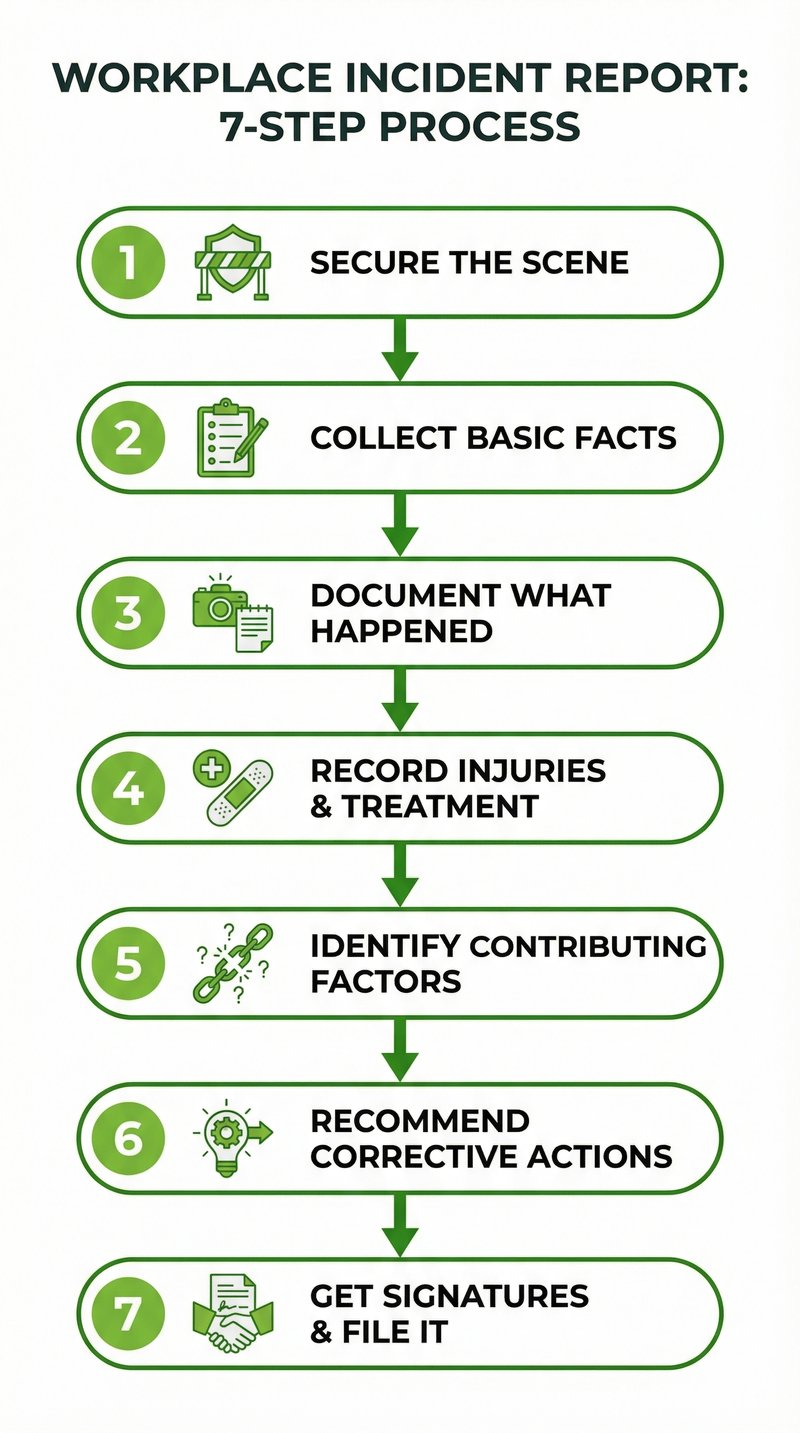
Here is the step-by-step process. Follow this sequence every time, and your reports will be consistent, complete, and audit-ready.
Step 1: Secure the Scene and Provide First Aid
Before you write anything, make sure the immediate danger is handled. Provide first aid, call emergency services if needed, and secure the area so nobody else gets hurt. For critical injuries or fatalities, do not disturb the scene beyond what is necessary to save a life. Provincial regulators require the scene to stay intact until an inspector releases it.
Step 2: Collect the Basic Facts
Within the first hour, record these details while they are fresh:
- Date and time of the incident (exact, not approximate)
- Location (specific: "northwest corner of Building C, 3rd floor scaffolding," not "on site")
- Names and roles of everyone involved, including witnesses
- Type of incident (injury, near miss, property damage, exposure)
- Weather and site conditions at the time
Step 3: Document What Happened
Write a chronological, factual description of the event. Start with what was happening immediately before the incident and walk through to the aftermath. Use plain language.
Write this: "At approximately 10:15 AM, the worker was carrying a 20 kg box of tile up the temporary staircase. The second step from the top had a loose tread that shifted under his weight. He lost his footing and fell backward approximately 4 feet, landing on his left side on the concrete floor below."
Do not write this: "Worker fell on the stairs because they were being careless and not paying attention."
Facts only. No blame. No assumptions about why it happened. That comes later in the investigation.
Step 4: Record Injuries and Treatment
Document what injuries were reported, what first aid was given on site, and whether the worker was sent for medical treatment. Be specific:
- "Worker reported pain in left shoulder and lower back"
- "First aid attendant applied ice pack and sling on site"
- "Worker transported to [hospital name] by personal vehicle at 10:45 AM"
Do not diagnose. You are not a doctor. Write what the worker reported and what treatment was provided.
Paper Reports Getting Lost in the Truck?
Stop chasing down incomplete, coffee-stained incident reports. Try Safety Evolution free for 30 days and let your crew submit mandatory-field, photo-backed reports straight from their phones.
30-Day Free Trial
Step 5: Identify Contributing Factors
This is where the report shifts from "what happened" to "why it happened." List the conditions, actions, or failures that contributed to the incident:
- Was the equipment defective or damaged?
- Was the worker trained for the task?
- Were safety procedures followed?
- Were environmental conditions a factor (rain, poor lighting, extreme heat)?
- Was there a supervision gap?
Be honest. If the temporary staircase had not been inspected that morning and the loose tread was a known issue, write that down. The point of an incident report is not to protect you from liability. It is to create an accurate record that helps you fix problems and prevent the next injury.
For a deeper dive into root cause analysis techniques, see our guide on how to learn from incidents through root cause investigation.
Step 6: Recommend Corrective Actions
Every incident report should end with specific steps to prevent recurrence. Vague recommendations like "improve safety awareness" are useless. Write actionable items with owners and deadlines:
- "Replace all temporary staircase treads and inspect weekly. Assigned to: Site Foreman. Deadline: March 25, 2026."
- "Add staircase condition to the daily FLHA checklist. Assigned to: Safety Coordinator. Deadline: Immediate."
- "Conduct a toolbox talk on stairway safety for all crews. Assigned to: Lead Hand. Deadline: Next shift."
Step 7: Get Signatures and File It
The report needs signatures from the person who wrote it, the injured worker (if able), and the site supervisor. Then file it properly:
- Send a copy to your WCB board within the required timeline (see province-specific deadlines below)
- Store the original in your project safety file
- Share relevant findings with your crew at the next toolbox talk
- Track the corrective actions through to completion
A report that gets filed and forgotten is almost as bad as no report. The follow-through on corrective actions is what actually prevents the next incident.
Province Reporting Deadlines: What You Need to Know
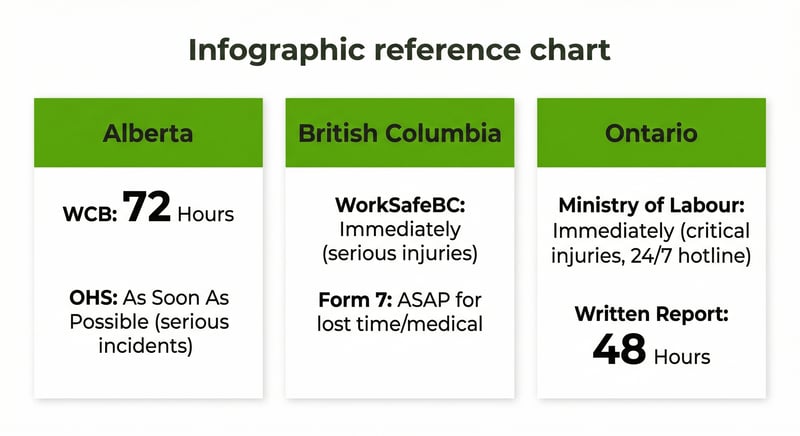
Reporting timelines vary by province, and missing them can result in fines. Here are the key deadlines for the provinces where most of our readers operate:
- Alberta: Report serious injuries and incidents to Alberta OHS as soon as possible. Submit the employer report of injury to WCB Alberta within 72 hours (3 days). Serious incidents include fatalities, hospitalizations, uncontrolled explosions or fires, and structural collapses.
- British Columbia: Notify WorkSafeBC immediately for serious injuries or fatalities. Submit a claim for any worker who misses time from work, needs medical treatment beyond first aid, or loses consciousness. There is no grace period for serious incidents; "immediately" means the same day.
- Ontario: Immediately notify the Ministry of Labour (1-877-202-0008, available 24/7) for fatalities or critical injuries. Provide a written report within 48 hours. Critical injuries include fractures of a leg or arm, amputations, loss of consciousness, and burns to a major portion of the body. Under O. Reg. 420/21, the definition and requirements were updated effective July 1, 2021.
If you are unsure whether your incident meets the threshold for reporting, report it anyway. Under-reporting carries penalties. Over-reporting does not.
Real Incident Report Examples from Construction Sites
Theory is helpful. Seeing what a completed report looks like is better. Here are two construction-focused examples of incident report writing that show what good (and bad) looks like.
Example 1: Fall from Height (Good Report)
Date/Time: March 14, 2026, 2:20 PM
Location: Building A, 4th floor, east side scaffolding, 123 Industrial Drive, Edmonton, AB
Involved: James R., Journeyman Carpenter (injured); Mark D., Lead Hand (witness); Sofia L., First Aid Attendant
Type: Injury, fall from height
Description: At approximately 2:20 PM, James R. was installing exterior sheathing from the 4th level of the east side scaffolding (approximately 12 feet above grade). While reaching to secure a panel, he stepped on a scaffold plank that had not been properly secured. The plank shifted, and James lost his balance. His fall arrest harness engaged, and he was suspended approximately 2 feet below the platform. He struck his right elbow on a cross-brace during the fall.
Injuries/Treatment: James reported pain and swelling in his right elbow. First aid attendant applied ice and a compression wrap on site. James was transported to the Royal Alexandra Hospital by his supervisor at 2:45 PM. X-rays confirmed a minor fracture of the radial head.
Contributing Factors:
- Scaffold plank was not secured with clamps as required by the site safety plan
- Morning scaffold inspection had been completed, but afternoon shift did not verify conditions after material deliveries were staged on the platform
- James was wearing his fall arrest harness, which functioned as designed and prevented a full fall
Corrective Actions:
- All scaffold planks inspected and secured by end of shift. Owner: Scaffold Foreman. Due: March 14, 2026.
- Scaffold re-inspection required after any material staging. Added to site safety plan. Owner: Site Superintendent. Due: March 15, 2026.
- Toolbox talk on scaffold plank security conducted for all crews. Owner: Lead Hand. Due: March 15, 2026.
This report works because it is specific, factual, and includes actionable corrective steps with deadlines and owners. Notice that it does not blame James. It identifies the system failure (unsecured plank after material staging) that led to the event.
Example 2: Near Miss, Falling Object (Common Mistakes Highlighted)
Date/Time: March 18, 2026, 9:45 AM
Location: Parkade construction, Level P2, northwest ramp, 456 Main Street, Calgary, AB
Involved: No injuries. Witnesses: Dan K., Labourer; Priya S., Apprentice Electrician
Type: Near miss, falling object
Description: At approximately 9:45 AM, a 15 kg section of steel rebar fell from the Level P1 deck through a floor penetration opening to the Level P2 ramp below. The rebar struck the concrete approximately 3 feet from where Dan K. was sorting materials. No one was struck.
Contributing Factors:
- The floor penetration had been covered with plywood the previous day, but the cover was removed during morning rebar placement and not replaced or barricaded
- No toe boards or debris netting were installed around the penetration
- The crew on Level P1 was not aware that workers were directly below
Corrective Actions:
- All floor penetrations to have secured covers or guardrails with toe boards reinstalled before any overhead work begins. Owner: Concrete Foreman. Due: Immediate.
- Multi-trade coordination meeting to review overhead/below work scheduling. Owner: Site Superintendent. Due: March 19, 2026.
- Near-miss reporting emphasized in next all-hands safety meeting. Owner: Project Manager. Due: March 20, 2026.
A 15 kg piece of rebar falling 10 feet onto a worker's head would be fatal. The fact that nobody was hurt does not make this a minor event. This is exactly the kind of near miss that needs a full report, investigation, and corrective action. If you are not sure about the difference between incidents, near misses, and accidents, our guide on incidents vs. accidents breaks it down.
5 Common Mistakes in Incident Report Writing
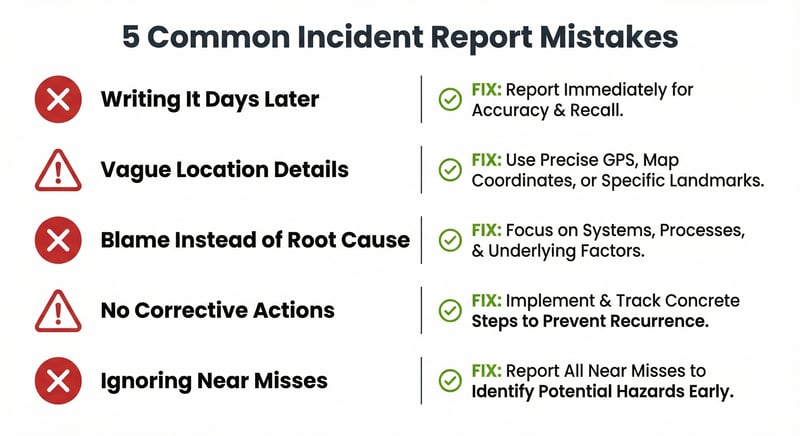
After reviewing hundreds of incident reports from contractors across Canada, these are the patterns that show up over and over:
- Writing it days later. Memory fades. Details change. Write the report the same day, ideally within 2 hours of the event.
- Being vague about the location. "On the job site" tells an investigator nothing. Specify the building, floor, area, and what work was happening around the incident.
- Assigning blame instead of identifying causes. "Worker was careless" is not a root cause. "Worker was not trained on the new equipment" is a root cause. The difference matters because only one of those leads to a fix.
- Skipping the corrective actions. A report without corrective actions is just a record of failure. It does not prevent the next incident. Every report needs specific, assigned, time-bound actions.
- Not filing near misses. Most contractors only report injuries. The events that almost hurt someone are the ones that tell you where your next injury is coming from. Track them. Investigate them. Fix them.
If your crew does not know how to write an incident report, that is a training gap you can fix quickly. A 30-minute session using real examples (like the ones above) is more effective than a 3-hour PowerPoint. Download our free incident report and investigation kit for templates and checklists you can hand to your supervisors today.
You can also explore our guide on effective workplace incident reporting for a broader look at building a reporting culture across your company.
If building a reporting process from scratch feels overwhelming, or if you have an audit coming up and your documentation has gaps, 30-Day Free Trial to instantly digitize your forms and ensure nothing slips through the cracks.
Stop Blaming "Worker Error"
If your investigations always end with 'the worker needs to be more careful', you are missing the root cause. Get our free Incident Investigation Kit to use the 5-category framework and uncover the real issues.
Download the Free Investigation Kit →
Frequently Asked Questions
How do you write an incident report at work?
Write the report the same day as the incident, ideally within 2 hours. Record the date, time, exact location, names of everyone involved, and a factual description of what happened in chronological order. Document injuries and treatment provided. Identify contributing factors without assigning blame. List specific corrective actions with deadlines and owners. Get signatures from the reporter, the injured worker (if able), and the supervisor.
When should an incident report be completed?
An incident report should be completed as soon as possible after the event, ideally within 2 hours while details are still fresh. For regulatory reporting, deadlines vary by province. In Alberta, employers must report to WCB within 72 hours. In Ontario, critical injuries must be reported to the Ministry of Labour immediately, with a written report within 48 hours. In BC, employers must notify WorkSafeBC as soon as possible for injuries requiring treatment beyond first aid.
Who is responsible for writing an incident report?
The person closest to the event is typically responsible for writing the initial incident report. On construction sites, this is usually the site supervisor or lead hand who witnessed what happened. The injured worker should also provide a written statement if they are able. The employer is ultimately responsible for ensuring the report is completed, filed with the appropriate WCB board, and that corrective actions are followed through.
Can incident reports be used in court?
Yes, incident reports can be used as evidence in legal proceedings, WCB claims, and regulatory investigations. This is why accuracy matters. Stick to objective facts, avoid speculation or assigning blame, and never alter a report after it has been filed. If you need to add information later, write a supplementary report that references the original. A factual, well-documented report protects both the worker and the employer.
What is the difference between an incident report and an accident report?
In workplace safety, an "incident" is a broader term that includes any unplanned event: injuries, near misses, property damage, and hazardous exposures. An "accident" typically refers specifically to an event that caused injury or damage. Modern safety practice uses "incident" because it captures near misses and close calls, which are critical for preventing future injuries. Most Canadian OHS legislation uses "incident" rather than "accident."
Are incident reports confidential?
Incident reports contain personal and medical information and should be treated as confidential documents. Access should be limited to people who need the information: the employer, the safety committee or representative, the WCB board, and regulatory inspectors. Workers have a right to see their own incident reports. Sharing incident details publicly or with people who do not need the information can violate privacy legislation. When sharing lessons learned from incidents, remove identifying details.
Get Weekly Safety Insights
Regulation updates, toolbox talk ideas, and compliance tips. One email per week.