Training
Online Forklift Training in Canada
Can you get forklift certified online in Canada? What counts, what does not, and how to combine online theory with hands-on evaluation.
In-house vs third-party forklift training comparison. Cost, OSHA compliance, scalability, and when each option makes sense for your operation.
Last updated: April 2026
Your forklift training bill keeps climbing. Every time a new operator starts or a certification comes up for renewal, you are writing another cheque to an outside training provider. At some point, you start wondering: could we just do this ourselves? The answer is yes, but only if you understand what "doing it yourself" actually requires under Canadian regulations.
Safety Evolution helps contractors make this decision every month. Here is an honest comparison so you can figure out which approach actually makes sense for your operation.
Below, we compare both approaches across cost, compliance, control, and scalability - so you can figure out which model fits your operation and where a hybrid approach might make the most sense.
Quick Answer
In-house forklift training costs $50 to $100 per operator after the initial train-the-trainer investment. Third-party training runs $300 to $500 per operator. In-house is more cost-effective at 10+ operators per year. Both approaches satisfy OSHA 1910.178(l) requirements in the US and provincial OHS regulations in Canada, as long as the training includes formal instruction, practical training, and a workplace evaluation.
Both OSHA and Canadian provincial regulations allow either in-house or third-party training. The regulatory test is not who delivers the training, but whether it meets the required standard:
| Requirement | US (OSHA) | Canada |
|---|---|---|
| Trainer qualification | Knowledge, training, and experience (1910.178(l)(2)(iii)) | Competent person (varies by province) |
| Training format | Formal instruction + practical + evaluation | Similar three-part requirement |
| Documentation | Employer certification with 4 required elements | Province-specific records |
The key difference between in-house and third-party is not regulatory compliance. It is cost, control, and scalability. For the full cost comparison, see our forklift training cost breakdown.
Yes. Canadian employers can conduct forklift training in-house, provided the program meets the same standards as third-party training. There is no regulation in any province that requires training to come from an external provider. The requirement is competency, not a specific source.
Under CSA B335-15, the training must include classroom theory, practical hands-on operation, and a formal competency evaluation, regardless of who delivers it. If your in-house program covers all three components and you have a qualified person delivering the training, you are meeting the standard.
The catch? "Qualified person" is where most in-house programs fall apart.
Setting up an in-house program requires more than asking your most experienced operator to show the new guy how to drive. Here is what you actually need:
Your in-house trainer must:
A skilled operator is not automatically a good trainer. Teaching adults to operate heavy equipment safely requires instructional skills, patience, and the ability to evaluate performance objectively. Consider investing in a forklift train-the-trainer certification for your designated trainer.
Beyond technical competency, look for these qualities when selecting your in-house trainer:
You need a written training program that covers:
This program must be available for review during regulatory inspections. "We train them on the job" is not a program.
You need the actual equipment your operators will use (or identical models) and a safe practice area. For construction contractors, this often means scheduling training during mobilization when equipment is available but the site is not active.
The practice area matters more than many employers realize. You need enough space for maneuvering exercises, stacking practice at various heights, and simulated real-world scenarios. A crowded yard where other work is happening simultaneously is not a safe or effective training environment. Ideally, designate a specific area and time block where the trainer has uninterrupted access to both the equipment and the space.
30-Day Free Trial to show whether your current model is keeping every operator compliant.Hard to keep forklift safety consistent across sites?
Different supervisors and paper systems create blind spots. Start a 30-Day Free Trial and standardize training and compliance tracking company-wide.
30-Day Free Trial| Cost Factor | Third-Party | In-House |
|---|---|---|
| Per-operator training | $150 to $400 each | $50 to $100 (materials only) |
| Trainer cost | Included in fee | $500 to $1,500 for train-the-trainer cert + trainer's time |
| Program development | None (provider's program) | 20 to 40 hours to build + maintain |
| Break-even point | N/A | Approximately 10 to 15 operators per year |
| Scheduling flexibility | Limited to provider's schedule | Train on your schedule, around your projects |
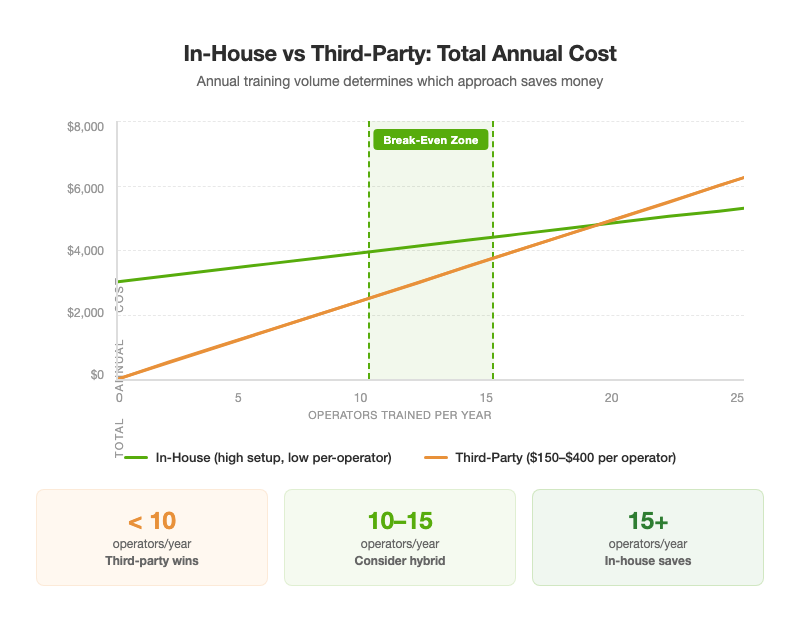
The math is straightforward. If you train fewer than 10 operators per year, third-party training is usually more cost-effective. If you train more than 15, in-house starts saving real money. Between 10 and 15 is a grey zone where the hybrid approach often makes the most sense.
When running the cost comparison, make sure you include these often-overlooked expenses:
For detailed cost figures by province: How Much Does Forklift Training Cost in Canada?
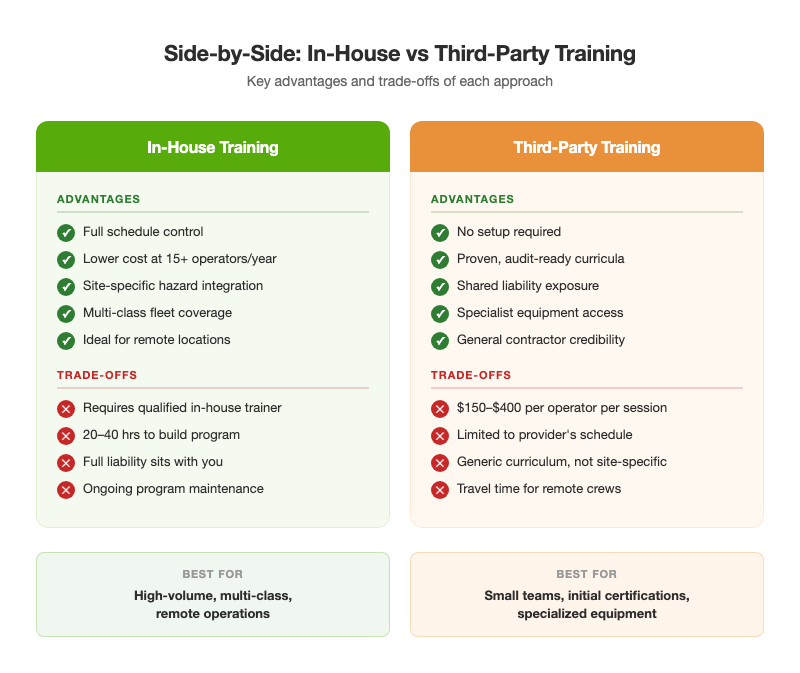
The approach we see work best for most mid-sized contractors (20 to 60 employees) is a hybrid model:
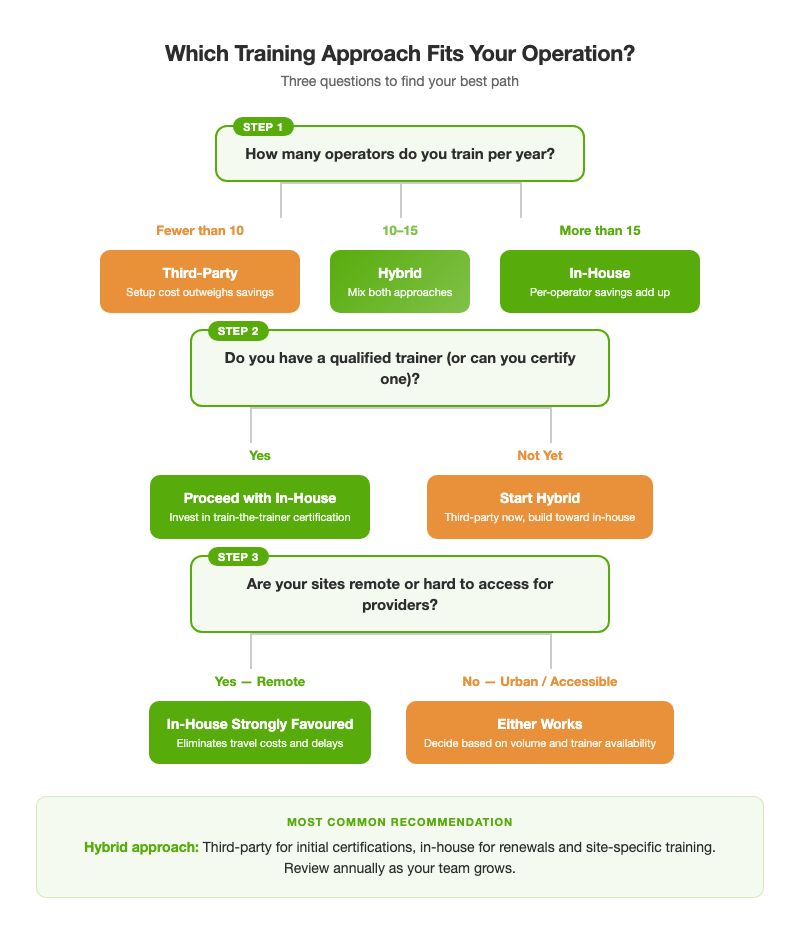
The hybrid approach sounds simple, but it requires coordination to avoid gaps. Here is how to make it work in practice:
One factor that is often overlooked in the in-house vs third-party decision is liability exposure. When you use a third-party training provider, some of the liability exposure shifts to that provider. If an incident investigation reveals that the training was inadequate, the third-party provider shares responsibility for the training quality (though the employer retains responsibility for ensuring the training was sufficient).
With in-house training, the entire liability for training quality sits with you. If your in-house program is found to be substandard during an investigation, there is no third party to point to. This is not a reason to avoid in-house training, but it is a reason to invest in doing it properly. A well-documented, CSA B335-15 compliant in-house program with a qualified trainer is perfectly defensible. A casual "show them the ropes" approach is not.
Key steps to protect your liability with in-house training:
For more on what happens when training gaps are exposed during an investigation: Forklift Accident Liability Without Certification
We audit in-house forklift training programs regularly, and the same problems come up repeatedly:
Build a forklift program your whole team can run
Use a 30-Day Free Trial to centralize records, assign actions, and keep every location aligned.
30-Day Free TrialYes. Canadian employers can deliver forklift training in-house as long as the program meets CSA B335-15 requirements, includes classroom, practical, and evaluation components, and is delivered by a qualified trainer. No province requires training to come from an external provider.
While not universally mandated, a forklift train-the-trainer certification is strongly recommended and may be required by some provincial regulations. It ensures your designated trainer has both the equipment competency and instructional skills needed to deliver effective training and evaluate operator competency.
In-house training becomes more cost-effective when you train more than 10 to 15 operators per year. Below that volume, the setup costs (trainer certification, program development, materials) outweigh the per-operator savings. A hybrid approach, using third-party for initial certification and in-house for renewals, often provides the best value for mid-sized contractors.
Most general contractors will accept in-house training if you can provide proper documentation showing the program meets CSA B335-15, your trainer is qualified, and operators were properly evaluated. Having detailed records is more important than where the training was delivered. Some large GCs have specific training provider requirements, so check your subcontract terms.
Start by sending your designated trainer to a train-the-trainer certification course. Then develop your written training program based on CSA B335-15 requirements (most train-the-trainer courses provide a curriculum template). Begin with in-house refresher courses for existing operators while continuing to use third-party providers for new operator certification. Once your program is established and you have conducted several training sessions, you can expand to handling initial certifications in-house as well.
Get Weekly Safety Insights
Regulation updates, toolbox talk ideas, and compliance tips. One email per week.
Can you get forklift certified online in Canada? What counts, what does not, and how to combine online theory with hands-on evaluation.
Compare online vs in-person fall protection courses in Canada. Provincial rules, costs, and when you still need hands-on training.
BC forklift training requirements under CSA B335-15 and WorkSafeBC. What employers must do to stay compliant.