Last updated: April 2026
You just found an expired first aid certificate in your training binder. The worker has been on site for two months. The certificate expired four months ago. And you have a safety audit next week.
This is one of the most common compliance gaps we see with contractors. Not because anyone is cutting corners on purpose, but because tracking 20 or 30 expiry dates across a crew that changes every season is genuinely hard to do with a spreadsheet and good intentions.
⚡ Quick Answer
- Standard first aid: Valid for 3 years from the date of issue
- Emergency first aid: Valid for 3 years from the date of issue
- CPR/AED certification: Technically valid for 3 years with your first aid certificate, but annual CPR refresher training is strongly recommended by all major providers (St. John Ambulance, Canadian Red Cross)
- Recertification: Must be completed before the certificate expires. If it lapses, you retake the full course.
- Cost: Recertification runs $60 to $120 depending on the course level and provider
- Behind on first aid actions? Start your 30-day free trial to track training, records, and corrective actions in one place.
First aid certificates in Canada are valid for 3 years from the date of issue, regardless of the provider or course level. When a certificate expires, the holder must complete a recertification course before the expiry date or retake the full original course if they miss the deadline. For employers managing crews of 10 to 50 workers, tracking these expiry dates is a compliance obligation that directly affects your COR audit score, your WorkSafeBC or Alberta OHS standing, and whether you have legal first aid coverage on every shift.
How Long Does a First Aid Certificate Last?
In Canada, both standard first aid and emergency first aid certificates are valid for 3 years from the date of issue. This applies to certificates from all major training providers including St. John Ambulance, Canadian Red Cross, Heart and Stroke Foundation, and accredited private training agencies.
The 3-year validity period is consistent across most Canadian provinces. The certificate your worker receives will have a clear issue date and expiry date printed on it. There is no ambiguity about when it expires.
What catches employers off guard is not the validity period itself. It is the gap between "knowing" a certificate is valid for 3 years and actually tracking expiry dates across a changing crew. A worker who was certified on day one of a 3-year project will need recertification before the project ends. If you are not tracking that, nobody is.
Province-Specific Validity and Renewal Rules
British Columbia
WorkSafeBC occupational first aid certificates (basic, intermediate, advanced) are valid for 3 years. Under the updated regulations effective November 1, 2024, renewal requirements depend on the level:
- Basic first aid (formerly OFA Level 1): Retake the full course to renew. No recertification option.
- Intermediate first aid (formerly OFA Level 2): Retake the full course to renew.
- Advanced first aid (formerly OFA Level 3): Can recertify through an approved provider if done before expiry. If the certificate has expired, you must retake the full 10-day course.
Red Cross and SJA standard/emergency first aid certificates issued in BC also follow the 3-year validity. Check with BC first aid requirements to confirm which certificates your workplace needs.
Alberta
Alberta OHS Code requires that first aiders hold a valid certificate from an approved training agency. All standard and emergency first aid certificates are valid for 3 years. Alberta allows recertification courses for both standard and emergency first aid, provided you complete the recertification before expiry. If you miss the deadline, you take the full course again.
For Alberta first aid requirements, the key rule: your designated first aider's certificate must be current for every shift they work. No grace period.
Ontario
Ontario follows WSIB Regulation 1101. First aid certificates are valid for 3 years. WSIB requires that the training be from an approved provider (St. John Ambulance, Canadian Red Cross, Heart and Stroke, or an approved equivalent). Recertification is available for standard first aid if completed before expiry.
Saskatchewan, Manitoba, and Other Provinces
The 3-year standard applies across all Canadian provinces. What varies is the type of first aid certification required (based on hazard level and crew size) and which training providers are accepted by the provincial regulator. Always confirm with your provincial workplace safety board.
Not sure which certificates your crew needs? Safety Evolution maps your team's certifications against provincial requirements and flags exactly what needs renewing.
Not sure if your first aid readiness would hold up in a real emergency?
See training gaps, expiring certificates, and missing documentation before they become incidents.
Start Your 30-Day Free Trial →What Is the Difference Between Recertification and a Full Course?
Recertification is a shorter, cheaper version of the original course. It assumes you already have the base knowledge and focuses on skill refresher and updates to protocols. Here is the comparison:
| Course Type | Duration | Typical Cost | Eligibility |
|---|
| Standard First Aid (full course) | 2 days (14 to 16 hours) | $130 to $200 | Anyone |
| Standard First Aid Recertification | 1 day (6 to 8 hours) | $75 to $120 | Must have valid (non-expired) certificate |
| Emergency First Aid (full course) | 1 day (6.5 to 8 hours) | $80 to $120 | Anyone |
| Emergency First Aid Recertification | Half day (4 to 6 hours) | $60 to $90 | Must have valid (non-expired) certificate |
The critical word is "valid." If your certificate has expired, even by one day, most providers will not let you take the recertification. You have to take the full course. That means double the time and 50% to 100% more cost. This is the single biggest reason to track expiry dates proactively.
Why CPR Should Be Renewed Annually
Here is a fact that most contractors do not realize: your first aid certificate is valid for 3 years, but CPR skills deteriorate much faster. Studies show that CPR skill retention drops significantly within 3 to 6 months of training without practice.
St. John Ambulance and the Canadian Red Cross both recommend annual CPR refresher training, even though the certificate technically lasts 3 years. Some provinces and some GCs require annual CPR renewal as part of their safety program.
For construction and industrial sites where cardiac events, electrocution, and crush injuries are real possibilities, annual CPR refresher training is not just a recommendation. It is a practical necessity. A worker who last practiced CPR 2.5 years ago may freeze in the moment when it matters.
How to Build an Expiry Tracking System That Works
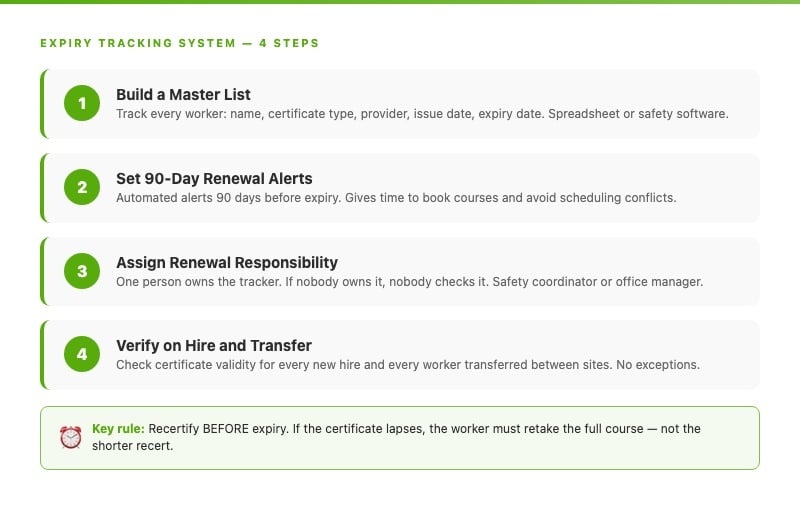
Forget the spreadsheet you update once a quarter when someone reminds you. Here is what actually works for a crew of 10 to 100:
- Collect certificate copies on day one. When a worker joins the crew, photograph or scan their first aid certificate. Record the worker name, certificate type, provider, issue date, and expiry date.
- Set 90-day advance reminders. Three months before each expiry, you need to book the recertification course. Courses fill up. Scheduling takes time. Ninety days gives you a buffer.
- Flag workers at 30 days. If a worker is 30 days from expiry and not yet registered for recertification, that is a red flag. Pull them into the next available course.
- Audit quarterly. Once per quarter, run through the full list. Look for expired certificates, missing documentation, and upcoming renewals in the next 90 days.
- Make it part of orientation. When onboarding new workers, check their first aid certificate validity as part of your orientation and onboarding process. Do not let anyone start work with an expired certificate.
If you want to eliminate the manual work, Safety Evolution's safety management platform tracks all certifications, sends automated expiry alerts, and gives you a real-time compliance dashboard. No more digging through filing cabinets during an audit.
What Happens If a First Aid Certificate Expires on Your Site?
Nothing good. Here is the blunt truth: if your designated first aider's certificate is expired and someone gets hurt on site, you have a compliance problem that compounds the incident itself.
Provincial regulators can issue orders for failure to maintain adequate first aid coverage. If an OHS inspector finds that your designated first aider's certificate expired two months ago, that is a violation. It does not matter that the worker "basically knows first aid." The certificate is the proof. Without it, you have no proof.
In Alberta, this can result in orders, administrative penalties, and serious reputational damage during a COR audit. In BC, WorkSafeBC can issue compliance orders and penalties. In Ontario, WSIB non-compliance can affect your experience rating and premiums.
The worst-case scenario: someone gets seriously hurt, the first aider's certificate is expired, and now the employer is facing scrutiny not just for the incident but for the systemic failure to maintain first aid coverage. That is when a small tracking gap becomes a major liability.
How to Handle Certificate Lapses Without Losing Compliance
A certificate lapse does not have to become a compliance crisis. The key is having a response plan before it happens, because on a crew of 20 workers with staggered training dates, it will happen.
If a certificate expires while the worker is active on site, the immediate step is to remove them from the designated first aider role. They can still work, but they cannot count toward your Schedule 2 or Schedule 3-A requirements until recertified. You need another qualified person covering that shift in the interim.
If no other qualified worker is available, you have two options: bring in a temporary first aider from another site or crew, or reduce operations to a level where your remaining coverage meets the minimum. Neither is ideal, which is why the 60-day advance warning system described above exists.
The recertification process is faster and cheaper than the original course. Standard first aid recertification is typically 8 hours (one day) compared to 14 to 16 hours for the full course. Emergency first aid recertification is 4 hours. These shorter courses assume you have the baseline knowledge and focus on skill refresher and updated protocols.
Document the lapse, the interim coverage arrangement, and the recertification date in your safety management records. This creates a paper trail showing you identified and addressed the gap proactively and systematically, which is exactly the kind of evidence a COR auditor or OHS officer wants to see during a review.
Still chasing first aid records across files and inboxes?
Centralize corrective actions and proof so your next review is predictable.
Start Your 30-Day Free Trial →Frequently Asked Questions
Does a first aid certificate expire after 3 years in all provinces?
Yes. Standard first aid and emergency first aid certificates are valid for 3 years across all Canadian provinces. The specific requirements for which level of first aid you need vary by province, but the 3-year validity period is consistent nationwide.
Can I recertify after my first aid certificate has expired?
No. Most training providers require that your certificate be current (not expired) to take a recertification course. If your certificate has expired, you must retake the full course. This means two full days for standard first aid instead of one day for recertification. Plan your renewals early to avoid this.
How much does first aid recertification cost?
Standard first aid recertification typically costs $75 to $120 and takes one day. Emergency first aid recertification costs $60 to $90 and takes about half a day. The full courses cost roughly double. Prices vary by provider and province.
Is a first aid certificate from one province valid in another?
Standard and emergency first aid certificates from nationally recognized providers (St. John Ambulance, Canadian Red Cross) are generally accepted across provinces. However, occupational first aid certificates (like BC's OFA system) may not be recognized in other provinces. If your crew works across provincial borders, check the requirements in each jurisdiction. Our first aid training guide for contractors has the full cross-province breakdown.
Do I need to renew CPR separately from first aid?
Your CPR certification is typically bundled with your first aid certificate and shares the same 3-year expiry. However, all major providers recommend annual CPR refresher training because CPR skills decline within months. Some workplaces and GCs require annual CPR renewal as part of their safety program, even though the certificate is technically valid for 3 years.
Get Weekly Safety Insights
Regulation updates, toolbox talk ideas, and compliance tips. One email per week.