COR
COR Certification Ontario Guide
COR in Ontario is required for City of Toronto and Metrolinx bids. IHSA steps, 14 audit elements, training costs, and realistic certification...
How health and safety compliance software automates inspections, incident tracking, and audit documentation for contractors.
Last updated: March 2026
Health and safety compliance software is a digital platform that automates regulatory tracking, inspection documentation, incident management, training records, and audit preparation. If your compliance process still involves paper binders, spreadsheet trackers, and a filing cabinet that nobody wants to open before an audit, you're spending 20+ hours per month on work that software handles in minutes.
This guide explains what compliance software actually automates, which features matter for contractors, and how to evaluate platforms for your operation. Whether you're preparing for a COR audit in Canada or an OSHA inspection in the US, the goal is the same: documented compliance that's always audit-ready, not a last-minute scramble.
Compliance software doesn't make you compliant. Your safety program, your training, and your workers make you compliant. What the software does is document, track, and prove that compliance in a way that's accessible, auditable, and automatic.
Here is what it replaces:
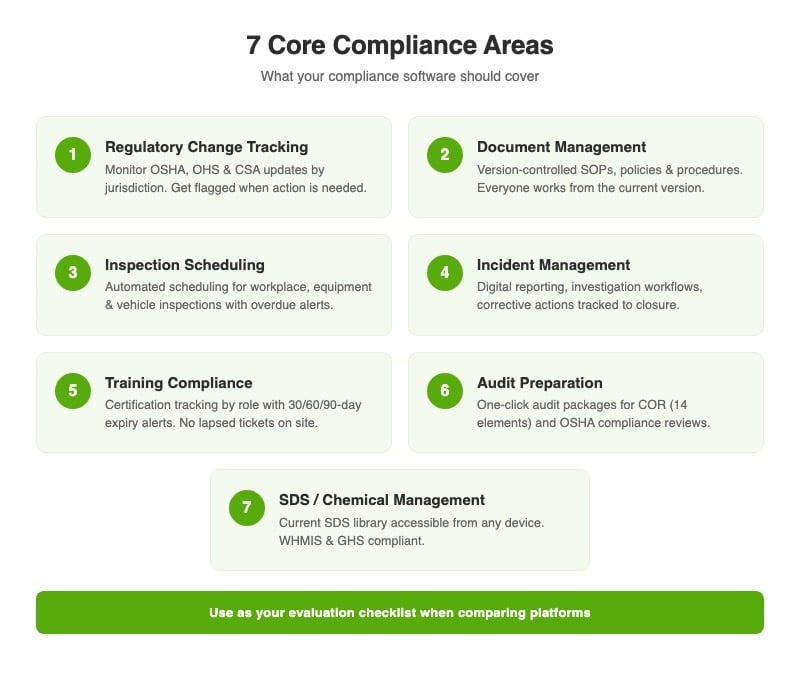
Not every platform covers all seven. Use this as your evaluation checklist.
OSHA standards change. Provincial OHS codes get amended. CSA standards release new editions. Alberta's OHS Code alone has been amended multiple times in the last three years. If you're relying on Google alerts or industry newsletters to catch regulatory changes, you will miss something. Compliance software monitors regulatory updates relevant to your industry and jurisdiction, then flags what requires action.
Safe work procedures, emergency response plans, safety policies, SOPs: every company has dozens of controlled documents that need version tracking, review dates, and distribution records. Digital document management ensures everyone accesses the current version and nobody works from a photocopied procedure from 2019.
Workplace inspections, equipment inspections, vehicle pre-trips, scaffold tag-ins: these all have frequencies (daily, weekly, monthly) and documentation requirements. The software schedules them, assigns them, tracks completion, and flags overdue items. A missed weekly inspection that nobody noticed becomes impossible when the system generates an automatic overdue alert.
From near-miss reports to serious injury investigations, the incident management workflow is where compliance software proves its value. A digital incident report captures the event, triggers an investigation workflow, assigns corrective actions, tracks them to closure, and generates the data you need for OSHA 300 logs or COR audit documentation. The alternative: a paper form that sits in someone's truck for a week before it reaches the office.
Every worker on your site needs specific certifications. OSHA 10 or 30, H2S Alive, CSTS, fall protection, confined space entry, first aid: the list is long and every certification has an expiry date. Compliance software builds training matrices by role, tracks every worker's certification status, sends renewal alerts, and generates the training records your COR auditor or OSHA inspector will ask for.
A COR audit in Canada requires documented evidence across 14 elements of your safety management system. An OSHA compliance audit can request years of recordkeeping data. The difference between "always audit-ready" and "scramble mode" is whether your documentation is digitised, indexed, and reportable. Compliance software generates audit-ready packages with one click.
If your workers handle hazardous materials, you need an SDS (Safety Data Sheet) library that's current, accessible, and compliant with WHMIS 2015 in Canada and GHS/HazCom in the US. Compliance software maintains your SDS library, tracks chemical inventories, and ensures workers can access the right SDS from their phone on site.
What If Your Safety Data Could Answer Questions on Its Own?
Ask about compliance gaps, training expiries, or audit readiness and get answers from your actual records. Not a chatbot. Not a dashboard you have to dig through.
Be the First to Try It →These terms get used interchangeably, but there's a real distinction that affects what you buy.
Compliance-focused software handles the documentation, tracking, and reporting side of safety management. It answers the question: "Can we prove we're compliant?" It covers inspections, incident records, training documentation, and audit preparation.
Full EHS platforms include compliance features plus broader environmental health and safety management: risk assessments, safety program design, environmental monitoring, sustainability reporting, and strategic safety planning. They answer: "How do we build a better safety program?"
For most contractors with 10 to 500 employees, a compliance-focused platform with strong inspection, incident, and certification features covers 80% of what you need. If you're managing environmental compliance (emissions, waste, spill reporting) alongside safety, a full EHS platform is worth the additional investment.
SE's recommendation: start with compliance. If you're not currently documenting inspections, tracking certifications, and generating compliance reports consistently, a full EHS platform will sit half-unused. Build the compliance foundation first.
Compliance software is a cost. Non-compliance is a bigger one.
OSHA serious violations carry penalties up to $16,550 per violation (as of January 2025). Willful or repeated violations reach $165,514 per violation. These penalties are per violation, not per inspection. A single OSHA visit that identifies three serious violations is $49,650 in fines before you negotiate.
Beyond fines: an OSHA citation goes on your public record. GCs check this before awarding contracts. An EMR above 1.0 can disqualify you from bids entirely. The average construction injury claim costs $44,179 (NAHB), and safety programs deliver a 4-6x return on investment.
Alberta OHS penalties reach $500,000 for a first offense with continuing offense penalties of $30,000 per day. Ontario's OHSA allows corporate fines up to $1,500,000. Real-world examples: Utopia Construction Inc. was fined $168,000 for OHS violations. Alberta Concrete Pumping was fined $86,000.
The other side: COR-certified contractors in Alberta qualify for up to 20% off WCB premiums through the Partnerships in Injury Reduction program. On a $200,000 annual premium, that's $40,000 back. COR certification requires the documented safety management system that compliance software generates.
Traditional compliance software records what you tell it. AI-powered platforms go further: they monitor, flag, and act without waiting for you to check.
Most platforms are adding "AI" to their marketing. The difference is whether AI does specific, measurable tasks or whether it is a chatbot layered over the same manual workflows.
Safety Evolution's SE-AI platform is built around three purpose-built agents that handle compliance administration end-to-end:
Together, these agents replace 20+ hours per week of compliance administration. Every answer includes source citations you can verify. If the data does not support an answer, the agent says so instead of fabricating a response. For contractors without a dedicated compliance team, this is the difference between proving compliance and hoping for the best.
Use this decision framework:
What If You Could Just Ask?
"Which workers have expired fall protection?" "Are we audit-ready for Site 7?" Get answers from your own safety data in seconds, not hours.
Be the First to Try It →Health and safety compliance software is a digital platform that automates the documentation, tracking, and reporting required to meet workplace safety regulations. It manages inspections, incident reports, training records, certification tracking, and audit preparation. The goal is to ensure your safety documentation is always audit-ready, whether for a COR audit in Canada or an OSHA inspection in the US.
Pricing ranges widely: from free (SafetyCulture for up to 10 users) to $200+ per user per month for enterprise platforms. Most mid-market compliance platforms cost $15-40 per user per month. Some platforms like Safety Evolution use tiered per-user pricing with AI agent capabilities priced separately, which scales better than fixed per-seat costs for growing teams. Annual costs for a 50-person team typically range from $1,800 to $14,400 depending on the platform.
Yes. COR (Certificate of Recognition) audits in Canada require documented evidence across 14 elements of your safety management system, including training records, inspection logs, incident reports, hazard assessments, and corrective actions. Compliance software generates this documentation continuously, so you're always audit-ready rather than scrambling before the auditor arrives. COR certification in Alberta qualifies you for up to 20% off WCB premiums.
Compliance software focuses on documenting, tracking, and proving regulatory compliance: inspections, incident records, training documentation, and audit preparation. Full EHS (Environment, Health, and Safety) software includes compliance features plus broader capabilities like environmental monitoring, risk assessment tools, sustainability reporting, and strategic safety program management. Most contractors with 10-500 employees get the most value from compliance-focused platforms.
AI can automate the administrative aspects of compliance: continuous certification monitoring, automated report generation, intelligent gap detection, and predictive risk flagging. It replaces the manual checking, compiling, and monitoring that consumes hours each week. AI cannot replace safety judgment, worker training, or the culture that drives actual safe behaviour on site. The best AI compliance tools handle the paperwork so your team can focus on the safety work.
Get Weekly Safety Insights
Regulation updates, toolbox talk ideas, and compliance tips. One email per week.
COR in Ontario is required for City of Toronto and Metrolinx bids. IHSA steps, 14 audit elements, training costs, and realistic certification...
COR audit checklist for construction: what auditors check, scoring thresholds, element-by-element prep guide, and interview tips to pass your next...
COR audits require 80% to pass. Here's what auditors evaluate, where contractors fail, and how to prepare in Alberta and BC.