Last updated: April 2026
Your maintenance audit is coming up, and you already know what that means: weeks of pulling together documentation, scheduling interviews, and hoping your auditor doesn't find the gaps you haven't had time to fix. But what if you could skip the audit entirely and spend that energy actually improving your safety program instead?
That's exactly what a COR Action Plan lets you do. At Safety Evolution, we help contractors across Canada navigate COR and SECOR certification every week, and the Action Plan is one of the most underused tools in the system. For 2026, both Energy Safety Canada (ESC) and the Alberta Construction Safety Association (ACSA) are actively accepting proposals, but the clock is ticking: ACSA's proposal deadline is May 8, 2026.
Here's everything you need to know to decide if an Action Plan is right for your company, and how to build a strong one.
⚡ Quick Answer: COR Action Plans in 2026
- What: An alternative to the internal maintenance audit that lets you implement measurable improvements to your OHS management system instead
- Who: COR or SECOR holders who have completed at least one full audit cycle (typically Year 5 or later)
- Deadlines: ACSA proposals due May 8, 2026. ESC proposals due March 31. Final submissions due by late November.
- Scoring: Minimum 60% to maintain your certification. Score 80%+ to be eligible for a second consecutive Action Plan.
- BC exception: WorkSafe BC does not participate in the Action Plan program
- If corrective actions are slipping: Start your 30-day free trial to track owners, due dates, and evidence before audit deadlines.
What Is a COR Action Plan?
A COR Action Plan is an alternative to the standard internal maintenance audit that allows certified employers to maintain their COR or SECOR by implementing measurable improvements to their occupational health and safety (OHS) management system. Instead of conducting the usual audit during your maintenance year, you build a plan based on recommendations from your previous certification audit and then execute it.
Every Action Plan has three core sections:
- Objectives: What you want to improve (pulled from your last certification audit's recommendations)
- Milestones: The specific, measurable steps you'll take to get there
- Deliverables: The evidence you'll submit to prove you actually did the work
Think of it this way: a maintenance audit measures where you are. An Action Plan measures where you're going, and whether you got there. For companies that already have a solid safety program and want to make targeted improvements, this can be significantly more valuable than rehashing an audit you've done multiple times.
If you're still building your safety program from scratch or working toward your first COR, an Action Plan isn't an option yet. You'll need to go through the full certification process first. But if you're maintaining an existing COR or SECOR, keep reading.

| |
COR Action Plan |
Maintenance Audit |
| Approach |
Improvement-based |
Compliance-based |
| Focus |
Targeted objectives from audit recommendations |
Full OHS system review |
| Evidence |
Deliverables you create and submit |
Audit findings from evaluation |
| Scoring |
60% minimum to pass; 80%+ for consecutive year |
Pass/fail based on audit score |
| Duration |
Full year of implementation |
Point-in-time evaluation |
Who Is Eligible for a COR Action Plan?
Most contractors think they can submit an Action Plan any time they want. They're wrong. Eligibility requirements are specific, and they differ depending on whether you're certified through ESC or through a provincial certifying partner like ACSA.
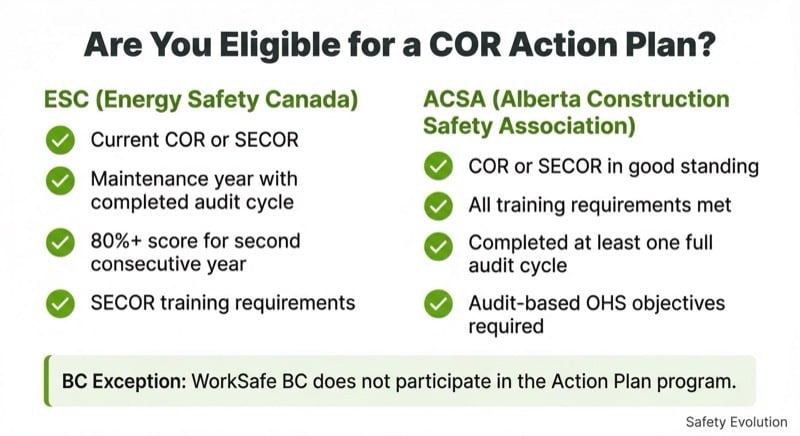
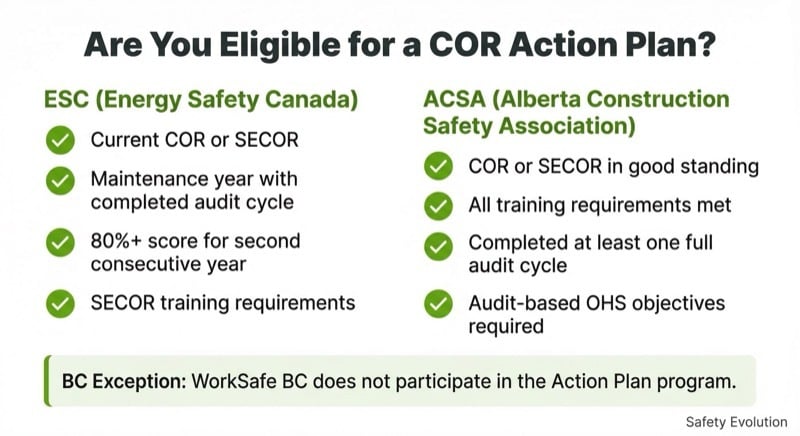
ESC (Energy Safety Canada) eligibility
- You hold a current, regular COR or SECOR (one-year certificates are not eligible)
- You are in a maintenance year and have completed one full three-year COR audit cycle
- If this is your second consecutive Action Plan, your first must have scored 80% or higher
- For SECOR employers: your COR Contact must have the two-day Safety Program Development course or up-to-date SECOR refresher training
ACSA (Alberta Construction Safety Association) eligibility
- You hold a current COR or SECOR in good standing
- You meet all COR or SECOR training requirements
- You've completed at least one full audit cycle (this means you're in Year 5 or later)
- If this is your second-year Action Plan, you scored 80% or higher on your first
- You can develop at least one OHS objective based on recommendations from your previous certification audit
- For SECOR: your certification audit must have been based on the 2023 ACSA SECOR Evaluation
If your certifying partner is not ESC or ACSA (for example, AMTA, CCSA, or another provincial body), check with them directly. Most follow a similar framework, but deadlines and specific requirements may differ.
Not sure whether you qualify? Safety Evolution can check your COR documentation and show you exactly where you stand and what needs to be addressed before your next audit.
The BC exception: If your COR is administered through WorkSafe BC, you cannot use an Action Plan. WorkSafe BC does not participate in the Action Plan program. This applies even if you hold an ESC COR that's recognized in BC. If you operate in BC, you'll need to complete your standard maintenance audit. For more on BC-specific requirements, see our COR certification BC guide.
What Are the 2026 Deadlines?
This is where urgency matters. The deadlines for ESC and ACSA are different, and missing them means you're stuck doing a full maintenance audit instead.
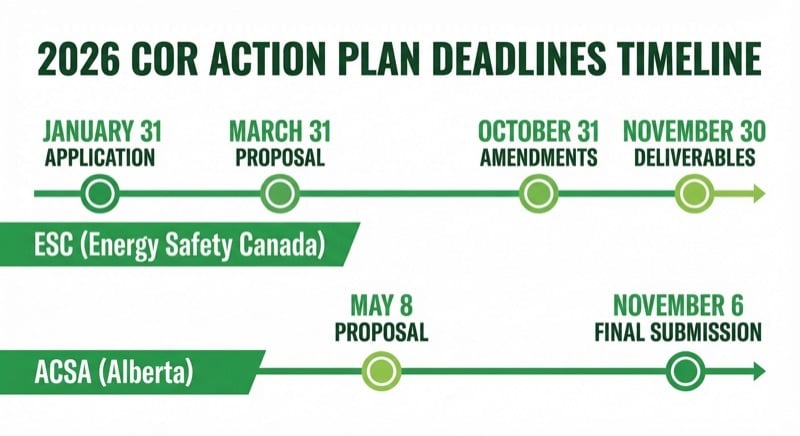
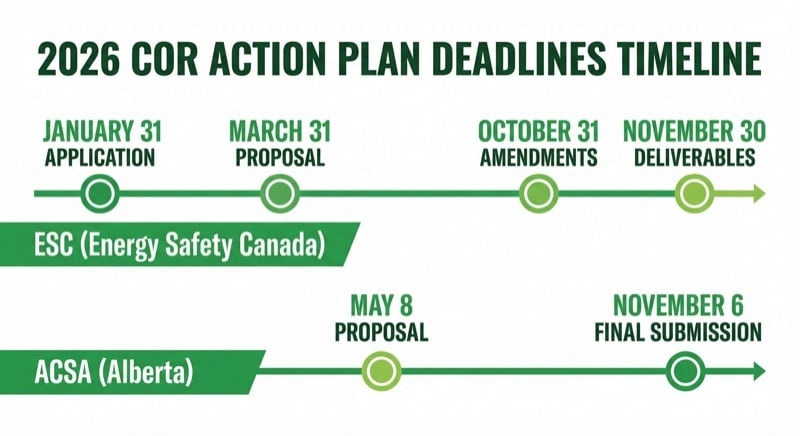
ESC deadlines (2026)
| Milestone |
Deadline |
| Application submission |
January 31, 2026 |
| Proposal submission |
March 31, 2026 |
| Amendments (if required) |
October 31, 2026 |
| Final deliverables |
November 30, 2026 |
Note: If you're going through ESC, the January 31 application deadline has already passed for 2026. If you haven't applied yet, you'll need to complete a standard maintenance audit this year and plan for an Action Plan in 2027.
ACSA deadlines (2026)
| Milestone |
Deadline |
| Proposal submission |
Friday, May 8, 2026 |
| Final submission |
Friday, November 6, 2026 |
If you're an ACSA member, you still have time to submit a proposal for 2026. But "still have time" doesn't mean "plenty of time." Building a strong proposal takes effort, and rushing it is the fastest way to get sent back for revisions, or worse, score below 60% and end up doing the maintenance audit anyway.
Audit deadlines close fast when action items are overdue
Track corrective actions, owners, and due dates in one place so your COR action plan stays audit-ready.
Start Your 30-Day Free Trial →
How Does the Action Plan Process Work?
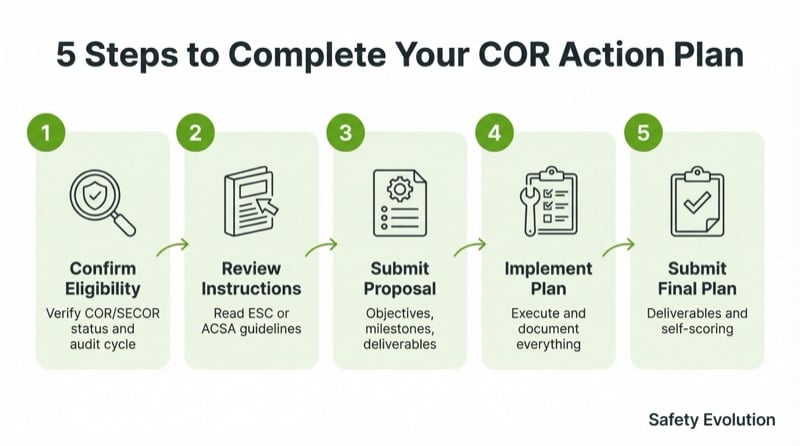
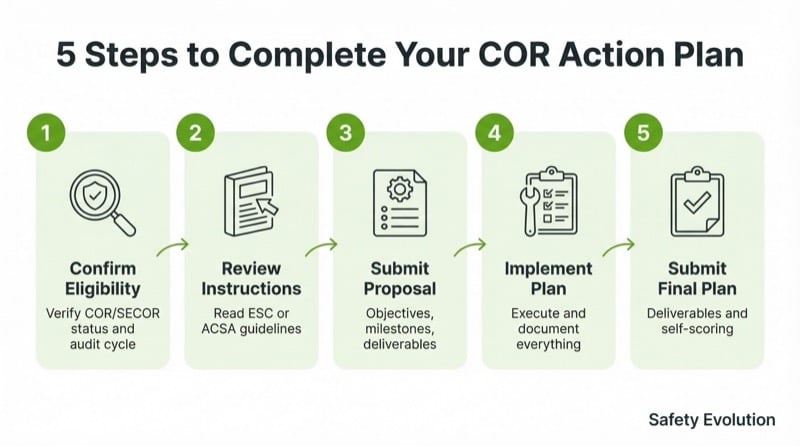
The process follows five steps. On paper, it looks straightforward. In practice, each step has friction points that trip up contractors who aren't prepared.
Step 1: Confirm your eligibility
Before you start building anything, run through the eligibility checklist for your certifying partner (ESC or ACSA; see above). The most common disqualifier? Companies that haven't completed a full audit cycle yet. If you're still in your first three-year certification cycle, you need to wait. There's no shortcut here.
Step 2: Review the Action Plan instructions
Both ESC and ACSA publish detailed instruction documents. Read them. We've seen contractors skip this step and submit proposals that get rejected because they missed a formatting requirement or chose objectives that don't align with their last certification audit. ACSA's instructions are available on their COR Action Plans page, and ESC provides guidance documents on their Action Plans page.
Step 3: Submit your proposal for approval
This is where most of the real work happens. Your proposal needs to include clearly defined objectives, measurable milestones, and specific deliverables. The objectives must come from the recommendations in your previous certification audit. You can't just pick something you feel like improving; it has to tie back to what the auditor flagged.
For ACSA, submit your proposal to the COR Department at COR@youracsa.ca. For ESC, follow the registration process outlined in their Action Plan registration instructions.
Here's the part that catches people off guard: all objectives and milestones must be started and completed AFTER your proposal is approved. Work you've already done before approval doesn't count. We've seen a 20-person mechanical contractor in Edmonton spend three months revamping their inspection process, only to learn they couldn't include any of that work on their Action Plan because it started before approval. They had to pick a different objective and start from scratch with five months left on the clock. Plan accordingly.
Step 4: Implement the Action Plan
Once your proposal is approved, execute it. Track your progress against the milestones you defined. Document everything. This isn't the place for vague claims like "we improved our safety meetings." You need concrete evidence: attendance records, updated procedures, training completion records, inspection data, whatever your deliverables specified.
This is also where having a solid documentation system pays off. If your Action Plan includes training or onboarding improvements, our free Orientation & Onboarding Package can help you build the framework. If your safety records are scattered across paper binders, phone photos, and someone's email inbox, pulling together your deliverables will be painful. If you're tracking things digitally, it's significantly easier. Safety Evolution's done-for-you safety services can help you build and maintain the documentation systems that make Action Plan delivery straightforward.
Step 5: Submit your completed plan
Submit your completed Action Plan with all deliverables and self-scoring to your certifying partner. For ACSA, this goes to COR@youracsa.ca by November 6, 2026. For ESC, the deliverables deadline is November 30, 2026.
Your certifying partner will review and score it. If it scores 60% or higher, your COR or SECOR is maintained. If it scores below 60%, your company must then conduct a full internal maintenance audit before December 31 of that year. There's no second chance on the Action Plan itself.
How to Build a Proposal That Actually Scores Well
Here's a blunt truth most guides won't tell you: the bar for a "passing" Action Plan is low (60%), but the bar for a useful one is much higher. If you're going to spend months on this instead of an audit, make it count.
Start with your audit recommendations
Pull out your last certification audit report and look at the recommendations. Every objective in your Action Plan must trace back to something the auditor identified. Don't start with what you want to improve; start with what the auditor said you should improve. The best proposals directly quote the audit finding and then lay out a specific plan to address it.
Make your milestones measurable
Vague milestones get low scores. "Improve our inspection process" is not a milestone. "Implement a monthly workplace inspection program with documented results for all active job sites by August 31, 2026" is a milestone. The more specific and time-bound your milestones are, the easier they are to score and the harder they are to argue against.
Choose deliverables that are easy to verify
Your deliverables are the evidence that you did what you said you'd do. Good deliverables include: completed training records with dates and names, updated written procedures with tracked changes, inspection reports from the new process, meeting minutes showing the objective was discussed, or before-and-after comparisons of the area you improved. Avoid deliverables that require subjective judgment ("safety culture has improved") and lean toward ones that can be verified with documentation.
If you want to understand how your safety management system is scored more broadly, our guide on how to pass a COR audit in Canada covers the audit elements that your Action Plan objectives should tie back to. And if your Action Plan objectives touch on incident reporting or investigation processes, grab our free Incident Report & Investigation Kit as a starting point for building those deliverables.
Score yourself honestly
Self-scoring is part of the submission process. Be honest. If you inflated your scores and the certifying partner disagrees, your final score drops, and you might land below 60%. Better to score yourself conservatively and let the reviewer bump you up than to overshoot and get corrected downward.
What Does 60% and 80% Actually Mean?
The scoring thresholds matter more than most people realize.
- Score 60% or higher: Your COR or SECOR is maintained for another year. You've met the requirement.
- Score 80% or higher: Your certification is maintained AND you're eligible to submit another Action Plan the following year instead of doing a maintenance audit.
- Score below 60%: Your Action Plan fails. You must then conduct a full internal maintenance audit before December 31 of that year to keep your COR or SECOR. This is the worst-case scenario: you've spent months on an Action Plan and now have to do the audit too.
That 80% threshold is important for planning. If you want to use Action Plans as an ongoing maintenance strategy (alternating with audits or doing them in consecutive years where allowed), you need to score well the first time. A 65% pass keeps your certification but locks you into a full audit next year.
Your COR certification also connects directly to your WCB premiums. Maintaining certification keeps your WCB premium discount active. Losing your COR because of a failed Action Plan (and a missed backup audit) means losing that discount too.
When Is an Action Plan NOT the Right Choice?
Action Plans are not for everyone. Here's when you should skip the Action Plan and do the maintenance audit instead:
- You're in your first certification cycle. You need to complete one full three-year cycle (initial certification + two maintenance years) before you're eligible.
- Your last audit had significant findings. If your previous certification audit identified major gaps, an Action Plan might not be enough. A maintenance audit gives you a comprehensive re-evaluation of your entire system, which might be what you need.
- You operate in BC. WorkSafe BC does not participate in the Action Plan program. If your COR is administered through a BC certifying partner, this option isn't available to you.
- Your documentation is weak. Action Plans require strong evidence and deliverables. If your safety documentation is disorganized or incomplete, you'll struggle to produce the deliverables needed to score well. Consider using the maintenance audit year to get your documentation systems in order first.
- You scored below 80% on your first Action Plan. If you already did an Action Plan last year and scored between 60% and 79%, you're not eligible for a second consecutive one. You'll need to do a maintenance audit this year.
The honest assessment: if you're not confident your team can build measurable objectives, track milestones, and produce solid deliverables, stick with the audit. An Action Plan done poorly is worse than an audit done well, because a failed Action Plan still requires the audit.
How Safety Evolution Can Help
Whether you're pursuing an Action Plan or preparing for a maintenance audit, Safety Evolution works as your done-for-you safety department. We help contractors across Canada build, maintain, and improve their safety programs, including Action Plan preparation.
Specifically, we can help you:
- Review your last certification audit to identify the strongest objectives for your Action Plan
- Build a proposal with measurable milestones and clear deliverables
- Set up tracking systems so you can document progress as you go
- Prepare your final submission and self-scoring
If your safety audit checklist is giving you anxiety, or you're not sure if an Action Plan or a maintenance audit is the better path for 2026, start with a conversation.
Still chasing action items in spreadsheets?
Move corrective actions, due dates, and evidence into one workflow so you are ready before the next COR review.
Start Your 30-Day Free Trial →
Frequently Asked Questions About COR Action Plans
What is a COR Action Plan?
A COR Action Plan is an alternative to the standard internal maintenance audit. Instead of auditing your existing safety program, you implement measurable improvements based on recommendations from your previous certification audit. It's made up of three sections: objectives, milestones, and deliverables. It must score at least 60% to maintain your COR or SECOR.
When is the deadline for COR Action Plans in 2026?
Deadlines depend on your certifying partner. For ACSA (Alberta), proposals are due Friday, May 8, 2026, with final submissions due Friday, November 6, 2026. For Energy Safety Canada (ESC), the application deadline was January 31, 2026, proposals were due March 31, and final deliverables are due November 30, 2026. Check with your specific certifying partner for their exact dates.
Can I do a COR Action Plan in British Columbia?
No. WorkSafe BC does not participate in the Action Plan program. If your COR is administered through a BC certifying partner, you must complete the standard maintenance audit. This applies even for ESC-issued COR certificates when it comes to BC maintenance requirements.
What happens if my Action Plan scores below 60%?
If your Action Plan scores below 60%, it fails and your company must conduct a full internal COR or SECOR maintenance audit before December 31 of that year to maintain your certification. This means you'll have spent months on the Action Plan and still need to complete the audit, so it's important to submit a strong plan.
Can I do two Action Plans in a row?
Yes, but only if your first Action Plan scored 80% or higher. Both ESC and ACSA require that first-year score threshold to be eligible for a second consecutive Action Plan. If you scored between 60% and 79%, your certification is maintained but you must complete a standard maintenance audit the following year.
Do I need special training to submit a COR Action Plan?
For COR holders, you must meet your certifying partner's standard training requirements. For SECOR employers going through ESC, your COR Contact must have the two-day Safety Program Development course or up-to-date SECOR refresher training. For ACSA SECOR Action Plans, your certification audit must have been based on the 2023 ACSA SECOR Evaluation. Contact your certifying partner to confirm your training status before submitting.
Get Weekly Safety Insights
Regulation updates, toolbox talk ideas, and compliance tips. One email per week.