Last updated: March 2026
You started your company to do good work, not to build a safety binder. But somewhere between winning your third contract and hiring your eighth worker, a GC asked for your "safety program" and you realized a few toolbox talks and a handshake policy weren't going to cut it anymore.
You're not alone. We work with small contractors every week who are in the exact same spot: 5 to 50 employees, no dedicated safety person, and a growing pile of compliance requirements that nobody warned them about. The good news? You don't need a full safety department to build a program that actually works. You just need to know what's required, what's optional, and where to start.
⚡ Quick Answer: Safety Program for Small Contractors
- Who needs one: Every employer in Canada is legally required to have a health and safety program, regardless of size
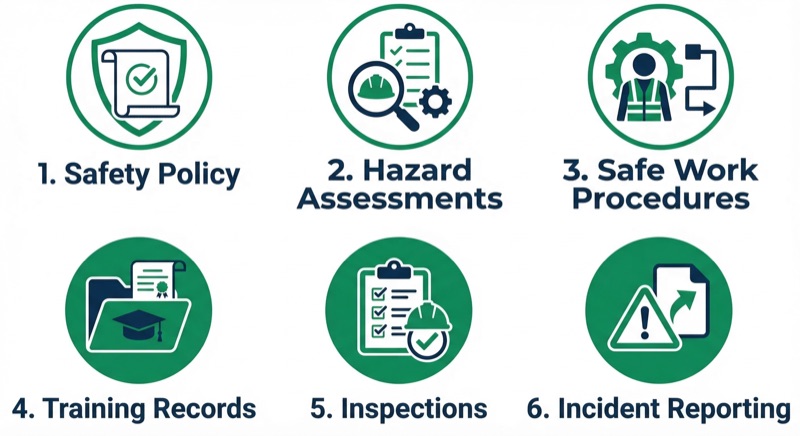
- Minimum elements: Safety policy, hazard assessments, safe work procedures, training records, inspections, incident reporting
- Best starting point: SECOR (Small Employer Certificate of Recognition) for companies with 10 or fewer employees
- Cost to build: Estimated $2,000 to $8,000 depending on your approach (DIY vs. professional help), plus ongoing maintenance
- Why it matters: Legal compliance, bid eligibility, WCB premium discounts of up to 20%, and liability protection
- Free Resource: Download our Construction Health & Safety Manual.
A safety program for a small contractor is a documented system that covers your company's health and safety policies, hazard controls, training records, and emergency procedures. It proves to regulators, GCs, and your own crew that you've identified the risks on your sites and you have a plan to manage them. For small contractors with 5 to 50 employees, this doesn't need to be a 300-page manual. It needs to be real, current, and something your crew actually follows.
Why Does a Small Contractor Need a Formal Safety Program?
Most small contractors think they can get away without a formal program until they're bigger. They're wrong.
Here's what actually happens: you bid on a project with a mid-size GC. They send you a prequalification package. Page two asks for your COR or SECOR number, your safety manual, your training matrix, and your incident history for the last three years. You don't have any of it. The bid dies right there.
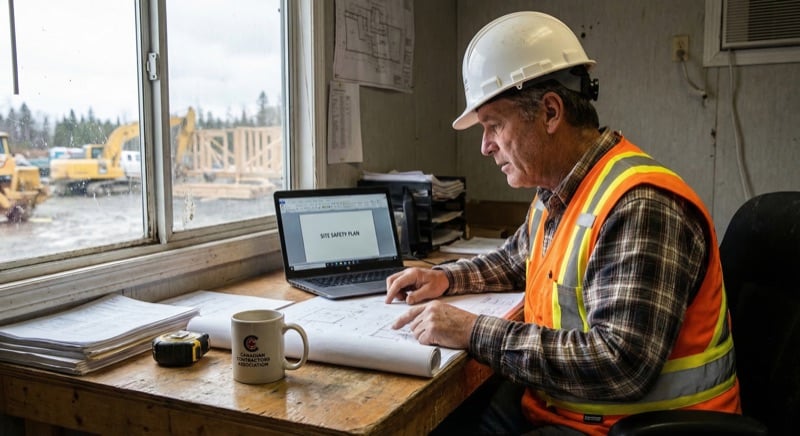
Or worse: an OHS officer shows up on your site after a near-miss report. They ask to see your safety policy, your hazard assessments, your toolbox talk records. You pull out a crumpled FLHA from last Tuesday and a safety manual you downloaded from the internet three years ago. That's not a program. That's a liability.
There are three hard reasons every small contractor needs a documented safety program:
1. It's the law. In every Canadian province, employers are legally required to ensure the health and safety of their workers. In Alberta, the OHS Act requires employers to establish and maintain a system for managing health and safety. In Ontario, any employer with more than five employees must prepare and annually review a written health and safety policy. The specific requirements vary by province, but the obligation is universal: you need a program, and it needs to be documented.
2. You can't bid without it. GCs increasingly require COR or SECOR certification as a condition of contract. If you're a subcontractor in construction, oil and gas, or utilities, your safety program is your ticket to the table. No program, no prequalification. No prequalification, no bid. If you're losing work to competitors who have their safety documentation in order, this is likely the reason. Check out our construction safety program template to see what a complete program looks like.
3. The financial penalties are real. In Alberta, administrative penalties can reach $10,000 per day for OHS violations. Convictions under the OHS Act can result in fines up to $500,000 and up to six months of imprisonment. These aren't theoretical numbers reserved for large companies. Small contractors get fined too, and a $10,000 hit lands a lot harder when your annual revenue is $800,000.
Beyond penalties, a COR or SECOR certification qualifies you for WCB premium discounts. In Alberta, that discount can be up to 20% of your annual premium. For a small contractor paying $30,000 to $60,000 in WCB premiums, that's $6,000 to $12,000 back in your pocket every year. That alone can pay for the cost of building your program.
Not sure where your safety program stands right now? and give you a clear picture of what you have, what is missing, and what to tackle first.
What's the Minimum Viable Safety Program?
Here's what trips up most small contractors: they think a safety program means a 200-page manual sitting on a shelf. It doesn't. A safety program is a living system, and for a small company, it can be lean.
There are six elements you absolutely need. Everything else is either a "nice to have" or something you'll add as you grow.
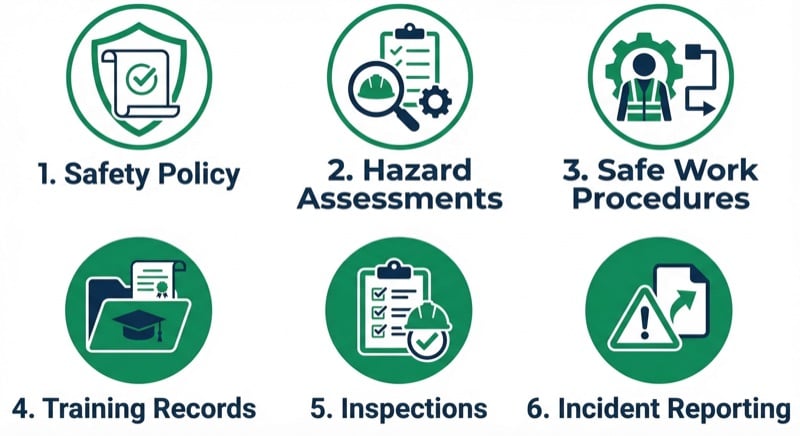
The 6 Non-Negotiables
1. Health and Safety Policy. A one-page document signed by the owner that states your commitment to safety. It sounds simple because it is. But this is the foundation everything else sits on, and auditors check for it first. It needs to be current, signed, and posted where your crew can see it.
2. Hazard Assessments. Your crew needs to identify hazards before they start work, every day. For most construction contractors, this means field-level hazard assessments (FLHAs). You also need formal hazard assessments for recurring tasks, sometimes called job hazard analyses. These don't need to be complicated, but they need to exist and your workers need to actually fill them out. Learn more in our guide to implementing a health and safety management system.
3. Safe Work Procedures. Written procedures for your high-risk tasks. If your crew works at heights, operates heavy equipment, or handles hazardous materials, you need documented procedures that describe how to do the work safely. Not a generic binder from the internet. Procedures specific to your work, written in language your crew understands.
4. Training and Competency Records. You need to prove your workers are trained for the tasks they perform. That means certificates for mandatory training (WHMIS, fall protection, first aid), orientation records for new hires, and documented toolbox talks. Safety Evolution's free orientation and onboarding package gives you a ready-to-use framework for this. You can also grab our free toolbox talk package with 50+ topics to start running regular safety meetings right away.
5. Workplace Inspections. Regular inspections of your sites, equipment, and work practices. For a small contractor, this might mean a weekly site walk-through with a documented checklist. The point is to catch problems before they become incidents. Use a simple documented checklist specific to your worksite conditions. Keep it practical, not bureaucratic.
6. Incident Reporting and Investigation. When something goes wrong, or almost goes wrong, you need a system to document it, investigate the root cause, and track corrective actions. This is where most small contractors fall apart. Incidents happen, nobody writes them down, and the same thing happens again three months later. Download our free incident report and investigation kit to set up a proper system.
Nice to Have (But Not Day One)
Emergency response plans, management review processes, contractor management programs, return-to-work procedures, and formal safety committee structures are all important. But if you're building from scratch, focus on the six non-negotiables first. You can layer in the rest as your company and your program mature.
Need a Complete Safety Program?
Stop starting from scratch. Download our Free Construction Health & Safety Manual to get compliant fast.
Download the Free Manual →
Why Is SECOR the Best Starting Point for Small Contractors?
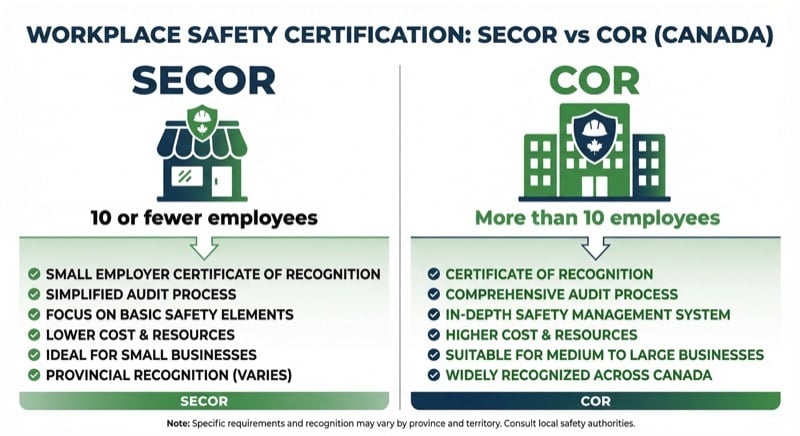
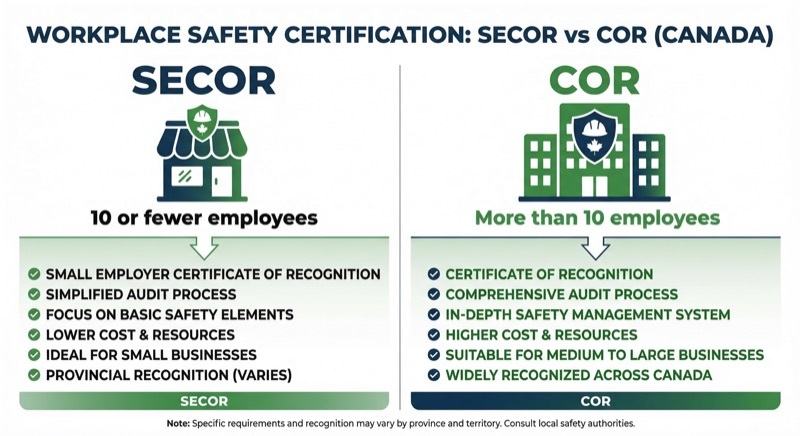
SECOR (Small Employer Certificate of Recognition) is a safety certification designed specifically for small employers. In Alberta, it's available to companies with no more than 10 employees at any given time (counting everyone on your WCB account, including owners, managers, and admin staff). In Saskatchewan, the threshold is 9 or fewer employees. Thresholds and requirements vary by province, so check with your local certifying partner for exact eligibility.
SECOR exists because the full COR process was built for companies with 50, 100, or 500 employees. It requires internal auditors, formal audit protocols, and a level of documentation that doesn't make sense for a crew of 8. SECOR gives small companies a realistic path to certification without the overhead.
Here's why it matters for your business:
- Bid eligibility. Many GCs accept SECOR as equivalent to COR for small subcontractors. Having your SECOR number on a prequalification package tells the GC you've been independently evaluated.
- WCB premium discounts. SECOR-certified companies in Alberta are eligible for WCB premium rebates of up to 20%. The exact discount depends on your industry rate group and claims history, but it's real money.
- Simpler audit process. The SECOR audit is a streamlined evaluation of your safety management system. It must achieve an overall score of 80% with no less than 50% in any single element. That's achievable for a well-prepared small company.
- A stepping stone to COR. When you grow past the SECOR threshold, you'll already have the foundation of a safety management system. Transitioning to COR is significantly easier when you've already been through the SECOR process.
For a detailed walkthrough of the SECOR process, read our complete guide on how to get SECOR certified. If you're comparing the two certifications, our COR certification guide breaks down what's involved at the full COR level.
How Do You Run a Safety Program When You Wear Every Hat?
This is the real question. You're the owner. You're the estimator. You're the project manager. You're probably still swinging a hammer half the week. And now you're supposed to be the safety coordinator too?
Here's the blunt truth: most small contractors who try to do everything themselves end up with a safety program that looks good on paper and falls apart on site. The manual sits in a drawer. The toolbox talks happen when someone remembers. The FLHAs get filled out in the truck after the job is done. Auditors see through this in about five minutes.
That doesn't mean you need to hire a full-time safety person. It means you need a system that works without one. Here's how:
Use software to automate the paperwork. Digital safety platforms like Safety Evolution's software let your crew complete FLHAs, toolbox talks, inspections, and incident reports from their phones. Everything gets time-stamped, stored, and organized automatically. No more chasing paper forms across three job sites. No more spending your Sunday night entering data into spreadsheets.
Delegate daily safety tasks to your crew. You don't have to run every toolbox talk yourself. Pick your most experienced worker on each site and make them responsible for running the morning safety meeting and ensuring FLHAs are completed. Give them a structured orientation process to follow for new hires. This distributes the load and builds safety culture from the ground up.
Outsource the heavy lifting. The parts of a safety program that actually take expertise, like writing your manual, building your forms, preparing for audits, and maintaining your documentation, don't have to be done in-house. Safety Evolution acts as a done-for-you safety department: we build audit-ready programs, control your documents, verify your daily forms, and package everything for GC submittals and audits. You focus on running your business. We make sure the safety side holds up.
Block 30 minutes per week for safety admin. That's it. Use it to review reports, check for overdue training, and flag anything that needs attention. If you've got the right software and the right support, 30 minutes a week is enough to stay on top of a small operation. The moment it starts taking more than that, it's time to either improve your systems or bring in help.
What Shortcuts Create the Most Liability?
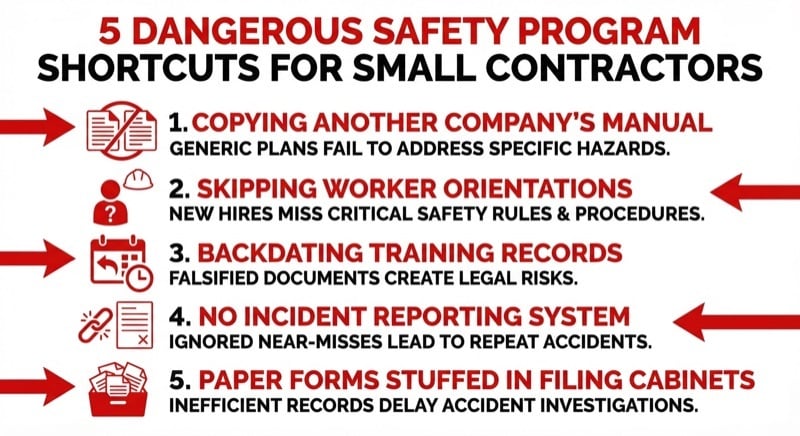
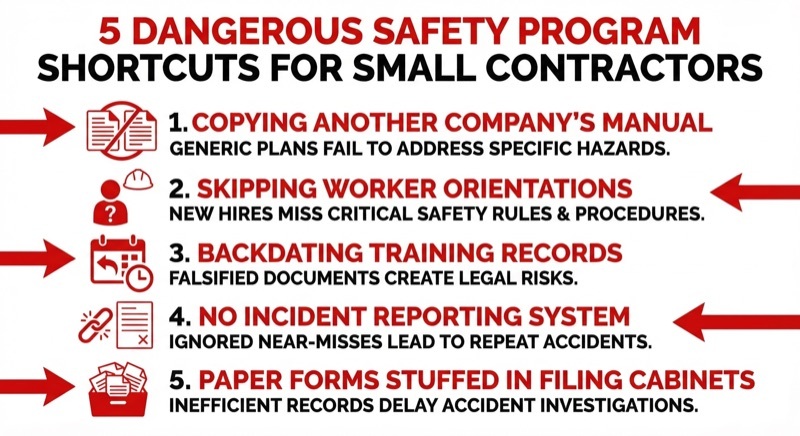
We've seen every version of "good enough" that isn't. Here are the shortcuts that create the most risk:
Copying another company's safety manual. This is the most common one. A buddy gives you his safety manual, you change the company name on the cover, and you call it done. The problem? That manual was written for a different operation with different hazards, different equipment, and different regulatory requirements. When an auditor asks you to explain your confined space entry procedure and your company doesn't do confined space work, the whole manual loses credibility. Every procedure in your manual should reflect work your company actually performs.
Backdating training records. It happens more than anyone admits. A worker needs fall protection training to start Monday. The course isn't available until next month. So someone signs off on a form that says the training was completed last week. This is fraud, full stop. If that worker gets hurt and the investigation reveals fabricated records, you're not just facing an OHS fine. You're facing potential criminal charges under due diligence law.
Running FLHAs as a checkbox exercise. If your crew fills out the same generic hazard assessment every morning without actually looking at the site conditions, you don't have a hazard assessment program. You have a paperwork program. FLHAs only work when workers genuinely assess the conditions in front of them that day. Train your crew on what a real hazard assessment looks like. Our guide to conducting a field-level hazard assessment walks through real examples.
No incident reporting system. "We haven't had any incidents" is not a safety record. It usually means incidents aren't being reported. Every near-miss, every first aid treatment, every equipment malfunction needs to be documented. If you can't show an investigation trail, an auditor will assume you're either not tracking incidents or actively hiding them.
Stuffing paper forms in a filing cabinet. Paper forms get lost, damaged, and misfiled. More importantly, they can't be searched, analyzed, or produced quickly when an auditor or GC asks for them. If you're still running your safety program on paper, you're creating a documentation gap that will cost you eventually. Moving to digital forms isn't a luxury. It's a basic risk management decision.
If any of this sounds familiar, it might be worth having someone take an honest look at where you stand. and tell you exactly what needs fixing, no guesswork, just a clear gap analysis.
How Do You Scale Your Safety Program as You Grow?
A safety program for a 6-person crew looks very different from one for a 30-person operation. The mistake is building for where you are today and scrambling to catch up when you grow. For a comprehensive view of what this looks like, see our construction safety program template.
Here's how to think about scaling:
Under 10 employees: Focus on SECOR certification. Build your minimum viable program (the 6 non-negotiables above). Use digital tools from the start so you don't have to migrate later. Get comfortable with the audit process.
10 to 20 employees: You've outgrown SECOR eligibility. Start planning your transition to full COR. This means expanding your safety manual, implementing formal internal audit processes, and potentially designating a safety lead (even if it's a part-time role). The foundation you built under SECOR makes this transition manageable.
20 to 50 employees: At this size, you likely need a dedicated safety coordinator, even if it's someone splitting their time between safety and operations. Your documentation requirements expand significantly: more detailed training matrices, formal management review processes, contractor management programs, and comprehensive emergency response plans.
The key principle: build your systems and documentation in a way that scales. If you start with a digital safety platform, adding 20 more workers means adding 20 more user accounts, not rebuilding your entire system. If you start with well-structured forms and procedures, expanding to new types of work means adding new procedures, not rewriting everything from scratch.
How Safety Evolution Helps Small Contractors
We built Safety Evolution specifically for contractors who need professional safety support without the cost of a full-time safety department. Here's what that looks like in practice:
Safety Services: We build your safety program from the ground up, or fix the one you've got. That includes your safety manual, your forms, your procedures, and your audit preparation. We don't hand you a template and wish you luck. We build it for your specific operation and make sure it passes your audit.
Safety Software: Our platform handles digital FLHAs, toolbox talks, inspections, incident reports, training tracking, and document control. Your crew uses it in the field on their phones. You see everything from a dashboard. When a GC asks for your safety records, you pull them up in seconds.
Big-Company Safety Without the Big-Company Admin
You don't have a dedicated 5-person safety team to push paper. Safety Evolution automates the heavy lifting so small contractors can punch above their weight, win bigger bids, and stay compliant.
30-Day Free Trial
Frequently Asked Questions
Do small contractors really need a safety program?
Yes. Every employer in Canada has a legal obligation to ensure worker health and safety, regardless of company size. Beyond legal compliance, most GCs require COR or SECOR certification for subcontractors to bid on work. A documented safety program is not optional for any contractor who wants to operate legally and win contracts.
How much does it cost to build a safety program for a small contractor?
Estimated costs range from $2,000 to $8,000 depending on your approach. DIY using templates and free resources will cost less upfront but takes significant time. Working with a professional safety company like Safety Evolution to build an audit-ready program typically falls in the $3,000 to $8,000 range, depending on company complexity and province. The WCB premium discount alone (up to 20% in Alberta) often pays for the investment within the first year.
What is the difference between SECOR and COR?
SECOR (Small Employer Certificate of Recognition) is a streamlined version of COR designed for small companies. In Alberta, SECOR is for employers with no more than 10 employees at any given time. COR (Certificate of Recognition) is the full certification for larger companies. Both demonstrate that your company has an effective health and safety management system, but SECOR has a simpler audit process and lower documentation requirements. When you grow past the SECOR threshold, you transition to COR.
Can I build a safety program myself without hiring a consultant?
You can, but the risk is building something that looks complete on paper but doesn't hold up under an audit. The most common issue we see with DIY programs is generic content that doesn't match the company's actual operations. If you go the DIY route, start with official resources from your certifying partner (ACSA in Alberta, BCCSA in BC) and customize every document to your specific work. Better yet, use a professional service to build the foundation and maintain it yourself going forward.
How long does it take to build a safety program from scratch?
For a small contractor targeting SECOR certification, expect 3 to 6 months from starting your program to being audit-ready. This includes developing your safety manual, implementing daily documentation practices (FLHAs, toolbox talks), establishing training records, and building enough history to demonstrate the program is active. Working with Safety Evolution typically accelerates this timeline because we build the documentation while you focus on implementation.
What happens if I get audited and don't have a safety program?
If an OHS officer inspects your operation and finds no documented safety program, you can receive orders to comply, administrative penalties (up to $10,000 per day in Alberta), or stop-work orders. In serious cases, convictions under provincial OHS legislation can result in fines up to $500,000 and imprisonment. Beyond regulatory penalties, you also lose the ability to bid on work requiring COR or SECOR, which limits your revenue potential significantly.
Your Next Step
Building a safety program doesn't have to be overwhelming. Start with the basics, get the right systems in place, and build from there. If you're a small contractor who's been putting this off, the best time to start was a year ago. The second best time is right now.
Get Weekly Safety Insights
Regulation updates, toolbox talk ideas, and compliance tips. One email per week.