Last updated: April 2026
A contractor in Calgary called us last year, two weeks before his COR maintenance audit. His question: "How often am I actually supposed to be holding safety meetings?" He had been doing monthly meetings, thought he was fine, and then learned his certifying partner expected weekly toolbox talks on top of the monthly formal meetings. He had no documentation for the weekly talks because he did not think they were required. For the complete overview of meeting types and requirements across the US and Canada, see our complete guide to safety meetings.
This is one of the most common and most confusing questions in Canadian workplace safety. The short answer is that it depends on your province, your company size, and what certification program you are in. The longer answer is below.
Quick Answer
- Legal minimum: Canadian OHS legislation does not mandate a specific number of "safety meetings" per month. However, JHSC (Joint Health and Safety Committee) meetings are typically required monthly in most provinces for workplaces meeting employee thresholds.
- JHSC threshold: Generally 20+ employees (Alberta, BC, Ontario, federal). Saskatchewan requires an OHS Committee at 10+ workers.
- COR/SECOR standard: Most certifying partners expect weekly toolbox talks plus monthly formal safety meetings, with documentation for both.
- Best practice: Daily toolbox talks (5 to 10 min) for construction/field work. Weekly or monthly formal meetings for all industries.
That covers the high-level picture, but the details matter. Provincial requirements differ more than most contractors realize, and COR audit expectations go well beyond the legal minimums. Below, we break down the specific rules for each major province and show you how to build a meeting schedule that satisfies both your regulator and your certifying partner.
Does Canadian Law Require Safety Meetings?
There is no single Canadian law that says "you must hold a safety meeting every week." Unlike what many online articles claim, the words "safety meeting" do not appear in most provincial OHS legislation as a standalone requirement. What the law does require is more nuanced, and frankly more demanding.
Want the complete meeting framework? Download the free Perfect Safety Meeting Roadmap : a proven template with 5 elements that turn safety meetings from compliance exercises into real conversations.
Every Canadian province requires employers to:
- Inform workers about known or foreseeable hazards
- Provide instruction, training, and supervision
- Establish and maintain a health and safety program (above certain employee thresholds)
- Ensure worker participation in health and safety
Safety meetings are how most employers satisfy these requirements. They are not explicitly named in the Act, but they are the most practical way to prove you are meeting your legal obligations. When an OHS officer shows up after an incident and asks "how did you communicate this hazard to your workers?", your documented safety meetings are your primary evidence.
Most contractors think the question is "are safety meetings required?" The real question is: "Can you prove you informed and trained your workers without them?" In practice, you cannot.
Safety Meeting Requirements by Province
Here is what each major province requires when it comes to formal committee meetings and worker consultation. For a full list of safety meeting topics you can use at these meetings, see our pillar guide.
Alberta
- JHSC required: Worksites with 20+ regularly employed workers, or as ordered by an OHS officer
- Health and safety representative: Required for worksites with 5 to 19 workers
- Meeting frequency: The OHS Code (Part 13) requires JHSCs to meet regularly, but does not prescribe a specific frequency. "Regularly" is generally interpreted as at least quarterly, though monthly is the standard for COR-certified companies.
- Key legislation: Occupational Health and Safety Act (S.A. 2020, O-2.2), OHS Code Part 13 (Sections 196 to 202). Note: OHS Code amendments took full effect March 31, 2025.
- Construction-specific: JHSCs are required on construction worksites with 20+ workers where work is expected to last 90 days or more.
British Columbia
- JHSC required: Workplaces with 20+ workers, or as ordered by WorkSafeBC
- Worker health and safety representative: Required for workplaces with 10 to 19 workers
- Meeting frequency: JHSCs must meet regularly, at least once each month, unless another schedule is permitted by regulation (BC Workers Compensation Act, Part 2, Section 37)
- Annual evaluation: Section 3.26 of the OHS Regulation requires a written evaluation of JHSC effectiveness annually
- Key legislation: Workers Compensation Act Part 2, Divisions 4 and 5; OHS Regulation Part 3
Ontario
- JHSC required: Workplaces with 20+ regularly employed workers
- Health and safety representative: Required for workplaces with 6 to 19 workers (and workplaces under 6 workers on some construction projects)
- Meeting frequency: JHSCs must meet at least once every three months, though quarterly is the minimum. Many construction employers hold monthly meetings to align with COR requirements.
- Key legislation: Occupational Health and Safety Act (OHSA), Sections 8 and 9
- Construction-specific: The Construction Projects regulation (O. Reg. 213/91) adds specific requirements for multi-employer worksites
Saskatchewan
- OHS Committee required: Workplaces with 10+ workers
- OHS Representative: Required for workplaces with 5 to 9 workers
- Meeting frequency: OHS Committees must meet at least once every calendar quarter (minimum 4 times per year)
- Key legislation: The Saskatchewan Employment Act, Part III; OHS Regulations, 1996
Federal Workplaces
- Workplace health and safety committee required: 20+ employees
- Health and safety representative: Required for workplaces with fewer than 20 employees
- Meeting frequency: At least 9 times per year, at regular intervals, during normal working hours (Canada Labour Code, Part II)
- Key legislation: Canada Labour Code, Part II; Policy Health and Safety Committees Regulations (SOR/2015-164)
Struggling to Keep Up with Province-by-Province Meeting Rules?
Alberta says monthly. Ontario says quarterly. BC depends on your workplace size. SE AI tracks your meeting schedule against your specific provincial requirements and flags gaps before an auditor does.
30-Day Free Trial
What About COR and SECOR Requirements?
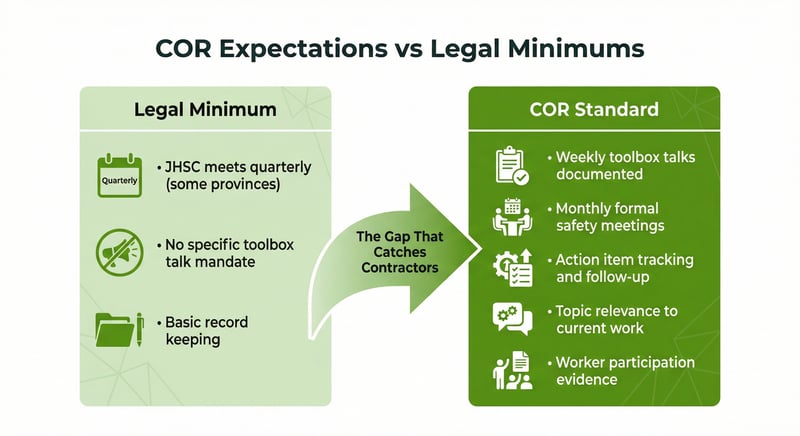
Here is where the gap trips most contractors. Provincial legislation sets a minimum floor for JHSC meetings (typically monthly or quarterly). But COR and SECOR audit protocols set a higher bar that catches companies off guard.
Most certifying partners expect:
- Weekly toolbox talks on active construction sites, documented with sign-in sheets
- Monthly formal safety meetings with agendas, minutes, and action item tracking
- Regular JHSC meetings (monthly for larger employers) with documented minutes and management response to recommendations
The COR audit does not just check whether you held meetings. It checks whether the topics were relevant to current work, whether workers participated, whether action items were followed up, and whether the meetings are integrated into your overall health and safety management system. For a framework on selecting topics that match your current hazards and work activities, see our guide on how to choose safety meeting topics for your workplace.
If you are pursuing COR certification, treat the COR standard as your meeting frequency target, not the provincial minimum. The provincial minimum will not score well on an audit.
What Counts as a "Safety Meeting"?
Not everything called a safety meeting serves the same purpose. Here are the types your program should include:
| Type |
Frequency |
Duration |
Purpose |
| Toolbox talk / tailgate meeting |
Daily or weekly |
5 to 10 min |
Task-specific hazards, pre-shift briefing |
| Formal safety meeting |
Weekly or monthly |
15 to 30 min |
Broader topics, incident review, program updates |
| JHSC meeting |
Monthly or quarterly |
30 to 60 min |
Worker-management consultation, hazard review, recommendations |
| Project kick-off meeting |
Per project |
30 to 60 min |
Site-specific hazards, emergency procedures, roles |
For a deeper look at the differences between these formats, read our guide to toolbox talks vs. safety meetings.
How to Build a Meeting Schedule That Works
Here is a practical schedule that meets both legal requirements and COR expectations for a typical construction contractor:
- Daily: Toolbox talk before each shift (5 min). Topic matches the day's work activities.
- Weekly: Formal safety meeting with the full crew (15 to 20 min). Review the week's hazards, near misses, and upcoming work.
- Monthly: JHSC meeting (for companies that meet the threshold). Review incident data, inspection findings, and corrective actions. Document minutes and management response.
- Quarterly: Program review meeting. Assess whether the safety program is working, update training needs, and plan for the next quarter.
Need templates to document these meetings? Download our free safety meeting templates for minutes, agendas, and sign-in sheets.
Adjusting Frequency for Your Risk Level
The schedule above is a baseline for a typical construction contractor. But your specific frequency should reflect your actual risk profile and workforce size. A 6-person residential framing crew has different needs than a 200-person pipeline project.
Higher frequency is warranted when:
- Your site has multiple hazardous trades working simultaneously (steel erection, crane operations, excavation)
- You are onboarding new or young workers who lack field experience
- You have had recent incidents, near misses, or enforcement actions
- Work conditions are changing rapidly (new phases, weather events, equipment mobilization)
- You are in the first year of a COR program and building your documentation track record
Lower frequency may be acceptable when:
- Your workforce is small, experienced, and stable (low turnover)
- The work is repetitive with consistent, well-understood hazards
- Your incident rate is low and trending downward
- You are in a lower-hazard environment (office, light manufacturing)
One thing to keep in mind: reducing frequency below your certifying partner's expectations is risky even if your incident data supports it. COR auditors evaluate your meeting frequency against the standard, not against your personal risk assessment. If ACSA expects weekly toolbox talks and you are doing biweekly, you will lose points regardless of your justification.
A smarter approach is to maintain the expected frequency but adjust the depth. Daily toolbox talks on a low-risk day can be a focused 3-minute reminder. High-risk days (crane lifts, confined space entry, new phase of work) get the full 10-minute briefing with crew input. The documentation shows consistent frequency, but the effort scales with actual risk. Auditors see a complete record. Your crew gets meetings that match the day's reality instead of feeling like repetitive filler.
What Happens If You Do Not Hold Safety Meetings?
Skipping safety meetings does not trigger a fine on its own in most provinces. There is no "safety meeting police" running random checks. But the consequences surface in three ways:
After an incident: OHS investigators will ask for evidence of worker training and hazard communication. Empty files are very bad news.
During a COR audit: Missing meeting documentation directly impacts your audit score. A low score means losing your COR, which means losing your WCB premium discount and potentially losing the ability to bid on work that requires COR.
In court: If a workplace injury leads to litigation, documented safety meetings are a core element of your due diligence defense. Companies that cannot produce meeting records have a much harder time demonstrating they took reasonable precautions.
COR Audit Coming Up and Not Sure Your Meeting Records Are Solid?
Auditors check meeting frequency, documentation quality, and follow-through on action items. SE AI reviews your records against COR Element 5 requirements and tells you exactly where you stand.
30-Day Free Trial
Frequently Asked Questions
How often are safety meetings required in Alberta?
Alberta OHS legislation requires worksites with 20+ workers to have a JHSC that meets "regularly," which is generally interpreted as at least quarterly. However, COR-certified companies are expected to hold weekly toolbox talks and monthly formal safety meetings with full documentation.
How often must a JHSC meet in British Columbia?
In BC, joint health and safety committees must meet regularly, at least once each month, as required by the Workers Compensation Act, Part 2, Section 37. WorkSafeBC may permit an alternative schedule in some cases.
Do small businesses need to hold safety meetings in Canada?
Yes. Even if your company is below the JHSC threshold, you still have a legal obligation to inform workers about hazards and provide training. Small businesses typically satisfy this through regular toolbox talks and informal safety discussions. Saskatchewan requires an OHS Committee at just 10 workers. Alberta requires a health and safety representative at 5 workers.
What is the penalty for not having a JHSC in Canada?
Penalties vary by province. In Alberta, failing to establish a required JHSC can result in administrative penalties or orders from an OHS officer. In Ontario, fines for OHSA violations can reach $100,000 for individuals and $1,500,000 for corporations. The more common consequence is a poor COR audit score leading to loss of certification and WCB premium discounts.
Do toolbox talks count as safety meetings for compliance?
Toolbox talks are one type of safety meeting, but they do not replace formal JHSC meetings where those are required. Think of them as complementary: toolbox talks handle daily task-specific hazards, while JHSC meetings address systemic safety issues and worker-management consultation. A strong safety program includes both.
Get Weekly Safety Insights
Regulation updates, toolbox talk ideas, and compliance tips. One email per week.