Are Safety Meetings Required by OSHA?
Federal OSHA doesn't require safety meetings, but 14+ states do. State-by-state requirements, Cal/OSHA's 10-day rule, and why you need them anyway.
Safety meetings cut injury costs 20-40%. Learn the 5 types, US + Canadian legal requirements, and how to run meetings crews actually pay attention to.
Last updated: April 2026
In 2024, 1,032 construction and extraction workers died on the job in the United States alone. That is roughly three workers every single day who left for work and never came home. Many of those fatalities involved hazards that had been identified before: falls from height, struck-by incidents, electrocutions. A safety meeting is a scheduled, documented discussion where workers and management review workplace hazards, analyze incidents, and reinforce safe work practices. When done right, safety meetings are the single cheapest intervention that consistently reduces injuries. When done wrong, they are 15 minutes of someone reading from a binder while the crew checks their phones.
A safety meeting is any structured conversation about workplace health and safety that involves both workers and management. The term covers everything from a 5-minute toolbox talk at the back of a pickup truck to a quarterly joint health and safety committee session with formal minutes and action items.
The confusion starts because "safety meeting" means different things in different contexts. In the US, construction crews often call pre-shift briefings "tailgate meetings." In Canada, the same format is a "toolbox talk." A toolbox talk is a specific type of safety meeting: short, topic-focused, crew-level. But your provincial or state regulator may require a completely different kind of safety meeting: a formal committee with documented minutes, equal worker-management representation, and quarterly reporting.
Understanding which type of safety meeting applies to your operation is not optional. Get it wrong and an auditor or inspector will explain it to you, usually at the worst possible time.
Not all safety meetings serve the same purpose. Here are the five types your operation may need, depending on your size, jurisdiction, and the work you do.
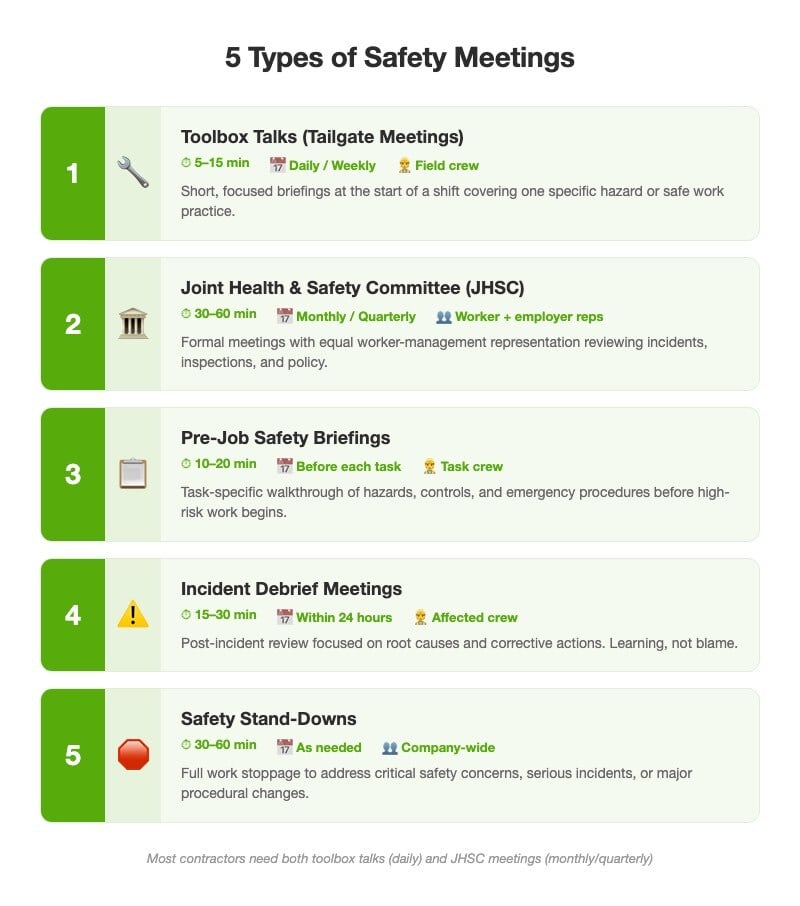
Short, focused, and frequent. Toolbox talks run 5 to 15 minutes, usually at the start of a shift or before a specific task. The supervisor picks one hazard or safe work practice and walks the crew through it. No boardroom, no projector. Just a crew gathered around a tailgate or in a lunch trailer.
In the US, these are often called "tailgate meetings" or "tailgate safety meetings," especially in construction. In Canada, "toolbox talk" is the standard term. Same format, different name. SE publishes 365+ free toolbox talk topics covering everything from fall protection to heat stress.
Formal, documented, and legally required in most Canadian provinces and several US states. A JHSC is a standing committee with equal numbers of worker and employer representatives. They meet on a regular schedule (monthly or quarterly, depending on jurisdiction), review incident data, conduct workplace inspections, and make written recommendations to management.
In Alberta, you need a JHSC if you have 20 or more regularly employed workers (Alberta OHS Act, Part 2, s.13-16). In Ontario, the threshold is also 20 workers under OHSA Section 9. In BC, WorkSafeBC requires a JOHSC for workplaces with 20 or more workers, and a worker representative for 10 to 19.
Before any high-risk or unfamiliar task, the crew gathers to walk through the hazards, controls, and emergency procedures specific to that job. In Canada, this ties directly to the Field Level Hazard Assessment (FLHA) process. In the US, it is part of the Job Hazard Analysis (JHA) workflow.
Pre-job briefings are not the same as daily toolbox talks. A toolbox talk covers a general topic. A pre-job briefing covers this specific task, this specific crew, these specific hazards, right now.
After any incident, near-miss, or first aid event, the affected crew meets to review what happened, identify root causes, and agree on corrective actions. The goal is learning, not blame. If your incident debrief turns into a finger-pointing session, your crew will stop reporting near-misses, and your incident data will go dark.
A stand-down is a project-wide or company-wide pause in work to focus on a specific safety issue. OSHA runs a National Safety Stand-Down to Prevent Falls in Construction every May. Companies also call their own stand-downs after a serious incident, a spike in near-misses, or when introducing a major procedural change.
Most people assume OSHA requires safety meetings. They are wrong. The answer depends entirely on where you operate and what type of work you do.
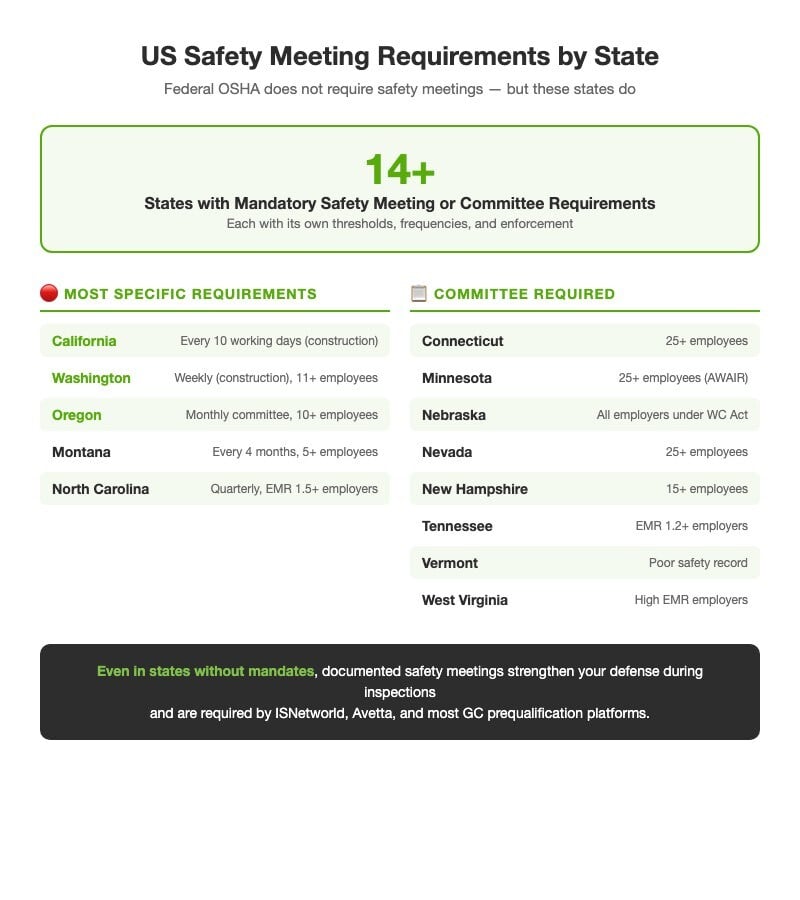
Federal OSHA does not explicitly require safety meetings. The General Duty Clause (OSH Act Section 5(a)(1)) requires employers to provide a workplace "free from recognized hazards," but it does not specify safety meetings as a compliance method. OSHA's Recommended Practices for Safety and Health Programs strongly encourage worker participation through meetings, but "recommended" is not "required."
State-plan states are a different story. At least 14 states have their own safety committee or safety meeting mandates that go beyond federal OSHA:
Even in states without explicit mandates, running regular safety meetings creates a documented safety culture that strengthens your defense if OSHA ever inspects. The companies in OSHA's Voluntary Protection Program (VPP) all run safety meetings. That is not a coincidence.
Every Canadian province and the federal jurisdiction mandate some form of safety committee or representative based on workforce size. The thresholds vary, but the pattern is consistent:
For contractors pursuing COR or SECOR certification, documented safety meetings are an auditable element. Auditors check meeting frequency, attendance records, topic relevance, and follow-up on action items. If your meetings are not documented, they did not happen as far as the audit is concerned.
Running Meetings but Not Sure They Count for Your Audit?
SE AI tracks meeting frequency, attendance gaps, and missing documentation before your auditor finds them.
30-Day Free TrialHere is the blunt truth about most safety meetings: they are boring. Workers show up because they have to, the supervisor reads a topic from a binder, everyone signs the sheet, and they go back to work having absorbed nothing. That is not a safety meeting. That is attendance theatre.
Effective safety meetings follow a simple pattern:
Before the meeting: Pick a topic that is relevant right now. Not a random topic from a list. If you had a near-miss with a forklift yesterday, tomorrow's toolbox talk is about forklift safety. If temperatures are hitting 35 degrees this week, the topic is heat stress. Review any recent incident reports or inspection findings.
During the meeting: Keep it short. Toolbox talks should be 5 to 15 minutes. JHSC meetings should run 30 to 60 minutes. Ask your crew questions instead of reading at them. "What would you do if..." gets more engagement than "OSHA standard 1926.501 requires..." The moment you lose the crew, the meeting is over regardless of how much content you have left.
After the meeting: Document everything: date, attendees, topic, discussion points, action items. Assign action items to specific people with specific deadlines. Follow up at the next meeting. If action items from last week's meeting never get addressed, your crew learns that safety meetings are just talk.
For a detailed walkthrough with templates and examples, see our guide on how to run an effective safety meeting.
The best safety meeting topics come from your own operation, not from a generic list. Start here:
We maintain a list of 100+ safety meeting topics organized by industry and season, plus 365 free toolbox talk topics you can download and use immediately.
If it is not documented, it did not happen. Every safety meeting should produce a record that includes:
How long you keep these records depends on your jurisdiction. In most Canadian provinces, safety records should be retained for at least three years; COR auditors may review documentation going back further. In the US, OSHA does not specify a retention period for meeting records, but state-plan states may; keeping five years of records is a safe baseline.
Digital documentation is replacing paper sign-in sheets on most job sites. A phone-based form captures the same data, adds GPS location and timestamps automatically, and is searchable when an auditor asks for records from six months ago. If you are still using paper binders, you are making your next audit harder than it needs to be. Download our free safety meeting templates to get started.
These terms get used interchangeably, but they are not the same thing.
| Element | Toolbox Talk / Tailgate Meeting | Formal Safety Meeting (JHSC) |
|---|---|---|
| Duration | 5-15 minutes | 30-60 minutes |
| Frequency | Daily to weekly | Monthly to quarterly |
| Who runs it | Supervisor or foreman | Committee co-chairs |
| Attendees | Field crew | Worker + employer representatives |
| Documentation | Sign-in sheet, topic covered | Formal minutes, recommendations, action items |
| Format | Informal, on-site | Structured agenda, meeting room |
Most contractors need both. Toolbox talks keep safety top-of-mind at the crew level every day. JHSC meetings handle the big-picture issues: incident trends, policy changes, workplace inspection findings, and recommendations to senior management. For a deeper comparison, see our guide on toolbox talks vs safety meetings.
Your Safety Meetings Should Build a Compliance Paper Trail
SE AI turns meeting records, attendance data, and action items into audit-ready documentation. Stop scrambling before every COR audit.
30-Day Free TrialIt depends on the type of meeting. Toolbox talks should be held daily or weekly for field crews. Formal JHSC meetings are typically monthly or quarterly, depending on your jurisdiction. Cal/OSHA requires construction tailgate meetings at least every 10 working days. Washington requires weekly crew meetings for construction. Check your specific state or provincial requirements for the minimum frequency that applies to your operation.
Federal OSHA does not explicitly require safety meetings. However, at least 14 US states with their own OSHA-approved plans do mandate safety committees or meetings. California, Washington, and Oregon have the most specific requirements. Even in states without mandates, OSHA's Recommended Practices for Safety and Health Programs encourage regular safety meetings as part of an effective safety program.
A toolbox talk (also called a tailgate meeting in the US) is a short, informal, topic-specific safety briefing lasting 5 to 15 minutes, typically held at the start of a shift for field crews. A formal safety meeting (such as a JHSC meeting) is a scheduled, documented session lasting 30 to 60 minutes, with both worker and management representatives, formal minutes, and written recommendations. Most contractors need both types.
For toolbox talks, the entire field crew working that shift should attend. For JHSC meetings, attendance is limited to the committee members: an equal number of worker-elected representatives and employer-appointed representatives. Pre-job briefings include everyone assigned to that specific task. Incident debriefs include the affected crew, the supervisor, and any investigators.
Start with recent incidents or near-misses from your own site. Then cover seasonal hazards relevant to the current weather (heat stress in summer, cold stress in winter). For high-risk tasks coming up that week, run a task-specific briefing. Regulatory updates and upcoming audit elements also make strong meeting topics. Avoid generic topics that do not connect to what your crew is actually doing this week.
Get Weekly Safety Insights
Regulation updates, toolbox talk ideas, and compliance tips. One email per week.
Federal OSHA doesn't require safety meetings, but 14+ states do. State-by-state requirements, Cal/OSHA's 10-day rule, and why you need them anyway.
Stop picking safety meeting topics at random. This 5-step framework matches topics to your hazard profile, season, and current work activities.
How often are safety meetings required in Canada? Provincial JHSC rules, meeting frequency, and what COR auditors expect. AB, BC, ON, SK covered.