Training
H2S Alive: Training Guide for Canadian Workers
H2S Alive costs $150-$250, takes one day, and lasts 3 years. Here's what to expect, who needs it, and how to choose a provider.
Learn how to respond to an H2S leak at work. Step-by-step emergency procedures, evacuation rules, and rescue protocols for Canadian workplaces.
Last updated: March 2026
Your monitor just hit 10 ppm. The alarm is screaming. Three workers are between the source and the wind, and nobody can remember where the assembly point is. This is the moment your emergency response plan either works or doesn't. There is no middle ground with hydrogen sulfide.
If you are not sure your current H2S response plan would survive a real event, Safety Evolution can analyse your emergency response documentation and show you exactly where the gaps are. Here is what yours needs to cover.
Quick Answer: What to Do During an H2S Leak
An H2S leak is an uncontrolled release of hydrogen sulfide gas into the air, most commonly occurring in oil and gas operations, wastewater treatment, pulp mills, and any environment where organic material decomposes. H2S is colourless, heavier than air (specific gravity of 1.19), flammable in concentrations between 4.3% and 46%, and lethal at concentrations most people encounter in confined or low-lying spaces.
Here's what makes an H2S gas leak uniquely dangerous compared to other chemical releases: your nose lies to you. At low concentrations (0.01 to 1.5 ppm), you'll notice a rotten egg smell. But at 100 ppm, your olfactory nerve shuts down within 2 to 15 minutes. You stop smelling the gas entirely. Meanwhile, the concentration keeps climbing. Workers have walked into lethal atmospheres convinced the danger had passed because they couldn't smell anything anymore.
The NIOSH Immediately Dangerous to Life or Health (IDLH) threshold is 100 ppm. At 700 to 1,000 ppm, rapid unconsciousness can occur within 1-2 breaths. That gap between "I can't smell it anymore" and "one breath kills" is where most H2S fatalities happen.
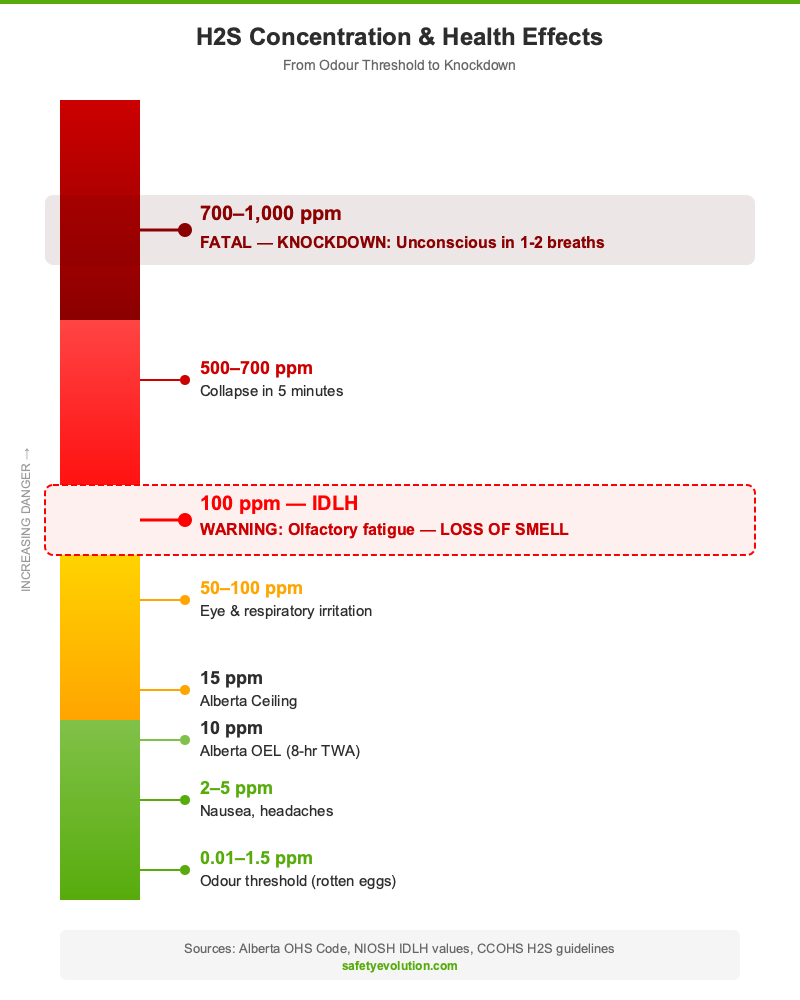
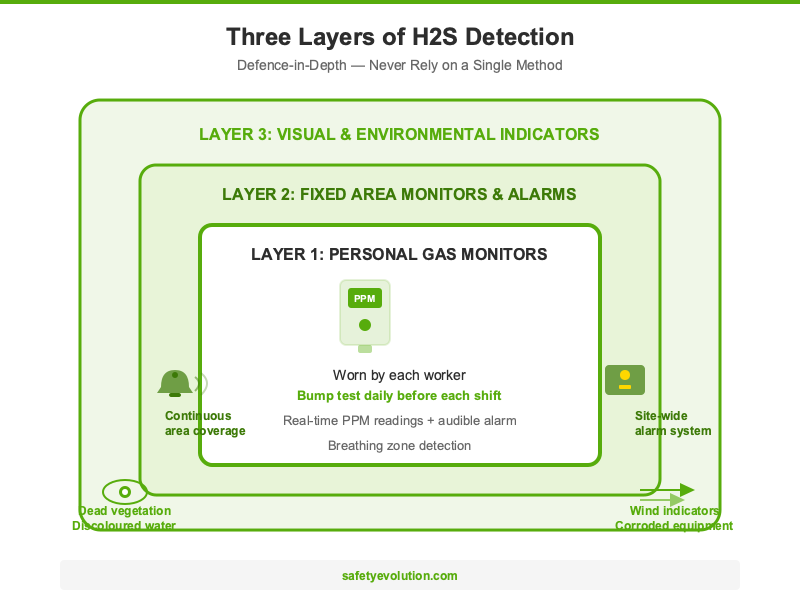
Most contractors think they'll smell an H2S leak and have time to react. They're wrong. Relying on your sense of smell is the single most common mistake in H2S detection, and it has killed people. Your emergency response plan needs three layers of detection, not one.
Every worker in an H2S environment needs a personal gas monitor clipped at the breathing zone. Single-gas H2S detectors or 4-gas monitors with an H2S sensor are standard. Typical alarm setpoints are 10 ppm for the low alarm (matching Alberta's 8-hour occupational exposure limit) and 15 ppm for the high alarm (matching Alberta's ceiling limit). BC uses a 10 ppm ceiling limit. Configure your monitors to match your jurisdiction's requirements.
Monitors must be bump tested before every shift and calibrated according to the manufacturer's schedule. A monitor that hasn't been bump tested is a paperweight with a false sense of security. If your team treats bump testing as optional, your detection system has a gap that will show up at the worst possible time.
Facilities with known H2S sources need continuous area monitoring with audible and visual alarms. WorkSafeBC specifically requires air monitoring equipment and warning alarms to be installed in H2S work areas. These systems catch ambient leaks before personal monitors alarm, giving everyone on site earlier warning.
H2S leaves traces. Dead vegetation near wellheads, pits, or process equipment. Tarnished copper or silver components. Discoloured paint on metal surfaces. Dead birds or small animals near low-lying areas. These indicators don't replace monitors, but they do tell you something is wrong before you walk into it. Train your crew to recognize them.
If you need help building a detection program that meets Alberta OHS Code or WorkSafeBC requirements, Safety Evolution's done-for-you safety services can set it up for you.
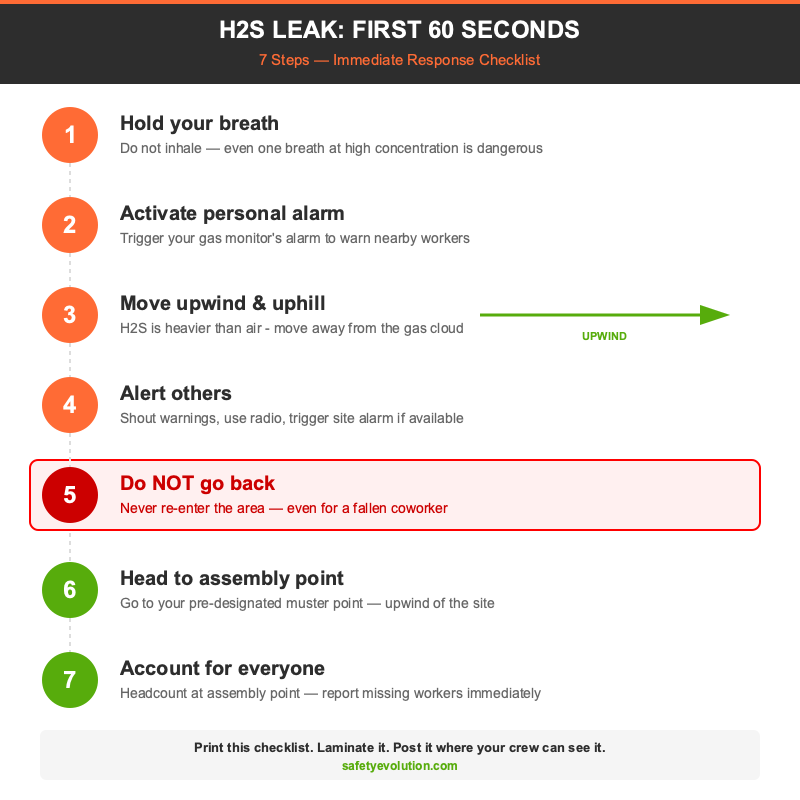
When the alarm sounds, the first minute determines the outcome. Here's the sequence, in order. Drilling this into your crew is the difference between an incident report and a fatality investigation.
That's it. Seven steps. If your crew can't execute them from muscle memory, you haven't drilled enough. Alberta OHS Code Section 117 requires employers to simulate potential emergencies at regular intervals. BC requires the same under the OHS Regulation. Annual drills are the minimum. Quarterly is better. Monthly for high-risk sites.
Evacuation sounds simple until you realize the wind shifted and your assembly point is now downwind of the source. Your evacuation plan needs to account for changing conditions, not just a single scenario.
Install windsocks at multiple locations across your site. WorkSafeBC explicitly requires a wind direction indicator near H2S work areas. Your evacuation routes must have at least two options based on wind direction. The primary route goes upwind. The secondary route handles a wind shift. Mark both on site maps, and make sure every worker has seen them.
Designated assembly points must be upwind, uphill, and far enough from the source that concentrations won't reach workers during a sustained release. 100 metres is a common starting distance for outdoor operations, but the right distance depends on the source volume, prevailing winds, and terrain. Re-evaluate assembly point locations when site conditions change.
If the H2S leak involves a confined space (tanks, vessels, manholes, excavations), the evacuation is more complex. H2S settles into low-lying and enclosed areas fast. Workers in confined spaces need pre-planned escape routes, personal escape-only respirators, and constant communication with a topside attendant. The attendant's job is to initiate the rescue protocol the second communication drops.
For a complete guide to building an emergency response plan that covers all these scenarios, see our post on how to create an emergency response plan.
Can your crew access the Emergency Response Plan in seconds?
Paper ERPs don't help when alarms go off. Put emergency procedures on every worker's phone. Start your 30-Day Free Trial.
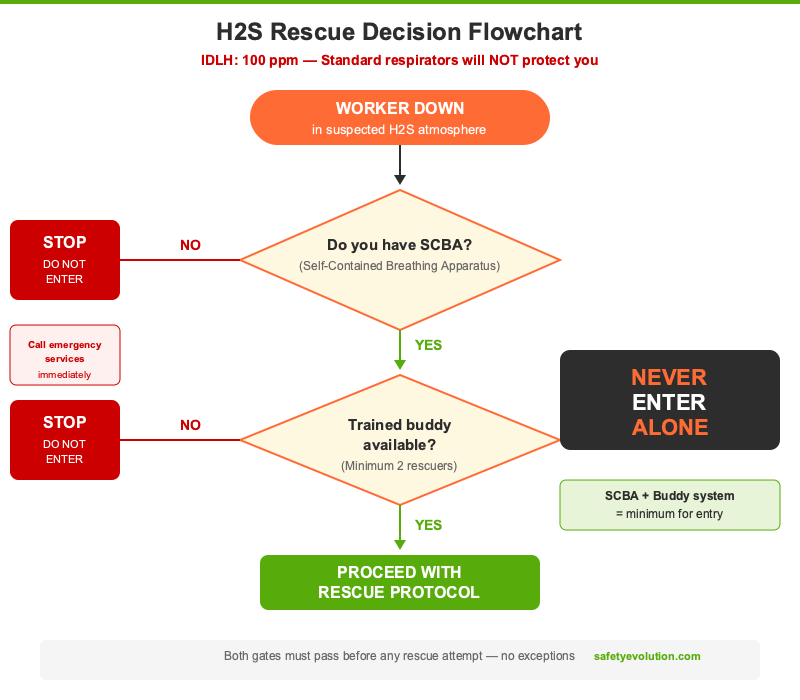
30-Day Free TrialThis is the blunt truth: would-be rescuers are the second-largest category of H2S fatalities. A worker goes down. A co-worker rushes in to help. Now you have two casualties. In some incidents, a third person follows. The rescue attempt becomes a mass casualty event.
Never enter an H2S atmosphere without a self-contained breathing apparatus (SCBA). Air-purifying respirators (cartridge respirators) are not rated for IDLH atmospheres. They filter contaminants from the air, but they can't supply clean air when there isn't enough oxygen or when H2S concentrations exceed the cartridge's capacity. In an IDLH environment (100 ppm or higher), only supplied air keeps you alive.
Every rescue attempt requires a minimum of two trained rescuers, with at least one remaining outside the hazard zone as a standby. The standby rescuer maintains communication, monitors conditions, and calls for additional help. This isn't a suggestion; it's how H2S Alive training teaches rescue procedures, and it's what Alberta OHS Code Sections 117 and 118 require when designating rescue workers.
Something most people don't learn until H2S Alive training: rescue victims off-gas hydrogen sulfide from their clothing, skin, and exhaled breath. CCOHS specifically warns that victims may pose a threat to responders. Rescuers need SCBA throughout the entire extraction, and decontamination should happen before moving victims into enclosed spaces like ambulances or first aid rooms.
If your crews work in H2S environments and you don't have trained rescue teams with SCBA equipment, you need to fix that before the next shift. Safety Evolution can check your training records and equipment logs and identify the gaps in your current program.
Both Alberta and British Columbia have specific requirements for emergency response plans in workplaces with H2S hazards. If you operate in oil and gas, wastewater, agriculture, or any industry with H2S exposure potential, these requirements apply to you.
Section 116 of Alberta's OHS Code requires your emergency response plan to include:
Section 117 requires employers to designate rescue and evacuation workers, train them, simulate potential emergencies, and repeat those simulations at required intervals. Section 118 requires the employer to provide equipment and PPE appropriate to the emergency. This means SCBA units for rescue teams, personal monitors for all workers, and area monitoring equipment for the site. For a full comparison of H2S exposure limits across Canadian provinces, see our detailed breakdown.
Alberta also requires the employer to involve affected workers in establishing the plan (Section 115(2)) and keep the plan current (Section 115(3)). A plan that sits in a binder untouched since 2019 doesn't comply.
BC's regulation under Part 5 (Chemical Agents and Biological Agents) requires employers to develop a written exposure control plan and a rescue plan for areas where H2S is an extreme hazard. WorkSafeBC specifically calls for:
For a comprehensive look at employer obligations across all aspects of H2S safety, see our H2S gas safety employer guide.
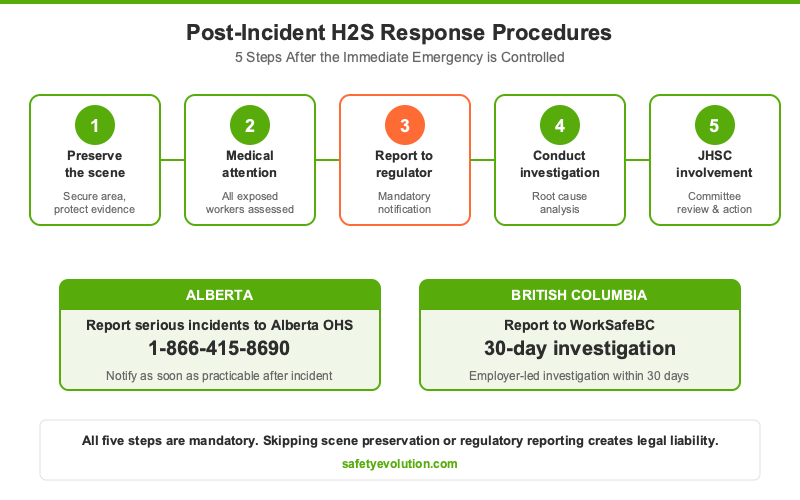
The leak is controlled. Everyone is accounted for. Now comes the part that determines whether it happens again.
Most incident investigations stop at "the valve failed." The useful ones ask why the valve failed, why nobody caught it during the last inspection, why the inspection checklist didn't include that valve, and why the procedure that was supposed to catch it wasn't followed. Root cause analysis isn't paperwork. It's how you find the systemic failure before it kills someone.
SE's free incident report and investigation kit walks you through a structured investigation framework, from scene preservation to corrective action tracking. It's built for the kind of investigation regulators expect to see.
For more on structuring effective incident reports, see our guide on the 7 essential elements of an incident report.
Writing an emergency response plan is straightforward. Building one that your crew will actually follow under stress is harder. Here's what separates plans that save lives from plans that collect dust.
If you don't have the in-house expertise to build or audit your H2S emergency response plan, that's exactly what Safety Evolution does. We're a done-for-you safety department, not a consulting firm that hands you a binder and walks away. We build the plan, train your people, and make sure it stays current.
Ensure your rescue procedures are bulletproof.
Manage your drills, incident reports, and ERPs in one system. Start your 30-Day Free Trial to digitize your emergency readiness.
30-Day Free TrialDon respiratory protection if available, move upwind and uphill immediately, activate your personal alarm, and alert other workers. Head to the designated assembly point and conduct a headcount. Never re-enter the area without a self-contained breathing apparatus (SCBA). The first 60 seconds determine the outcome; your response must be trained to the point of muscle memory.
No. While H2S has a distinctive rotten egg odour at low concentrations (0.01 to 1.5 ppm), olfactory fatigue sets in at approximately 100 ppm. Your sense of smell shuts down within 2 to 15 minutes, leaving you unable to detect the gas at the exact concentrations that are lethal. Always use calibrated personal gas monitors and fixed area detection systems.
Air-purifying respirators (cartridge-style) filter contaminants from the existing air but cannot supply breathable air when concentrations exceed the cartridge's capacity or when oxygen levels are too low. At IDLH concentrations (100 ppm and above), only a self-contained breathing apparatus provides a safe, independent air supply. H2S Alive training includes hands-on SCBA operation for this reason.
Alberta OHS Code Part 7 (Sections 115-118) requires employers to establish a written emergency response plan that identifies potential emergencies, outlines response procedures, designates trained rescue workers, specifies equipment and PPE requirements, and defines evacuation and communication procedures. The plan must be developed with worker involvement, kept current, and tested through regular emergency simulations.
In Alberta, report serious incidents immediately to OHS at 1-866-415-8690. In British Columbia, report immediately to WorkSafeBC's Prevention Information Line. Preserve the incident scene, provide medical attention to exposed workers, and begin a formal investigation. In BC, the full investigation report must be submitted to WorkSafeBC within 30 days. Both provinces require joint health and safety committee involvement in incident investigations.
Always evacuate upwind and uphill. H2S is heavier than air (specific gravity 1.19) and settles in low-lying areas, ditches, and confined spaces. Check the windsock before moving. Your site should have windsocks at multiple locations and at least two evacuation routes based on different wind directions. Assembly points must be located upwind of potential H2S sources.
Get Weekly Safety Insights
Regulation updates, toolbox talk ideas, and compliance tips. One email per week.
H2S Alive costs $150-$250, takes one day, and lasts 3 years. Here's what to expect, who needs it, and how to choose a provider.
H2S gas monitors save lives. Learn which types Canadian workplaces need, what features matter, calibration rules, and how to choose the right...
H2S kills in seconds at high concentrations. Learn Canadian exposure limits, employer duties, and how to build an H2S safety plan for your crew.