Training
H2S Alive: Training Guide for Canadian Workers
H2S Alive costs $150-$250, takes one day, and lasts 3 years. Here's what to expect, who needs it, and how to choose a provider.
H2S kills in seconds at high concentrations. Learn Canadian exposure limits, employer duties, and how to build an H2S safety plan.
Last updated: March 2026
A worker on a sour gas lease in southeastern Alberta steps into a low-lying area beside a wellhead. He smells rotten eggs — then, within minutes, nothing. Not because the gas cleared. Because at 100 ppm, hydrogen sulfide causes olfactory fatigue in 2 to 15 minutes, according to OSHA. Your nose goes silent. At higher concentrations — 700 to 1,000 ppm — collapse can come within 1 to 2 breaths. His personal monitor was in the truck. By the time his partner found him, he was unconscious.
This is not a rare scenario. Alberta's OHS investigation records include multiple fatalities where workers were overcome by H2S at oil batteries, well servicing operations, and confined spaces. Saskatchewan has called sour gas from oil wells a "growing and deadly problem." And it happens fast: at 700–1,000 ppm, hydrogen sulfide can cause rapid unconsciousness within 1–2 breaths.
At Safety Evolution, we help oil and gas contractors, construction companies, and industrial operators across Alberta and BC build H2S safety programs that actually protect their crews. This guide covers everything you need to know as a Canadian employer: what H2S is, how it kills, where your workers are exposed, what the regulations require, and how to build a safety plan that holds up to a site audit.
Hydrogen sulfide (H2S) is a colourless, flammable, and extremely toxic gas that smells like rotten eggs at low concentrations and is 1.19 times heavier than air. It accumulates in low-lying areas, confined spaces, and poorly ventilated enclosures. At higher concentrations, the smell turns sweet, and above 100 ppm, you lose the ability to smell it entirely.
H2S is also called sulfuretted hydrogen, and has been referred to as sewer gas or stink damp. In oil and gas, "sour gas" means natural gas that contains hydrogen sulfide — it is not another name for pure H2S. It is both a chemical asphyxiant (it poisons the body's ability to use oxygen at the cellular level) and an irritant. It is flammable and explosive in air at concentrations between 4.3% and 46%.
H2S shows up wherever organic material breaks down or wherever you encounter sour gas reservoirs. If you run a crew in any of these sectors, your workers are at risk:
The common thread is that H2S is heavier than air. It pools in low spots: ditches, basements, tank bottoms, excavations, manholes. A work area that tested clean at breathing height can have lethal concentrations at knee level.
If your crews work in any of these environments, you need a formal H2S safety program. Not a toolbox talk. A documented, auditable program with monitoring, training, respiratory protection, and emergency response. Safety Evolution's done-for-you safety services can build one from scratch or audit what you already have.
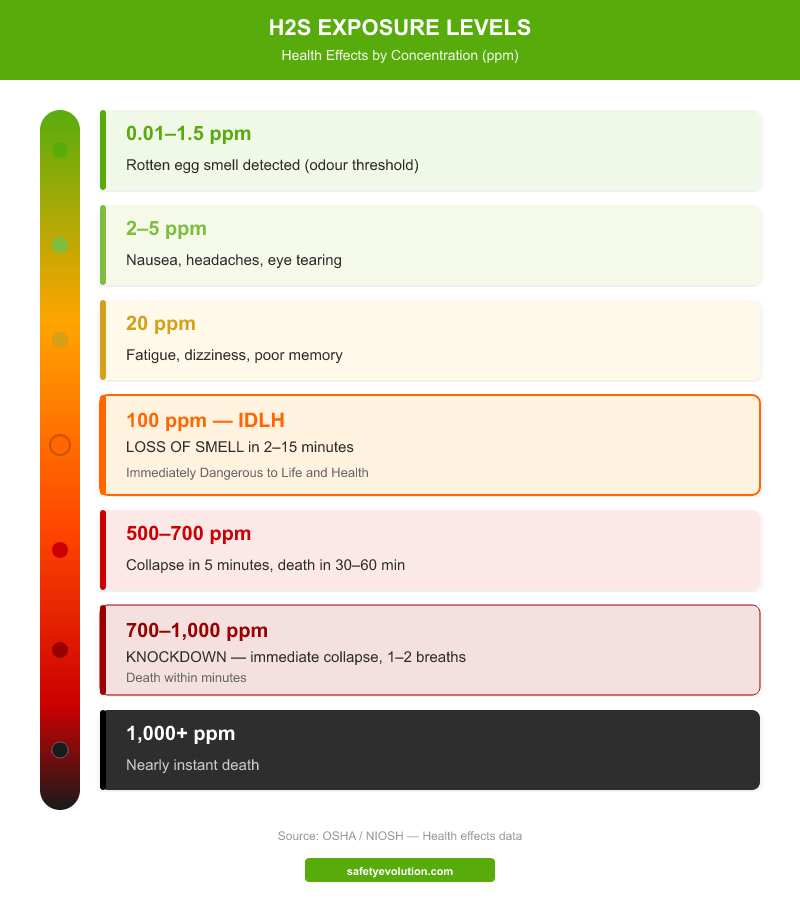
Most contractors think H2S is only dangerous at high concentrations. That is wrong. Repeated or prolonged exposure at low levels can cause irritation and symptoms including headache, fatigue, irritability, nausea, and sleep disturbance. Persistent neurological problems are more clearly documented after serious acute exposures, particularly those involving loss of consciousness. And the transition from "uncomfortable" to "dead" can happen in minutes, not hours.
Here is what happens to the human body as H2S concentration increases:
| Concentration (ppm) | Effect on Workers |
|---|---|
| 0.01 to 1.5 | Odour threshold. Rotten egg smell first noticeable. Offensive at 3-5 ppm. |
| 2 to 5 | Nausea, tearing of eyes, headaches, loss of sleep with prolonged exposure. Bronchial constriction in asthma patients. |
| 10 | Alberta 8-hour OEL / BC ceiling limit. This is your regulatory ceiling for extended work. |
| 20 | Fatigue, loss of appetite, headache, irritability, poor memory, dizziness. |
| 50 to 100 | Eye irritation ("gas eye"), respiratory tract irritation after 1 hour. Digestive upset. |
| 100 (IDLH) | Loss of smell in 2-15 minutes. Coughing, drowsiness. Throat irritation. Death possible after 48 hours of continuous exposure. |
| 200 to 300 | Severe eye and respiratory irritation. Risk of pulmonary edema (fluid in lungs). |
| 500 to 700 | Staggering and collapse in 5 minutes. Serious eye damage in 30 minutes. Death in 30-60 minutes. |
| 700 to 1,000 | "Knockdown." Immediate collapse within 1-2 breaths. Breathing stops. Death within minutes. |
| 1,000+ | Nearly instant death. |
The most dangerous number on that chart is 100 ppm, not 1,000. That is where olfactory fatigue kicks in. Your nose stops detecting the gas. Workers assume the area is safe because the smell is gone. That false sense of safety has killed more people than the high-concentration knockdowns, because at least with knockdown, nobody walks willingly into the cloud.
Long-term effects matter too. Workers who survive acute H2S exposure often report lasting headaches, poor attention span, memory problems, and motor function issues. Cardiovascular problems have been documented at exposures above occupational limits.
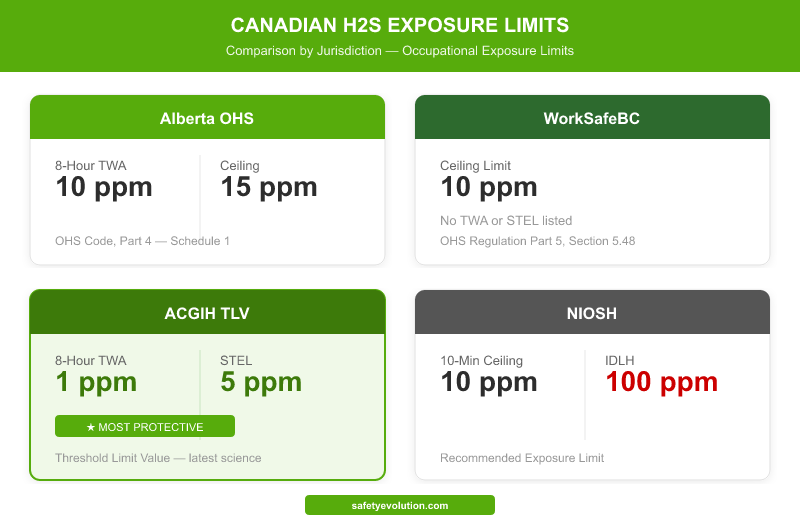
H2S exposure limits vary by province. If you operate in both Alberta and BC, your H2S program needs to meet the more protective standard for each metric. Here is how the major jurisdictions compare:
| Jurisdiction | 8-Hour TWA | Ceiling / STEL | IDLH |
|---|---|---|---|
| Alberta OHS Code | 10 ppm | 15 ppm (ceiling) | 100 ppm |
| WorkSafeBC | N/A | 10 ppm (ceiling) | 100 ppm |
| ACGIH TLV | 1 ppm | 5 ppm (STEL) | 100 ppm |
| NIOSH REL | N/A | 10 ppm (10-min ceiling) | 100 ppm |
Notice the gap between the Alberta OEL (10 ppm TWA) and the ACGIH TLV (1 ppm TWA). The ACGIH values represent the latest science on safe exposure thresholds. Some employers, particularly those with progressive safety programs or workers with existing respiratory conditions, choose to follow ACGIH limits even when provincial regulations allow higher exposures. If you bid on federal projects or work under the Canada Labour Code, your exposure limits may differ from provincial requirements. Federally regulated workplaces are governed by the Canada Occupational Health and Safety Regulations (SOR/86-304), which reference ACGIH TLVs and BEIs as the exposure standards for airborne chemical agents.
The critical takeaway: at 100 ppm (the IDLH), a worker is in immediate danger of death or permanent injury. Your alarm set points should trigger evacuation well below this. Typical industry practice sets low alarms at 10 ppm and high alarms at 15 ppm for personal monitors.
If your crew works in or near sour gas environments, H2S training is essential — but not every worker needs the same course. Here is the honest breakdown.
H2S Alive is the industry-standard training program administered by Energy Safety Canada. It is required for workers who will work in H2S environments and may be assigned respiratory protective equipment. It is a full-day course (approximately 8 hours) covering H2S properties, health hazards, hazard assessment and control, respiratory protective equipment, H2S detection, and initial response strategy. Every participant must physically demonstrate putting on a mask and breathing under air, performing rescue drag techniques, and donning and doffing a self-contained breathing apparatus (SCBA). The certificate is valid for 3 years.
Most GCs in Alberta's oil and gas sector will not let you on site without a current H2S Alive ticket. For field workers in H2S environments, it is as non-negotiable as your safety orientation.
H2S Awareness is a separate course offered by Energy Safety Canada for workers who may attend a location where H2S is present but who are NOT assigned respiratory protective equipment and are NOT expected to work directly in an H2S environment. It is typically 4 hours and covers properties, health effects, safe work practices, and emergency response. It does not include hands-on SCBA or rescue components. H2S Awareness is appropriate for office staff, management, delivery personnel, or workers in adjacent areas. H2S Awareness is not a replacement for H2S Alive.
The distinction matters: H2S Alive is for workers who will work in H2S environments, may be assigned respiratory equipment, and might need to rescue someone or escape through an H2S cloud while wearing SCBA. Awareness is for people who need to recognize the hazard and evacuate but will not be working in the H2S environment itself. Sending a field worker to an awareness course instead of H2S Alive is a compliance gap that auditors catch and that can get someone killed.
On the standards side, use the applicable provincial OHS rules and Energy Safety Canada guidance as your primary framework. The ANSI/ASSP Z390.1 standard addresses H2S training and safety management and may be referenced as a supplementary best practice. Aligning your safety plan with both provincial requirements and recognized industry standards demonstrates that your program goes beyond the regulatory minimum.
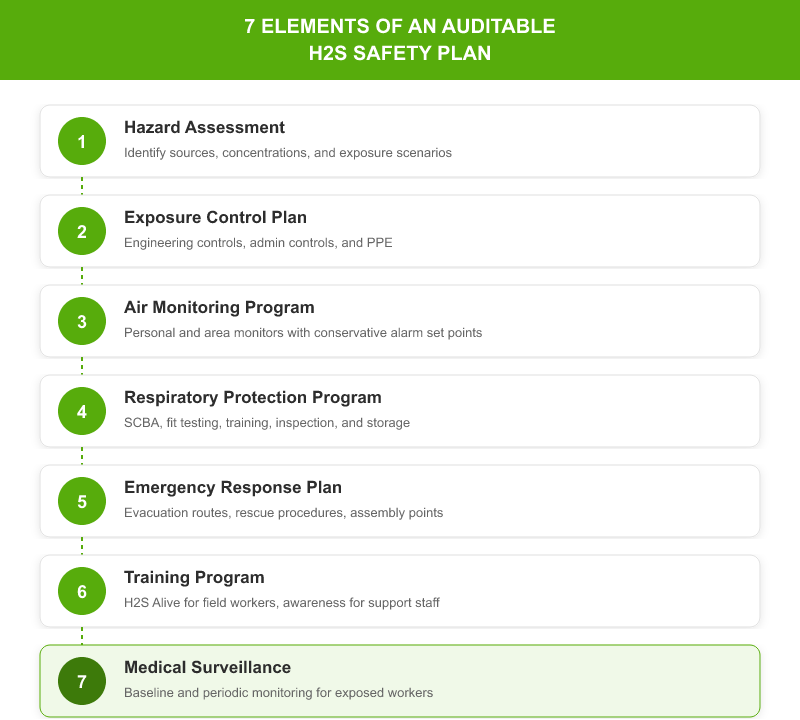
A binder on a shelf labelled "H2S Safety Plan" is not a safety plan. We have seen contractors with 200-page manuals that nobody has read, no current monitoring data, expired training certificates, and emergency response procedures that reference equipment the company does not own. An auditor will see right through that in about 10 minutes.
Here is what an auditable H2S safety plan actually requires:
Identify every task, location, and scenario where your workers could encounter H2S. This includes the obvious (well servicing, tank entry) and the overlooked (excavation near old landfills, sewer line tie-ins). Document the potential sources, expected concentration ranges, and exposure duration for each scenario. Update the assessment when you take on new work or change operations.
Apply the hierarchy of controls specifically to H2S:
Every worker in an H2S environment needs a personal gas monitor. Period. Area monitors cover fixed locations, but H2S concentrations shift with wind, temperature, and activity. A personal monitor on the worker's breathing zone is the only reliable way to catch an exposure before it becomes an emergency.
Set alarm points conservatively: low alarm at 10 ppm, high alarm at 15 ppm. Some operations set the low alarm at 5 ppm. Calibrate monitors according to the manufacturer's schedule and document every calibration. An uncalibrated monitor is worse than no monitor, because it gives false confidence.
Your RPP needs to cover equipment selection, fit testing (annual, documented), training on donning and doffing, inspection and maintenance schedules, and storage requirements. Per Energy Safety Canada guidance, if workers enter an area with more than 10 ppm H2S, they should use full-face pressure-demand SCBA or a combination supplied-air respirator with auxiliary self-contained air supply. Air-purifying respirators should only be considered where a thorough hazard assessment confirms adequate oxygen content, known and stable contaminant concentrations below IDLH, appropriate approved cartridges, and site-specific procedures are in place — consult your occupational hygienist before relying on APRs in any H2S environment. Workers with facial hair that breaks the respirator seal cannot be assigned to H2S work without a supplied-air alternative.
This is where most H2S safety plans fall apart. The plan looks fine on paper, but nobody has practised it, the SCBA units are expired, and the assembly point is downwind from the wellhead.
Your emergency response plan for H2S must include: evacuation routes mapped for multiple wind directions, designated assembly points upwind and uphill, rescue team assignments with current SCBA training, communication protocols (who calls 911, who accounts for personnel), first aid procedures specific to H2S exposure (move to fresh air, CPR if needed, do NOT enter without SCBA), and annual drill documentation.
H2S Alive for every worker who will work in an H2S environment and may be assigned respiratory protective equipment. H2S Awareness for support staff, management, and workers who may attend a location with H2S but are not assigned respiratory equipment and are not expected to work in the H2S environment. Track certificate expiry dates and schedule renewals before they lapse. Safety Evolution's training tracking system automates expiry alerts so you never have a worker on site with an expired ticket.
Medical monitoring may be appropriate based on the exposure assessment, control strategy, and occupational health advice. It is a risk-based program element, not a universal standalone legal requirement in every Alberta or BC workplace. WorkSafeBC's exposure control plan guidance includes health monitoring when required, and Alberta OHS Code Part 4 has explicit health assessment requirements for some substances but not a blanket H2S medical surveillance mandate. Where medical monitoring is implemented, it typically includes baseline respiratory function testing, documentation of pre-existing conditions that increase H2S sensitivity (asthma, cardiovascular conditions), and periodic follow-up. Even where not strictly mandated, medical monitoring strengthens your due diligence position and demonstrates employer commitment to worker health.
Building all seven of these elements, keeping them current, and making sure your field crew actually follows them is a full-time job. That is why contractors with 50 to 500 employees hire Safety Evolution as their done-for-you safety department. We build the program, manage the documentation, track the training, and keep you audit-ready.
If you are in oil and gas in Western Canada, H2S is not a theoretical hazard. It is a daily operational reality. Alberta and Saskatchewan sit on some of the largest sour gas reserves in the world. Concentrations at the wellhead can exceed 30% H2S, which is 300,000 ppm. That is 3,000 times the IDLH.
What makes oil and gas H2S exposure particularly dangerous:
The Alberta Energy Regulator (AER) and provincial OHS both govern H2S operations in the oil patch, and non-compliance carries serious consequences. Stop-work orders, fines, and the reputational damage from an incident can end a contractor's ability to bid on sour gas work permanently.
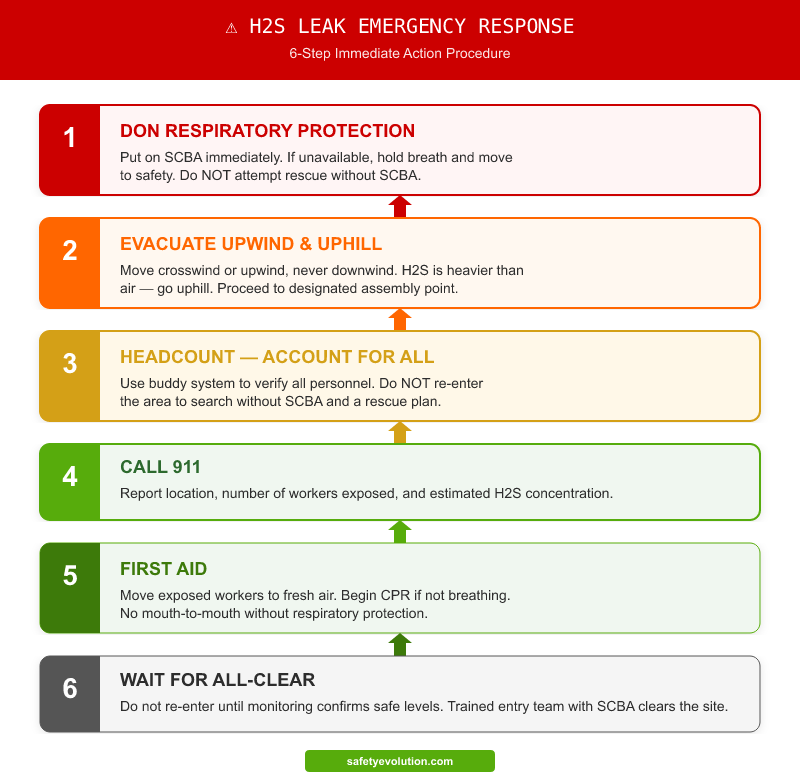
When a personal monitor hits the high alarm or you smell that unmistakable rotten egg odour, the response must be immediate and automatic. Hesitation kills.
The biggest mistake during an H2S emergency is the untrained rescue attempt. A worker goes down. A coworker runs in to help without SCBA. Now you have two casualties. This scenario has repeated itself in multiple Canadian workplace fatalities. It is why H2S Alive training includes rescue drag techniques with SCBA, and why your emergency response plan must explicitly prohibit unprotected rescue entry.
If your crew does not have an incident investigation process in place before something goes wrong, you are not prepared. Download Safety Evolution's free investigation kit to build that capability now, not after an incident forces your hand.
Want Expert Eyes on Your Safety Program?
Book a free 30-minute assessment with a safety consultant. You'll get a 90-day action plan, whether you work with us or not.
Get Your Free Assessment →H2S smells like rotten eggs at low concentrations (0.01 to 5 ppm). As concentrations increase above 30 ppm, the odour becomes sweet or sickeningly sweet. At 100 ppm and above, olfactory fatigue sets in and you lose the ability to smell the gas entirely. This is extremely dangerous because workers assume the gas has dissipated when they can no longer smell it. Never rely on your sense of smell to detect H2S; always use a calibrated personal gas monitor.
H2S exposure limits in Canada vary by province. Alberta's OHS Code sets the occupational exposure limit at 10 ppm as an 8-hour time-weighted average (TWA) with a 15 ppm ceiling. WorkSafeBC sets a ceiling limit of 10 ppm. The ACGIH, which many Canadian jurisdictions reference, recommends a TLV of 1 ppm TWA and 5 ppm STEL. The NIOSH Immediately Dangerous to Life and Health (IDLH) level is 100 ppm. Employers should follow the most protective limit applicable to their jurisdiction and project requirements.
At concentrations of 700 to 1,000 ppm, H2S causes immediate collapse ("knockdown") within 1-2 breaths, and death follows within minutes. At 500-700 ppm, workers stagger and collapse within 5 minutes, with death occurring in 30-60 minutes. Concentrations above 1,000 ppm cause nearly instant death. Even the IDLH level of 100 ppm can be fatal with prolonged exposure (48+ hours). The speed of onset is what makes H2S one of the most dangerous gases in Canadian workplaces.
H2S Alive is the industry-standard hydrogen sulfide safety course administered by Energy Safety Canada. It is a full-day course covering H2S properties, health hazards, detection, respiratory protection (including hands-on SCBA use), and initial response strategy. The certificate is valid for 3 years. H2S Alive is required for workers who will work in H2S environments and may be assigned respiratory protective equipment. Energy Safety Canada also offers H2S Awareness for workers who may attend a location with H2S but are not assigned respiratory equipment and not expected to work in the H2S environment — Awareness is not a replacement for H2S Alive. Most general contractors in Alberta's oil and gas sector require a current H2S Alive ticket as a condition of site access for field workers.
H2S is heavier than air, with a specific gravity of 1.19. This means it sinks and accumulates in low-lying areas, confined spaces, basements, ditches, and excavations. When assessing H2S hazards on site, check low points first. A work area that reads safe at head height can have dangerous concentrations at ground level. Always monitor at the breathing zone and at lower elevations when H2S may be present.
If your personal monitor alarms or you smell rotten eggs: don respiratory protection immediately (SCBA if available), move upwind and uphill away from the source, and evacuate to your designated assembly point. Account for all workers using your buddy system. Call emergency services with your location and estimated exposure details. Do not re-enter the contaminated area to rescue others without SCBA and a rescue plan. Provide first aid to exposed workers in fresh air: if the worker is not breathing, begin CPR, but do not perform mouth-to-mouth without respiratory protection.
H2S Alive costs $150-$250, takes one day, and lasts 3 years. Here's what to expect, who needs it, and how to choose a provider.
Learn how to respond to an H2S leak at work. Step-by-step emergency procedures, evacuation rules, and rescue protocols for Canadian workplaces.
Canadian H2S exposure limits by province: Alberta OEL, BC ceiling, ACGIH TLV. Full ppm chart with health effects at every level from odour to fatal.