Last updated: March 2026
You are an Alberta contractor with operators running forklifts on your sites. Maybe you have been doing this for years with training cards from a provider you found online. Maybe you just hired someone who says they are certified but the card is from a company you have never heard of. Alberta's approach to forklift certification is different from BC or Ontario, and that difference catches employers off guard.
Safety Evolution works with Alberta contractors daily. Here is how forklift certification actually works in this province, what Alberta OHS requires, and how to stay on the right side of an inspection.
⚡ Quick Answer
- Regulator: Alberta Occupational Health and Safety (Alberta OHS)
- Key legislation: OHS Code Part 40 (Powered Mobile Equipment)
- Approach: Performance-based. No prescribed curriculum, but employers must ensure competency
- No government-issued licence: Alberta does not issue forklift licences. Certification is employer-driven.
- Renewal: No legislated expiry, but 3-year renewal is industry standard
- Cost: $150 to $350 per operator for initial certification in Alberta
Below, we break down exactly what Alberta OHS requires, how enforcement actually works in this province, and what you need to have documented before an inspector shows up on your site.
What Does Alberta OHS Require for Forklift Operators?
Alberta takes a performance-based approach to forklift training. Unlike BC, which directly references CSA B335-15, Alberta's OHS Code Part 40 focuses on the outcome: the employer must ensure the operator is competent. How you get there is, to a large extent, up to you.
Under Part 40 of the OHS Code, employers must ensure that:
- Operators are trained in the safe operation of the specific equipment they will use
- Operators demonstrate competency before operating independently
- Training records are maintained and available for inspection
- Equipment is inspected before each shift and maintained in safe working condition
The flexibility of Alberta's approach is both a strength and a risk. It means you are not locked into a specific training program, but it also means you cannot point to a regulation and say "we followed the steps." You need to demonstrate that your training program, whatever it looks like, actually produces competent operators.
Common Alberta OHS Violations Related to Forklift Training
Alberta OHS publishes enforcement actions, and forklift-related violations are a recurring theme. The most common citations we see include:
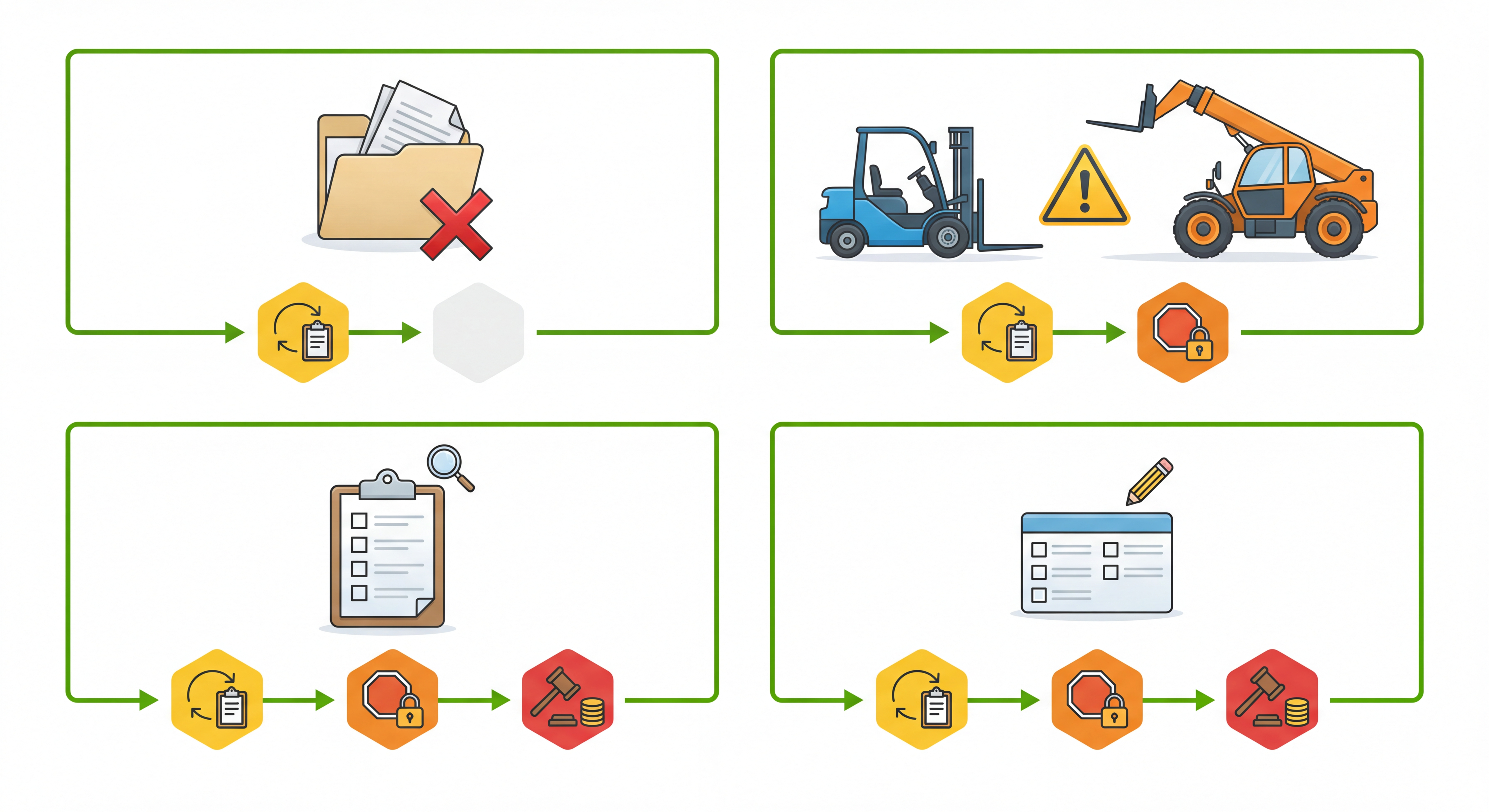
- No training documentation on site: The operator says they are trained, but there are no records to verify it. In Alberta's performance-based system, the burden of proof falls on the employer.
- Training does not match equipment: An operator trained on a warehouse counterbalance is operating a rough terrain telehandler on a construction site. The training record shows one equipment class, but the operator is running a completely different class.
- No evidence of competency evaluation: The operator attended a course, but there is no record of a practical evaluation confirming they can actually operate the equipment safely.
- Pre-shift inspections not documented: The equipment is running, but there are no inspection logs. This is often cited alongside training violations because it suggests a broader failure of the employer's forklift safety management.
Penalties for these violations in Alberta can include compliance orders (fix it within a deadline), stop-work orders (cease forklift operations until resolved), and administrative penalties (fines). For serious violations, especially those contributing to injuries, fines under Alberta's OHS Act can reach $500,000 for individuals and $1,000,000 for corporations.
How to Choose a Training Provider in Alberta
Alberta does not license or certify forklift training providers. Anyone can offer forklift training. This means quality varies enormously, from excellent programs that exceed CSA B335-15 to bare-minimum operations that are barely legitimate.
Here is what to look for:
- CSA B335-15 alignment: Even though Alberta does not mandate CSA B335-15 directly, aligning your training with this standard gives you the strongest defensible position during an inspection or investigation
- Three-component training: Theory, practical, and evaluation. If a provider skips any component, move on.
- Equipment-specific training: Training must cover the specific class and type of equipment the operator will use
- Detailed documentation: The provider should give you more than a wallet card. You need records showing what was covered, on what equipment, with what evaluation results.
- Established reputation: Check references. Ask other contractors in your area who they use.
Alberta Training Provider Red Flags
Because Alberta does not regulate forklift training providers, the market includes both excellent programs and questionable operations. Watch for these warning signs:
- No written curriculum available for review: A legitimate provider should be able to show you their course outline, learning objectives, and evaluation criteria before you book.
- Same-day certification for new operators: A complete beginner cannot realistically cover all required theory, complete adequate practical training, and pass a meaningful evaluation in a single day. Providers offering this are cutting content or cutting corners on evaluation.
- No practical component: Some providers, particularly online-only operations, issue certificates without any hands-on training or evaluation. These certificates are worthless during an Alberta OHS inspection.
- Vague documentation: If the provider issues only a wallet card with a name and date, that is not adequate documentation. You need records showing what was covered, on what equipment, with what evaluation results.
- US-focused content: Providers that reference OSHA rather than CSA B335-15 or Alberta OHS Code Part 40 are not delivering training appropriate for Alberta workplaces.
Training Providers by Region
Alberta's forklift training landscape varies by region:
- Calgary and Edmonton: The most competitive markets with dozens of providers. Competition keeps prices reasonable ($200 to $350 for initial certification), and many offer on-site group training options.
- Red Deer and Lethbridge: Fewer providers, but several established companies serve these areas. Expect similar pricing to Calgary and Edmonton.
- Fort McMurray and northern Alberta: Fewer local options, and those that exist often cater specifically to oil and gas clients. Pricing may be higher ($250 to $400) due to limited competition and the additional requirements of oil and gas operators. On-site training is often the most practical option for remote northern sites.
- Rural Alberta: Access to training providers can be challenging. Mobile trainers who travel to your site are often the best option. Safety Evolution can coordinate on-site training for rural Alberta operations.
30-Day Free Trial and flag where certification gaps exist.
Still tracking forklift certifications in spreadsheets?
If cards expire and no one catches it, you carry the risk. Start a 30-Day Free Trial and track operator status in one place before your next audit.
30-Day Free Trial
Forklift Training Costs in Alberta
Here is what Alberta contractors typically pay:
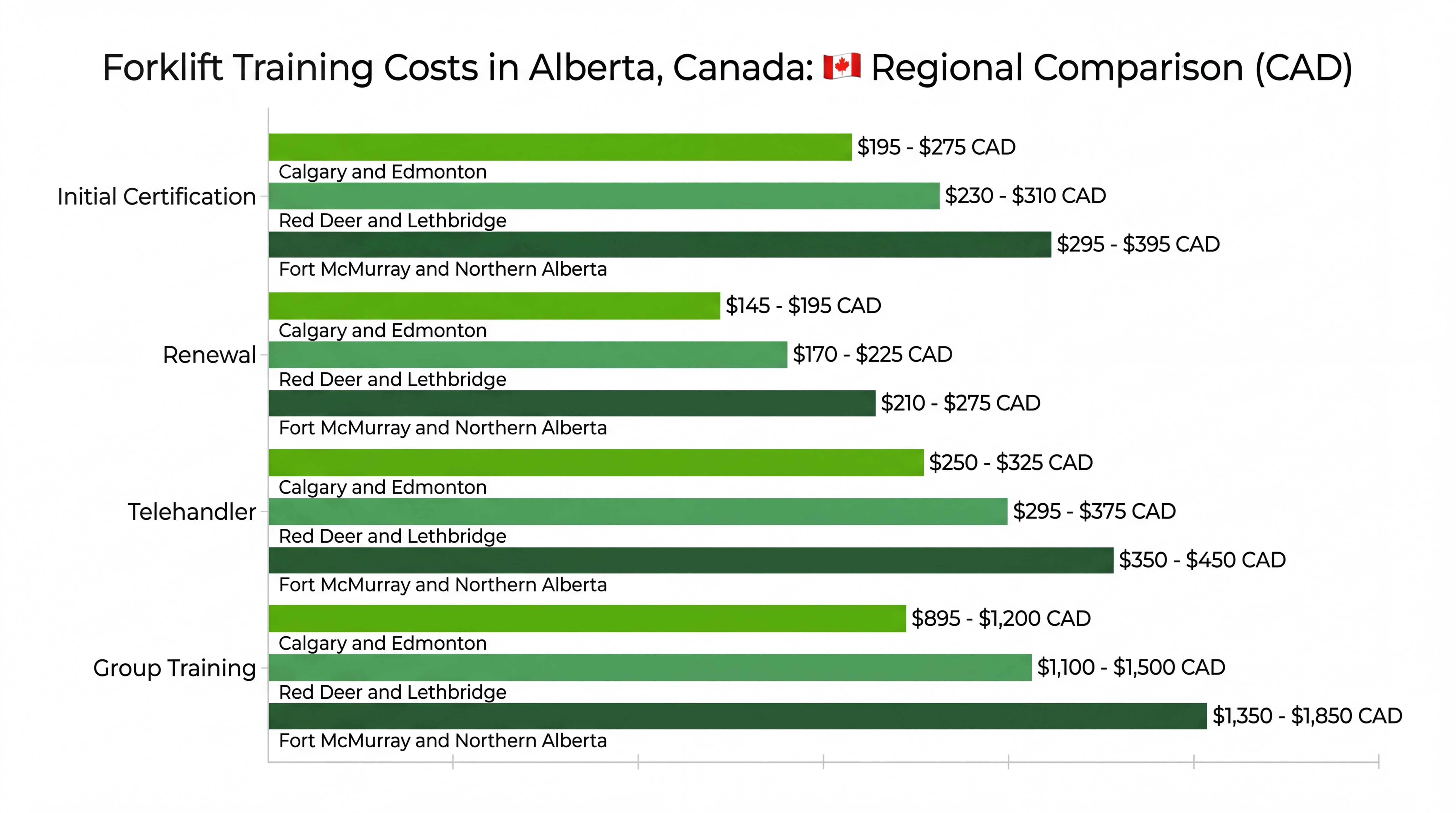
| Training Type |
Typical Cost (Alberta) |
Duration |
| Initial certification (counterbalance) |
$200 to $350 |
1 to 3 days |
| Renewal/refresher |
$100 to $200 |
4 to 8 hours |
| Telehandler / Class 7 |
$250 to $400 |
1 to 2 days |
| On-site group (5+ operators) |
$150 to $250 per person |
Varies |
For a detailed national comparison: How Much Does Forklift Training Cost in Canada?
Alberta-Specific Considerations
Oil and Gas Sites
If your crew operates forklifts on oil and gas sites, you are dealing with additional requirements beyond standard OHS Code Part 40. Many oil and gas companies require ISN, ComplyWorks, or Avetta compliance, and they will verify training records as part of the pre-qualification process. Some sites require site-specific forklift training on top of general certification.
Construction Sites
Alberta construction sites often involve Class 5 (pneumatic tire) and Class 7 (rough terrain) forklifts. The terrain, weather conditions, and proximity to other trades create unique hazards that standard warehouse forklift training does not cover. Make sure your training provider addresses outdoor and construction-specific scenarios. See forklift classes explained for equipment type details.
Seasonal and Weather Considerations
Alberta's climate creates forklift operating challenges that other provinces do not face to the same degree. Your training program should address:
- Winter conditions: Ice and packed snow on outdoor operating surfaces dramatically reduce traction and increase stopping distances. Operators need training on reduced-speed operation in winter conditions, and pre-shift inspections should include checking for ice on travel routes.
- Cold weather equipment issues: Propane-powered forklifts can experience reduced performance in extreme cold. Diesel engines may require block heaters. Battery performance on electric trucks drops significantly below -20°C. Operators need to understand how cold affects their equipment.
- Visibility: Short winter days mean many forklift operations happen in low-light conditions. Ensure all forklift lights are functional, and consider additional lighting in outdoor operating areas during winter months.
- Spring freeze-thaw: As temperatures fluctuate around freezing, outdoor surfaces can be dry in the afternoon and ice-covered the next morning. Operators who were comfortable on yesterday's dry surface may not adjust their speed for today's conditions.
COR and Forklift Training
If your company holds or is pursuing a Certificate of Recognition (COR), your forklift training program is part of your safety management system that will be audited. Auditors look for documented training programs, up-to-date training records, and evidence of ongoing competency management. A disorganized forklift training program can create findings during your COR audit.
Learn more about COR in Alberta: COR Certification Alberta Guide
What Happens During an Alberta OHS Inspection?
Alberta OHS officers can inspect any workplace at any time. For forklift operations, they typically look at:
- Training documentation: Can you produce training records for every operator on site? Do the records show what equipment classes were covered?
- Competency evidence: How do you know this operator is competent? What evaluation was performed?
- Pre-shift inspections: Are they being done? Where are the records?
- Equipment condition: Is the equipment maintained? Are defects being tracked and resolved?
- Traffic management: Are pedestrians protected? Are there designated travel routes?
How to Prepare for an Alberta OHS Inspection
Alberta OHS officers can arrive unannounced. Here is how to be ready:
- Keep training records on site and organized. An officer should not have to wait while you call the office to have records emailed. Have a binder or digital system accessible at each work location.
- Ensure pre-shift inspection logs are current. If the officer asks for today's inspection log and it is blank, that is an immediate finding.
- Brief your supervisors. The people most likely to interact with an OHS officer are your site supervisors. They should know where training records are stored, how your inspection process works, and who to contact if they cannot answer a question.
- Have your written program accessible. Your forklift safety program document, operator authorization list, and traffic management plan should all be on site and current.
If an officer finds gaps, you could receive a compliance order (fix it within a deadline), a stop-work order (cease operations until resolved), or an administrative penalty (fine). For serious violations, prosecution is possible under Alberta's OHS Act.
Setting Up Your Alberta Forklift Program
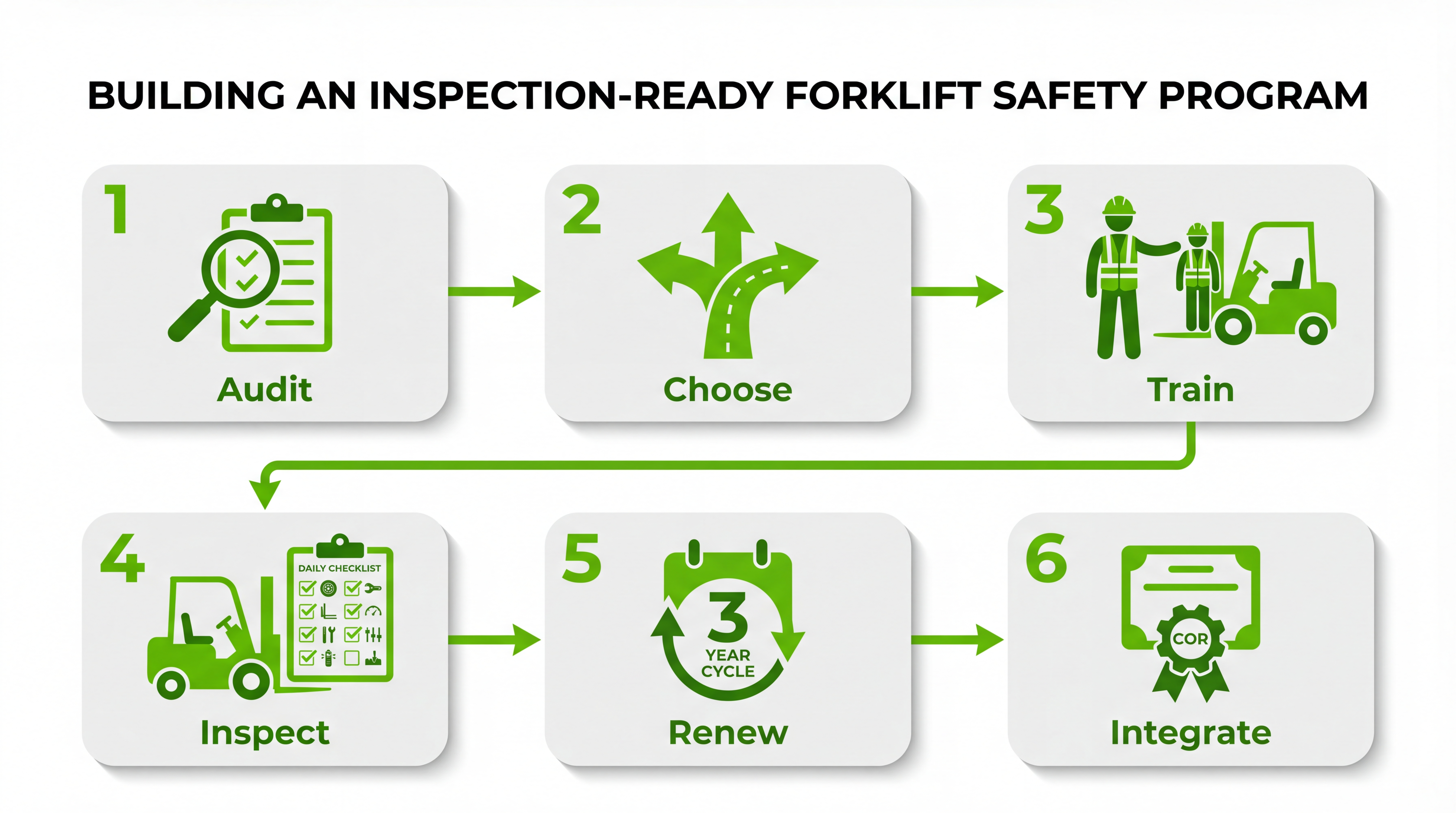
- Audit your current state. List all forklift equipment, all operators, and current training status. Identify gaps.
- Choose your training approach. Third-party, in-house, or hybrid. Align with CSA B335-15 for best practice.
- Train and document. Ensure every operator completes theory, practical, and evaluation. Document everything.
- Implement daily inspections. Use a standardized checklist. Digital forms are strongly recommended for audit readiness.
- Track renewals. Set up a 3-year renewal cycle and track expiry dates automatically.
- Integrate with COR. If you have or are pursuing COR, make your forklift program part of your safety management system documentation.
Alberta Employer Compliance Checklist
Use this checklist to verify your Alberta forklift program is inspection-ready:
- ☐ Training records on file for every operator, including equipment classes covered and evaluation results
- ☐ Training aligned with CSA B335-15 (even though not legislatively mandated, this is best practice)
- ☐ 3-year renewal cycle tracked for all operators
- ☐ Pre-shift inspection process in place with documented checklists
- ☐ Equipment maintenance records current and accessible
- ☐ Site-specific training documented for each work location
- ☐ Written operator authorization for each piece of equipment
- ☐ COR audit requirements addressed (if applicable)
- ☐ ISN/ComplyWorks/Avetta training records uploaded (if working in oil and gas)
- ☐ Winter operating procedures documented and communicated to operators
Safety Evolution's safety services include full program development for Alberta contractors. We handle the documentation, training coordination, and ongoing compliance tracking so you can focus on running your operation.
Get ahead of forklift recertification risk
Stop finding gaps after an incident or inspection. Use a 30-Day Free Trial to monitor training, expiries, and compliance actions across your crew.
30-Day Free Trial
Frequently Asked Questions
Do you need a forklift licence in Alberta?
Alberta does not issue forklift licences through a government agency. Instead, employers are responsible for ensuring operators are trained and competent under OHS Code Part 40. Certification is obtained through training providers or in-house programs, not from a provincial licensing body.
How much does forklift certification cost in Alberta?
Initial forklift certification in Alberta typically costs $200 to $350 per operator for a standard counterbalance class. Renewal training costs $100 to $200. Specialized classes like telehandlers may cost $250 to $400. On-site group training for 5 or more operators is often more cost-effective at $150 to $250 per person.
Does forklift certification expire in Alberta?
Alberta does not set a hard legislated expiry date for forklift certification. However, the employer's ongoing duty to ensure operator competency, combined with the 3-year renewal recommendation from CSA B335-15, creates an effective renewal requirement. Industry standard in Alberta is 3-year renewal.
What Alberta regulation covers forklift training?
Forklift training in Alberta is governed by Part 40 (Powered Mobile Equipment) of the OHS Code, under the Occupational Health and Safety Act. This requires employers to ensure operators are trained and competent. While it does not prescribe a specific curriculum, aligning with CSA B335-15 is considered best practice.
Can I do forklift training in-house in Alberta?
Yes. Alberta allows employers to deliver forklift training in-house, provided the program produces competent operators and is properly documented. There is no requirement to use a third-party provider. However, in-house programs require a qualified trainer, a written curriculum, proper evaluation procedures, and thorough documentation. Many Alberta employers use a hybrid approach: third-party for initial certification and in-house for refreshers and site-specific training.
Is forklift training different for oil and gas sites in Alberta?
The core forklift training requirements under OHS Code Part 40 apply to all Alberta workplaces, including oil and gas. However, oil and gas clients often impose additional requirements through contractor management systems like ISN, ComplyWorks, or Avetta. These may include shorter renewal cycles (2 years instead of 3), site-specific training for each facility, and verification of training records as part of pre-qualification. Operators on oil and gas sites may also need H2S Alive and other certifications alongside their forklift training.
Get Weekly Safety Insights
Regulation updates, toolbox talk ideas, and compliance tips. One email per week.