Last updated: April 2026
Your crew lead just told you the new site requires fall protection tickets before anyone sets foot on the scaffolding. The job starts Monday. You need options in Edmonton, and you need them fast.
A fall protection course in Edmonton teaches workers to identify fall hazards, inspect and use harnesses, and develop fall protection plans that meet Alberta's legal requirements. Edmonton has over a dozen training providers, with costs ranging from $79 to $150 for a one-day certification, depending on the type you need.
But here is the part most providers do not tell you upfront: not all fall protection certifications carry the same weight. If your crews work energy sector or oil sands sites, you need ESC (Energy Safety Canada) certification specifically. A generic course will not get them past the gate.
This guide breaks down every option available in Edmonton so you can pick the right course for your crew, your budget, and the sites you actually work on.
Quick Answer: Fall Protection Course Edmonton
- Cost: $79 to $200 CAD, depending on course type and provider
- Duration: Full day (8 hours) for in-class, or blended options with 4 hours in class
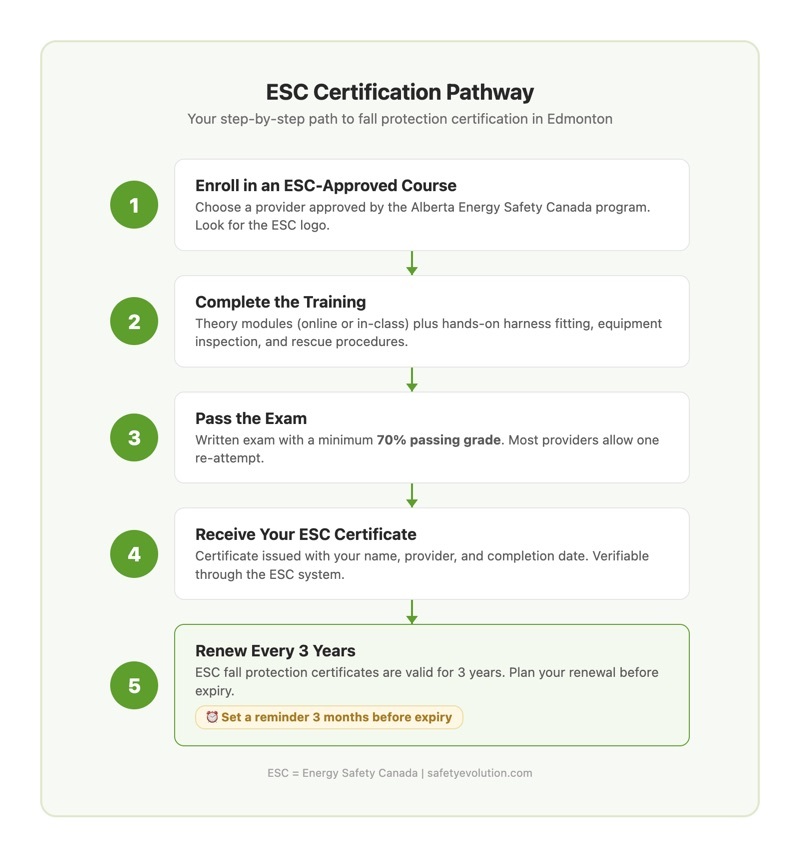
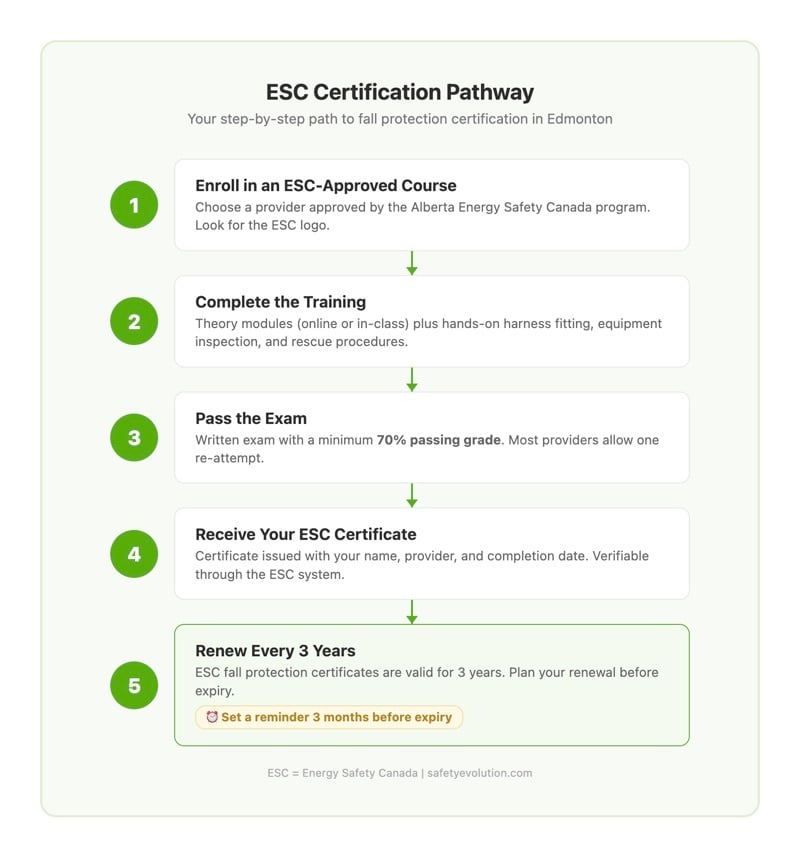
- Certification validity: 3 years for ESC-certified courses
- Exam pass mark: 70% minimum for ESC certification
- Legal trigger: Alberta OHS Code Part 9 requires training when workers can fall 3 metres or more
- Free resource: See the fall protection training requirements guide for Canada-wide rules
What Alberta Law Requires Before You Work at Heights
Alberta's OHS Code Part 9 does not leave room for interpretation. Under Section 139, employers must protect any worker exposed to a fall of 3 metres (10 feet) or more. That threshold drops even lower if there is an unusual possibility of injury, like falling onto rebar, into a pit, or through an opening in a work surface.
The law mandates a specific hierarchy of controls:
- Guardrails (the default, if reasonably practicable)
- Travel restraint systems (if guardrails are not feasible)
- Personal fall arrest systems (if travel restraint is not feasible)
- Equally effective controls (last resort)
Section 141 is where training becomes non-negotiable. Employers must ensure every worker is trained in the safe use of fall protection before allowing them to work in any area where a fall protection system must be used. The training must cover 10 specific elements, including:
- Current Alberta fall protection legislation
- Fall hazard identification
- Anchor assessment and selection
- Correct use of connecting hardware
- The effect of a fall on the human body (maximum arresting force, shock absorbers, swing fall, free fall)
- Pre-use equipment inspection
- Emergency response procedures
- Hands-on practice with inspecting, fitting, and connecting fall protection systems
If your workers fall 3 metres or more and are not protected by guardrails, Section 140 requires a written fall protection plan that specifies the hazards, the systems in use, anchor points, clearance distances, and rescue procedures. That plan must be available on site and reviewed with workers before work begins.
The penalties for non-compliance are not abstract. Violation tickets range from $100 to $500 per worker, plus a 20% victim surcharge. For serious offences, the Alberta OHS Act Section 48(1) allows fines of up to $500,000 and up to 6 months in prison per violation on first offence. In December 2024, one Alberta employer received a $10,000 administrative penalty for a single fall-related equipment violation.
Bottom line: if your crew works at heights in Alberta, they need documented fall protection training. Not eventually. Before they start.
ESC vs Non-ESC Certification: Which One Do You Need?
This is the question most Edmonton training providers gloss over, and it is the one that matters most for your bottom line.
ESC (Energy Safety Canada) certification, formerly known as OSSA, is the industry standard for Alberta's energy sector. If your crews work on oil sands sites, pipeline projects, refineries, or petrochemical facilities, ESC fall protection is almost always a site access requirement. No ESC ticket, no entry.
Non-ESC fall protection courses still meet Alberta OHS Code requirements and satisfy Section 141 for general construction, commercial, and residential work. They follow CSA Z259 standards. They are perfectly legal.
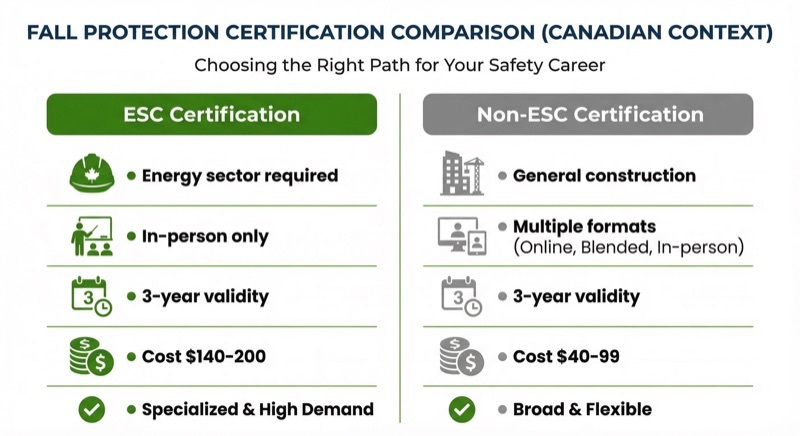
But "legal" and "accepted on every site" are not the same thing. Here is how they compare:
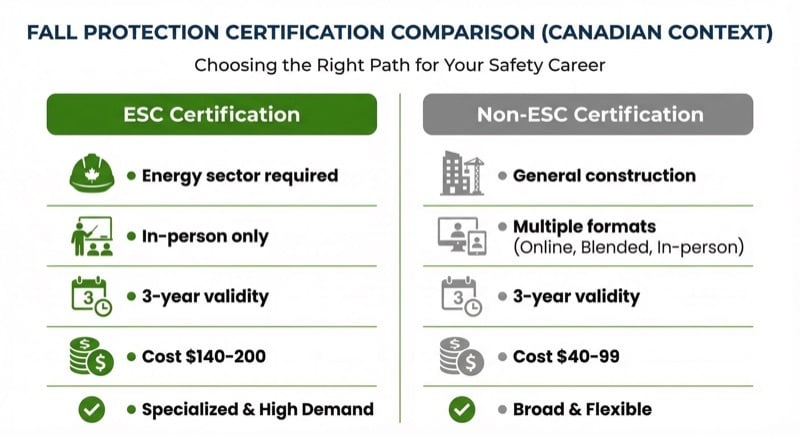
ESC certification:
- Recognized across all Canadian energy sector sites
- Certified by Energy Safety Canada (the certifying body)
- Requires in-person, hands-on practical assessment
- Valid for 3 years
- 70% minimum exam pass mark
- Typically $140 to $200 in Edmonton
Non-ESC certification:
- Meets Alberta OHS Code Part 9 and CSA Z259 standards
- Accepted for general construction, commercial, and residential sites
- Available in-person, blended, or online-only formats
- Valid for 3 years (provider-dependent)
- Typically $40 to $99 in Edmonton
The decision is simple: if any of your projects touch the energy sector, get ESC certification. It covers you everywhere. If you exclusively do residential or commercial construction with no energy sector work, a non-ESC course saves money and still meets the law. When in doubt, go ESC. The $50 to $100 difference is nothing compared to losing a site access because the wrong ticket is in your worker's wallet.
Not sure what will fail your fall protection audit?
See where your documentation is weak before the audit, then fix owners, due dates, and evidence fast.
Start Your 30-Day Free Trial →How Much Does a Fall Protection Course Cost in Edmonton?
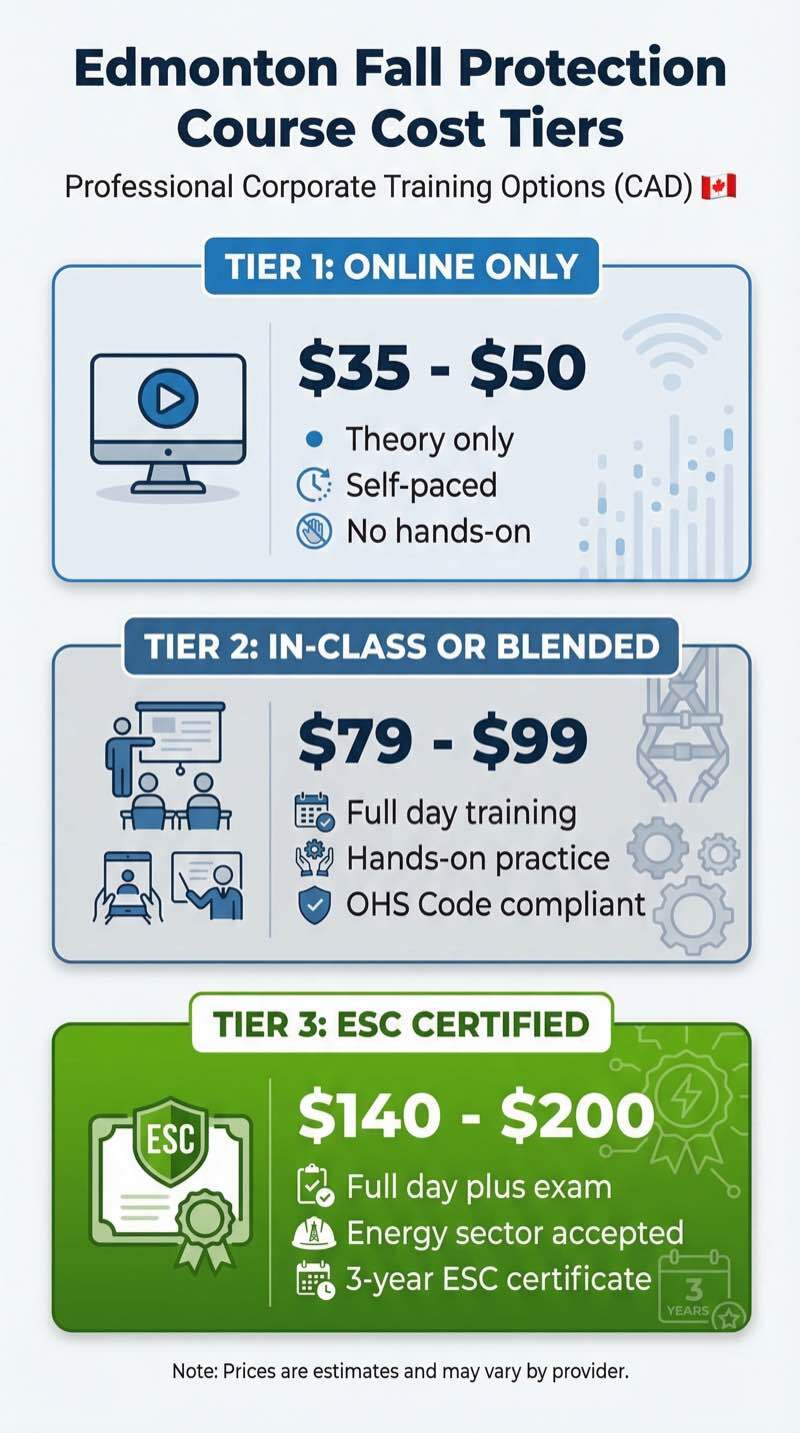
Pricing across Edmonton providers falls into three clear tiers, each tied to what you actually get. Here is what you are looking at as of early 2026:
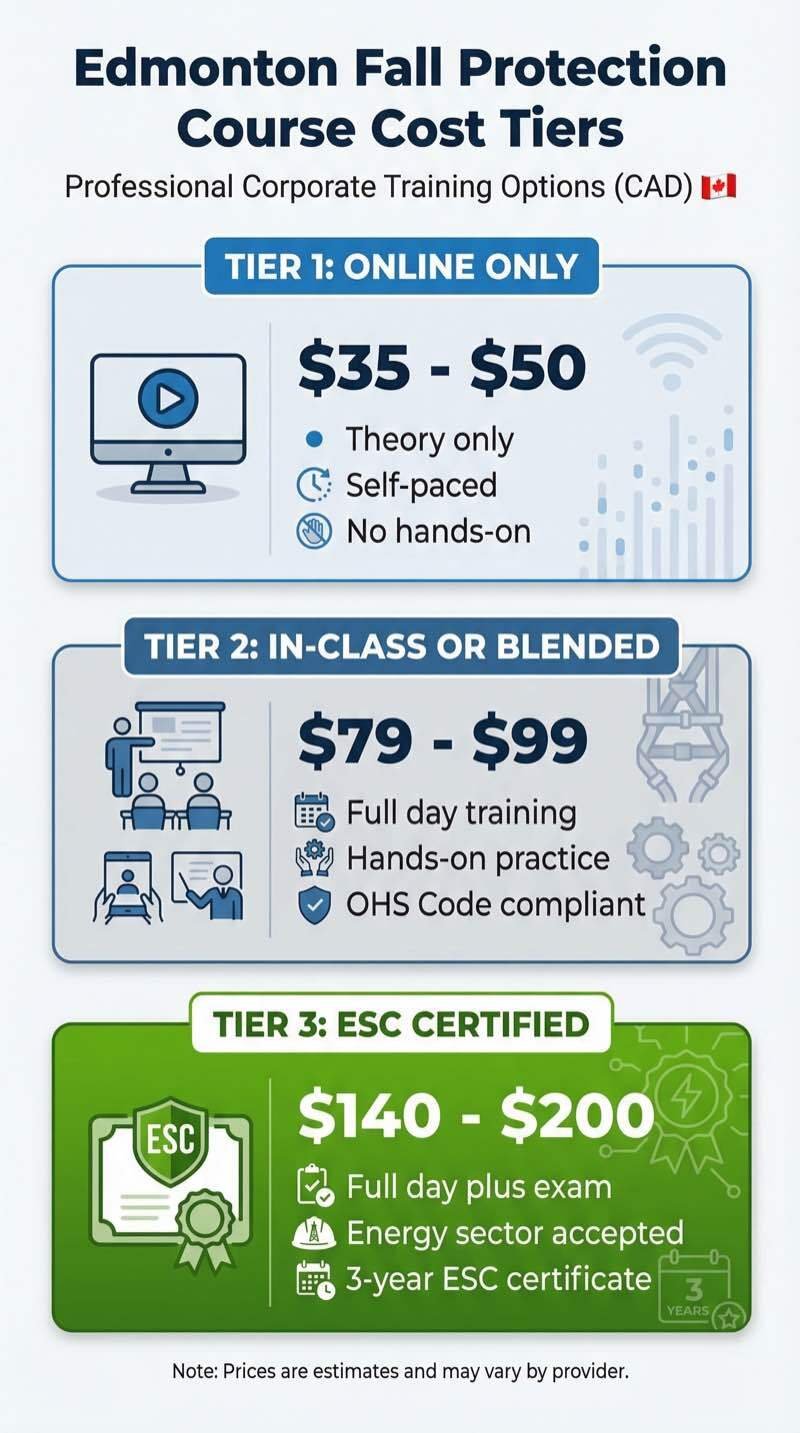
Tier 1: Online-only theory ($35 to $50)
Self-paced, 4 to 8 hours of online modules covering fall protection fundamentals. You get a certificate, but no hands-on component. This will not satisfy ESC requirements and many site-specific orientations will not accept it alone. Best for: refresher knowledge or pairing with separate practical training your employer provides on site.
Tier 2: In-class or blended ($79 to $99)
A full day (8 hours) of instructor-led training with hands-on equipment exercises. Blended options split the theory online and reduce in-class time to 4 hours. These courses meet Alberta OHS Code standards and CSA Z259 requirements. Best for: general construction, commercial, and residential workers who do not need ESC certification.
Tier 3: ESC-certified ($140 to $200)
Full-day, in-person training with theory, practical assessment, and ESC examination. Instructors are ESC Evaluating Instructors. Upon passing (70% minimum), you receive an Energy Safety Canada certificate valid for 3 years. Best for: anyone working energy sector sites, oil sands, pipelines, or petrochemical facilities.
Most Edmonton workers should budget $99 to $150 per person, depending on whether they need ESC. If you are sending a full crew, ask providers about group rates. Many Edmonton training centres offer discounts for 5 or more students.
In-Person vs Online Fall Protection Training
Alberta's OHS Code Section 141(2)(j) requires hands-on practice with inspecting, fitting, adjusting, and connecting fall protection systems. That is not a suggestion. It is a legal training requirement.
Here is the honest breakdown:
In-person (full day, 8 hours): Theory plus hands-on practical with real harnesses, lanyards, and anchor systems. You practice donning and doffing a harness. You inspect equipment. You connect systems. This is what the law requires, and it is what most sites expect to see on a training record.
Blended (4 hours online + 4 hours in-class): Theory portion completed online at your own pace, then a half-day in-class session for the hands-on component. Same certification result as full in-person. Good option for experienced workers renewing their ticket who do not need to sit through 8 hours of theory again.
Online-only (4 to 8 hours, self-paced): Covers theory and hazard identification. Does not include hands-on equipment practice. Cannot issue ESC certification. Some employers accept it as a knowledge component paired with on-site practical training, but many do not.
Most contractors we work with at Safety Evolution choose in-person or blended for initial certification, then use online for knowledge refreshers between renewals. The blended format is especially popular for fall protection recertification when workers already have site experience.
What to Look for in an Edmonton Training Provider
Not all training centres deliver the same quality, even when the certificate looks identical. Here is what separates a good provider from a box-checking exercise:
1. ESC certification status. If you need ESC, confirm the provider is authorized to deliver ESC courses and issue ESC certificates. Look for "ESC Evaluating Instructor" credentials. Some providers still advertise "OSSA" branding, which is the old name for the same organization.
2. Hands-on to theory ratio. A full-day course that spends 7 hours on PowerPoint and 1 hour on harnesses is not preparing your crew for the job. Ask how much time is spent with actual equipment.
3. Class size. Smaller classes mean more time per student with hands-on equipment. Ask the maximum class size before booking.
4. Location and scheduling. Edmonton has training centres across the city, from the south side to West Edmonton. Some providers run courses daily; others run weekly. If you need to certify a crew by Monday, availability matters more than saving $20.
5. Recertification support. Your team's tickets expire every 3 years. Providers that track expiry dates and send reminders save you from the scramble of expired certifications mid-project. Safety Evolution offers training tracking and expiry management built into your safety program.
One thing most contractors discover too late: the cheapest course often costs more in the long run. If a $40 online course does not satisfy a site orientation requirement, you are paying twice, once for the original course and again for the one the site actually accepts.
How Long Is Fall Protection Certification Good For?
ESC fall protection certification is valid for 3 years from the date of successful completion. After that, you need to retake the course. There is no "refresher" shortcut for ESC: it is the full course again.
Non-ESC certifications also typically carry a 3-year validity, though this varies by provider. Some online-only certificates may have shorter validity periods.
The practical tip: track your crew's expiry dates in a spreadsheet, a safety management system, or through your training and orientation program. One expired ticket discovered during a site audit can delay your entire project.
If you are managing training records for multiple workers across multiple certifications, Safety Evolution can check every certification and flag what is expired, what is missing, and what is coming due. We have seen contractors running 50-person crews with certifications tracked in email threads. It does not have to be that painful.
Still chasing fall protection evidence across files and inboxes?
Centralize corrective actions and proof so your next review is predictable.
Start Your 30-Day Free Trial →
Frequently Asked Questions
How long is a fall protection course in Edmonton?
Most in-person fall protection courses in Edmonton run a full day (approximately 8 hours), covering both theory and hands-on practical training. Blended courses reduce in-class time to about 4 hours by completing theory online first. Online-only courses can be finished in 4 to 8 hours at your own pace.
Is fall protection certification mandatory in Alberta?
Yes. Alberta OHS Code Section 141 requires employers to ensure workers are trained in fall protection before they work in any area where a fall protection system must be used. This applies to any situation where a worker could fall 3 metres or more, or less if there is an unusual possibility of injury.
Can I take fall protection training online in Alberta?
You can complete the theory portion of fall protection training online. However, Alberta OHS Code Section 141(2)(j) requires hands-on practice with fall protection equipment, which cannot be done online. ESC certification always requires in-person attendance. Some providers offer blended courses that combine online theory with a half-day in-person practical session.
What is the pass mark for ESC fall protection?
The ESC (Energy Safety Canada) fall protection examination requires a minimum score of 70% to pass. Upon successful completion, you receive a certificate valid for 3 years.
Does my employer have to pay for fall protection training?
Under Alberta OHS Code Section 141, the obligation to ensure workers are trained rests with the employer. While the Code does not explicitly mandate who pays, the employer has the legal duty to ensure training is completed. In practice, most employers cover the cost as it is their compliance obligation.
Get Weekly Safety Insights
Regulation updates, toolbox talk ideas, and compliance tips. One email per week.