Last updated: April 2026
Your new hire starts Monday. The site super wants a fall protection ticket before the crew heads up to the second level. You search "fall protection course Calgary" and find 20 providers, three different course formats, and prices ranging from $79 to $250. Which one actually meets the Alberta OHS Code requirements?
A fall protection course in Calgary is a one-day training program (typically 8 hours) that certifies workers to use fall arrest systems, travel restraint, and other protective equipment when working at heights of 3 metres or more, as required under Alberta OHS Code Part 9. Calgary courses typically cost $100 to $250 CAD depending on the provider and certification type, with ESC (Energy Safety Canada) courses at the higher end.
This guide breaks down every Calgary training option: ESC vs non-ESC certification, in-person vs blended formats, verified cost ranges, and exactly what the Alberta OHS Code requires your crew to learn. If you need to understand fall protection training requirements across Canada, start with our national guide. This page focuses specifically on Calgary.
Quick Answer: Fall Protection Course Calgary
- Cost: $100 to $250 CAD (typical range across Calgary providers)
- Duration: 1 day (8 hours in-person) or 4-hour practical + online theory (blended)
- Certification validity: 3 years for ESC-certified courses
- Exam pass mark: 70% minimum (ESC courses)
- Legal requirement: Mandatory under Alberta OHS Code Part 9, s.141 when workers may fall 3 metres or more
What Does Alberta Require for Fall Protection Training?
Alberta's OHS Code Part 9 does not suggest fall protection training. It demands it. Under Section 141(1), an employer must ensure that a worker is trained in the safe use of the fall protection system before allowing the worker to work in an area where a fall protection system must be used. No exceptions. No grace period.
The trigger? Section 139(1) lays it out. Fall protection is required when a worker may fall:
- 3 metres (10 feet) or more at any temporary or permanent work area
- Less than 3 metres if there's an unusual possibility of injury (landing on rebar, machinery, or an uneven surface)
- Into or onto a hazardous substance or object, or through an opening in a work surface, at any height
- More than 1.2 metres but less than 3 metres at a permanent work area
The OHS Code also mandates a specific hierarchy of protection. This is not a menu where you pick your favourite option. It's a ranked list, and you work from the top down:
- Guardrails (s.139(3)): the default. Install a guardrail first.
- Travel restraint system (s.139(5)): only if guardrails aren't reasonably practicable.
- Personal fall arrest system (s.139(6)): only if travel restraint isn't reasonably practicable.
- Equally effective controls (s.139(7)): the last resort.
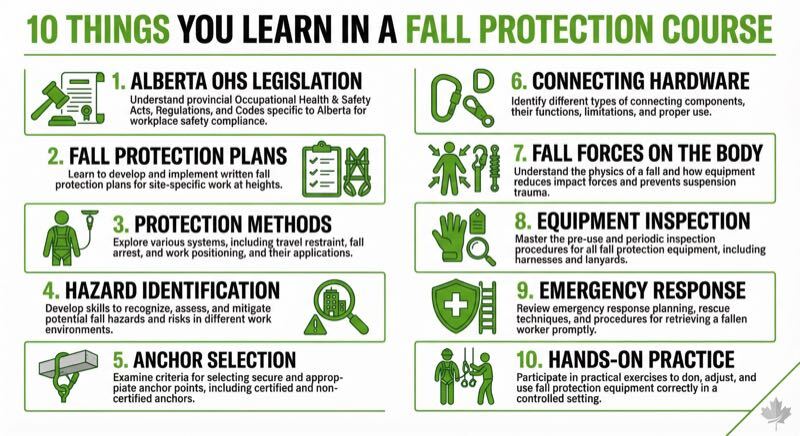
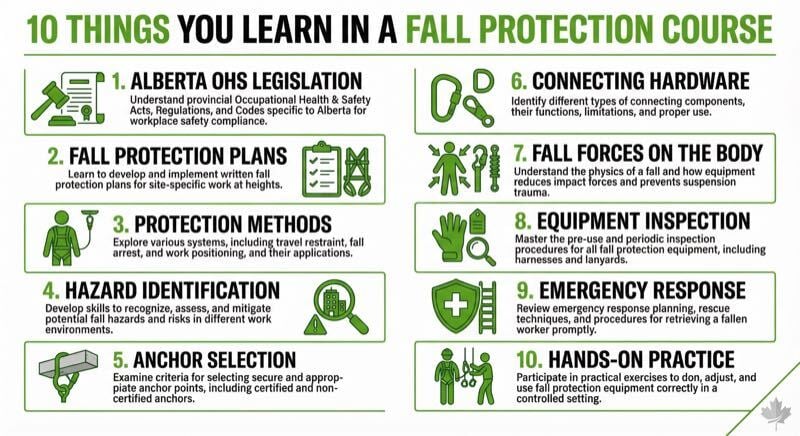
Section 141(2) lists exactly 10 training components your workers must complete. Not "cover briefly." Complete. That includes reviewing current Alberta legislation, understanding fall protection plans, identifying hazards, selecting anchors, inspecting equipment, and practising emergency response procedures with hands-on exercises.
The penalties for non-compliance are real. OHS violation tickets for fall protection issues range from $100 to $500 per violation (plus a 20% victim surcharge). Administrative penalties can hit $10,000. And if someone gets hurt? Under the OHS Act, a first offence conviction can mean up to $500,000 in fines and up to 6 months in prison. For serious contraventions under Section 41, that ceiling jumps to $1,000,000 and 12 months.
When a worker needs fall protection and doesn't have it, every person on that site is exposed: the employer, the supervisor, and the worker.
ESC vs Non-ESC Courses: Which Do You Need?
This is the distinction most Calgary training pages skip, and it matters more than the price difference.
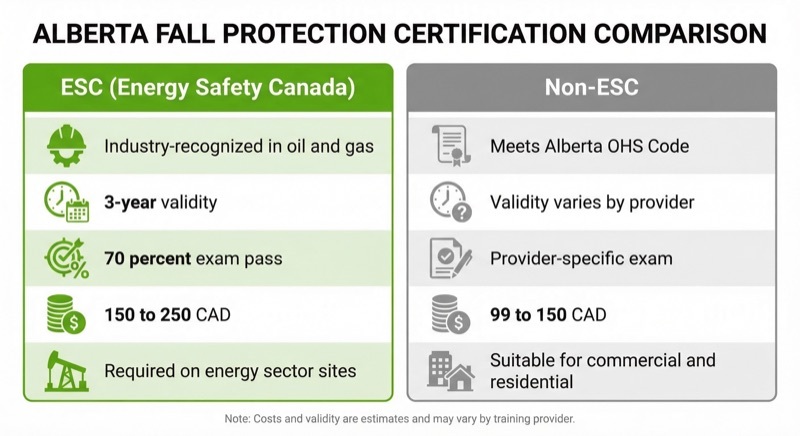
ESC (Energy Safety Canada) fall protection certification is the industry standard for Alberta's oil and gas, pipeline, and energy sectors. ESC replaced the former OSSA (Oil Sands Safety Association) accreditation. If your crew works on energy sector sites, pipeline projects, or with prime contractors who require ESC credentials, this is the certification you need. ESC courses include a standardized exam (70% pass mark), a 3-year certificate, and recognition across most major Alberta energy employers.
Non-ESC fall protection courses still meet the Alberta OHS Code Part 9 training requirements under Section 141. They cover the same regulatory content: hazard identification, equipment inspection, harness fitting, and emergency response. The difference? Non-ESC certificates may not be accepted on energy sector sites that specifically require ESC credentials. They typically cost less ($99 to $150 vs $150 to $250 for ESC) and are suitable for commercial construction, residential builds, and general industry work where site-specific requirements don't mandate ESC.
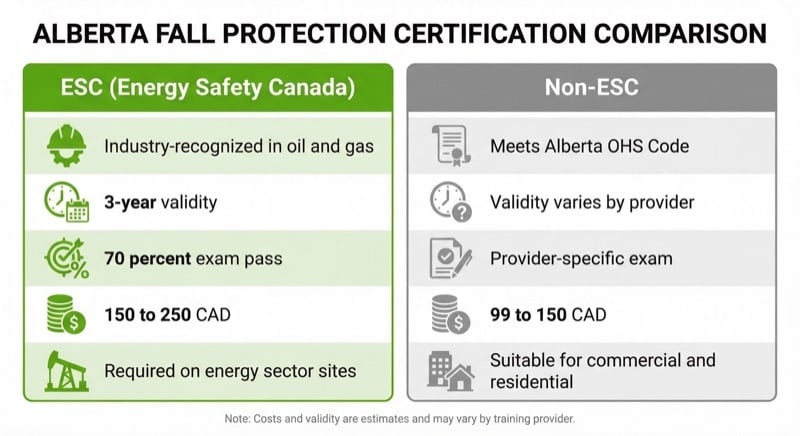
The decision is straightforward: check your site access requirements. If the prime contractor's orientation package lists ESC fall protection as mandatory, don't send your crew with a non-ESC ticket. They'll be turned away at the gate.
Calgary Fall Protection Training Providers
Calgary has more fall protection training providers than most Alberta cities. Courses run daily (some 7 days a week), and most offer multiple formats. Here's what's available based on verified information from provider websites.
Note: Costs listed are approximate and may change. Always confirm current pricing directly with the provider before booking.
In-Person Courses (Full Day)
The traditional format: 8 hours in a classroom with hands-on equipment training. You show up in the morning, practise with harnesses and lanyards, take the exam, and leave with a certificate.
- Worksite Safety (Calgary location): Standard fall protection at $99; ESC fall protection at $150. Runs Monday to Friday with free student parking.
- AIP Safety: ESC and non-ESC courses available in Calgary and southern Alberta. Includes hands-on equipment training with travel restraint and fall arrest scenarios. Contact for current pricing.
- MHSA (Rocky View/Calgary area): 1-day industrial/commercial end user course. Available as both ESC-accredited and non-accredited versions. Serves Calgary, Red Deer, and Edmonton.
- Certified Safety Training: In-person certification courses available 7 days a week. CSA-certified curriculum exceeding CSA Z259 standards. Contact for pricing.
- Rhino Safety Training: ESC fall protection at $175 + GST. Covers hazard assessment, equipment selection, and fall arrest planning.
- CalFast (Calgary Fasteners & Tools): 8-hour class following Part 9 of the Alberta OHS Code. Contact for pricing.
Blended Learning (Online + Hands-On)
Blended courses split the training: complete the theory portion online at your own pace, then attend a shorter in-person session (typically 4 hours) for the hands-on practical component. This works well for crews with tight site schedules who can't spare a full day away.
- Worksite Safety (Calgary): Blended fall protection at $79. Online theory + 4-hour in-class practical. Must complete online portion before attending the in-person session.
- Certified Safety Training (Calgary): Hybrid delivery with online module (learning and exam) plus in-person hands-on skills session. Contact for pricing.
ESC-Certified Courses
These courses specifically carry the Energy Safety Canada certification, formerly OSSA. The certificate is valid for 3 years and requires a 70% exam pass mark.
- Worksite Safety: $150 (Calgary). Full-day ESC course.
- AIP Safety: ESC Fall Protection consistent with CSA Z259 guidelines. 3-year certification. Contact for pricing.
- MHSA: ESC-accredited fall protection end user. Available at Rocky View (Calgary area).
You can also search the Energy Safety Canada website for authorized training providers near Calgary.
Not sure what will fail your fall protection audit?
See where your documentation is weak before the audit, then fix owners, due dates, and evidence fast.
Start Your 30-Day Free Trial →
What Does a Fall Protection Course Actually Cover?
Alberta OHS Code Section 141(2) lists 10 specific training components. A legitimate fall protection course in Calgary covers all of them. Here's what that looks like in practice:
- Alberta fall protection legislation review: current OHS Code Part 9 requirements, employer and worker obligations, the protection hierarchy.
- Fall protection plans: what a plan must contain under s.140, who writes it, and when it needs updating.
- Fall protection methods: guardrails, travel restraint, personal fall arrest systems, safety nets, and control zones.
- Hazard identification: how to assess a work area for fall risks before work begins. This connects directly to your site orientation process.
- Anchor selection: identifying and assessing anchors rated for fall arrest loads. Not every pipe or beam qualifies.
- Connecting hardware: carabiners, snap hooks, D-rings, and why auto-locking gates matter.
- Effects of a fall on the body: maximum arresting force, swing fall distance, free fall limits, and why shock absorbers exist.
- Pre-use equipment inspection: what to check on a harness, lanyard, and SRL before every use. Damaged gear gets retired, not "one more shift."
- Emergency response procedures: rescue planning for a suspended worker. Suspension trauma can become life-threatening in minutes.
- Hands-on practice: inspecting gear, fitting harnesses, adjusting straps, connecting to anchors, and running through emergency scenarios.
That last point is critical. The OHS Code specifically requires practice in inspecting, fitting, adjusting, and connecting fall protection systems (s.141(2)(j)). A course that skips the hands-on component doesn't meet the regulation, no matter how polished the online modules look.
For ongoing safety meetings, our free toolbox talk package includes fall protection topics you can use between certification courses to keep the knowledge fresh.
In-Person vs Online: Which Format Works?
Most GCs assume online is faster and cheaper. That's half true. Here's the honest breakdown.
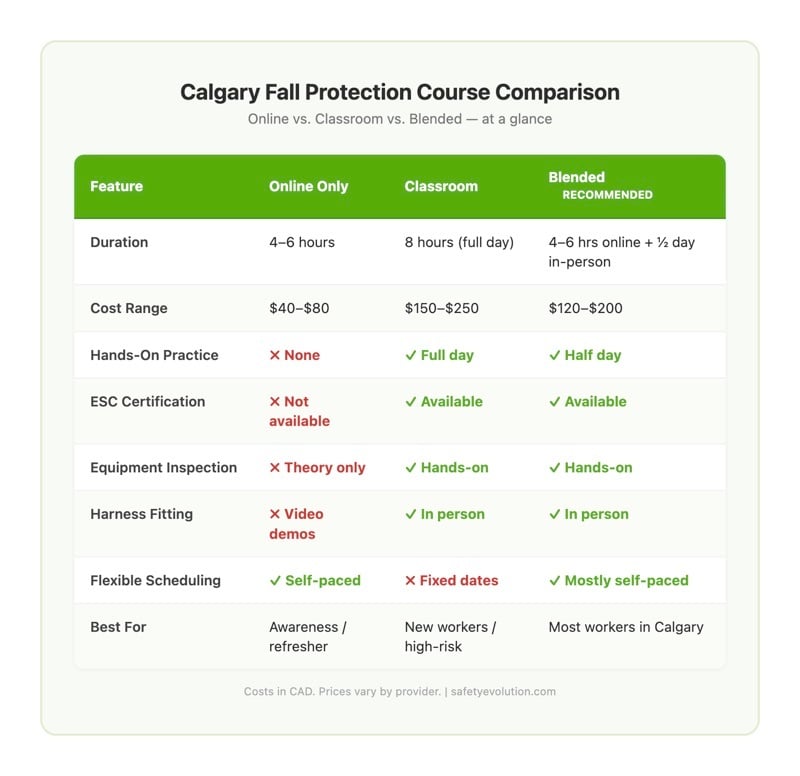
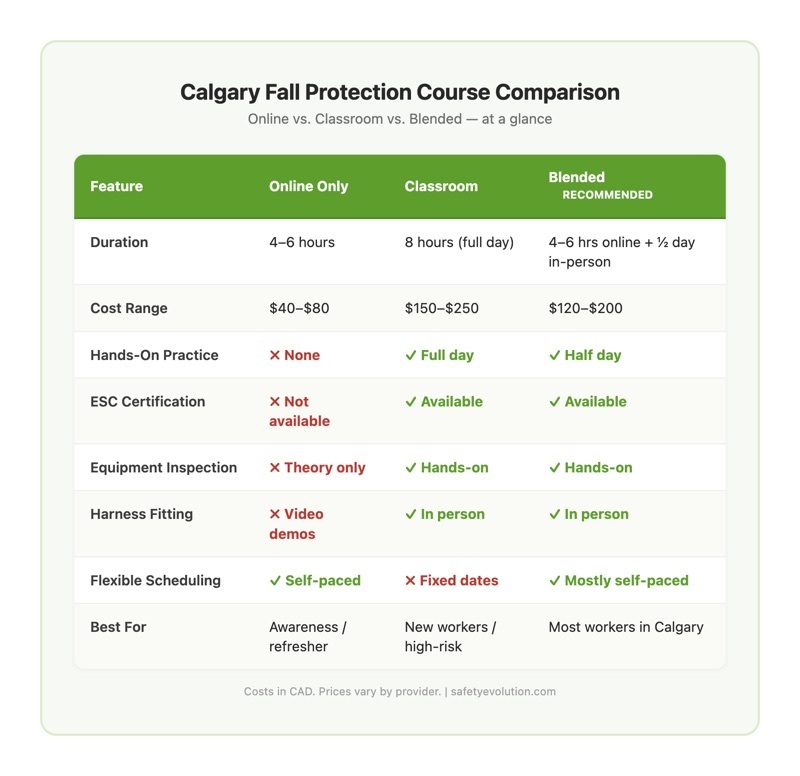
Fully online courses exist, but they have a fundamental limitation in Alberta. OHS Code Section 141(2)(j) requires hands-on practice with fall protection equipment: inspecting gear, fitting harnesses, connecting to anchors, and running emergency response scenarios. You cannot practise donning a harness through a screen. A fully online course covers the theory but does not satisfy the complete regulatory requirement on its own.
Blended courses (online theory + in-person practical) are the practical middle ground. Workers complete the theoretical content online at their own pace, then attend a shorter in-person session (typically 4 hours instead of 8) for the hands-on component. Total cost is often lower ($79 to $150 depending on the provider). The catch: workers must complete the online portion before showing up for the practical session.
In-person courses (full day, 8 hours) remain the most common format. Theory and practice happen in one session. Workers leave with the certificate the same day. It's more time away from the site, but there's no coordination between online and in-person scheduling.
The blunt truth: if your crew needs fall protection training and you book a fully online course without a practical component, you're checking a box without actually meeting the regulation. When an OHS officer asks your worker to demonstrate proper harness fitting on site and they fumble through it, the online certificate won't help.
How to Choose the Right Fall Protection Course
Most GCs think any fall protection ticket is the same. They're not. An ESC certificate from an authorized training provider gets your crew on energy sector sites. A generic online certificate might not survive an OHS inspection.
Ask these five questions before booking:
- Does your site require ESC certification? Check with the prime contractor or site owner. Energy sector projects almost always require it. Commercial construction typically doesn't.
- Does the course include hands-on training? If it doesn't, it doesn't meet Alberta OHS Code s.141(2)(j). Walk away.
- Is the training provider authorized? For ESC courses, check the Energy Safety Canada training provider directory. For non-ESC courses, verify the curriculum covers all 10 components of s.141(2).
- What equipment standard does the course reference? It should reference CSA Z259 series standards (the standard referenced in Part 9 of the OHS Code) and current Alberta legislation.
- Does the schedule work for your crew? Blended courses reduce on-site time. In-person courses are done in a day. Factor in travel to the Calgary training location.
If your safety program needs more than a one-off training session, Safety Evolution's safety services include ongoing training coordination, safety courses with expiry tracking, and fall protection program development tailored to your operation.
Still chasing fall protection evidence across files and inboxes?
Centralize corrective actions and proof so your next review is predictable.
Start Your 30-Day Free Trial →
Frequently Asked Questions
How long is fall protection certification good for in Alberta?
ESC (Energy Safety Canada) fall protection certification is valid for 3 years. After 3 years, workers must retake the course and exam to renew. Non-ESC certifications may have different validity periods depending on the training provider, so confirm the renewal timeline when you book.
How much does a fall protection course cost in Calgary?
Calgary fall protection courses typically range from $100 to $250 CAD per person. Standard non-ESC courses start around $99. ESC-certified courses run $150 to $250. Blended courses (online theory + in-person practical) can cost as little as $79. Group and on-site training may offer volume discounts for crews of 10 or more.
Can I take fall protection training online in Alberta?
You can complete the theory portion of fall protection training online. However, Alberta OHS Code Section 141(2)(j) requires hands-on practice with fall protection equipment, including inspecting, fitting, and connecting harnesses and components. A fully online course without a practical component does not meet the full regulatory requirement. Blended courses (online theory + in-person practical) are the best option if you want to reduce classroom time.
Is fall protection training mandatory in Alberta?
Yes. Under Alberta OHS Code Part 9, Section 141(1), employers must ensure workers are trained in fall protection before allowing them to work in any area where a fall protection system is required. This applies when workers may fall 3 metres or more, or at lower heights where there is an unusual possibility of injury.
What is the difference between fall protection and working at heights?
"Fall protection" is the term used in Alberta's OHS Code (Part 9) and across most western Canadian provinces. "Working at Heights" (WAH) is a specific mandatory training program in Ontario, regulated by the Ministry of Labour. The ESC fall protection course is valid in Alberta but is not a substitute for Ontario's WAH certification on Ontario construction projects. If your crew works in both provinces, they may need both certifications.
Get Weekly Safety Insights
Regulation updates, toolbox talk ideas, and compliance tips. One email per week.