Last updated: May 2026
If your crew treats JSAs like paperwork, you are carrying hidden risk on every task handoff. Most incidents do not happen because teams never heard of hazards. They happen because hazard controls were vague, rushed, or never tied to the exact steps crews were about to perform. At Safety Evolution, we see this pattern repeatedly during site support work. A construction Job Safety Analysis (JSA) is a task-by-task hazard planning process that breaks work into steps, identifies hazards at each step, and assigns specific controls before work starts.
⚡ Quick Answer
- What it is: A pre-task method to break work into steps, identify hazards, and define controls and responsibilities.
- Who leads it: Usually the supervisor or foreman, with input from workers doing the job and any affected trades.
- When to use it: Before high-risk, non-routine, or changing tasks, and whenever site conditions shift.
- Canada: Requirements are driven by provincial OHS duties to identify hazards and control risk (for example, Alberta OHS Act and OHS Code obligations).
- US: OSHA requires employers to provide a workplace free of recognized hazards and control job-site risks through planning and supervision.
Why construction JSAs fail on real sites
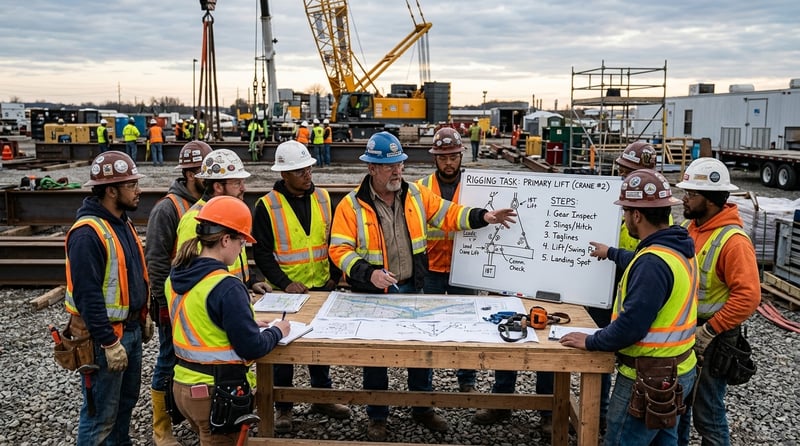
Most people think a JSA fails because the form is too long. They are wrong. JSAs fail because the crew cannot use them in live production pressure. If controls are generic, if hazards are copied from yesterday, or if nobody owns each control, the form is decoration.
Blunt truth: a signed JSA does not protect you. A controlled task does. The legal and operational test is whether hazards were reasonably identified and controlled, not whether someone initialed a box.
Example from a mixed-trade retrofit: a six-person crew had a "working at heights" line in the JSA, but no step-specific control for material hoisting near a stair opening. The team paused only after a near miss with a falling tool. The issue was not missing paperwork. The issue was missing step-level planning.
JSAs getting signed but not followed in the field?
If pre-task plans are not translating into real controls, use a 30-day trial to standardize JSA workflows, ownership, and verification before incidents force the change.
Start Your 30-Day Free Trial →
How to run a construction JSA step by step
1) Define the exact task scope
Write the task exactly as it will be performed: location, crew size, equipment, and handoffs. "Install rooftop unit on Building C" is usable. "HVAC work" is not.
2) Break the task into 6 to 10 clear steps
Use action language: unload materials, stage tools, isolate energy, access work area, install component, test, cleanup. If a step has different risks than the step before, it needs its own line.
3) Identify hazards per step
For each step, ask what can injure people, damage equipment, or create environmental exposure. Include interaction hazards from nearby crews, traffic, weather, overhead work, and changing ground conditions.
4) Assign controls in hierarchy order
Prioritize elimination and engineering controls, then administrative controls, then PPE. Be specific: "install temporary guardrail at stair opening" is stronger than "use caution."
5) Assign a control owner and verification point
Every control needs one owner and one check. For example: "Foreman verifies lockout before energization test." No owner means no accountability.
6) Brief the crew and capture feedback before work starts
Run a short pre-task meeting. Ask each trade what changed since planning and what could go wrong in their step. Update the JSA in real time if conditions changed.
7) Re-open the JSA when scope or conditions change
If weather shifts, equipment changes, a new contractor enters the zone, or sequence changes, reopen and revise. A static JSA in a dynamic work zone is a known failure pattern.
Construction JSA template you can use
Use this structure in your digital form or paper version. Keep it short enough for field use, but specific enough for enforcement and supervision.
- Task information: Project, location, date, supervisor, crew, permit references.
- Step number and action: What exactly happens in this step.
- Hazards: Exposure by person, equipment, and environment.
- Controls: Engineering, administrative, PPE, with control detail.
- Owner: Named person accountable for each control.
- Verification: What will be checked, by whom, and when.
- Stop-work triggers: Conditions that force immediate pause and reassessment.
- Sign-off: Crew acknowledgment after briefing and revisions.
Need a connected process around the form itself? Pair your JSA with your safety program development workflow so pre-task planning, inspections, and corrective actions stay linked.
Canada vs US compliance: keep references separated
In Canada
Canadian requirements are set through provincial or territorial OHS frameworks. Employers and supervisors are expected to identify hazards, assess risk, and implement effective controls. Start from your province's official regulator and align task-level planning to those duties.
In the United States
US employers are governed by OSHA requirements, including the duty to provide a workplace free from recognized hazards, plus task-specific construction standards. Your JSA should show how hazards were anticipated and controlled before and during task execution.
- Occupational Safety and Health Act, Section 5(a)(1): osha.gov
- OSHA Construction standards (29 CFR 1926): osha.gov
- OSHA hazard identification resources: osha.gov
Where JSAs fit with FLHAs, toolbox talks, and permits
On many crews, JSA, FLHA, and toolbox talk are treated as separate forms. That creates duplication and missed controls. Use the JSA as the core task-risk record, then feed key controls into your FLHA and daily talk so workers hear the same message at the point of work.
If your team is still maturing this process, align it with your broader COR readiness and audit discipline and your supervisor training cadence. Consistency across these systems is what drives fewer repeat incidents.
JSA quality checklist for supervisors
- Does each step describe one clear action?
- Are hazards specific to that step and that location?
- Are controls specific, observable, and assigned to one owner?
- Are stop-work triggers defined in plain language?
- Did affected trades review and challenge assumptions?
- Was the JSA updated after any scope or condition change?
If you cannot answer yes to these six checks, the JSA is not ready for execution.
Crews moving faster than your hazard controls?
When schedules compress, generic JSAs become expensive. Start a 30-day free trial to standardize task-level planning, ownership, and field verification across every crew.
Start Your 30-Day Free Trial →
Frequently Asked Questions
What is the difference between a JSA and FLHA in construction?
A JSA is usually a structured task breakdown with step-level hazards and controls. An FLHA is often a field-level hazard check tied to immediate site conditions. Strong programs connect both so planning and field reality stay aligned.
Who should complete a construction JSA?
The supervisor or foreman typically leads it, but the people performing the task must contribute. Workers often see practical hazards and sequence conflicts that planners miss.
How often should a JSA be updated?
Update the JSA whenever task scope, crew composition, equipment, or site conditions change. If risk conditions changed, your controls must be reviewed before work continues.
Is a signed JSA enough for compliance?
No. Regulators and clients care whether hazards were identified and controlled effectively. Documentation helps, but enforcement risk remains if controls were weak or not implemented.
Can one JSA template work for both Canada and the US?
Yes, the workflow can be shared, but legal references and required triggers should be localized to the province, territory, state, or federal framework that governs your site.
Get Weekly Safety Insights
Regulation updates, toolbox talk ideas, and compliance tips. One email per week.