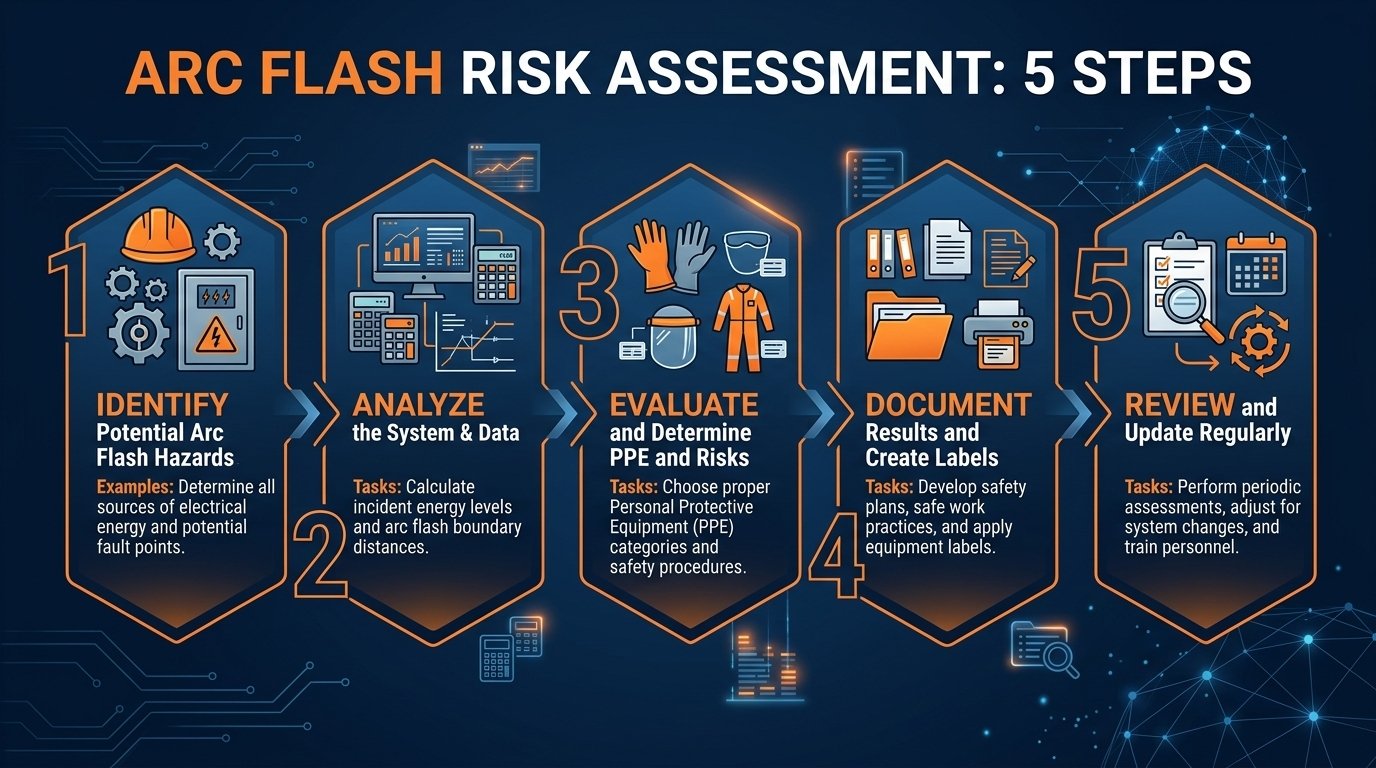
Slapping generic warning stickers on your electrical panels doesn't protect your workers, and it certainly won't protect you from OSHA or provincial regulators. An arc flash risk assessment is a formal engineering study that calculates the specific incident energy of electrical equipment to determine safe approach boundaries and required PPE. Most facility managers treat this assessment as a "one and done" checklist item to appease an auditor. They're wrong. A risk assessment is a living, breathing part of your safety program that dictates daily operations.
⚡ Quick Answer
What It Is: An engineering study to calculate incident energy and determine PPE and boundaries.
Frequency: Must be reviewed at intervals not to exceed 5 years, or whenever a major system modification occurs.
Outputs: Updated single-line diagrams, incident energy calculations, and specific equipment labels.
This guide breaks down the five core steps of a proper assessment, why the 5-year review rule trips up most companies, and how to manage the resulting data so your crews actually use it.
Step 1: Data Collection & Single-Line Diagrams
The foundation of any arc flash study is accurate data. An engineer or qualified electrical worker must walk the facility and document the entire electrical distribution system. They gather data on utility feeds, transformers, switchgear, breakers, fuses, and cable lengths.
This data is used to build or update the facility's single-line diagram (SLD). The blunt truth? If your facility is over ten years old, your current SLD is almost certainly wrong. Contractors add circuits, swap breakers, and bypass panels over time. The assessment starts by mapping the physical reality, not the original blueprints.
Step 2: Short Circuit & Coordination Studies
Before calculating incident energy, the engineer performs a short circuit study to determine the maximum fault current that could flow at various points in the system. They verify that the existing equipment is rated to handle that current without catastrophic failure.
Next is the protective device coordination study. This ensures that the breaker closest to the fault trips first, isolating the problem without shutting down the entire facility. This timing is critical, the longer it takes a breaker to trip, the longer the arc flash burns, and the higher the incident energy.
Step 3: Incident Energy Calculations
Using the data from the first two steps, the engineer calculates the incident energy at each piece of equipment, typically using IEEE 1584 standards. The calculation outputs the energy in cal/cm².
This number directly dictates two things: the arc flash boundary (the distance at which the energy drops to 1.2 cal/cm²) and the required arc flash PPE category needed to work on that specific panel.
Step 4: Equipment Labeling
The calculations mean nothing if the worker standing in front of the panel doesn't have the data. NFPA 70E and CSA Z462 require specific warning labels to be affixed to the equipment.
These labels must display the nominal system voltage, the arc flash boundary, and either the available incident energy (and working distance) or the required PPE category. Generic "Warning: Arc Flash Hazard" stickers do not meet compliance standards. The label must provide the specific mathematical data for that exact piece of equipment.
Step 5: Training & Implementation
The engineering firm hands you a thick binder with calculations and a stack of labels. You stick the labels on the panels. Are you compliant? No.
If your workers don't know how to read the labels, the entire exercise was pointless. You must provide specific arc flash training so your qualified workers know how to use the data on the labels to select their PPE and establish their physical approach boundaries before they begin LOTO procedures.
Are your crews actually reading the labels?
Don't assume they are checking the cal/cm² ratings. Try Safety Evolution free for 30 days and force your workers to verify label data directly in their digital hazard assessments.
Both NFPA 70E and CSA Z462 require the arc flash risk assessment to be reviewed periodically, at intervals not to exceed five years. However, this is a maximum limit, not a default schedule.
The standard also states that the assessment must be reviewed whenever a major modification or renovation occurs. If you add a new production line, upgrade a transformer, or change out main breakers in year two, your original assessment is immediately void. The incident energy calculations have changed. Relying strictly on the 5-year clock while heavily modifying your facility is a massive compliance liability.
Digitizing Your Risk Assessment Data
When you spend $20,000 on an engineering study, letting the resulting single-line diagrams sit in a binder in the maintenance office is a waste of money and a risk to your crew.
When you move to a digital safety program, you upload the single-line diagrams and assessment data directly into the platform. Workers can pull up the exact specifications for a piece of equipment on their phone while standing in front of it. Management can track when specific panels were last assessed and set automated alerts for the 5-year review deadline.
Put your engineering data to work.
Make sure your crews have instant access to SLDs and hazard data in the field. Start your 30-Day Free Trial and see exactly where the gaps are before your next audit.
How often must an arc flash risk assessment be updated?
It must be reviewed at intervals not to exceed 5 years, OR whenever a major modification or renovation to the electrical distribution system occurs.
Who can perform an arc flash risk assessment?
The data collection can be performed by a qualified electrical worker, but the incident energy calculations and coordination studies must typically be performed or stamped by a licensed Professional Engineer (PE / P.Eng) specializing in power systems.
Are generic arc flash warning labels compliant?
No. NFPA 70E and CSA Z462 require labels to display the nominal system voltage, the arc flash boundary, and the specific incident energy or required PPE category for that exact piece of equipment.
Get Weekly Safety Insights
Regulation updates, toolbox talk ideas, and compliance tips. One email per week.