Workplace Safety
What Is Arc Flash? The Ultimate Guide
An arc flash reaches 35,000°F. Learn the causes, approach boundaries, and how to prevent it under NFPA 70E & CSA Z462.
Not sure what PPE to wear? We break down NFPA 70E PPE Categories 1-4, minimum ratings, and why synthetic clothing melts.
Last updated: April 2026
A standard high-visibility vest or a polyester uniform shirt won't just fail to protect you during an arc flash, it will melt directly into your skin, turning a survivable thermal event into a fatal injury. Arc flash PPE (Personal Protective Equipment) is specialized, arc-rated clothing and gear designed to resist ignition and insulate the worker from extreme thermal energy. Most safety managers think buying Category 4 arc flash suits for everyone solves the problem. They're wrong. Heavy PPE causes heat stress, limits mobility, and increases the risk of mistakes. You must match the gear exactly to the hazard.
This guide breaks down the four PPE Categories defined by NFPA 70E and CSA Z462, what gear is required for each, and the fatal mistakes crews make when layering clothing.
It is crucial to understand that arc flash PPE is not designed to prevent all burns. According to safety standards, the gear is engineered to limit the injury to a survivable second-degree burn (1.2 cal/cm²) if an arc flash occurs.
The clothing is rated by its Arc Thermal Performance Value (ATPV), measured in calories per square centimeter (cal/cm²). This number represents the maximum incident thermal energy the fabric can absorb before the wearer suffers a second-degree burn. The higher the cal/cm² rating, the heavier and more protective the garment.
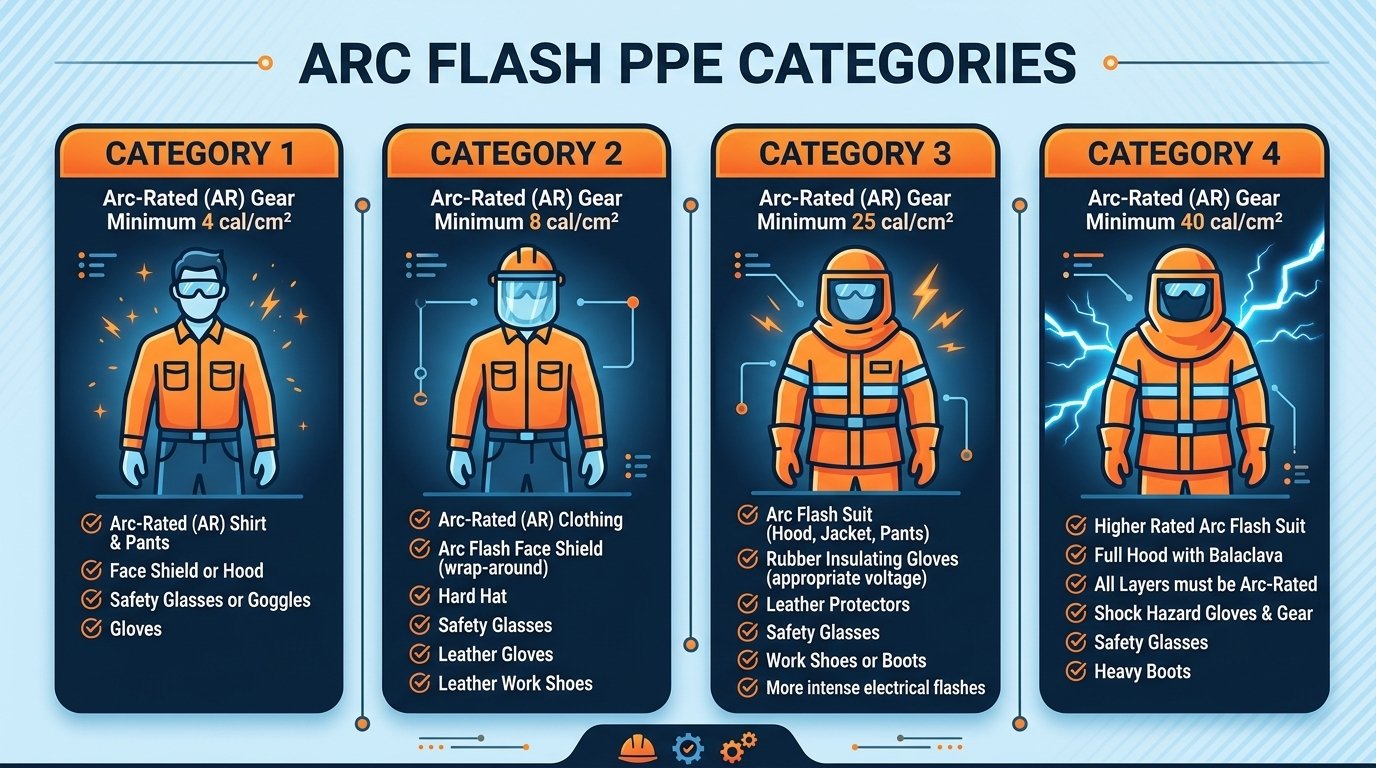
To simplify compliance, NFPA 70E and CSA Z462 utilize a category system. Once you complete an arc flash risk assessment, you will know the incident energy of the equipment. You then select the PPE category that meets or exceeds that energy level.
This is the lowest level of protection. It requires a single layer of arc-rated clothing, such as an AR long-sleeve shirt and AR pants, or an AR coverall. Workers must also wear an arc-rated face shield or arc flash suit hood, heavy-duty leather gloves (or rubber insulating gloves with leather protectors), and safety glasses.
Category 2 is common for daily electrical work. It requires arc-rated clothing (shirt/pants or coveralls) that meets the 8 cal/cm² minimum. Crucially, it also requires an arc-rated balaclava in addition to the arc-rated face shield, or a full arc flash suit hood. Hearing protection and safety glasses are mandatory.
At Category 3, single-layer clothing is no longer sufficient. Workers must wear a multi-layer arc flash suit system consisting of an AR flash suit jacket and AR pants (or AR coveralls), plus an AR flash suit hood. The hood must have a minimum rating of 25 cal/cm².
This is the highest standard category, used for extreme hazard environments. It requires a heavy, multi-layer arc flash suit, including the jacket, pants, and hood, all rated for at least 40 cal/cm². Working in Category 4 gear is physically demanding and significantly increases the risk of heat stress, which is why de-energizing the equipment is always the preferred alternative.
Are your crews wearing the right PPE?
Don't rely on memory. Try Safety Evolution free for 30 days and embed mandatory PPE checklists directly into your digital hazard assessments.
30-Day Free TrialThe blunt truth is that the most expensive arc-rated suit in the world won't save you if you are wearing a polyester gym shirt underneath it.
During an arc flash, the intense heat will transfer through the arc-rated outer layer. If the undergarments are made of meltable synthetic fibers, such as polyester, nylon, or spandex, they will melt and fuse to the worker's skin. Undergarments must be made of non-melting, untreated natural fibers like 100% cotton, wool, or silk, or they must be specifically arc-rated.
Managing an electrical safety program involves more than just buying the gear. PPE must be inspected before every use, cleaned according to manufacturer specifications (fabric softeners can ruin the arc rating), and replaced when worn.
When you digitize your safety program, you can track the lifecycle of every arc flash suit in your inventory. Digital FLHAs force the worker to verify they are wearing the correct category of PPE based on the specific equipment label before they enter the arc flash boundary. It removes the guesswork and ensures compliance is verified in real-time.
Take the guesswork out of electrical compliance.
Ensure your crews are verifying equipment labels and PPE requirements every time. Start your 30-Day Free Trial and see exactly where the gaps are before your next audit.
30-Day Free TrialIt stands for calories per square centimeter. It is the unit of measurement used to quantify the incident thermal energy of an arc flash, and the protective rating (ATPV) of arc flash PPE.
No. While heavy 100% cotton is non-melting and acceptable as an undergarment beneath arc-rated clothing, untreated cotton is flammable and will ignite during an arc flash. Outerwear must be specifically arc-rated (AR) or flame-resistant (FR).
No. The PPE category is dictated by the calculated incident energy, not just the voltage. Some low-voltage panels with very high fault currents require Category 4, while some high-voltage lines with fast-clearing breakers may require a lower category.
Get Weekly Safety Insights
Regulation updates, toolbox talk ideas, and compliance tips. One email per week.
An arc flash reaches 35,000°F. Learn the causes, approach boundaries, and how to prevent it under NFPA 70E & CSA Z462.
Ensure your electrical safety meets compliance. We break down the core requirements of NFPA 70E in the US and CSA Z462.
Discover how safety software automates LOTO compliance, tracks training, and keeps crews alive during energized work.