Workplace Safety
What Is Arc Flash? The Ultimate Guide
An arc flash reaches 35,000°F. Learn the causes, approach boundaries, and how to prevent it under NFPA 70E & CSA Z462.
Ensure your electrical safety meets compliance. We break down the core requirements of NFPA 70E in the US and CSA Z462.
Last updated: April 2026
A generic safety manual won't save you during an electrical incident investigation, and it certainly won't save a worker's life. When a 480V panel arcs, investigators don't look for good intentions, they look for a documented, rigorously enforced electrical safety program. NFPA 70E and CSA Z462 are the definitive consensus standards that dictate how companies must protect workers from electrical shock and arc flash hazards. Most companies think providing an arc-rated suit and some insulated gloves constitutes a safety program. They're wrong. True compliance requires comprehensive risk assessments, strict lockout/tagout procedures, and ongoing training.
This guide breaks down exactly what these standards require, how they apply in your jurisdiction, and where paper-based compliance typically falls apart.
Whether you operate in Texas or Alberta, the foundations of electrical safety are identical. Both NFPA 70E and CSA Z462 require employers to move from reactive safety to proactive hazard management.
First, you must develop a formal, written Electrical Safety Program (ESP). This document outlines your company's overarching policies, procedures, and responsibilities regarding electrical hazards. Second, every task involving energized equipment requires a specific arc flash risk assessment and shock risk assessment before work begins. Finally, job briefings are mandatory. Before touching a tool, the crew must review the hazards, the procedures, and the required PPE for that specific task.
The National Fire Protection Association's NFPA 70E is the gold standard for electrical safety in the US workplace. While it is a consensus standard and not technically a law, OSHA treats it with the weight of law.
OSHA frequently uses NFPA 70E as evidence of industry-recognized hazards and accepted safe work practices. If an incident occurs, OSHA will cite an employer under the General Duty Clause (Section 5(a)(1)) or specific electrical standards (like 1910 Subpart S), using NFPA 70E as the benchmark for what the employer should have done. The 2024 edition places a heavy emphasis on the hierarchy of risk control and the requirement to establish an electrically safe work condition.
The Canadian Standards Association developed CSA Z462 to align with NFPA 70E, making North American compliance easier for cross-border companies. However, the enforcement mechanism is uniquely Canadian.
Provincial Occupational Health and Safety (OHS) regulators, such as WorkSafeBC or Alberta OHS, do not explicitly write every technical electrical rule into their legislation. Instead, they require employers to follow "accepted industry practices." In Canada, CSA Z462 is that accepted practice. If a worker is injured in an arc flash, provincial inspectors will measure the employer's safety program directly against the requirements of CSA Z462 to determine if due diligence was exercised.
Is your electrical safety program actually being followed?
A binder in the office doesn't protect workers in the field. Try Safety Evolution free for 30 days and enforce digital risk assessments and LOTO before the work begins.
30-Day Free Trial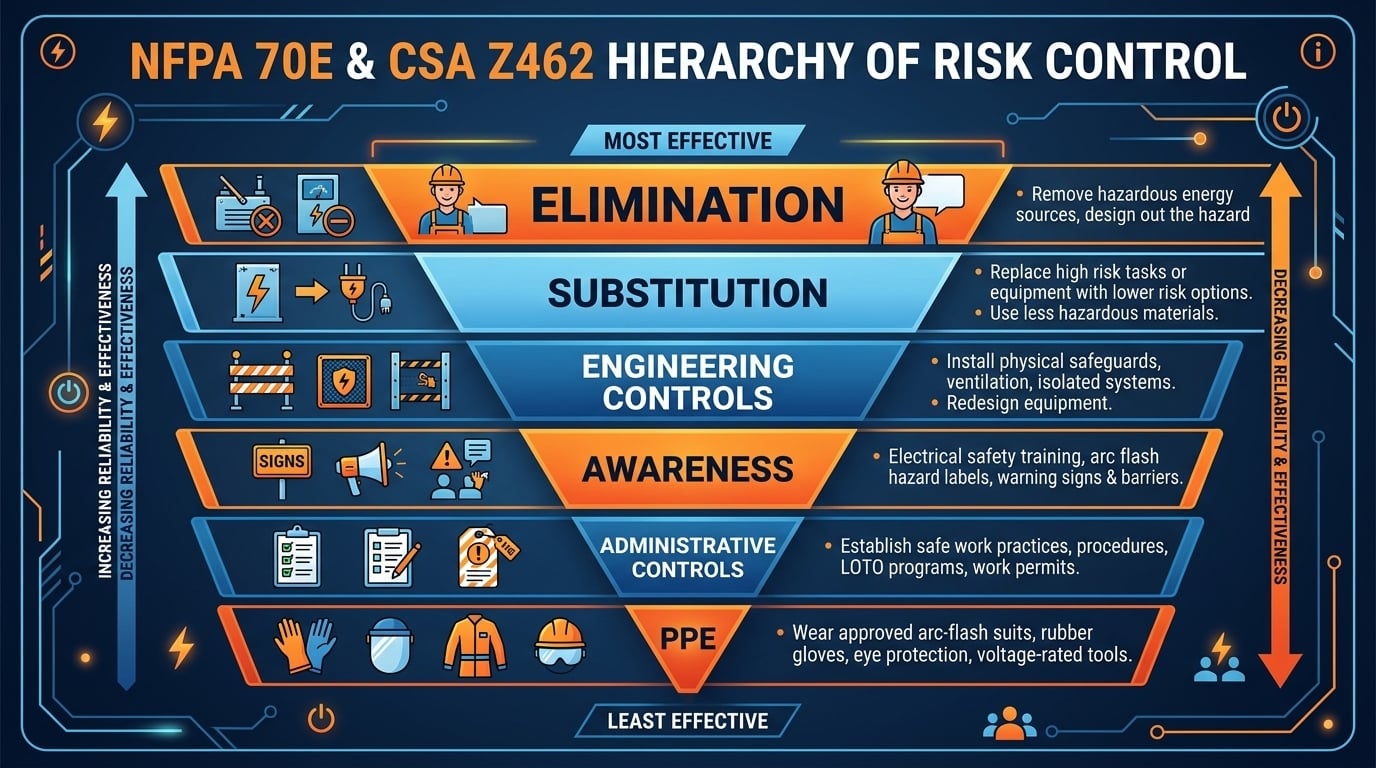
Both standards agree on one fundamental truth: relying on arc flash PPE as your primary safety strategy is a failure of management. PPE is the absolute last line of defense.
The standards mandate the Hierarchy of Risk Control. Elimination (turning the power off and verifying it) is always the first and best option. Substitution and Engineering Controls (like arc-resistant switchgear) come next. Only when you reach the bottom of the hierarchy, Administrative Controls (procedures, training) and PPE, should you be relying on human behavior and gear to prevent injury. If you aren't actively trying to design the hazard out of the job, you aren't compliant.
The blunt truth about electrical safety compliance is that a perfect paper manual is useless if it stays in the foreman's truck. In a fast-paced environment, paper procedures create lethal friction.
When crews are under pressure to get a facility back online, they skip steps. LOTO tags get hastily filled out, complex risk assessments are pencil-whipped, and arc flash training certificates expire without anyone noticing. Paper forms get lost, damaged, or submitted days late, giving management zero visibility into whether the crew actually verified zero energy state before they opened the panel.
To survive an audit, and more importantly, to keep your crews alive, you need certainty that procedures are being followed in real-time. Digitizing your safety program removes the friction that leads to pencil-whipping.
With a digital platform, workers access the latest single-line diagrams, complete mandatory FLHAs, and run through digital LOTO checklists directly on their phones. Management gets instant alerts if a high-risk electrical task is started without the proper sign-offs, ensuring that NFPA 70E and CSA Z462 are more than just acronyms, they are active, enforced daily practices.
Take the guesswork out of electrical compliance.
Ensure your crews are following exact LOTO procedures and risk assessments every time. Start your 30-Day Free Trial and see exactly where the gaps are before your next audit.
30-Day Free TrialNo, NFPA 70E is a consensus standard, not a law. However, OSHA uses it as the benchmark for industry-accepted safe work practices when enforcing the General Duty Clause.
While not always written directly into provincial law, OHS regulators across Canada use CSA Z462 as the standard for determining if an employer exercised reasonable due diligence in protecting workers from electrical hazards.
Both standards are updated on a three-year cycle. The most recent editions for both NFPA 70E and CSA Z462 were released in 2024.
Yes. As a host employer or prime contractor, you have a legal obligation to ensure that the contractors you hire are following accepted electrical safety standards and that hazards are communicated to them.
Get Weekly Safety Insights
Regulation updates, toolbox talk ideas, and compliance tips. One email per week.
An arc flash reaches 35,000°F. Learn the causes, approach boundaries, and how to prevent it under NFPA 70E & CSA Z462.
Not sure what PPE to wear? We break down NFPA 70E PPE Categories 1-4, minimum ratings, and why synthetic clothing melts.
Discover how safety software automates LOTO compliance, tracks training, and keeps crews alive during energized work.