Last updated: April 2026
An invisible line on the floor could be the difference between a minor incident and a fatality. When working on or near energized electrical equipment, safety regulations don't just recommend staying back, they require precise mathematical distances to be observed. Arc flash approach boundaries are specific, calculated distances radiating from energized equipment that dictate who can enter the space and what protective gear they must wear. Most people think "stay back a few feet" is sufficient. They're wrong. A blast pressure wave doesn't care about a visual estimate; it cares about incident energy.
⚡ Quick Answer
- Arc Flash Boundary: The outermost limit where incident energy equals 1.2 cal/cm² (the threshold for a second-degree burn).
- Limited Approach Boundary: The shock protection boundary that unqualified persons cannot cross unless escorted.
- Restricted Approach Boundary: The innermost shock protection boundary. Crossing it is treated as making contact with the live part.
- Rule of Thumb: If you aren't a qualified electrical worker wearing the appropriate PPE, stay outside the Arc Flash Boundary.
To comply with NFPA 70E (US) and CSA Z462 (Canada), and to actually keep your crews alive, you must understand exactly what these three boundaries mean and how to enforce them on a chaotic job site.
1. The Arc Flash Boundary
The Arc Flash Boundary is typically the outermost of the three approach limits, though on lower-voltage equipment with high fault currents, this can occasionally vary. This boundary is strictly focused on thermal protection, it is the distance at which the incident energy from a potential arc flash drops to 1.2 calories per square centimeter (cal/cm²).
Why 1.2 cal/cm²? Because that is the exact scientific threshold where unprotected skin receives a second-degree burn. It represents a curable injury rather than a catastrophic or fatal one.
Anyone crossing the Arc Flash Boundary must wear the appropriate flame-resistant (FR) clothing and arc flash PPE specified by the equipment's arc flash risk assessment or label. There are no exceptions for "just taking a quick look."
2. The Limited Approach Boundary
Unlike the Arc Flash Boundary, which protects against thermal energy, the Limited Approach Boundary is designed to protect against the shock hazard. It is the distance from an exposed energized electrical conductor or circuit part within which a shock hazard exists.
This is the line in the sand for unqualified personnel. Unqualified workers (anyone who is not a trained and qualified electrical worker for that specific equipment) must stay completely outside the Limited Approach Boundary.
The only exception is if an unqualified person is continuously escorted by a qualified person, and even then, they must be advised of the hazards and cannot cross the inner boundaries.
Are your risk assessments getting pencil-whipped?
Safety boundaries only work if the crew actually calculates and respects them before starting work. Try Safety Evolution free for 30 days and enforce digital FLHAs directly from the field.
30-Day Free Trial
3. The Restricted Approach Boundary
The Restricted Approach Boundary is the innermost shock protection boundary. For regulatory and safety purposes, crossing this boundary is treated exactly the same as making physical contact with the energized electrical conductor.
Only qualified electrical workers who have completed specific arc flash training are permitted to cross the Restricted Approach Boundary. Furthermore, they can only cross it if they are wearing the required insulating PPE (like voltage-rated gloves) and have an approved energized electrical work permit, unless they are performing specific diagnostic tasks like voltage testing.
Unqualified persons are never permitted inside the Restricted Approach Boundary, period. Not even with an escort.
How to Find Your Boundaries
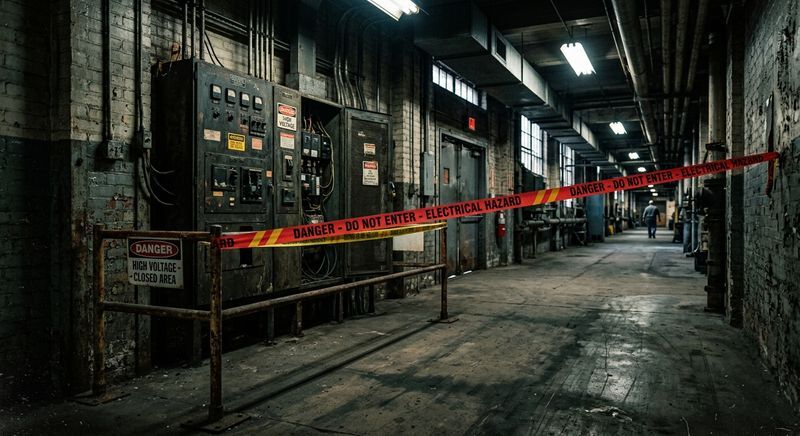
You do not guess these distances. The exact dimensions of the Arc Flash, Limited, and Restricted boundaries must be determined through a formal engineering study or by strictly following the table methods outlined in NFPA 70E or CSA Z462.
Once calculated, this information must be clearly printed on an arc flash warning label affixed directly to the equipment. Before any panel cover is removed, the qualified worker must read the label, establish the physical boundaries using barricades or red tape, and ensure the area is secure.
Digitizing Your Electrical Safety Procedures
Knowing the boundaries is the easy part. Enforcing them on a Tuesday afternoon when the plant manager is screaming about downtime is where programs fail.
When safety managers rely on paper forms, they have no idea if the electrician actually barricaded the Arc Flash Boundary or if they just checked a box on an FLHA from the breakroom. Moving your electrical safety program to a digital platform changes the dynamic. Digital hazard assessments force workers to review the equipment labels and confirm boundary setups before the system allows them to proceed with the LOTO procedure.
Stop relying on paper for high-risk work.
Ensure your crews are reviewing boundary requirements and following exact LOTO procedures every time. Start your 30-Day Free Trial and see exactly where the gaps are before your next audit.
30-Day Free Trial
Frequently Asked Questions
Can an unqualified person cross the Arc Flash Boundary?
Yes, but only if they are wearing the required arc-rated PPE specified on the equipment label for that distance.
Can an unqualified person cross the Limited Approach Boundary?
Yes, but only if they are continuously escorted by a qualified electrical worker who has advised them of the hazards.
Who can cross the Restricted Approach Boundary?
Only qualified electrical workers wearing the proper voltage-rated PPE and possessing an energized work permit (if performing physical work).
Get Weekly Safety Insights
Regulation updates, toolbox talk ideas, and compliance tips. One email per week.