Workplace Safety
Arc Flash Boundaries: Limited, Restricted & Flash
Learn the exact definitions of the Arc Flash, Limited, and Restricted approach boundaries to keep your workers safe.
An electrical explosion creates two hazards. Learn the exact difference between the thermal arc flash and concussive blast.
Last updated: April 2026
When an electrical fault occurs, the resulting explosion is often referred to simply as an "arc flash." In reality, that term only describes half of the nightmare. An electrical explosion produces two distinct hazards simultaneously: an arc flash (the extreme thermal heat) and an arc blast (the concussive pressure wave). Most workers focus entirely on the heat, buying heavy arc-rated suits to prevent burns. They're wrong to ignore the blast. While a Category 4 suit might save your skin from the 35,000°F fire, it will do absolutely nothing to stop the pressure wave from crushing your lungs or throwing you across the room.
This guide breaks down the physical differences between the two events, the specific injuries they cause, and why your arc flash PPE is only a partial solution.
The arc flash is the part of the explosion you can see and feel as heat. It occurs when electrical current leaves its intended path and travels through the air to another conductor or to ground. The air becomes a plasma, acting as a conductor for massive amounts of energy.
The temperature of an arc flash can instantly reach 35,000°F (19,426°C). To put that in perspective, the surface of the sun is roughly 10,000°F. The primary injuries caused by the flash are severe, deep-tissue burns. If a worker is wearing standard synthetic clothing (like polyester or nylon), the heat will instantly melt the fabric, fusing it directly to their skin.
The intense light emitted by the flash can also cause temporary or permanent blindness, and the vaporization of copper and aluminum components creates a highly toxic cloud of gas that can severely burn the respiratory tract if inhaled.
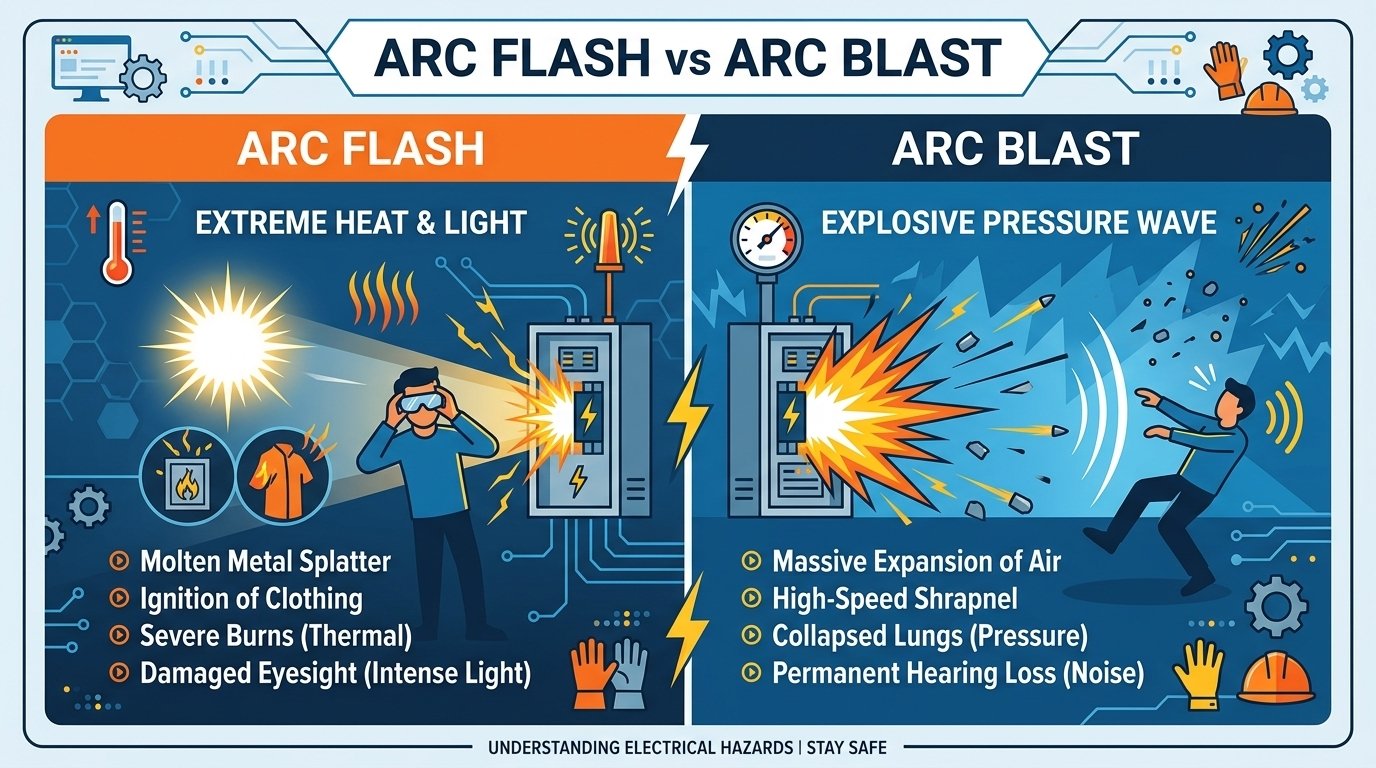
The arc blast is the concussive, explosive force that accompanies the flash. When the electrical fault vaporizes metal conductors, the solid metal expands into vapor at an astonishing rate. For example, copper expands to 67,000 times its original volume instantly.
This rapid expansion creates a massive pressure wave, the arc blast. This blast can generate pressures exceeding 2,000 pounds per square foot. The physical devastation is immense:
Are your risk assessments capturing the full hazard?
Don't let your crews rely solely on PPE to survive. Try Safety Evolution free for 30 days and enforce strict LOTO procedures before work begins.
30-Day Free TrialThe critical difference between the flash and the blast is how we protect against them. NFPA 70E and CSA Z462 dictate the use of arc-rated PPE to protect against the thermal energy of the flash. If you are wearing a properly rated suit, you can survive the heat.
However, there is no PPE that protects against the arc blast. A heavy suit will not stop the pressure wave from collapsing your lungs, nor will it stop you from being thrown backward into a concrete wall.
Because you cannot protect against the blast, elimination of the hazard is the only acceptable primary control. This means de-energizing the equipment and establishing an electrically safe work condition through strict Lockout/Tagout (LOTO) procedures. Energized work should only be performed when de-energizing introduces greater hazards or is completely infeasible.
Preventing an arc blast requires strict adherence to approach arc flash boundaries and LOTO procedures. When these procedures live on paper forms, crews are more likely to take shortcuts, assuming that their PPE will save them if something goes wrong.
Moving your safety program to a digital platform removes that dangerous complacency. Digital hazard assessments force the worker to actively confirm the equipment is de-energized, verifying the LOTO checklist step-by-step on their mobile device before they are authorized to begin work.
Don't let paper procedures put your crew at risk.
Ensure your crews are following exact LOTO procedures every time. Start your 30-Day Free Trial and see exactly where the gaps are before your next audit.
30-Day Free TrialNot always. A minor, low-energy arc flash might not vaporize enough material to create a significant pressure wave. However, in higher energy faults, the flash and the blast occur simultaneously.
No. Arc-rated PPE is designed to insulate the worker from the thermal energy (the heat) to prevent second-degree burns. It provides no protection against the concussive pressure wave or the kinetic impact of being thrown.
The only way to completely prevent an arc blast is to de-energize the equipment and verify an electrically safe work condition using strict Lockout/Tagout procedures before work begins.
Get Weekly Safety Insights
Regulation updates, toolbox talk ideas, and compliance tips. One email per week.
Learn the exact definitions of the Arc Flash, Limited, and Restricted approach boundaries to keep your workers safe.
An arc flash reaches 35,000°F. Learn the causes, approach boundaries, and how to prevent it under NFPA 70E & CSA Z462.
Discover how safety software automates LOTO compliance, tracks training, and keeps crews alive during energized work.