Last updated: April 2026
One number shows up on almost every prequalification form, bid package, and ISNetworld profile a contractor submits: TRIR. A low TRIR opens doors. A high TRIR gets your bid tossed before anyone reads your scope of work.
TRIR (Total Recordable Incident Rate) is an OSHA safety metric that measures the number of recordable workplace injuries and illnesses per 100 full-time workers over a given period. It uses a standardized formula so companies of any size can be compared side by side.
Quick Answer: TRIR at a Glance
- Formula: TRIR = (Number of Recordable Incidents x 200,000) / Total Hours Worked
- The 200,000: Represents 100 employees working 40 hours/week for 50 weeks/year
- 2024 construction benchmark: 2.3 per 100 FTE (Bureau of Labor Statistics)
- Good TRIR for contractors: Below 2.0 for construction; many GCs require below 1.0 for high-risk work
- Why it matters: Required for ISNetworld, Avetta, ComplyWorks prequalification and most GC bid packages
What Is TRIR?
Total Recordable Incident Rate (TRIR) is a safety metric that normalizes your recordable incident count against the total hours your workforce put in. It answers a simple question: if we had 100 full-time employees working for a year, how many OSHA recordable incidents would we have?
That normalization is what makes TRIR useful. A company with 500 employees and 10 recordables is not the same as a company with 50 employees and 10 recordables. TRIR puts both on the same scale so general contractors, insurance companies, and prequalification platforms can compare them.
Internally, TRIR gives you a trend line. If it is climbing quarter over quarter, your safety system is drifting. If it is flat or declining, the work you are doing in the field is showing up in the numbers.
How to Calculate TRIR
The OSHA-standard formula is straightforward:
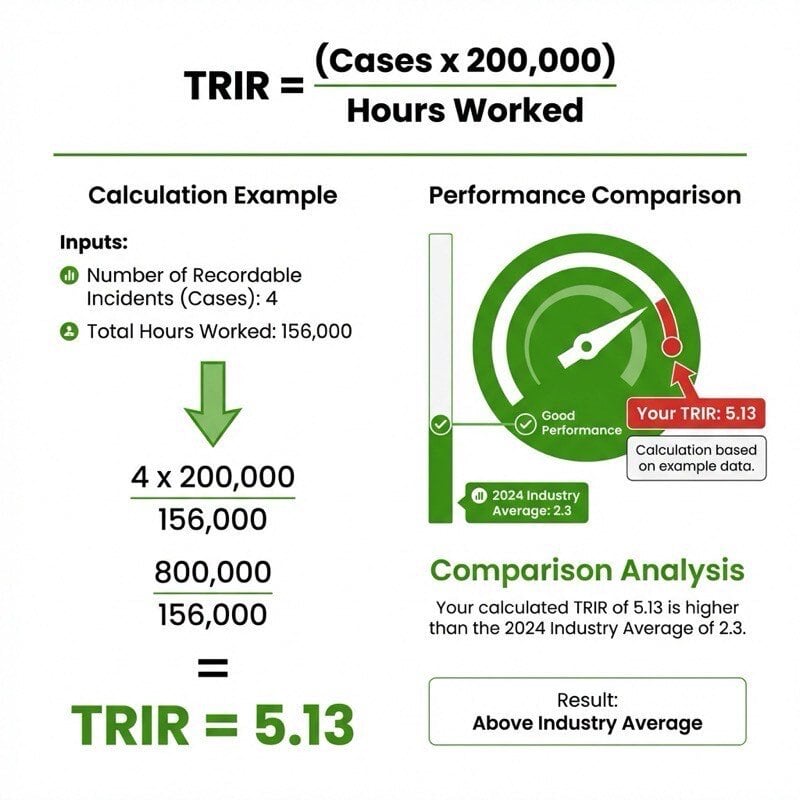
TRIR = (Number of OSHA Recordable Incidents x 200,000) / Total Hours Worked
The 200,000 multiplier represents 100 employees working 40 hours per week for 50 weeks per year. This is the standard base established by OSHA's recording and reporting regulations under 29 CFR 1904.
TRIR Calculation Example
A construction contractor with 75 employees worked a total of 156,000 hours last year. During that time, they had 4 OSHA recordable incidents.
TRIR = (4 x 200,000) / 156,000 = 5.13
That means for every 100 full-time workers, this contractor would expect about 5.1 recordable incidents per year. For construction, that is well above the industry average and would likely trigger questions from clients and prequalification reviewers.
Step-by-Step TRIR Calculation
- Count your recordable incidents for the period (see "What Counts as an OSHA Recordable Incident" below)
- Calculate total hours worked by all employees during the same period. Include overtime. Include temporary and contract workers on your payroll.
- Multiply the recordable incident count by 200,000
- Divide by total hours worked
If you want to skip the math, use our free TRIR calculator to plug in your numbers and get your rate instantly.
Not Sure What Should Count as Recordable?
Safety Evolution scans your incident records and flags the cases that meet OSHA recordability criteria, so your TRIR is accurate and defensible.
30-Day Free Trial
What Counts as an OSHA Recordable Incident?
Under 29 CFR 1904.7, a work-related injury or illness is OSHA recordable if it results in any of the following:
- Death
- Days away from work (the employee misses one or more days)
- Restricted work or job transfer (the employee cannot perform their normal duties)
- Medical treatment beyond first aid (stitches, prescription medications, physical therapy)
- Loss of consciousness
- Significant injury or illness diagnosed by a physician (cancer, chronic illness, fractured bones, punctured eardrums)
What Does NOT Count as Recordable
First aid treatment alone is not recordable. OSHA defines first aid as:
- Cleaning, flushing, or soaking surface wounds
- Wound closure with adhesive bandages or butterfly bandages
- Non-prescription medications at nonprescription strength
- Tetanus immunizations
- Drilling a fingernail to relieve pressure
- Eye patches, finger splints, elastic bandages
- Hot or cold therapy, massage
If the only treatment provided falls within that first aid list, the case is not recordable. The line between first aid and medical treatment is where most recording disputes happen. When in doubt, the OSHA recordkeeping guidelines under 1904.7 are the definitive reference.
What Is a Good TRIR?
Context matters. A TRIR of 2.0 in oil and gas extraction (where the 2024 all-industry average was 2.3) is decent. A TRIR of 2.0 in construction (where the industry average was also 2.3) is slightly below average. A TRIR of 2.0 in professional services would be alarming.
2024 industry benchmarks (BLS data):
- All private industry: 2.3 per 100 FTE
- Construction: 2.3 per 100 FTE (down from 2.4 in 2023)
- Manufacturing: 2.8 per 100 FTE
Source: Bureau of Labor Statistics, Survey of Occupational Injuries and Illnesses, 2024
For prequalification, many general contractors set their threshold between 1.0 and 2.0. Some owner-operators on high-risk projects (refineries, chemical plants, large commercial builds) require a TRIR below 1.0. If your TRIR is above the GC's threshold, your bid does not get reviewed regardless of price.
TRIR vs DART Rate
TRIR and DART rate are related but measure different things.
TRIR counts all OSHA recordable incidents: every case that required medical treatment beyond first aid, resulted in days away, restricted work, transfer, loss of consciousness, or significant diagnosis.
DART counts only the more severe cases: those resulting in Days Away from work, Restricted duty, or job Transfer. DART is always a subset of TRIR.
A company can have a TRIR of 4.0 but a DART of 1.5 if most incidents only required medical treatment and did not result in missed work or restricted duties. Conversely, if every incident is severe enough to cause lost time, TRIR and DART will be very close.
Both are commonly requested on prequalification forms. TRIR tells you how often incidents happen. DART tells you how severe they are.
How to Lower Your TRIR
TRIR is a lagging indicator. You cannot improve it directly. You improve it by strengthening the leading indicators that drive it down.
Five proven approaches:
- Increase inspection frequency and quality. More eyes on the work means hazards get caught before they become incidents. Short daily walkthroughs outperform lengthy monthly audits.
- Fix corrective actions faster. An open corrective action is a future incident with a date attached. Track closure rates monthly and make overdue items visible to leadership.
- Build a near-miss reporting culture. Every near miss reported is an incident prevented. Make reporting easy (30 seconds on a phone, not a 2-page form) and follow up visibly.
- Keep training current. Expired certifications and untrained workers on high-risk tasks are the most common root causes in OSHA citations. Track who is current and who is due every month.
- Review your OSHA 300 log quarterly. Look for patterns: same body part, same type of incident, same crew, same time of day. Patterns tell you where to focus prevention efforts.
For a complete framework of what to track monthly, see our safety metrics guide.
How TRIR Connects to EMR and Insurance
TRIR and your experience modification rate (EMR) are connected through the same underlying data: workplace incidents.
When a recordable incident results in a workers' compensation claim, that claim enters the NCCI system and affects your EMR calculation. A rising TRIR often predicts a rising EMR 12 to 18 months later (because EMR uses a rolling three-year claims window).
The financial impact compounds. Higher TRIR makes it harder to win work through prequalification. Higher EMR increases your insurance premiums. Both reduce your competitiveness and profitability. Investing in the leading indicators that reduce recordables improves both numbers simultaneously.
Your TRIR Tells You the Score. Safety Evolution Tells You Why.
Safety Evolution analyzes your safety records to surface the patterns behind your TRIR: which crews, which tasks, which sites are driving your numbers up.
30-Day Free Trial
Frequently Asked Questions
What does TRIR stand for?
TRIR stands for Total Recordable Incident Rate. It measures the number of OSHA-recordable workplace injuries and illnesses per 100 full-time equivalent workers over a 12-month period. It is also referred to as Total Recordable Injury Rate or Total Recordable Incidence Rate.
How do you calculate TRIR from the OSHA 300 log?
Count the total number of entries on your OSHA 300 log for the year. This is your recordable incident count. Then use the formula: TRIR = (Recordable Incidents x 200,000) / Total Hours Worked. Your total hours worked should include all employees on your payroll, including overtime hours and temporary workers.
What is the average TRIR for construction in 2024?
The average TRIR for the construction industry in 2024 was 2.3 per 100 full-time equivalent workers, according to the Bureau of Labor Statistics. This was down from 2.4 in 2023 and represents the lowest construction TRIR on record going back over a decade.
Can your TRIR be zero?
Yes. A TRIR of zero means your company had zero OSHA recordable incidents during the measurement period. This is achievable, especially for smaller contractors or companies with strong safety programs. However, a sustained TRIR of zero over multiple years should prompt a review of your recording practices to ensure all recordable incidents are being properly documented.
What is the difference between TRIR and LTIR?
TRIR includes all OSHA recordable incidents (medical treatment beyond first aid, days away, restricted work, transfers, loss of consciousness, significant diagnoses). LTIR (Lost Time Incident Rate) counts only incidents that result in one or more days away from work. LTIR is a narrower measure of more severe incidents. In the US, DART rate has largely replaced LTIR in most prequalification systems.
Get Weekly Safety Insights
Regulation updates, toolbox talk ideas, and compliance tips. One email per week.