Last updated: April 2026
Your crew shows up to a roofing job. Harnesses on, SRLs clipped. Someone calls it "fall protection." Someone else calls it "fall arrest." The site super figures they mean the same thing.
They don't. And mixing up these terms can get your fall protection plan flagged, your equipment selection wrong, or your crew exposed to hazards you thought were covered.
Fall protection is the umbrella term for every system that prevents or manages falls at height. Fall arrest is just one specific type of fall protection: the system that catches a worker after a fall has already started.
Here's why the distinction matters, what Canadian regulations actually require, and how to make sure your site has the right system in place.
Quick Answer
- Fall protection = the entire category (guardrails, nets, restraint, arrest, elimination)
- Fall arrest = a specific system that stops a fall after it starts (harness + SRL/lanyard + shock absorber + anchor)
- Fall restraint = a specific system that prevents you from reaching the edge where you could fall
- The hierarchy: Eliminate the hazard → install guardrails → use restraint → use arrest (Alberta OHS Code s.139)
- Key misconception: Most people say “fall protection” when they mean “fall arrest.” Arrest is actually the last resort, not the default.
What Is Fall Protection?
Fall protection is not a single piece of equipment. It is the full range of methods, systems, and controls used to prevent workers from falling or to protect them if they do.
Fall protection follows a legally mandated hierarchy of controls, from elimination at the top down to fall arrest at the bottom. Employers must start at the highest level and work down, only moving to the next when the one above is not reasonably practicable. For a full breakdown of all six levels, see our fall protection hierarchy guide.
What Is Fall Arrest?
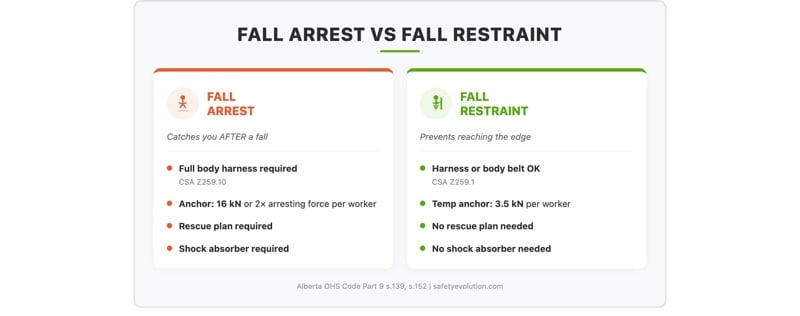
A fall arrest system catches a worker who has already gone over the edge. It does not prevent the fall. It stops the descent before the worker hits the ground or a lower surface.
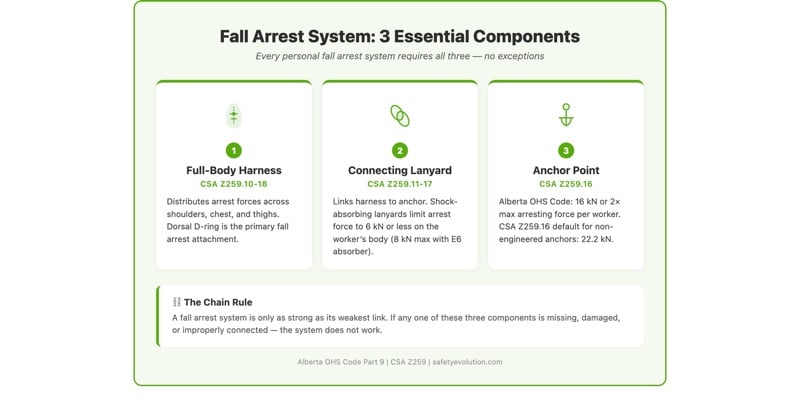
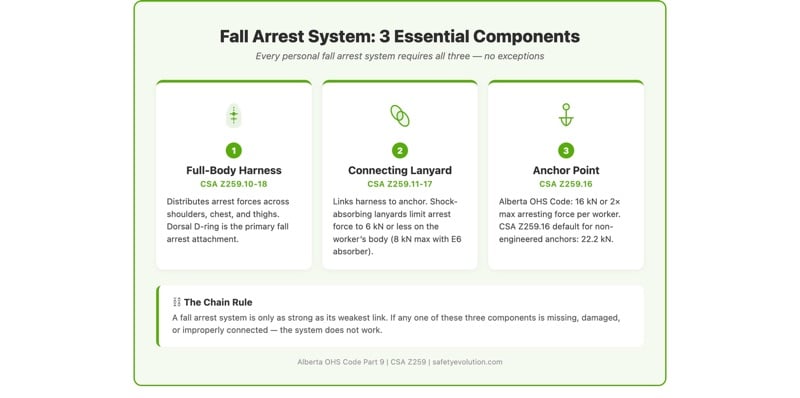
A complete personal fall arrest system includes:
- Full body harness (CSA Z259.10-18): Must be a Class A harness at minimum. Body belts are explicitly prohibited for fall arrest under Alberta OHS Code s.142.1(b).
- Connecting subsystem: Either a shock-absorbing lanyard (CSA Z259.11-17) or a self-retracting device/SRL (CSA Z259.2.2-17).
- Anchor point: Alberta OHS Code requires a minimum of 16 kN or 2 times the maximum arresting force per attached worker (s.152). CSA Z259.16 sets a default of 22.2 kN (5,000 lbs) for non-engineered field-selected anchors. Either way, it is a significant structural requirement.
- Rescue plan: Mandatory. Alberta OHS Code s.140(2)(f) requires written rescue procedures for any worker suspended by a fall arrest system. Suspension trauma can cause death in under 30 minutes (CCOHS).
Fall arrest is the most complex option in the hierarchy. It involves the most equipment, the highest anchor loads, mandatory rescue planning, and real physiological risk if rescue is delayed. That is why Canadian regulations treat it as a last resort, not the default.
What Is Fall Restraint?
A travel restraint system prevents the worker from ever reaching the point where a fall could happen. The worker is tethered so they can get close to the edge but not go over it.
A travel restraint system includes:
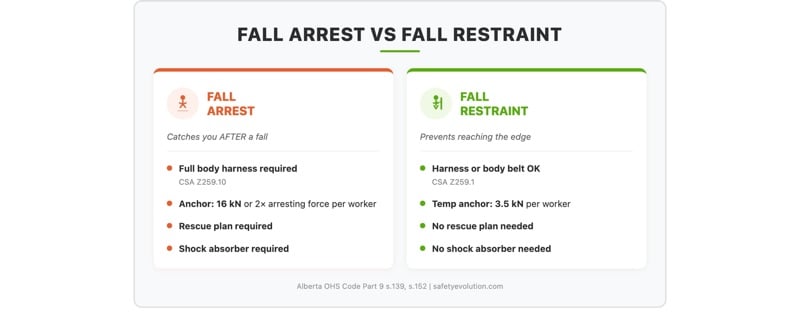
- Full body harness or body belt: Body belts (CSA Z259.1-05) are permitted for travel restraint, unlike fall arrest.
- Fixed-length or adjustable lanyard: Measured so the worker cannot reach the unprotected edge when fully extended.
- Anchor point: Alberta OHS Code requires a minimum of 3.5 kN per worker for a temporary travel restraint anchor (s.152.1(1)). That is a fraction of the 16 kN required for fall arrest anchors.
Because the worker never actually falls, there is no need for a shock absorber, no need for a rescue plan, and no risk of suspension trauma. The system is simpler, cheaper, and safer. That is exactly why it sits higher than fall arrest in the hierarchy. Note: when fall arrest is used, Alberta OHS Code s.151(4) requires the lanyard to be secured to an anchor no lower than the worker's shoulder height where reasonably practicable.
The critical rule from CCOHS: if a travel restraint system does not prevent the worker from reaching the fall hazard, a fall arrest system must be used instead. There is no grey area. Need help building a site-specific fall protection program? Safety Evolution can help.
Not sure where your fall protection program is exposed?
See missing training, inspections, and corrective actions before they become stop-work or audit issues.
Start Your 30-Day Free Trial →Fall Protection vs Fall Arrest vs Fall Restraint: Key Differences
This is where the confusion usually lives. Here is a direct comparison:
| Feature |
Fall Protection (Umbrella) |
Fall Arrest |
Fall Restraint |
| What it does |
Prevents or manages falls through any method |
Stops a fall after it starts |
Prevents the worker from reaching the edge |
| When it activates |
Always active (varies by method) |
Only after the worker falls |
Before the worker reaches the hazard |
| Includes |
Guardrails, nets, restraint, arrest, elimination |
Harness + SRL/lanyard + shock absorber + anchor |
Harness/belt + fixed lanyard + anchor |
| Harness required? |
Depends on method |
Yes, full body (CSA Z259.10) |
Full body or body belt (CSA Z259.1) |
| Anchor load |
Varies |
16 kN or 2x arresting force per worker (AB OHS Code s.152) |
3.5 kN per worker (AB OHS Code s.152.1) |
| Rescue plan? |
Depends |
Mandatory (AB OHS Code s.140) |
Not required |
| Body belt OK? |
Depends |
No. Prohibited (AB OHS Code s.142.1) |
Yes (CSA Z259.1-05) |
| Hierarchy position |
The entire hierarchy |
Second to last (before "equally effective controls") |
Preferred over arrest |
The single biggest takeaway: fall arrest is not the go-to option. It is what you use when guardrails and restraint are not reasonably practicable. If you can keep a worker from reaching the edge, you should.
The Fall Protection Hierarchy: Where Fall Arrest Fits
Fall arrest sits near the bottom of the fall protection hierarchy. Alberta OHS Code s.139 requires employers to consider guardrails and travel restraint before turning to fall arrest. You must demonstrate the higher-level controls are not reasonably practicable before defaulting to harnesses. For the full hierarchy breakdown and how to apply it, see our dedicated hierarchy guide.
Looking for fall protection training that covers all of this? Make sure your provider covers the full hierarchy, not just harness inspection.
Common Mistakes on Canadian Job Sites
After working with hundreds of contractors on their safety programs, these are the mistakes we see repeatedly:
1. Calling everything "fall arrest" in the fall protection plan. Your fall protection plan (required under AB OHS Code s.140 when workers may fall 3 metres or more) must specify the actual system being used. Writing "fall arrest" when the crew is actually in travel restraint, or vice versa, creates a documentation mismatch that auditors and inspectors will catch. Use the correct terminology for the correct system.
2. Defaulting to fall arrest when restraint would work. Fall arrest means higher anchor requirements (16 kN vs 3.5 kN per Alberta OHS Code), mandatory rescue plans, shock absorbers, and suspension trauma risk. If the work area allows you to tether workers short of the edge, restraint is simpler, safer, and preferred by regulation. Many roofing and formwork tasks can use restraint if the anchor placement is planned properly.
3. Using body belts for fall arrest. Alberta OHS Code s.142.1(b) is explicit: a body belt may only be used as part of a travel restraint system or fall restrict system. Full body harnesses (CSA Z259.10-18) are mandatory for fall arrest. We still see body belts on sites where workers are clearly in fall arrest configurations. That is a compliance violation.
4. Skipping the rescue plan. If someone falls and the fall arrest system catches them, they are now hanging in a harness. Suspension trauma can cause unconsciousness in minutes and death in under 30 minutes. Alberta OHS Code s.140(2)(f) requires rescue procedures for anyone in a personal fall arrest system. "We'll figure it out" is not a plan.
5. Not verifying fall clearance distance. A 1.8 m (6-foot) lanyard with a deployed shock absorber (up to 1.07 m), plus harness stretch, plus the worker's height below the D-ring, can easily exceed 5.5 metres of total clearance needed. Alberta OHS Code s.151(1) requires that a personal fall arrest system be arranged so the worker cannot hit the ground or a lower level. If your work surface is only 4 metres above the next level, the math does not work. The worker hits the lower surface before the system fully arrests the fall. Always calculate clearance before selecting your system.
Not sure whether your fall protection plan matches what is actually happening on your sites? That gap between the paperwork and the field is where injuries happen. Use our free toolbox talk package to train your crew on the differences, or let Safety Evolution check your documentation for mismatches before an inspector does.
Still chasing fall protection evidence across files and inboxes?
Centralize corrective actions and proof so your next review is predictable.
Start Your 30-Day Free Trial →Frequently Asked Questions
What are the 3 types of fall protection?
The three main types of personal fall protection are guardrails (passive), travel restraint (prevents reaching the edge), and fall arrest (stops a fall in progress). However, the full fall protection hierarchy includes five levels: elimination, engineering controls (guardrails/covers), administrative controls, travel restraint, and fall arrest.
Is fall protection the same as fall arrest?
No. Fall protection is the umbrella term for all methods of preventing or managing falls, including guardrails, safety nets, travel restraint, and fall arrest. Fall arrest is one specific type of fall protection that stops a worker after a fall has already started. Confusing the two can lead to incorrect equipment selection and fall protection plan errors.
When is fall arrest required instead of fall restraint?
Fall arrest is required when guardrails and travel restraint are not reasonably practicable for the specific work task (Alberta OHS Code s.139). If the work area, anchor placement, or task requirements make it impossible to keep the worker tethered short of the fall hazard, fall arrest becomes the required system. Examples include leading-edge steel erection and certain scaffold work.
What CSA standards apply to fall arrest equipment?
Key CSA standards for fall arrest in Canada include: CSA Z259.10-18 (full body harnesses), CSA Z259.11-17 (energy absorbers and lanyards), CSA Z259.2.2-17 (self-retracting devices), CSA Z259.17-21 (selection and use of active fall protection), and CSA Z259.16 (design of active fall protection systems).
Do I need a rescue plan for travel restraint?
No. A rescue plan is required for fall arrest systems because a worker may be suspended in a harness after a fall, risking suspension trauma. Travel restraint systems prevent the worker from falling in the first place, so rescue from suspension is not a factor. However, you still need a fall protection plan that specifies the travel restraint system being used (Alberta OHS Code s.140).
Get Weekly Safety Insights
Regulation updates, toolbox talk ideas, and compliance tips. One email per week.