Last updated: April 2026
You've got a crew working at height, a GC breathing down your neck about compliance, and six different fall protection options that all sound the same on paper. Pick the wrong one and you're looking at a stop-work order, or worse, someone going home in an ambulance. This isn't a theoretical problem. Every year in Alberta, falls remain the leading cause of workplace fatalities in construction.
The confusion we see most often isn't whether fall protection is needed; it's which type to use and when. If you are not sure your current program covers everything, Safety Evolution can analyse your fall protection documentation and flag where the wrong system type is specified. Otherwise, this guide cuts through the noise.
Quick Answer: Fall Protection Types
The six main fall protection system types in Canada are: guardrails (passive), travel restraint, personal fall arrest, safety nets, warning lines, and control zones. Alberta OHS Code Part 9 requires fall protection at 3 metres (10 feet) and follows a hierarchy: eliminate the hazard first, then use passive systems like guardrails before resorting to personal fall arrest equipment. All fall protection equipment must meet CSA Z259 series standards.
What Does Alberta OHS Code Require for Fall Protection?
Fall protection is any system designed to prevent a worker from falling, or to arrest a fall before it causes injury. Under Alberta's OHS Code Part 9, employers must provide fall protection when a worker could fall 3 metres or more, or where a fall from any height could result in serious injury (near moving machinery, open holes, water hazards).
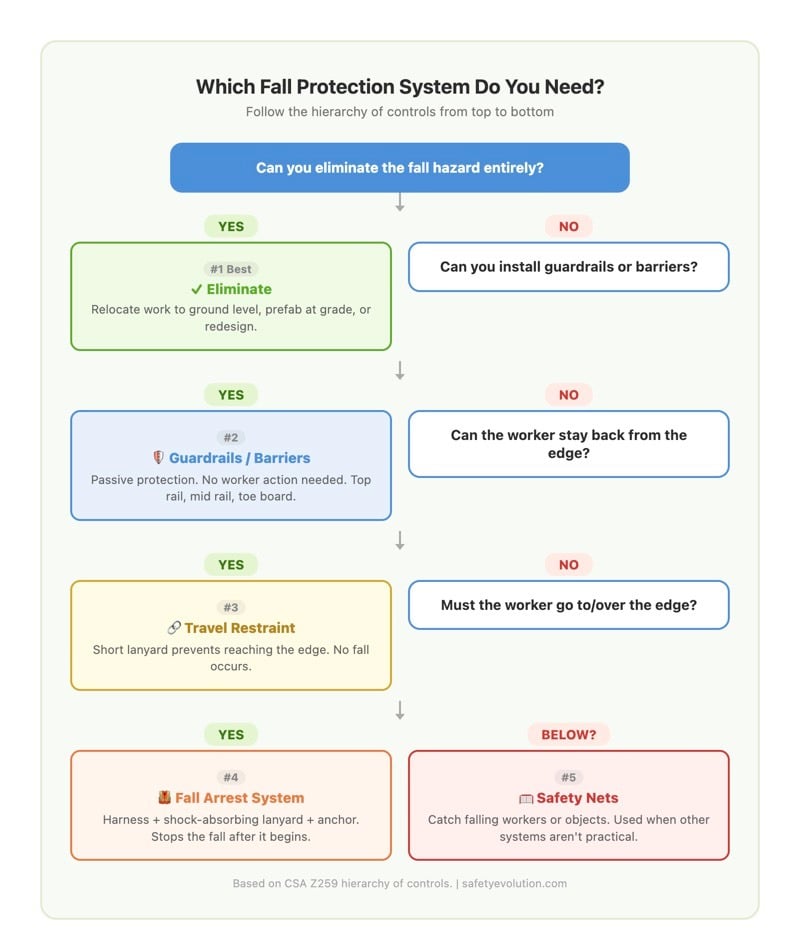
The law doesn't just say "use fall protection." It prescribes a hierarchy of controls that dictates which system you should reach for first. The hierarchy exists because not all systems are equal: some prevent falls entirely, while others just stop you after you've already started falling.
If you're a GC or site supervisor, your job isn't just picking a system. It's documenting why you chose it, making sure it meets CSA Z259 standards, and having a written fall protection plan that covers every worker on your site. Let's break down each type so you can make the right call.
What Are Guardrails and When Should You Use Them?
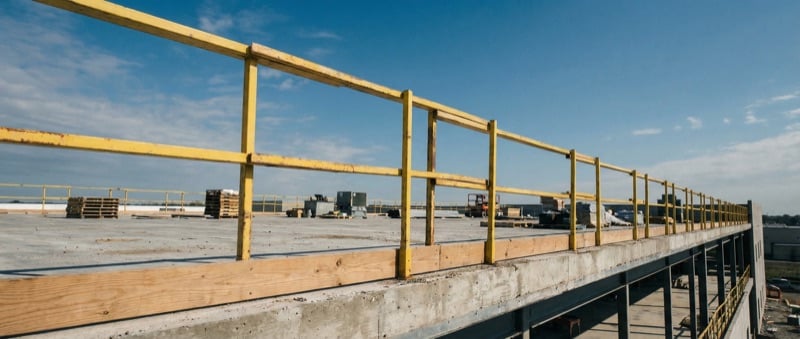
Guardrails are passive fall protection. That means they protect workers without the worker doing anything: no harness to put on, no lanyard to clip in, no training on self-rescue. You build it, and it works.
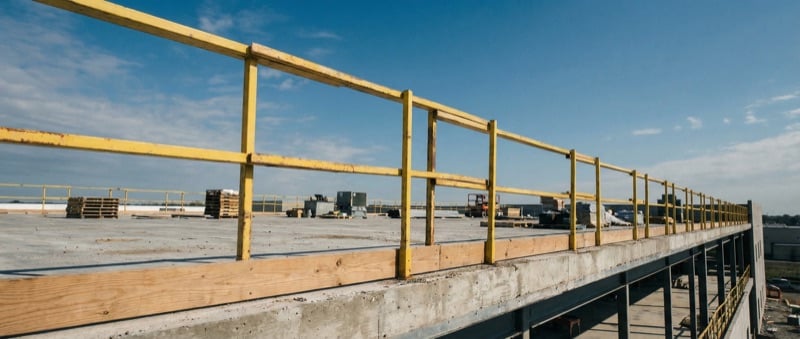
Under Alberta OHS Code, a guardrail system needs three components:
- Top rail: between 920 mm and 1,070 mm (roughly waist to chest height)
- Mid rail: centred between the top rail and the walking surface
- Toe board: at least 89 mm high to stop tools and materials from sliding off the edge
The system must withstand a point load of 900 N (about 200 lbs of force) applied in any direction at the top rail. That's not a suggestion; it's a structural requirement.
When to use them: Guardrails are the first choice in the fall protection hierarchy after eliminating the hazard. Use them on open edges, floor openings, ramps, platforms, and anywhere workers need unrestrained movement near a fall hazard. If a guardrail is reasonably practicable, it should be your default before you even think about harnesses.
The blunt truth: Most contractors skip guardrails because they take time to install. They go straight to harnesses because it feels faster. But a guardrail protects every person on that platform, all day, without a single inspection. A harness only works if the worker actually clips in, and anyone who's spent time on a real site knows that doesn't always happen.
How Does a Travel Restraint System Work?
A travel restraint system prevents the worker from reaching the fall hazard entirely. Think of it like a leash: the worker wears a harness connected to an anchor by a lanyard that's short enough that they physically cannot get to the edge.
This is the second choice in the hierarchy after guardrails. The advantage over fall arrest is huge: because the worker can never reach the edge, there's no free fall, no fall arrest force on the body, and no need for a rescue plan.
A travel restraint system requires:
- A full-body harness meeting CSA Z259.10
- A connecting lanyard (no shock absorber needed since there's no fall to arrest)
- An anchor rated for the restraint load (not the same rating as fall arrest anchors)
- Proper setup so the lanyard length genuinely prevents the worker from reaching the edge
Here's where it goes wrong on real sites: the foreman sets up a travel restraint system with a lanyard that's too long. The worker can still reach the edge. That's not travel restraint; that's a fall arrest system without the right anchor rating or shock absorber. It's a regulation violation waiting for an inspector. Getting this wrong isn't just a compliance issue; it's a geometry problem that can get someone killed.
Not sure where your fall protection program is exposed?
See missing training, inspections, and corrective actions before they become stop-work or audit issues.
Start Your 30-Day Free Trial →What Is a Personal Fall Arrest System?
A personal fall arrest system (PFAS) is designed to stop a worker who has already started falling. It's the system most people picture when they hear "fall protection": a harness, a lanyard with a shock absorber, and an anchor point overhead.
Under Alberta OHS Code Part 9, a personal fall arrest system must include:
- Full-body harness (CSA Z259.10): distributes arrest forces across the torso and thighs
- Shock-absorbing lanyard (CSA Z259.11) or self-retracting device (SRD) (CSA Z259.2.2): limits arrest force to 8 kN or less on the worker
- Anchor (CSA Z259.15 or engineered): rated for at least 22.2 kN (5,000 lbs) per worker, or designed by a professional engineer
- Adequate clearance: enough distance below the anchor so the worker won't hit the ground or a lower level after the fall plus deceleration distance
That last point is the one contractors mess up most. A standard 6-foot lanyard with a shock absorber, plus harness stretch and the worker's height, requires roughly 5.5 to 6 metres of clearance below the anchor. If you're working on a two-storey structure, the math doesn't work. You need a shorter lanyard or an SRD.
Fall arrest is third in the hierarchy for a reason: it allows the worker to actually fall before catching them. Every fall arrest event means potential injuries, equipment replacement, and a mandatory rescue. Alberta OHS Code requires that if you use fall arrest, you must have a written fall protection plan and a rescue plan that gets the worker down within minutes, not hours. If you don't have a plan in place, that's where Safety Evolution's done-for-you safety services can help.
Your crew also needs proper fall protection training before they clip into any fall arrest system. That's not a formality; workers need to understand clearance calculations, equipment inspection, and emergency procedures. For a deeper look at how fall arrest fits within the broader picture, read our guide on fall protection vs fall arrest.
When Are Safety Nets Required?
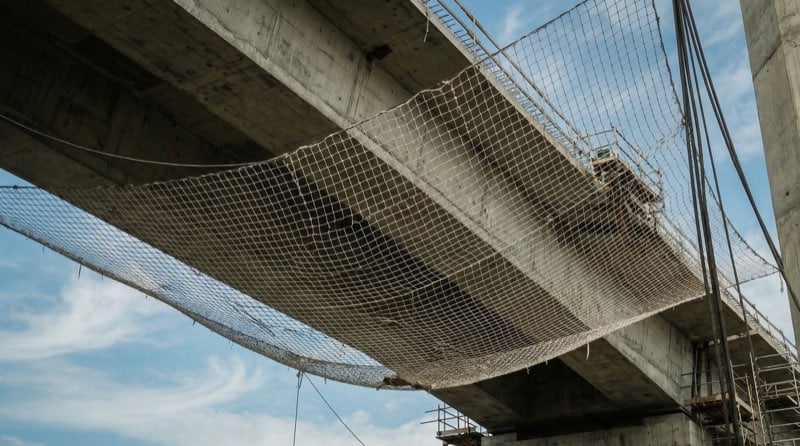
Safety nets are a passive collective system that catches workers (or falling objects) after a fall. They're most common on bridge construction, large structural steel projects, and situations where guardrails aren't feasible and personal fall arrest systems aren't practical for the work being done.
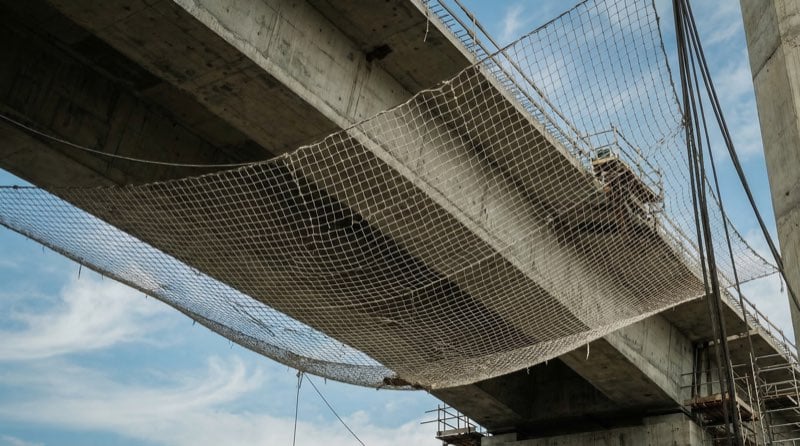
Under Alberta OHS Code, safety nets must:
- Be installed as close as practicable below the work area (maximum 6 metres)
- Extend far enough beyond the edge to catch a falling worker
- Meet the requirements of CSA Z259.16
- Be inspected by a competent person before each shift and after any event that could affect their integrity
Safety nets share the guardrail advantage: they protect everyone in the area without requiring individual equipment. But they're expensive to install, require engineering for the support structure, and most small-to-mid-size contractors don't have the project scope to justify them.
If you're running a 15-person crew on a commercial build, safety nets probably aren't in your budget or your scope. But on large infrastructure projects, they can eliminate hundreds of individual harness setups.
What Are Warning Lines and Control Zones?
Warning lines and control zones are administrative fall protection methods used on flat rooftops and large open surfaces. They don't physically stop a fall. They mark a boundary and restrict who can enter the danger zone.
Warning Lines
A warning line is a barrier set up at least 2 metres from the edge of a flat roof or open surface. It typically consists of stanchions and a rope, wire, or chain at a height between 840 mm and 1,000 mm. The purpose is simple: anyone inside the warning line perimeter can work without other fall protection, because they're far enough from the edge.
Workers who need to cross the warning line and work between it and the edge must use another fall protection method (typically travel restraint or fall arrest).
Control Zones
A control zone is the area between the warning line and the unprotected edge. Only designated, trained workers are allowed into a control zone, and they must be using an alternative fall protection method. It's not a free pass to work near the edge without equipment.
Most contractors think of warning lines and control zones as "easy" fall protection. They're not. They require a written fall protection plan, clear site markings, worker training on boundaries, and supervision to make sure nobody wanders past the line without proper gear. Miss any of those requirements and an OHS inspector will shut it down.
How Do You Choose the Right Fall Protection System?
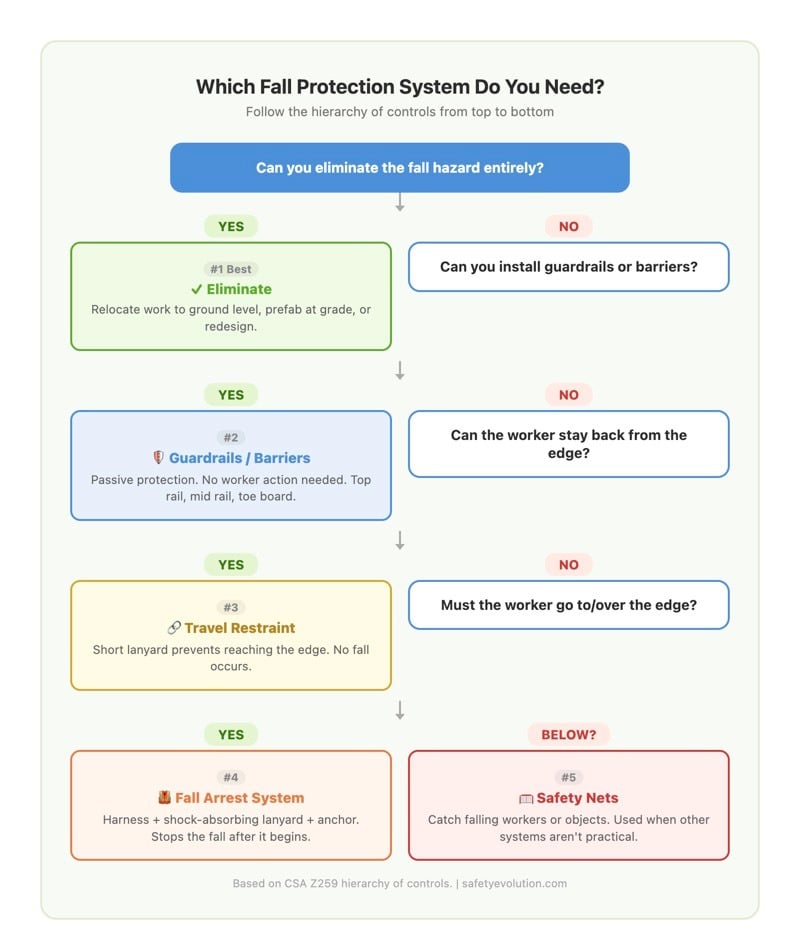
System selection follows the fall protection hierarchy mandated by Alberta OHS Code Part 9. You start at elimination and work down — guardrails before restraint, restraint before arrest — and you must document why each higher-level option is not reasonably practicable. For the full decision tree and how to apply it step by step, see our hierarchy guide.
Once you know which level of control applies, the question becomes: which specific system fits the job? That's what the rest of this guide covers.
What About Fall Protection Equipment Inspections?
Every piece of fall protection equipment must be inspected before each use by the worker, and formally inspected at intervals by a competent person. CSA Z259 standards set the baseline, but Alberta OHS Code is clear: damaged, worn, or suspect equipment must be removed from service immediately.
That includes:
- Harnesses with frayed webbing, damaged stitching, or corroded hardware
- Lanyards that have been shock-loaded (they're single-use after a fall arrest event)
- SRDs that don't retract smoothly or show signs of damage
- Anchors with loose bolts, cracked welds, or corrosion
Use a documented fall protection equipment inspection checklist to track every piece of equipment on your site. If it goes out and comes back without a documented inspection, you're gambling with both lives and compliance.
Still chasing fall protection evidence across files and inboxes?
Centralize corrective actions and proof so your next review is predictable.
Start Your 30-Day Free Trial →
Frequently Asked Questions
What are the main types of fall protection systems in Canada?
The main fall protection types used on Canadian construction sites are: guardrails (passive protection), travel restraint systems, personal fall arrest systems (harness, lanyard, and anchor), safety nets, warning lines, and control zones. Alberta OHS Code Part 9 requires employers to follow a hierarchy that prioritizes hazard elimination and passive systems before personal protective equipment.
At what height is fall protection required in Alberta?
Alberta OHS Code Part 9 requires fall protection when a worker could fall 3 metres (10 feet) or more. Fall protection is also required at any height where a fall could result in injury due to the work environment, such as near open holes, moving equipment, or hazardous surfaces below.
What is the difference between travel restraint and fall arrest?
Travel restraint prevents the worker from reaching the fall edge entirely, using a harness and short lanyard that physically stops them before the hazard. Fall arrest allows the worker to reach the edge but catches them after a fall starts, using a shock-absorbing lanyard or SRD. Travel restraint is higher in the protection hierarchy because it prevents falls rather than just arresting them. Learn more in our fall protection vs fall arrest guide.
What CSA standards apply to fall protection equipment?
The CSA Z259 series covers all fall protection equipment in Canada. Key standards include: Z259.10 for full-body harnesses, Z259.11 for shock-absorbing lanyards, Z259.2.2 for self-retracting devices, Z259.15 for anchors, Z259.1 for body belts and travel restraint, and Z259.16 for safety net systems. All fall protection equipment used on Canadian worksites must meet the applicable CSA Z259 standard.
Do I need a fall protection plan in Alberta?
Yes. Alberta OHS Code Part 9 requires a written fall protection plan whenever workers use travel restraint, fall arrest, safety nets, or work in control zones. The plan must describe the fall hazards, the systems being used, anchor locations, rescue procedures, and the training workers have received. If you're using a personal fall arrest system, you also need a separate rescue plan. Safety Evolution can help you build a compliant fall protection plan.
Get Weekly Safety Insights
Regulation updates, toolbox talk ideas, and compliance tips. One email per week.