Last updated: April 2026
You booked your ESC fall protection course for next week. Your crew lead said the exam is "easy if you pay attention." But you have seen workers fail, rebook, and lose two days of work while the rest of the crew waited for a replacement. That is not happening to you.
Fall protection test questions and answers are the fastest way to check your knowledge before exam day. This study guide gives you 18 practice questions across 5 core topic areas, based on the core topics covered in the Energy Safety Canada (ESC) fall protection course. Every answer includes an explanation of why it is correct, so you actually learn the material instead of just memorizing letters.
Quick Answer
This guide contains 18 practice questions grouped into 5 topic areas: hierarchy of controls, harness inspection, anchor points, provincial height requirements, and rescue planning. Each question uses a multiple choice format similar to the ESC exam, with the correct answer and a detailed explanation. Scroll to any section or work through all 18 questions in order.
How the ESC Fall Protection Exam Works
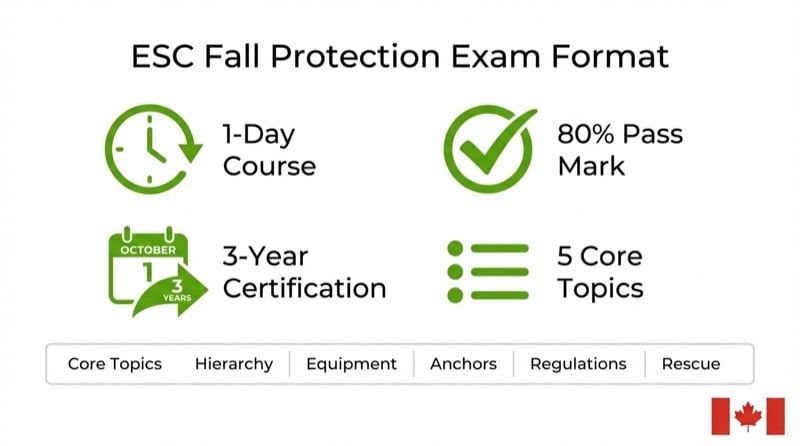
The Energy Safety Canada (ESC) Fall Protection course is a 1-day classroom program that replaced the former OSSA Fall Protection certification. It is the industry standard for oil and gas, pipeline, and construction work across Alberta and Western Canada.
Here is what to expect on exam day:
- Format: Written exam with multiple choice questions
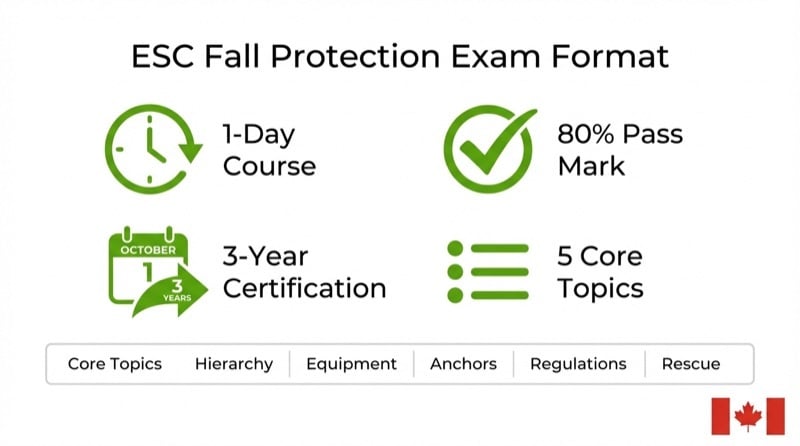
- Pass mark: 70% minimum
- Certification validity: 3 years from course completion date
- Topics covered: Fall protection hierarchy, equipment inspection, anchor points, fall protection plans, rescue procedures, and provincial regulations
- Practical component: Participants must demonstrate correct harness donning and equipment selection for travel restraint and fall arrest scenarios
The exam is consistent with the Alberta OHS Code Part 9 and CSA Z259 standards. If you can answer the practice questions below, you are well prepared for the written portion.
Hierarchy of Controls Questions
The fall protection hierarchy is the foundation of every exam. If you understand the order and why it matters, you will answer at least 4-5 questions correctly. The hierarchy moves from most effective (elimination) to least effective (personal protective equipment).
Question 1: What is the correct order of the fall protection hierarchy of controls, from most effective to least effective?
- Fall arrest, travel restraint, guardrails, elimination
- Guardrails, elimination, fall arrest, travel restraint
- Elimination, engineering controls (guardrails), administrative controls, PPE (travel restraint, then fall arrest)
- PPE, administrative controls, engineering controls, elimination
Answer: C
Why: The hierarchy always starts with elimination, meaning you remove the need to work at height entirely. If that is not possible, you move to engineering controls like guardrails or covers that physically prevent falls without relying on worker behaviour. Administrative controls (warning lines, safe work procedures) come next. PPE is the last resort, and within PPE, travel restraint (which prevents you from reaching the edge) ranks above fall arrest (which catches you after a fall). Source: CCOHS Fall Protection Hierarchy.
Question 2: A contractor is planning roof work on a commercial building. Which fall protection method should be considered FIRST?
- Issue full-body harnesses to all workers
- Install a temporary guardrail system around the roof perimeter
- Determine if the work can be completed from the ground using an extension tool or drone
- Set up a controlled access zone with warning lines
Answer: C
Why: Before selecting any fall protection equipment, you must first ask: "Can we eliminate the need to work at height?" Using drones for roof inspections, extension tools for painting, or pre-assembling components at ground level are all elimination strategies. Only when elimination is not reasonably practicable do you move down the hierarchy to guardrails (B), then administrative controls (D), then harnesses (A).
Question 3: What is the key difference between a travel restraint system and a fall arrest system?
- Travel restraint is cheaper than fall arrest
- Travel restraint prevents the worker from reaching the fall hazard; fall arrest catches the worker after a fall
- Fall arrest uses a harness; travel restraint uses a body belt
- There is no difference; the terms are interchangeable
Answer: B
Why: A travel restraint system uses a fixed-length lanyard that physically prevents the worker from reaching the edge where a fall could occur. A fall arrest system allows the worker to reach the edge but is designed to catch and stop them if they fall. Travel restraint is preferred in the hierarchy because it prevents the fall entirely, while fall arrest manages the consequences of a fall that has already started.
Question 4: Which of the following is an example of an engineering control for fall protection?
- A written safe work procedure for roof access
- A full-body harness connected to a self-retracting lifeline
- A permanent guardrail installed around a floor opening
- A safety monitor stationed at the roof edge
Answer: C
Why: Engineering controls are physical barriers that protect workers without relying on behaviour or training. A permanent guardrail is a classic engineering control: once installed, it protects every worker automatically. Option A is an administrative control, option B is PPE (fall arrest), and option D is an administrative control. Guardrails, covers over openings, and fixed scaffolding platforms are all engineering controls.
Harness Inspection Questions
Every fall protection exam tests your ability to inspect equipment before use. A harness that passes visual and tactile inspection could save your life. One that does not could fail under load. Pre-use inspection is not optional: it is required under CSA Z259.10 and Alberta OHS Code Part 9.
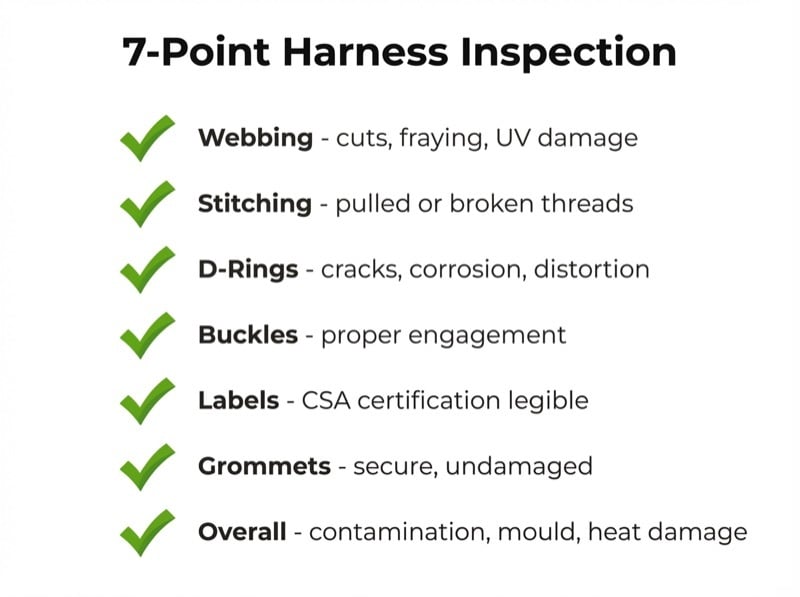
Question 5: Before each use, a full-body harness must be inspected. Which of the following is NOT part of a standard pre-use inspection?
- Checking webbing for cuts, fraying, or chemical damage
- Verifying the CSA certification label is present and legible
- Load testing the harness by hanging a 100 kg weight from the D-ring
- Inspecting all buckles and adjustment hardware for proper function
Answer: C
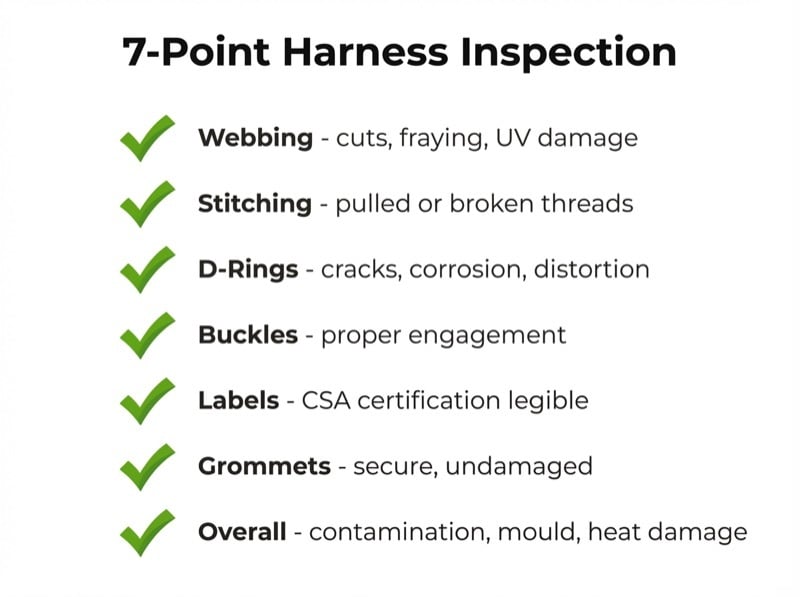
Why: Pre-use inspection is a visual and tactile check, not a load test. Workers should never load-test their own harnesses because doing so can weaken the materials and create a false sense of security. The 7-point inspection covers: webbing (cuts, abrasion, UV damage), stitching (pulled or broken threads), D-rings (cracks, distortion, corrosion), buckles (proper engagement), labels (CSA certification legible), grommets/rivets (secure and undamaged), and overall condition (contamination, mould, heat damage).
Question 6: A worker notices the CSA certification label on their harness is no longer legible. What should they do?
- Continue using it if the harness looks fine otherwise
- Write the certification details on the harness with a marker
- Remove the harness from service and tag it for inspection by a competent person
- Use it for travel restraint only, not fall arrest
Answer: C
Why: The CSA certification label is your proof that the harness meets Canadian safety standards. Without a legible label, you cannot confirm the harness model, manufacture date, or certification status. Alberta OHS Code requires that fall protection equipment meet applicable CSA standards, and an illegible label means compliance cannot be verified. The harness must be removed from service until a competent person inspects and re-certifies it, or it must be destroyed.
Question 7: After a worker has been caught by a fall arrest system (the harness arrested an actual fall), what must happen to the harness?
- Inspect it and return it to service if no visible damage is found
- Remove it from service immediately; it cannot be reused unless the manufacturer or a professional engineer certifies it as safe
- Have a supervisor visually inspect it and sign off on continued use
- Send it for recertification within 30 days
Answer: B
Why: Under Alberta OHS Code Part 9, once a personal fall arrest system has stopped a fall, it must be removed from service immediately. The forces generated during a fall can cause internal damage to webbing fibres and stitching that is invisible to the eye. However, the code does not require the equipment to be destroyed in every case. It may return to service only if the manufacturer or a professional engineer certifies it as safe for continued use. Without that certification, the equipment must be permanently retired.
Question 8: How often must a full-body harness receive a formal inspection by a competent person, beyond daily pre-use checks?
- Every 30 days
- At least once per year, or as recommended by the manufacturer
- Only after a fall event
- Every 3 years when the certification is renewed
Answer: B
Why: In addition to the worker's daily pre-use inspection, fall protection equipment must receive a formal inspection by a competent person at the interval specified by the manufacturer and the applicable standard. CSA Z259.10 recommends at least annual inspection by a trained competent person, though manufacturers may require more frequent intervals for harsh environments (chemical exposure, extreme temperatures, or high UV). Alberta OHS Code requires inspection before use as specified by the manufacturer.
Not sure where your fall protection program is exposed?
See missing training, inspections, and corrective actions before they become stop-work or audit issues.
Start Your 30-Day Free Trial →Anchor Point Questions
Anchor points are where your life literally hangs. Choosing the wrong anchor, or connecting to one that cannot handle the load, is one of the most common fall protection failures on Canadian work sites. These questions test your understanding of anchor strength requirements and proper selection.
Question 9: Under Alberta OHS Code Part 9, what is the minimum anchor strength requirement for a personal fall arrest system?
- 10 kN per attached worker
- 16 kN or 2 times the maximum arresting force per attached worker
- 22.2 kN (5,000 lbs) per attached worker
- 44.4 kN (10,000 lbs) per attached worker
Answer: B
Why: Alberta OHS Code Part 9 requires that anchor points used for fall arrest withstand 16 kN or 2 times the maximum arresting force per attached worker. This applies to both permanent and temporary anchors. Note that the older 22.2 kN (5,000 lbs) figure still appears in many manufacturer specifications and in CSA Z259.16 for non-engineered field-selected anchors. When the Alberta code and manufacturer requirements differ, you must meet the higher of the two. On an ESC exam focused on Alberta, 16 kN is the code-based answer; on a job site, always verify against both the code and the manufacturer's rated capacity.
Question 10: Where should an anchor point ideally be located relative to the worker?
- At the worker's feet
- Directly overhead or as high as possible above the worker's D-ring
- At the same height as the worker's waist
- Location does not matter if the anchor meets strength requirements
Answer: B
Why: An anchor point directly overhead minimizes free fall distance and reduces the swing radius (pendulum effect) if a fall occurs. A lower anchor increases both the fall distance and the swing arc, which increases the arrest force on the body and the risk of striking objects during the swing. Alberta OHS Code Part 9 requires workers to secure the lanyard to an anchor no lower than shoulder height where reasonably practicable. If attachment below shoulder height is unavoidable, the worker must still meet clearance and arrest-force requirements. The ideal anchor is always at or above the worker's dorsal D-ring height.
Question 11: Which of the following would NOT be an acceptable anchor point for a personal fall arrest system?
- A structural steel beam certified by a professional engineer for fall arrest loads
- A rooftop mechanical unit (HVAC condenser) bolted to the roof
- A purpose-built roof anchor meeting CSA Z259.16 installed by a qualified person
- A temporary anchor strap wrapped around a structural member rated to 22.2 kN
Answer: B
Why: Mechanical equipment on rooftops (HVAC units, vents, pipes) is not designed to withstand fall arrest forces. Even if bolted down, these units are engineered for their operational loads, not the 22.2 kN dynamic forces of a fall arrest. Workers sometimes connect to them out of convenience, which is one of the most dangerous anchor mistakes on a job site. Only structural members, engineered anchors, or certified anchor devices should be used.
Question 12: A worker is using a fall arrest system connected to an anchor at foot level. What is the primary risk?
- The harness will not fit properly
- The free fall distance will be significantly increased, potentially exceeding safe limits and causing the worker to hit a lower level
- The anchor will be easier to inspect
- There is no additional risk if the anchor meets the required strength
Answer: B
Why: A foot-level anchor dramatically increases free fall distance. If a worker's dorsal D-ring is at approximately 1.5 metres and the anchor is at their feet, the free fall distance before the lanyard engages includes: the lanyard length + the distance from D-ring to anchor + energy absorber deployment (up to 1.07 metres). The total fall distance can easily exceed 5 metres, meaning the worker could strike the ground or a lower level before the system fully arrests the fall. This is why overhead anchors are always preferred.
Height Requirements Questions
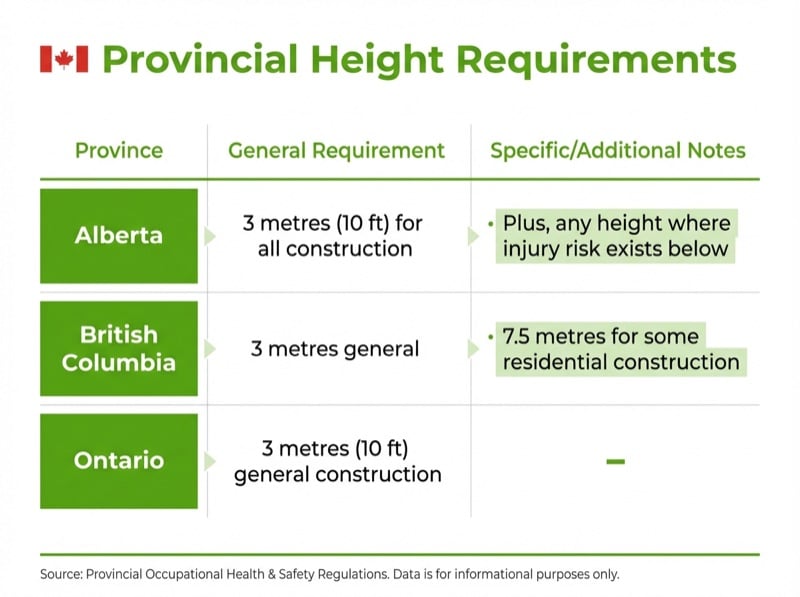
Every province sets its own height threshold for when fall protection is required. Most default to 3 metres, but there are important exceptions that catch workers off guard on exams.
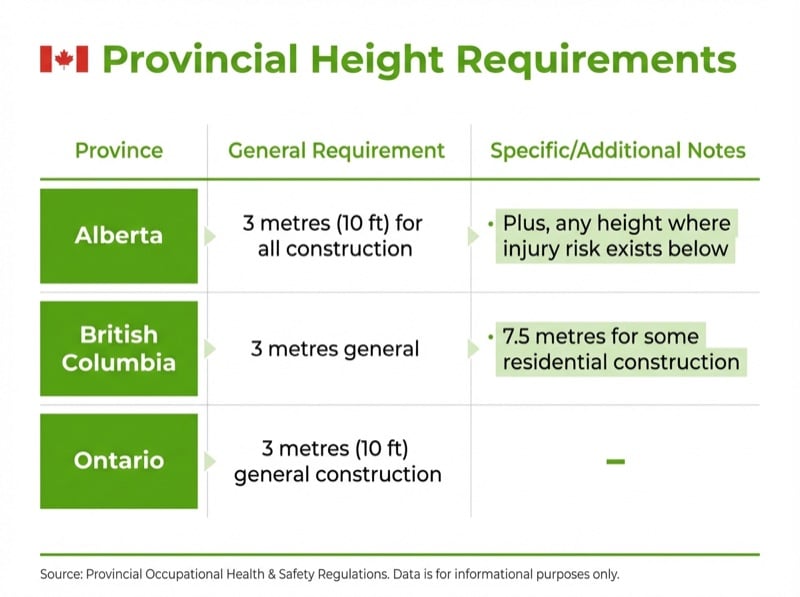
Question 13: In Alberta, at what height must an employer ensure fall protection is in place?
- 2 metres (6.5 ft)
- 3 metres (10 ft), with additional requirements at lower heights where there is an unusual possibility of injury or a hazardous landing surface
- 3.7 metres (12 ft)
- 4.5 metres (15 ft)
Answer: B
Why: Alberta OHS Code Part 9, s.139 requires fall protection when a worker: (a) may fall 3 m or more, (b) may fall less than 3 m where there is an unusual possibility of injury, (c) could fall into or onto a hazardous substance or object or through an opening in a work surface, or (d) is at a permanent work area where the fall is more than 1.2 m and less than 3 m. The "3 metres" is the general trigger, but these four conditions mean fall protection can be required well below that height depending on the hazard. This is one of the most frequently tested distinctions on the exam.
Question 14: A worker is on a construction site in Alberta, working 2 metres above a concrete floor with exposed rebar below. Is fall protection required?
- No, because the height is below 3 metres
- Yes, because the hazard below (exposed rebar) creates a risk of serious injury regardless of height
- Only if the employer has a written fall protection plan
- Only if the worker requests fall protection equipment
Answer: B
Why: This is the exception that most workers get wrong. Under s.139, fall protection is required where a worker could fall into or onto a hazardous substance or object, regardless of height. Exposed rebar is exactly this scenario: a fall onto it from any height could cause impalement. Additionally, at less than 3 m the "unusual possibility of injury" provision applies. Employers cannot use "it is under 3 metres" as a blanket exemption when the landing surface is hazardous.
Question 15: In British Columbia, when is a written fall protection plan required under WorkSafeBC OHSR Part 11?
- At any height where fall protection is used
- Only when working above 10 metres
- When workers are above 7.5 metres and not protected by permanent guardrails
- Only when using fall arrest systems, not travel restraint
Answer: C
Why: In BC, the general trigger to use fall protection is still 3 metres (or less than 3 m where the fall could cause greater injury), the same as Alberta. The 7.5 m threshold is different: it is the height at which a written fall protection plan is required when workers are not protected by permanent guardrails. This distinction trips up workers who assume 7.5 m is BC's trigger height for using fall protection. It is not. You need fall protection at 3 m; you need a documented plan at 7.5 m. Source: WorkSafeBC OHSR Part 11.
Rescue Planning Questions
Your fall protection plan is not complete without a rescue plan. In Alberta, s.140 of the OHS Code specifically requires rescue procedures as part of every fall protection plan. If a worker falls and is suspended in their harness, you have minutes to get them down before suspension trauma becomes life-threatening.
Question 16: Under Alberta OHS Code s.140, which of the following must be included in a written fall protection plan?
- Equipment costs and supplier contact information
- Rescue procedures for a worker suspended by a fall arrest system
- A list of all workers who have fall protection training
- The name of the fall protection equipment manufacturer
Answer: B
Why: Alberta OHS Code s.140 requires that a fall protection plan include: the hazards identified at the work site, the fall protection system to be used, the procedures for rescue if a worker falls and is suspended, the procedures for equipment inspection, and any site-specific factors. Rescue procedures are not optional: they are a legislated requirement. A plan without a rescue component is incomplete and non-compliant.
Question 17: Why is rapid rescue critical after a worker is caught by a fall arrest system and left suspended in their harness?
- The harness straps will begin to deteriorate after 30 minutes
- Suspension trauma (orthostatic intolerance) can become life-threatening within minutes as blood pools in the legs
- The anchor point will weaken over time under the static load
- It is not critical; the worker can wait safely for emergency services
Answer: B
Why: Suspension trauma (also called orthostatic intolerance or harness hang syndrome) occurs when a worker hangs motionless in a harness. The harness straps compress the veins in the legs, causing blood to pool in the lower extremities. The heart cannot circulate enough oxygenated blood to the brain and vital organs. This can lead to unconsciousness within minutes and death within 15 to 30 minutes if the worker is not rescued. Suspension trauma can cause loss of consciousness within minutes and death in under 30 minutes. Rescue must happen as quickly as possible. This is why every fall protection program must include a site-specific rescue plan, not just "call 911."
Question 18: Which of the following is the BEST example of a rescue plan for a worker suspended after a fall?
- Call 911 and wait for emergency services to arrive
- Have a trained rescue team on site with equipment to reach and lower the suspended worker within minutes
- Instruct the suspended worker to climb the lanyard back to the work surface
- Cut the lanyard to lower the worker to the ground
Answer: B
Why: Emergency services response times in Alberta can range from 10 to 45+ minutes depending on location. That is too long when suspension trauma can become life-threatening in minutes. A proper rescue plan includes trained rescuers on site with the equipment and procedures to reach a suspended worker and lower them to safety rapidly. Option A is insufficient as a standalone plan. Option C is unrealistic for an injured or unconscious worker. Option D could cause a secondary fall and additional injury. The employer is responsible for having rescue capability on site before any work at height begins.
Study Tips for Your Fall Protection Exam
Passing your fall protection exam comes down to understanding principles, not memorizing answers. Here are 5 strategies that work:
- Master the hierarchy first. If you understand why elimination beats guardrails, and why guardrails beat harnesses, you can reason through any hierarchy question even if the wording is unfamiliar.
- Get hands on with equipment. The practical component requires you to don a harness and select correct equipment for scenarios. Practice donning until it is second nature. Know the difference between a shock-absorbing lanyard and a self-retracting lifeline.
- Study your province. The exam covers Alberta OHS Code Part 9 requirements. Know the 3-metre trigger, the exceptions, and what must be included in a fall protection plan under s.140.
- Think "worst case" on anchor questions. Anchor questions often test whether you know the difference between Alberta code requirements (16 kN or 2x max arresting force) and CSA/manufacturer defaults (22.2 kN for non-engineered anchors). Read the question carefully to determine which standard it references.
- Do not skip rescue planning. Suspension trauma is a favourite exam topic because it tests whether you understand the urgency of rescue. Remember: minutes, not hours.
Need fall protection training with instant certificates and expiry tracking? Safety Evolution delivers online and in-person courses aligned with ESC standards. Or download our free toolbox talk package to run fall protection refreshers with your crew.
Still chasing fall protection evidence across files and inboxes?
Centralize corrective actions and proof so your next review is predictable.
Start Your 30-Day Free Trial →Frequently Asked Questions
How many questions are on the ESC fall protection exam?
The ESC fall protection exam is a written multiple choice test taken at the end of the 1-day classroom course. You need a minimum score of 70% to pass. The exam covers fall protection hierarchy, equipment inspection, anchor points, provincial regulations, and rescue planning.
What score do you need to pass the fall protection test?
You need a minimum of 70% on the written exam to pass the ESC fall protection course and receive your certification. For those applying to become fall protection instructors, the required pass mark is 90%.
How long is fall protection certification good for?
ESC fall protection certification is valid for 3 years from the date of course completion. After 3 years, you must retake the full 1-day course to renew. Check with your training provider for current renewal requirements and options.
Can you retake the fall protection exam if you fail?
Rewrite policies vary by training provider and are not set by ESC. Contact your provider before course day to understand their specific rewrite policy and any associated fees. Studying with practice questions beforehand significantly reduces the risk of failing.
What topics does the fall protection exam cover?
The ESC fall protection exam covers: the hierarchy of fall protection controls, personal fall protection equipment (harnesses, lanyards, SRLs), anchor point requirements, pre-use equipment inspection, fall protection plan requirements under provincial OHS codes, and rescue planning including suspension trauma. The exam is aligned with Alberta OHS Code Part 9 and CSA Z259 standards.
Get Weekly Safety Insights
Regulation updates, toolbox talk ideas, and compliance tips. One email per week.