Last updated: May 2026
If you are searching for a WorkSafeBC hazard assessment form, you are probably trying to solve a real field problem, fast. Crews are mobilizing, supervisors are juggling paperwork, and nobody wants to discover documentation gaps after an incident. A WorkSafeBC hazard assessment form is a documented record of hazards, risk level, controls, owners, and follow-up actions for BC work activities. The key is not finding a magic PDF. The key is using a defensible form structure that matches WorkSafeBC requirements and your actual site conditions.
⚡ Quick Answer
- Official form: No single universal WorkSafeBC hazard assessment form is mandated for every employer.
- Inspection duty: Regular inspections are required under BC OHS Regulation 3.5.
- Special trigger: A special inspection is required when needed because of malfunction or accident under BC OHS Regulation 3.7.
- Correction rule: Unsafe or harmful conditions must be remedied without delay under BC OHS Regulation 3.9.
- Program threshold: OHS program requirements apply at 20+ workers with at least one moderate/high hazard workplace, and at 50+ workers overall under BC OHS Regulation 3.1.
Do You Need an "Official" WorkSafeBC Hazard Assessment Form?
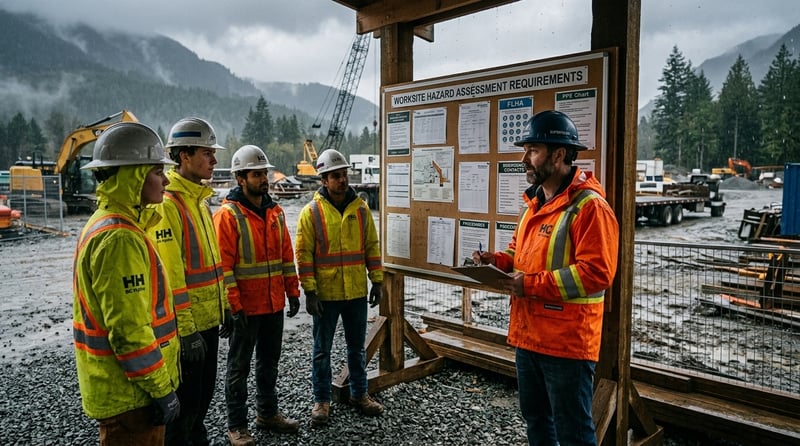
Short answer, no. WorkSafeBC does not require one single universal form that every BC employer must use. What it requires is that employers identify hazards, assess risk, and document what they found and what they did about it.
Most people think compliance means downloading one "approved" template and using it forever. They are wrong. What inspectors care about is whether your records show real hazard identification, practical controls, and timely closeout, not whether your header looks like someone else's template.
As WorkSafeBC states in OHS Regulation 3.5, employers must ensure "regular inspections are made of all workplaces, including buildings, structures, grounds, excavations, tools, equipment, machinery and work methods and practices". That language focuses on documented hazard management performance, not use of one universal template.
WorkSafeBC itself points employers to risk-assessment guidance and practical tools you can adapt, including its resource on assessing risks and its Key Risk Inventory guide plus KRI template.
The blunt truth is this. A neat form that is filled out after the shift to "catch up" is weak evidence. A simple form completed before work starts, then updated when conditions change, is far more defensible.
What WorkSafeBC Actually Requires You to Do (and Document)
BC compliance gets easier when you separate requirements into four operational rules. You need a system that proves inspections happen, special inspections trigger when they should, hazards are corrected fast, and your OHS program threshold is handled correctly.
- Regular inspections (OHS 3.5): You must ensure regular inspections of workplace areas, equipment, work methods, and practices. Source: WorkSafeBC OHS Regulation 3.5.
- Special inspections (OHS 3.7): You must perform special inspections when required by malfunction or accident circumstances. Source: WorkSafeBC OHS Regulation 3.7.
- Correction without delay (OHS 3.9): Unsafe or harmful conditions found during inspection must be remedied without delay. Source: WorkSafeBC OHS Regulation 3.9.
- OHS program triggers (OHS 3.1): Program requirements apply at 20+ workers with at least one moderate/high hazard-rated workplace, and at 50+ workers overall. Source: WorkSafeBC OHS Regulation 3.1.
Specific messy example from the field. A 38-person Lower Mainland contractor had inspection checklists, but no clear post-incident special inspection records after a tool failure event. They fixed the hazard physically, but could not show inspection trigger, owner, and closeout trail. That is exactly where defensibility breaks down.
Minimum Fields Your BC Hazard Assessment Form Must Include
If your form misses these fields, you will eventually miss actions. Build for execution, not paperwork aesthetics.
- Work activity or task: What exactly is being assessed.
- Hazard description: Specific hazard, not generic labels.
- Risk rating: Your method (for example likelihood x severity).
- Immediate controls: Controls required before starting or continuing work.
- Corrective actions: Longer-term fixes that need tracking.
- Responsible person: Named owner for each action.
- Due date: Deadline for corrective completion.
- Verification/sign-off: Who confirmed controls were implemented.
- Review date or trigger: When this assessment must be revisited.
- Version/date control: Record revision date so you can prove currency.
Keep a separate field for immediate controls versus corrective actions. Combining them into one line is where teams lose follow-up accountability. If you are still on paper, you can still run this structure, but you need a disciplined closeout process and a central filing method.
For teams building better form workflows, this field-level hazard assessment example gives practical context you can mirror by crew type and task category.
Still running hazard forms on paper and missing follow-up actions?
When corrective actions live in notebooks, delays become normal. Start a 30-day trial and track hazards, owners, and closeout status in one place.
Start Your 30-Day Free Trial →
Daily FLHA vs Periodic Site Risk Inventory: When to Use Each
Use both. Just use them for different jobs.
- Daily FLHA: Pre-task, shift-level control check for changing conditions, crew changes, and immediate work hazards.
- Periodic risk inventory: Broader hazard pattern review across recurring tasks, equipment, and locations, often used for program-level control planning.
Think of FLHA as your frontline tactical tool and risk inventory as your strategic risk map. If you force one form to do both jobs, it usually does neither well. Daily forms become bloated, and periodic reviews become shallow.
Practical rule: FLHA records should reference known recurring hazards from your inventory, while inventory updates should reflect repeated FLHA findings. That linkage gives you stronger audit value and better resource planning.
When you are ready to reduce duplicate entries and paper drift, digital digital safety forms can tie FLHA completion to corrective action workflows so actions do not vanish after the morning huddle.
Common WorkSafeBC Documentation Failures (and How to Fix Them)
These are the recurring misses that create inspection pain in BC operations:
- No corrective-action closeout evidence: Add owner, due date, and verification fields that cannot be skipped.
- Hazard logged, control not verified: Require a control verification step before record closure.
- Forms completed after the fact: Set supervisor expectation that assessment happens before work starts, not during end-of-day admin.
- No special inspection record after incident/malfunction: Add a trigger checklist that forces OHS 3.7 documentation when events occur.
If you need a tighter process around event response, pair your hazard form process with an incident report and investigation kit so evidence capture and corrective ownership stay aligned.
Implementation Playbook: Roll Out Your Form in 14 Days
You do not need a six-month project. You need a controlled rollout with clear ownership.
Days 1 to 3: Finalize form structure and risk rating method
Lock required fields, define rating logic, and publish one BC-specific standard form version.
Days 4 to 7: Supervisor rollout and crew training
Train supervisors on when to open a form, how to assign action owners, and how to verify closure. Use real site scenarios, not slide decks.
Days 8 to 14: Pilot, audit, adjust
Run pilot crews, review completion quality, and fix friction points. Then set monthly reviews so stale forms do not quietly accumulate.
If your team needs implementation support beyond forms, involve your safety services team early and give supervisors ready-to-use coaching tools like this toolbox talk package.
Want to see how this workflow looks in software before changing your process company-wide? Start a 30-day free trial first, then decide whether you need a full rollout.
Want hazard assessments completed, tracked, and closed out in one system?
If hazards are identified but actions are still slipping, your process is leaking accountability. Start a 30-day trial and run assessments with clear ownership from identification to closeout.
Start Your 30-Day Free Trial →
Frequently Asked Questions
Does WorkSafeBC require one specific hazard assessment form for every employer?
No. WorkSafeBC does not prescribe one universal form for all employers. Employers must assess risk, document findings, and show that hazards are controlled and corrected in a timely way.
What is the difference between an inspection report and a hazard or risk assessment form?
An inspection report records what was checked and what conditions were found. A hazard or risk assessment form documents hazard analysis, risk rating, controls, and action ownership for specific tasks or recurring risk patterns.
When is a special inspection required in BC?
Under BC OHS Regulation 3.7, a special inspection is required when needed because of events like malfunction or accident. The key is documenting trigger, findings, and corrective follow-up clearly.
How long should we keep hazard assessment records?
WorkSafeBC expects employers to maintain records that demonstrate due diligence and current hazard management. Set a written retention policy tied to your OHS program and keep records accessible for inspections and internal reviews.
Can we use digital forms instead of paper for WorkSafeBC compliance?
Yes. Digital forms are acceptable when they capture required assessment details, preserve record integrity, and support traceable corrective-action closeout. The format matters less than evidence quality and follow-through.
Do small employers under 20 workers still need documented hazard assessments?
Yes, hazard identification and risk control duties still apply. The formal OHS program threshold in Regulation 3.1 may differ by workforce size and hazard profile, but documentation remains essential for due diligence.
Get Weekly Safety Insights
Regulation updates, toolbox talk ideas, and compliance tips. One email per week.