Last updated: March 2026
You've got a jug of solvent sitting on a shelf in the shop. There's a label on it, but nobody on your crew knows what half the symbols mean. The red diamonds might as well be abstract art. And honestly? You've been too busy running jobs to find out.
Then an OHS inspector walks through. Points at that jug. Asks your newest guy what the pictogram means. Dead silence. That's a compliance gap that can cost you real money, and it takes about 15 minutes to fix.
At Safety Evolution, we help contractors across Canada build safety programs that pass audits and keep crews protected. WHMIS labels come up in almost every assessment we run.
⚡ Quick Answer: WHMIS Labels
- What: WHMIS labels are standardized warnings on hazardous products used in Canadian workplaces, required under the Hazardous Products Act
- Two types: Supplier labels (6 required elements, bilingual) and workplace labels (3 elements minimum)
- Pictograms: 10 total (9 red-bordered GHS diamond symbols + 1 biohazard symbol unique to Canada) that identify specific hazards like flammability, toxicity, and corrosion
- 2022 updates: New hazard class (Chemicals Under Pressure) and revised flammable gas classifications are now fully in effect as of December 2025
- Penalties: Non-compliance can result in fines up to $1,000,000 CAD and up to 2 years imprisonment
What Is a WHMIS Label?
A WHMIS label is a standardized warning label required on any hazardous product used, stored, or handled in a Canadian workplace. WHMIS stands for the Workplace Hazardous Materials Information System. It's Canada's national hazard communication standard, and it applies to every province and territory.
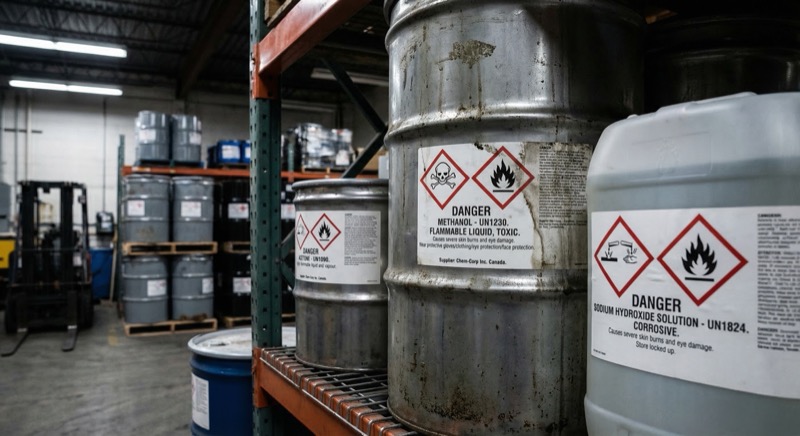
Think of a WHMIS label as the first line of defence. Before your crew reads a Safety Data Sheet, before they sit through training, the label is what they see when they pick up a container. It tells them: this product can hurt you, here's how, and here's what to do about it.
Since 2015, Canada has aligned WHMIS with the Globally Harmonized System (GHS), which means the symbols and label format match what's used in over 65 countries worldwide. If your crew has worked internationally, these red diamond symbols will look familiar.
For a deeper dive into the documents that go hand-in-hand with WHMIS labels, check out our complete guide to Safety Data Sheets.
Not sure if your WHMIS program is compliant? Book a free safety assessment — we'll review your labelling, SDS management, and training records, then give you a 90-day action plan.
What Are the Two Types of WHMIS Labels?
Most contractors think there's just one WHMIS label. They're wrong. There are two distinct types, and confusing them is one of the most common audit findings we see.
Supplier Labels
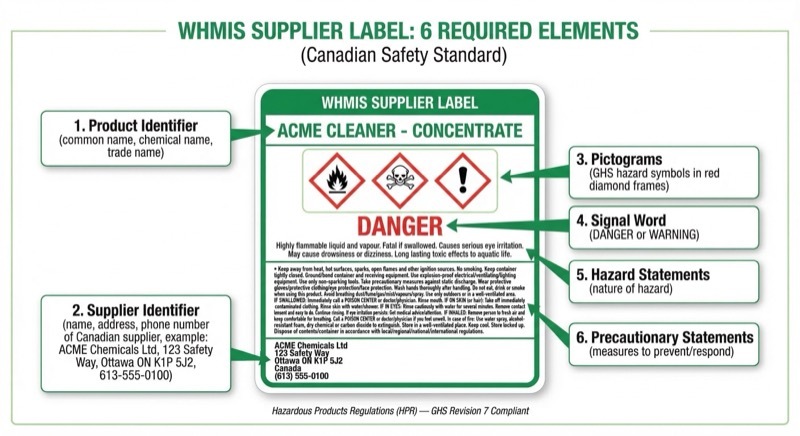
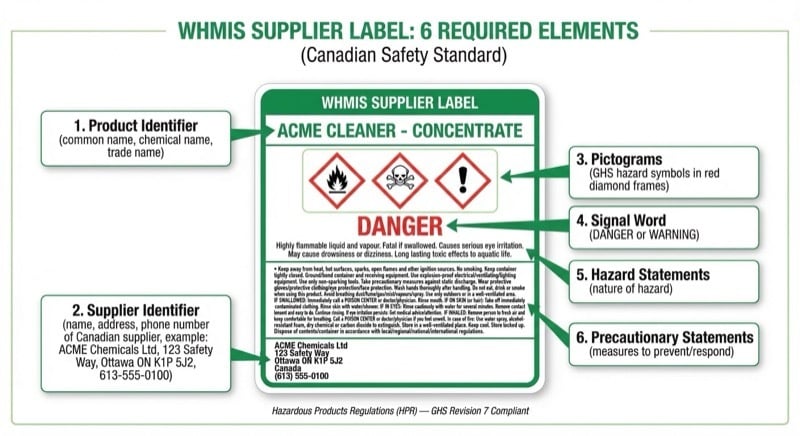
These come from the manufacturer or importer. They arrive pre-printed on the product container. A compliant supplier label must include six elements, all in both English and French:
- Product identifier - the brand name, chemical name, or trade name
- Initial supplier identifier - name, address, and phone number of the Canadian manufacturer or importer
- Pictogram(s) - the red diamond hazard symbols (more on these below)
- Signal word - either "Danger" (severe hazard) or "Warning" (less severe hazard)
- Hazard statement(s) - standardized phrases describing the hazard (e.g., "Fatal if inhaled," "Causes skin irritation")
- Precautionary statement(s) - instructions for safe handling, storage, first aid, and disposal
If a product arrives on site and any of these six elements is missing or illegible, that's a compliance problem. Your supplier needs to fix it, or you need to create a workplace label.
Workplace Labels
Here's where most contractors slip up. You need a workplace label when:
- You pour or transfer a hazardous product into a different container (decanting)
- You produce a hazardous product on-site (mixing chemicals, for example)
- The supplier label is damaged, missing, or no longer readable
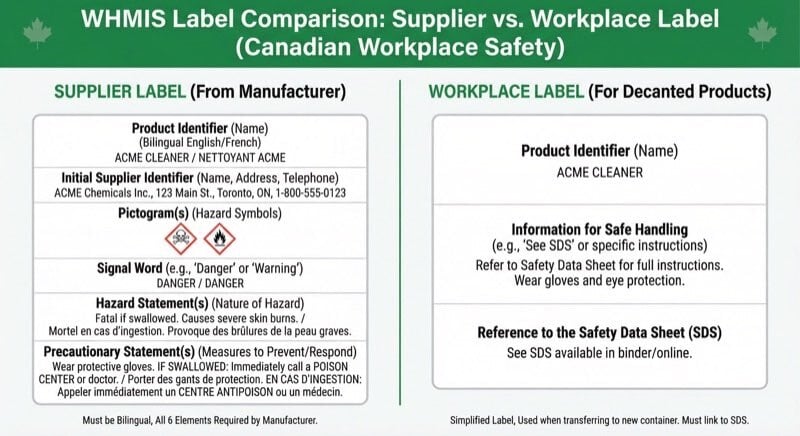
A workplace label is simpler than a supplier label. It needs only three things:
- Product identifier (the name of the product)
- Safe handling information
- A reference to the Safety Data Sheet (SDS)
There's one exception: if you pour a product into a container and you'll use it all during that same shift while it stays under your control, you only need the product name on the container. But if you walk away, if someone else might use it, or if it sits until tomorrow, you need the full workplace label.
This is the kind of detail that trips people up during audits. Building a labelling procedure into your overall safety program is the easiest way to avoid it.
What Do the WHMIS Pictograms Mean?
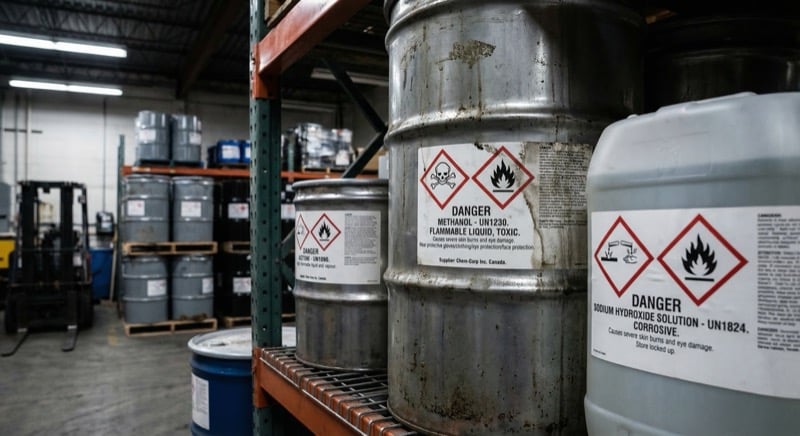
The pictograms are the red-bordered diamond symbols on WHMIS labels. There are 10 pictograms in WHMIS: 9 red-bordered diamond symbols from the GHS system, plus 1 biohazard symbol (a black circle, unique to Canada). Each represents a different type of hazard. Your crew should be able to recognize all of them on sight.
Here's each pictogram, what it looks like, and what it means for your job site:
1. Flame
What it covers: Flammable gases, liquids, solids, aerosols, pyrophoric substances, self-heating substances, self-reactive substances, organic peroxides, and the new Chemicals Under Pressure category (Categories 1 and 2).
On site, this means: Keep away from heat, sparks, and open flames. Store in ventilated areas. This is the pictogram you'll see most often on construction sites, from acetone to spray paint to certain adhesives.
2. Flame Over Circle
What it covers: Oxidizing gases, liquids, and solids.
On site, this means: These products can cause or intensify a fire. They don't burn on their own, but they feed fires. Keep them away from anything flammable. Think oxygen cylinders and certain cleaning agents.
3. Gas Cylinder
What it covers: Gases under pressure (compressed, liquefied, refrigerated liquefied, dissolved) and Chemicals Under Pressure (all categories).
On site, this means: The container is pressurized. It can explode if heated or punctured. Store upright, secured, away from heat sources. Common on sites with welding gases, propane, and compressed air.
4. Corrosion
What it covers: Substances corrosive to metals, skin corrosion, and serious eye damage.
On site, this means: This product will eat through metal, skin, or eyes on contact. Full PPE required: gloves, goggles, face shield. Battery acid, certain concrete cleaners, and drain openers carry this pictogram.
5. Exploding Bomb
What it covers: Self-reactive substances and organic peroxides (Types A and B).
On site, this means: Risk of mass explosion or explosion with blast effects. Handle with extreme care. Less common on typical construction sites, but shows up in demolition, mining, and specialized chemical work.
6. Skull and Crossbones
What it covers: Acute toxicity, oral, dermal, or inhalation (Categories 1, 2, and 3). These are the most dangerous toxicity levels.
Book Your Free Safety Assessment
30-minute review + 90-day action plan. No obligation.
Book Now →
On site, this means: Small amounts can kill or cause serious harm. Specific PPE, ventilation, and emergency procedures are mandatory. Methanol, certain pesticides, and hydrogen cyanide carry this symbol.
7. Health Hazard
What it covers: Respiratory sensitization, carcinogenicity, reproductive toxicity, germ cell mutagenicity, specific target organ toxicity, and aspiration hazard.
On site, this means: Long-term or serious health effects. This is the pictogram that scares experienced safety managers the most, because the harm isn't always immediate. Certain solvents, silica dust products, and epoxy hardeners can carry this. It means this product can cause cancer, organ damage, or reproductive harm with repeated exposure.
8. Exclamation Mark
What it covers: Less severe acute toxicity (Category 4), skin irritation, eye irritation, skin sensitization, and specific target organ toxicity (single exposure, Category 3).
On site, this means: Harmful but not immediately life-threatening. Think irritation, allergic reactions, drowsiness, or dizziness. Still requires proper PPE and safe handling. Many common cleaning products and mild solvents carry this pictogram.
9. Biohazardous Infectious Materials
What it covers: Materials containing organisms or toxins that cause disease in humans or animals.
On site, this means: Most construction sites won't encounter this pictogram regularly. It's more common in healthcare, laboratory, and waste management settings. But if you're working in a hospital renovation or near a wastewater facility, you need to know it.
Not sure your crew could name all nine? That's exactly what effective workplace safety training that includes how to read a Safety Data Sheet solves. A quick WHMIS refresher during a toolbox talk can make the difference between compliance and a citation. Safety Evolution's free 52-week toolbox talk package includes chemical safety topics you can run tomorrow morning.
What Changed With the 2022 WHMIS Amendments?
Here's the blunt truth: if your WHMIS training materials haven't been updated since 2023, your program might not be compliant anymore.
In December 2022, Health Canada amended the Hazardous Products Regulations (HPR) to align with GHS Revision 7 (and parts of Revision 8). Suppliers had a three-year transition period that ended December 14, 2025. That deadline has passed. Compliance is now mandatory.
The key changes that affect your labels:
- New hazard class: Chemicals Under Pressure. This is an entirely new category. Products that don't fit neatly into "compressed gas" or "aerosol" now have their own classification with specific label requirements. They get both the Flame and Gas Cylinder pictograms (Categories 1 and 2).
- Revised flammable gas classifications. The flammable gases class was restructured with new subcategories (1A and 1B), plus new designations for pyrophoric gas and chemically unstable gas.
- Updated SDSs required. Supplier labels and Safety Data Sheets must now use the same revision version. Mixed versions are no longer allowed.
- Label and SDS consistency. If you have products with old-format labels (pre-2022 amendments), those labels need to be replaced with updated versions from your supplier.
For most contractor worksites, the practical impact is straightforward: check that your suppliers have provided updated labels and SDSs, and make sure your WHMIS training covers the new Chemicals Under Pressure class and revised flammable gas categories.
Not sure where your program stands? Book a free safety assessment and we'll walk through your WHMIS compliance in 30 minutes.
What Happens If You Get WHMIS Labels Wrong?
A 14-person mechanical contractor in Calgary learned this the expensive way. They'd been using the same solvent degreaser for years, always from the same supplier. When they switched to a bulk container and started pouring it into smaller jugs for different crews, nobody put workplace labels on those jugs. An OHS inspector flagged every single unlabelled container during a routine site visit. The result: corrective orders, mandatory retraining for the entire crew, and two lost workdays sorting out the paperwork.
Under federal law, WHMIS violations can result in:
- Fines up to $1,000,000 CAD
- Up to 2 years imprisonment
- Product seizure or import refusal (for suppliers)
- Corrective orders requiring immediate compliance
Provincial penalties are comparable. Alberta, BC, and Ontario all enforce WHMIS under their own OHS legislation with equivalent fines and potential business impacts.
The real cost isn't usually the fine itself. It's the downstream damage: project delays, GC confidence shaken, retraining time, and the follow-up inspections that come when you're already on the regulator's radar.
Safety Evolution builds safety programs that are audit-ready that include WHMIS procedures, labelling protocols, and training documentation. We handle the system so your crew can focus on the work.
How Do You Set Up a WHMIS Labelling System That Actually Works?
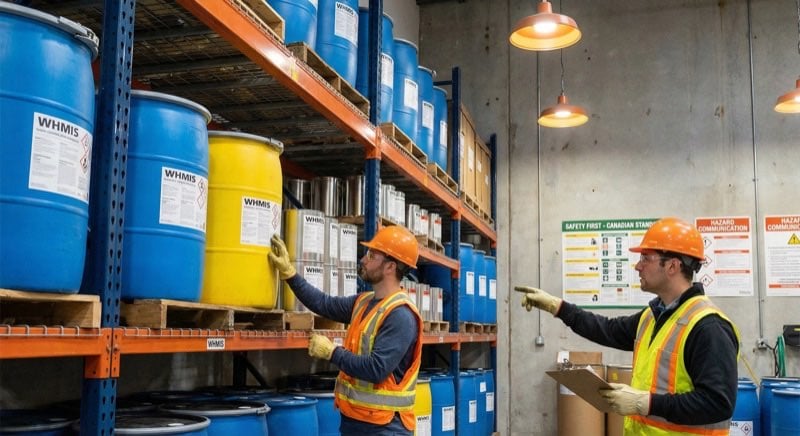
Here's what separates a program that passes audits from one that collects dust in a binder.
Step 1: Build Your Chemical Inventory
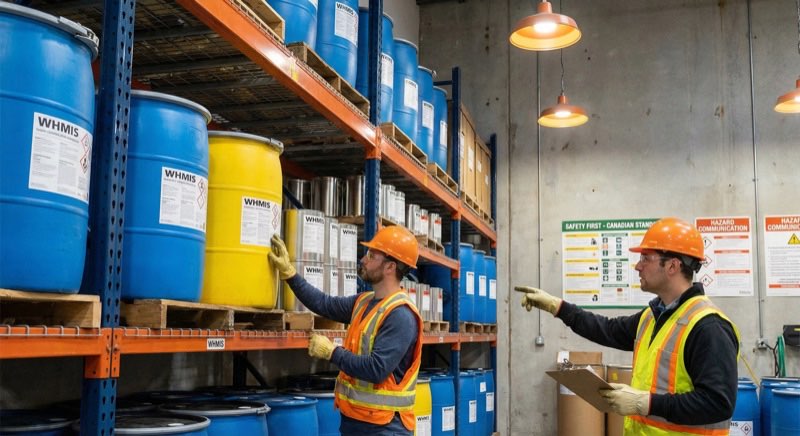
Walk your shop, your trucks, and your site trailers. List every hazardous product. Yes, even the WD-40. Every product needs a current SDS on file and a readable label. Most contractors discover they have 15 to 40 hazardous products once they actually look. Our field-level hazard assessment guide covers how to catch chemical hazards during daily inspections.
Step 2: Verify Every Supplier Label
Check that each product has a supplier label with all six required elements. If any labels are damaged, faded, or missing elements, contact your supplier for replacements. After December 2025, all labels must reflect the 2022 HPR amendments.
Step 3: Set Up Workplace Label Supplies
Keep blank workplace label templates accessible. Stock them in the shop, in the site trailer, and in service trucks. When someone pours a product into a new container, labelling it should take 30 seconds, not a trip back to the office.
Step 4: Train Your Crew
Every worker who handles hazardous products needs WHMIS training that covers:
- How to read supplier and workplace labels
- What each pictogram means
- Where to find Safety Data Sheets
- What to do in an emergency (spill, exposure, fire)
- The 2022 amendments: Chemicals Under Pressure and revised flammable gas classes
Training needs to be site-specific. Generic WHMIS courses cover the basics, but your crew also needs to know exactly which hazardous products are on their site and what the specific risks are. Check out Safety Evolution's training courses for options that include certificates and expiry tracking. And if you're onboarding new workers, our free orientation and onboarding package includes WHMIS as part of the safety orientation checklist.
Step 5: Inspect and Maintain
Labels fade. They peel. Solvents drip on them. Build a label check into your regular workplace safety routine. A monthly walkthrough of chemical storage areas takes 20 minutes and prevents 90% of WHMIS audit findings.
This sounds like a lot. And if you're a 20-person outfit trying to run three sites, a GC submittal, and payroll, building a WHMIS system from scratch is going to sit on the back burner. That's exactly why Safety Evolution exists. Book your free safety assessment and get a 90-day action plan that covers WHMIS, labelling, training, and everything else your program needs.
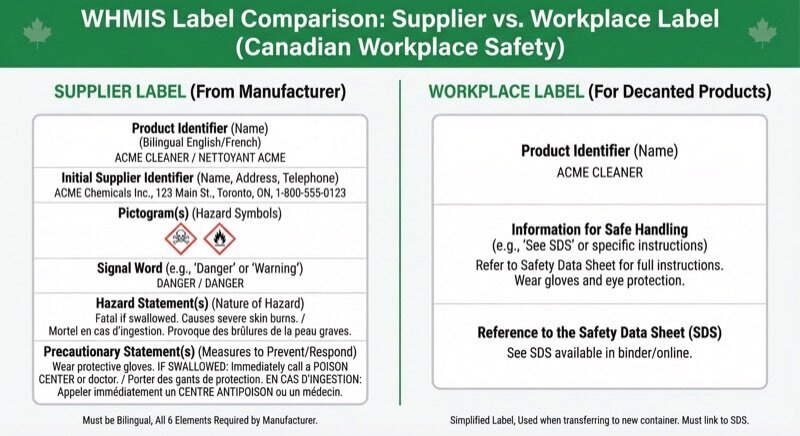
Supplier Labels vs. Workplace Labels: Quick Comparison
| Feature |
Supplier Label |
Workplace Label |
| Who creates it |
Manufacturer or importer |
Employer (your company) |
| Language |
Must be bilingual (English + French) |
Can be in one official language |
| Required elements |
6 elements (product ID, supplier ID, pictograms, signal word, hazard statements, precautionary statements) |
3 elements (product ID, safe handling info, SDS reference) |
| When required |
On all hazardous products entering Canada |
When decanting, producing on-site, or replacing damaged labels |
| Pictograms |
Required |
Not required (but recommended) |
Want Expert Eyes on Your Safety Program?
Book a free 30-minute assessment with a safety consultant. You’ll get a 90-day action plan — whether you work with us or not.
Get Your Free Assessment →
Frequently Asked Questions About WHMIS Labels
How many pictograms are there in WHMIS?
There are 10 pictograms used in WHMIS: 9 red-bordered diamonds from the GHS system, plus 1 biohazard symbol unique to Canada. Each GHS pictogram is a red-bordered diamond containing a black symbol that represents a specific hazard type: flame, flame over circle, gas cylinder, corrosion, exploding bomb, skull and crossbones, health hazard, exclamation mark, and biohazardous infectious materials. Not every hazard class requires a pictogram; some lower-severity categories use only signal words and hazard statements.
When do you need a workplace label instead of a supplier label?
You need a workplace label in three situations: when you transfer (decant) a hazardous product into a different container, when you produce a hazardous product on-site (such as mixing chemicals), or when the original supplier label is damaged, missing, or illegible. If the product stays in its original container with a readable supplier label, no workplace label is needed.
What are the six required elements on a WHMIS supplier label?
A WHMIS supplier label must include: (1) product identifier (name), (2) initial supplier identifier (name, address, phone number), (3) pictogram(s), (4) signal word ("Danger" or "Warning"), (5) hazard statement(s) describing the nature of the hazard, and (6) precautionary statement(s) with safe handling, storage, and emergency instructions. All elements must appear in both English and French.
What changed with the 2022 WHMIS amendments?
The December 2022 amendments aligned Canada's Hazardous Products Regulations with GHS Revision 7 (and elements of Revision 8). Key changes include a new "Chemicals Under Pressure" hazard class, revised flammable gas subcategories (1A and 1B), and requirements that labels and SDSs use the same revision version. The three-year transition period ended December 14, 2025, and full compliance is now mandatory.
What are the penalties for WHMIS label non-compliance in Canada?
Federal penalties for WHMIS violations include fines up to $1,000,000 CAD and up to 2 years imprisonment under the Hazardous Products Act. Provincial penalties vary but are comparable, and may include corrective orders, stop-work orders, and follow-up inspections. Non-compliant suppliers can face product seizures and import refusals.
Do WHMIS labels need to be bilingual?
Supplier labels must be bilingual, provided in both English and French. This can be one bilingual label or two separate labels (one in each language). Workplace labels follow provincial or territorial requirements, and in most jurisdictions they can be in the language of the workplace. However, it is best practice to include both official languages where feasible.