Last updated: July 2026
Between 2011 and 2017, the Bureau of Labor Statistics recorded 40 crane-related fatalities in construction caused by rigging failure. Over half of all fatal crane injuries involved a worker struck by an object or equipment that should never have been in the air. Rigging safety rules exist to prevent exactly that. Rigging safety rules are the documented practices, inspection protocols, load calculations, and qualification standards that keep hoisted loads controlled and workers out of the line of fire. When crews skip even one step, the consequences are immediate and usually irreversible.
If you are building your safety programme around a few toolbox talks and a laminated checklist, this post will show you where the gaps actually are. We cover the seven non-negotiable rules, the specific US and Canadian standards that back them up, and what a qualified rigger actually looks like on paper. For a broader view of rigging compliance across both markets, see our guide to rigging safety and compliance.
Quick Answer: The 7 Rigging Safety Rules
- Inspect every sling, hook, and shackle before each lift.
- Plan the lift. Confirm load weight, centre of gravity, hazards, and communication.
- Calculate sling angles and respect working load limits.
- Know the standards that apply in your jurisdiction.
- Qualify your riggers with documented training and experience.
- Protect workers with proper PPE, including correctly fitted equipment.
- Monitor the lift actively and stop immediately if anything changes.
Detailed requirements differ between the United States and Canada. Both frameworks are covered below.
Still Tracking Rigging Compliance With Paper Checklists?
If your rigging inspections live in a binder that stays in the trailer, nobody checks them when it matters. Try Safety Evolution free for 30 days and run pre-use inspections from a phone, with time-stamped photos and automatic follow-ups.
Start Your 30-Day Free Trial →
Why Rigging Safety Rules Fail on Real Job Sites
Most rigging accidents do not happen because the crew never heard the rules. They happen because someone assumed the rules were already covered. Here is the pattern we see across construction, oil and gas, and industrial sites in both the United States and Canada:
Someone skips the pre-use inspection because the sling looked fine yesterday. A chain sling with a hairline crack, a synthetic web sling with a melted edge, or a hook with a throat opening stretched 15 percent beyond manufacturer spec. All three are removal criteria under OSHA 29 CFR 1926.251 and ASME B30.9. All three get missed when the inspection is a glance instead of a documented check.
Someone rigs a load without calculating the sling angle. At 30 degrees from horizontal, a single-leg sling carries twice the tension of the load weight. That is not a safety margin problem. That is a physics problem, and physics does not negotiate.
Someone puts an experienced worker on rigging duty without verifying qualification. Twenty years on site does not automatically make someone a qualified rigger under OSHA 1926.1404. Documentation matters. An OSHA inspector will ask for training records, not stories.
The blunt truth: the majority of rigging violations are not exotic technical failures. They are routine behaviours, repeated daily, that never get caught until a load drops. The rules below are designed to catch those behaviours before the lift starts.
7 Rigging Safety Rules Every Crew Must Follow
Rule 1: Inspect Every Sling, Hook, and Shackle Before Each Lift
OSHA 29 CFR 1926.251 and ASME B30.9 require a pre-use inspection of all rigging equipment before every lift. Not weekly. Not at shift change. Before every lift. The person performing the inspection must know the removal criteria for each piece of equipment.
| Equipment Type |
Look For |
Standard |
| Chain slings |
Nicks, cracks, bent or stretched links, excessive wear at bearing points |
OSHA 1926.251(a)(3), ASME B30.9 |
| Wire rope slings |
Kinking, crushing, broken wires, corrosion, bird-caging, damaged end fittings |
OSHA 1926.251(c)(4), ASME B30.9 |
| Synthetic web slings |
Cuts, tears, abrasion, melting or charring, missing or illegible tags |
OSHA 1926.251(d)(4), ASME B30.9 |
| Hooks |
Throat opening beyond 15% of original, twisted or bent body, worn latch |
ASME B30.10 |
| Shackles |
Distorted pin or bow, excessive wear, mismatch between pin and bow markings |
ASME B30.26 |
Defective equipment must be removed from service immediately. Not set aside for later. Not tagged with a piece of tape and used for the next lift. Removed. OSHA can cite a serious violation at up to $16,550 per instance, and a willful or repeated violation at up to $165,514.
A proper inspection takes five minutes. A dropped load takes about one second. For a step-by-step field guide, see our rigging inspection checklist.
Rule 2: Plan the Lift Before the Load Leaves the Ground
Every lift needs a plan, even the ones that look simple. The plan should answer four questions before the signal is given:
- What does the load weigh? Include all rigging hardware in the total weight.
- Where is the centre of gravity? An off-centre load is an off-balance load.
- What hazards are in the path? Overhead power lines, unstable ground, occupied zones, weather.
- How does the crew communicate? Hand signals, radio, or both. Who is the signal person?
In the United States, OSHA 1926.1428 requires signal persons to be qualified through a third-party accredited entity or an employer's audited programme. In Canada, CSA Z150 and provincial regulations require signal persons to be competent and familiar with the signals used on site. The signals themselves are standardised, but the qualification path is jurisdiction-specific.
Planning is not just paperwork. A proper job hazard analysis should identify rigging hazards before the crew is standing underneath a suspended load. If the lift plan lives only in the crane operator's head, you do not have a lift plan. You have a guess.
Rule 3: Calculate Sling Angles and Respect Working Load Limits
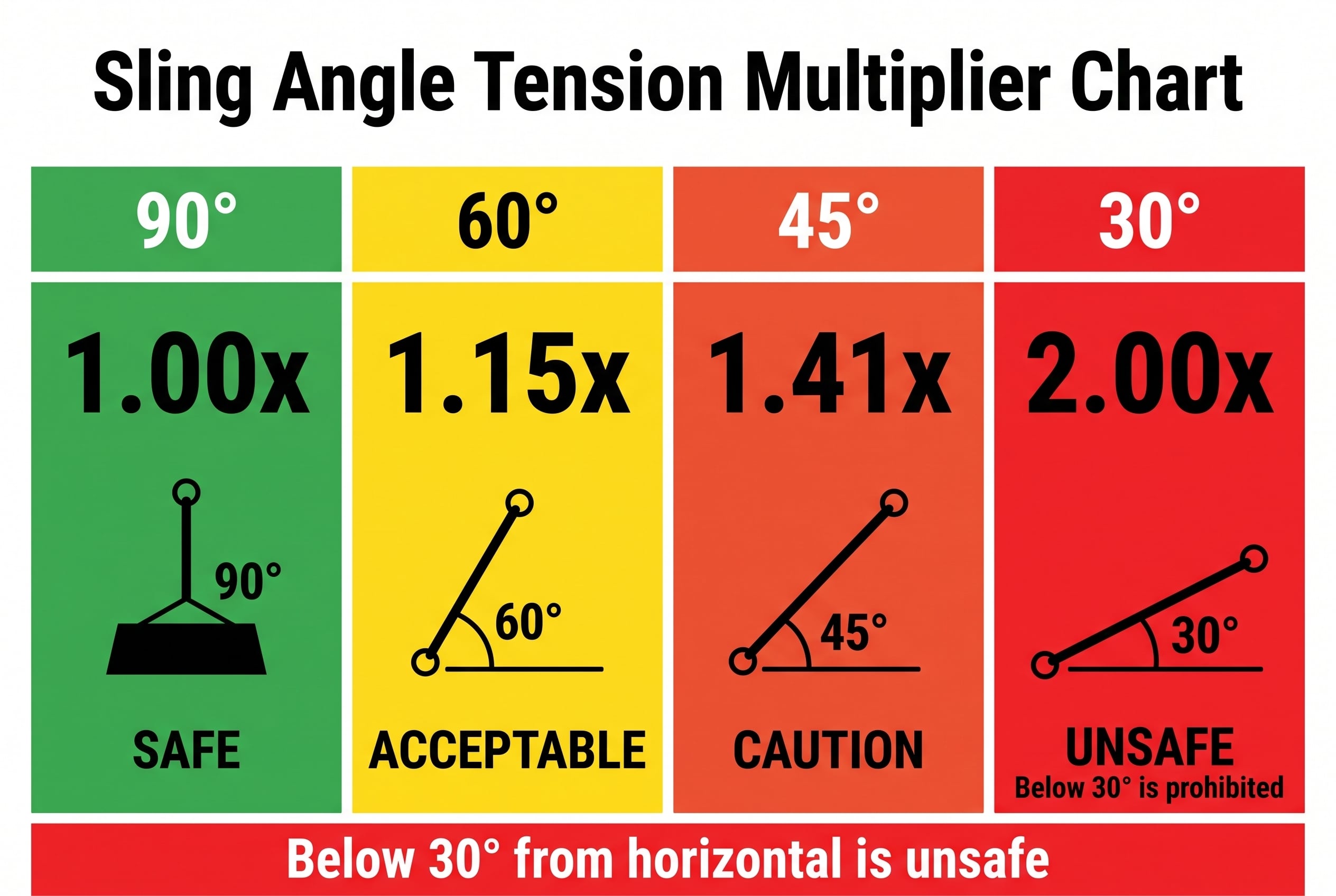
A sling rated for 2,000 pounds at a vertical hitch does not carry 2,000 pounds safely at 30 degrees. The tension in each leg increases as the angle from horizontal decreases. This is the single most common rigging miscalculation on job sites.
Working load limits must be read from the manufacturer's identification tag, not from memory. For alloy chain slings, OSHA 1926.251 requires that working load limits be permanently marked on the sling by the manufacturer. For wire rope and synthetic slings, the tag is the authority. No tag, no lift.
| Sling Angle (from horizontal) |
Tension Multiplier (per leg) |
Example: 2,000 lb vertical WLL |
| 90 degrees (vertical) |
1.00x |
2,000 lb |
| 60 degrees |
1.15x |
1,730 lb |
| 45 degrees |
1.41x |
1,410 lb |
| 30 degrees |
2.00x |
1,000 lb |
| Never below 30 degrees |
N/A |
Unsafe. Use a spreader bar or different rigging configuration. |
The formula is straightforward: tension equals load divided by the number of legs, divided by the sine of the sling angle from horizontal. Most crews do not carry a calculator. That is why the job site needs a printed chart, a rigging card, or a digital tool that does the math before the hook is attached. For a deeper explanation of how WLL is determined and marked, read our guide on working load limit (WLL).
Rule 4: Know the Standards That Apply in Your Jurisdiction
In the United States
OSHA 29 CFR 1926.251 sets the baseline for rigging equipment used in construction. It covers alloy steel chains, wire rope, synthetic webbing, and synthetic rope. The standard requires that equipment not be loaded beyond its recommended safe working load, that defective equipment be removed immediately, and that all equipment be inspected before each use.
For crane operations, OSHA 29 CFR 1926.1400 Subpart CC is the governing standard. It defines a rigger as anyone who attaches or detaches loads, and it requires employers to ensure rigging work is supervised by a qualified rigger. The standard also mandates that rigging equipment be inspected in accordance with manufacturer requirements or ASME B30.9 and B30.26.
ASME B30.9:2021 (Slings) and ASME B30.26:2021 (Rigging Hardware) are industry consensus standards adopted by reference in OSHA regulations. They provide the detailed inspection and removal criteria that inspectors expect to see documented on site. For a dedicated breakdown of OSHA's crane and rigging requirements, see our overview of OSHA rigging standards.
In Canada
Canada does not have a single federal OSHA equivalent for rigging. Standards are adopted by reference in provincial regulations, with CSA Z150 serving as the backbone for crane and lifting operations.
CSA Z150:20 (reaffirmed 2025) covers design, construction, load rating, installation, erection, inspection, maintenance, repair, modification, testing, and operation of mobile cranes. It is adopted by reference in Alberta OHS Code Part 6, Ontario O. Reg. 213/91, and British Columbia OHS Regulation Part 14, among others.
Alberta OHS Code Part 6, Sections 74 through 81, sets specific requirements for rigging equipment, inspections, and operation. Section 75(1) states that no person shall operate a crane or hoist unless they are competent to do so. Section 78 requires hook inspections before each use. The consequences of poor rigging practices in Alberta have been documented through provincial incident investigations, with crane-related fatalities recurring across multiple years due to failure to follow lifting procedures.
Provincial crane operator certification is mandatory in Nova Scotia, New Brunswick, Quebec, Ontario, Manitoba, Alberta, and British Columbia. In other provinces and territories, certification is voluntary but strongly recommended. If your crews operate across provincial boundaries, you need to verify compliance in each jurisdiction, not just the one where your head office is located.
Rule 5: Qualify Your Riggers With Documented Training and Experience
Under OSHA 1926.1404, a qualified rigger is a person who possesses a recognized degree, certificate, or professional standing, or who has extensive knowledge, training, and experience, and can successfully demonstrate the ability to solve problems related to the subject matter, the work, or the project. That is not a suggestion. That is the regulatory definition, and OSHA inspectors ask for the paperwork that proves it.
OSHA has required both a written evaluation and a practical demonstration for signal person qualifications -- and by extension employer rigger qualification programmes -- since 29 CFR 1926.1428 took effect in 2010. In 2025, OSHA intensified enforcement of documentation requirements: employers must maintain records of both the training content and the practical assessment results, and those records must be available for inspection. If your rigger qualification programme was built five years ago around a single classroom session, it probably does not meet current expectations.
In Canada, the requirement is framed as competence rather than qualification, but the practical standard is similar. Alberta OHS Code Section 75 requires operators to be competent, which includes training and experience specific to the equipment and tasks they perform. Ontario and British Columbia have equivalent language in their respective regulations.
The uncomfortable honesty: experience without documentation is not a defence in an inspection. A superintendent with twenty years on site can describe every rigging failure he has ever seen, but if he cannot produce training records for the rigger on his crew, the citation lands on the employer, not the individual. The 2025 penalty for a serious violation is up to $16,550. For a willful or repeated violation, it is up to $165,514.
Rule 6: Protect Workers With Proper PPE
Rigging crews need more than a hard hat and steel-toe boots. The PPE requirements are specific to the hazards of the lift:
- Hard hats with chin straps. A hard hat that falls off when the worker looks up is not protection.
- Cut-resistant gloves for handling wire rope and chain. Synthetic slings can produce severe abrasion injuries under tension.
- Steel-toe or composite-toe boots with ankle support. Dropped loads do not land on toes selectively.
- High-visibility clothing so the crane operator and signal person can see every crew member in the lift zone.
- Eye protection when working with wire rope, which can produce flying fragments during inspection or attachment.
Effective January 13, 2025, OSHA revised 29 CFR 1926.95 to require properly fitting PPE for all construction workers, including diverse body types. If your safety programme still issues one-size-fits-all gloves or hard hats designed for a narrow range of head sizes, you are out of compliance. PPE that does not fit properly is PPE that does not protect properly.
Rule 7: Monitor the Lift Actively and Stop Immediately if Anything Changes
The lift does not end when the load is airborne. It ends when the load is landed, secured, and the rigging is detached. During the lift, the signal person, crane operator, and rigger must maintain continuous communication. If the load begins to swing, rotate, or drift, the lift stops. If weather changes, the lift stops. If anyone enters the drop zone, the lift stops.
This sounds obvious, but the data says otherwise. The CDC NIOSH lift-zone safety bulletin notes that 40 percent of crane accident victims are injured or killed because they are struck by an uncontrolled hoisted load or crane part. Many of those incidents occurred after the lift had already started and conditions changed without anyone calling a stop.
Every crew member involved in the lift must have stop-work authority. Not just the foreman. Not just the safety manager. If a new worker sees a sling riding over a sharp edge and says nothing because he is junior, the culture has already failed. The rule is simple: see something, say something, stop something.
Rigging Safety Is Not a One-Time Training Event
The seven rules above are not a certification course. They are daily operating discipline. A crew that inspects every sling, calculates every angle, and qualifies every rigger is not being cautious. They are being competent. The gap between those two descriptions is where most rigging accidents happen.
If your current safety programme relies on annual training and a verbal reminder before the lift, you are managing safety by hope. Hope is not a standard, and it is not a defence in an audit or an investigation.
Tired of Finding Rigging Violations After the Fact?
Paper checklists get filled out in the truck. Digital inspections get filled out at the hook. Start your 30-Day Free Trial and see how real-time rigging tracking, photo documentation, and automatic flagging change what your crew does before the lift starts.
Start Your 30-Day Free Trial →
Frequently Asked Questions
What are the safety rules for rigging?
The seven core rigging safety rules are: inspect all equipment before each lift, plan every lift including weight and hazards, calculate sling angles and respect working load limits, know the regulatory standards in your jurisdiction, qualify riggers with documented training, provide proper PPE including correctly fitted equipment, and monitor the lift actively with stop-work authority for all crew members.
What is the OSHA standard for rigging?
OSHA 29 CFR 1926.251 is the primary standard for rigging equipment in construction, covering alloy steel chains, wire rope, synthetic webbing, and synthetic rope. For crane operations, OSHA 29 CFR 1926.1400 Subpart CC governs rigging work and requires supervision by a qualified rigger. ASME B30.9 and B30.26 provide the detailed inspection and removal criteria adopted by reference in OSHA standards.
What are the 3 main hazards when rigging?
The three main rigging hazards are struck-by loads due to rigging failure or overload, caught-in or crushed-by incidents from improper sling angles or uncontrolled load movement, and falls caused by inadequate PPE or workers entering the drop zone. Between 2011 and 2017, over half of all fatal crane injuries in US construction involved workers struck by objects or equipment.
What is the rule of thumb for rigging?
A common rule of thumb is that sling tension doubles when the angle from horizontal drops to 30 degrees. At 30 degrees, a sling rated for 2,000 pounds vertically is only safe to 1,000 pounds. As a practical guideline, never rig below 30 degrees from horizontal without using a spreader bar or adjusting the rigging configuration.
What are the signal person requirements under OSHA?
Under OSHA 1926.1428, signal persons must be qualified through a third-party accredited entity or an employer's audited qualification programme. The qualification must be documented, and the signal person must know the standard hand signals or radio protocols used on site. A practical demonstration and written evaluation have both been required since 2010.
How often should rigging equipment be inspected?
OSHA 29 CFR 1926.251 requires a pre-use inspection before every lift. ASME B30.9 also recommends documented periodic inspections based on frequency of use, severity of service conditions, and experience with the equipment on related jobs. Inspections should cover chain slings, wire rope slings, synthetic slings, hooks, and shackles. For a detailed field checklist, see our rigging inspection checklist.