Last updated: May 2026
If your rigging inspection notes are vague, your lift is exposed before it even starts. Crews often find defects at shift start but still run the lift because production is hot and nobody wants the delay. A rigging inspection checklist is a shift-start and pre-use control that verifies condition, load limits, and documentation before any hoist happens. Safety Evolution teams see the same pattern on mixed fleets: the gear is usually there, but the inspection standard is inconsistent by foreman and site.
⚡ Quick Answer
- US requirement: Inspect rigging equipment each shift and during use as needed, remove defective gear from service (OSHA 1926.251(a)(1)).
- US sling rule: A competent person inspects slings and attachments each day before use (OSHA 1926.251(a)(6)).
- US records: Monthly crane inspection records must include inspected items, results, inspector/date/signature, and be kept at least 3 months (OSHA 1926.1412(e)(3)).
- Canada BC core: Rigging and slinging must be done by or under direct supervision of qualified workers (WorkSafeBC OHSR 15.2).
- Canada BC checks: Do not exceed WLL and inspect slings before use (WorkSafeBC OHSR 15.4(2), 15.31).
How Should You Use This Rigging Inspection Checklist on Site?
Use this checklist for shift-start and pre-use inspection decisions. It is not a substitute for engineered lift plans, crane setup calculations, or manufacturer instructions. If your lift requires engineered controls, treat this checklist as the entry gate, not the full plan.
Most teams think a quick visual pass is enough if the same sling worked yesterday. They are wrong. Wear progression, tag damage, and hardware deformation can change from one shift to the next, especially when gear moves between crews.
The blunt truth is simple. If your crew cannot produce clear pass or fail inspection notes, auditors will assume the check did not happen. Use this workflow so your supervisor, client rep, and regulator can all see the same inspection standard in plain language.
For related program controls, align this checklist with your equipment inspections program guide, your equipment inspection checklist workflow, and your forklift inspection checklist process so supervisors use one standard across site types.
What Is the Rigging Inspection Checklist for the Canada Lane?
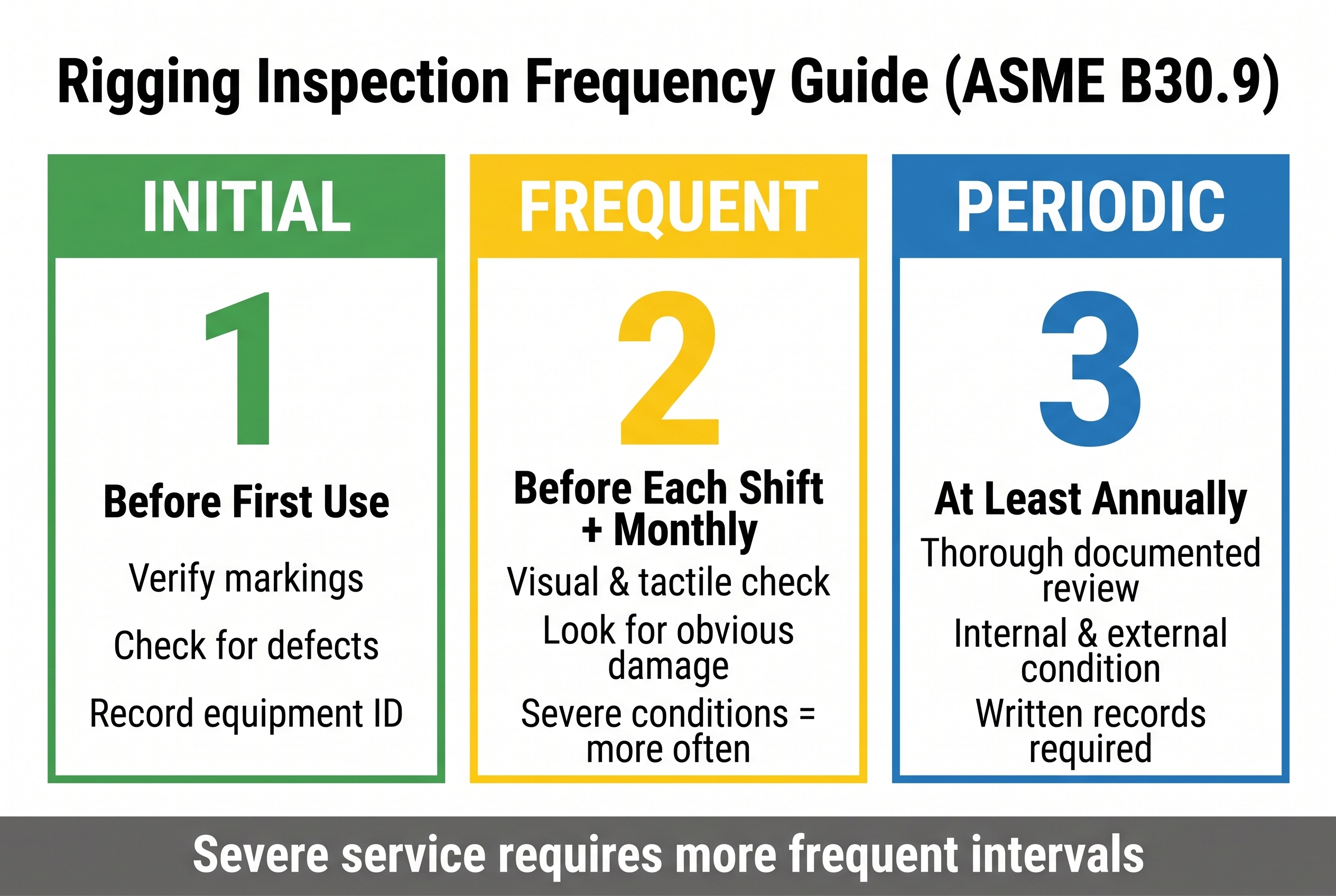
Canada lane applies to Canadian sites only. Do not blend OSHA language into this section. In BC, rigging and slinging must be performed by, or directly supervised by, qualified workers under OHSR 15.2.
Step 1, confirm qualification and supervision: identify the qualified person or direct supervisor before touching the load path. Record name and role on the shift sheet.
Step 2, verify WLL against lift demand: check that planned load and configuration stay within working load limits. OHSR 15.4(2) prohibits exceeding WLL. If tag data is unreadable, treat the item as fail until verified.
Step 3, inspect slings before use: run a hands-on pre-use inspection for cuts, broken stitching, kinks, abrasion, heat damage, corrosion, and hardware distortion. OHSR 15.31 requires sling inspection before use.
Step 4, check wire rope rejection triggers: apply BC wire rope rejection criteria under OHSR 15.25. If broken-wire thresholds or other rejection indicators are met, remove from service immediately.
Step 5, confirm control before first pick: verify hitch selection, connection seating, hook latch status, and exclusion zone communication before the signal to hoist.
Alberta note on currency: Alberta's official OHS Code page shows an update package in force dated Dec 10, 2024. Use that as your currency checkpoint, then verify province-specific clause language before finalizing site forms.
Need compliance support upstream of field execution. Pair this checklist with the equipment inspections pillar guide so site paperwork and actual lift practice stay aligned.
What Fails Immediately in Canada Remove-from-Service Checks?
Do not run a "one more shift" mindset. If inspection evidence indicates failure, tag out now. Delayed removal is where incidents and enforcement action usually converge.
Immediate fail examples for Canadian rigging checks:
- Sling ID or capacity unreadable: remove from service until identification and capacity are fully verified.
- Visible damage: cuts, severe abrasion, broken stitching, melted fibres, crushed or bird-caged wire rope, severe corrosion.
- Hardware deformation: bent hooks, stretched links, cracked or distorted shackles, latch that does not seat correctly.
- WLL mismatch: planned lift demand exceeds rated capacity for any component in the configuration.
Tag and isolate process: mark OUT OF SERVICE, physically segregate failed gear from ready-to-use inventory, record defect and location, notify supervisor before replacement is issued.
Field pressure is real during turnarounds and shutdown windows, but the control standard does not change. If a sling tag is unreadable or damage is visible, treat it as fail, tag it out, and replace it before the lift proceeds.
Different crews, different forms, same rigging risk?
When inspection wording changes by supervisor, audit exposure climbs fast. Standardize rigging checks and records across sites in one system before your next client review.
Start Your 30-Day Free Trial →
What Is the Rigging Inspection Checklist for the US Lane?
US lane applies to OSHA-governed sites only. Keep this workflow separate from provincial Canadian requirements.
Step 1, shift-start rigging equipment inspection: inspect rigging equipment before each shift and as needed during use. OSHA 1926.251(a)(1) requires defective equipment to be removed from service.
Step 2, daily sling and attachment inspection: have a competent person inspect slings and attachments each day before use under OSHA 1926.251(a)(6). Record inspector identity, condition result, and disposition.
Step 3, construction crane visual check: OSHA 1926.1412(d)(1) requires competent-person visual inspection before each shift. Confirm no apparent deficiencies that create a safety hazard.
Step 4, apply sling standard context: for general industry operations, align sling controls with OSHA 1910.184 requirements and manufacturer criteria.
Step 5, escalate and isolate defects: any item that fails inspection gets removed from service immediately and cannot return until corrected and cleared.
If your teams run both construction and plant environments, sync this lane with your crane inspection checklist and fall protection equipment inspection checklist so competent-person responsibilities are explicit by site type.
What Are the US Remove-from-Service Criteria and Documentation Rules?
US audit risk is usually not just the defect. It is the missing record trail. If your logs do not show what was checked, by whom, and when, your defense is weak even if the crew did a visual check.
US remove-from-service triggers:
- Defective rigging equipment: remove immediately under OSHA 1926.251(a)(1).
- Defective sling or attachment: remove immediately under OSHA 1926.251(a)(6).
- Alloy chain sling periodic inspection overdue: thorough inspection interval cannot exceed 12 months, and employer must keep record of the most recent month inspected under OSHA 1926.251(b)(6).
Documentation matrix crews can run:
- Each shift: rigging equipment condition, sling condition, pass or fail result, inspector name, immediate action taken for defects.
- Monthly crane inspections: items checked, inspection results, inspector name and signature, date. Retain at least 3 months under OSHA 1926.1412(e)(3).
- Periodic chain sling record: month of latest thorough inspection, sling ID, disposition, corrective action if removed.
Weak note to avoid: "Checked rigging, looks okay." Strong note: "Pre-shift inspection completed by J. Ortiz, competent person. 2 wire rope slings and 4 shackles inspected. One 1/2 in sling with crushed section tagged OUT OF SERVICE and isolated in quarantine bin."
How Do You Write Auditor-Proof Pass/Fail Inspection Notes?
Use language that tells the next reviewer exactly what happened without interpretation.
Pass note template: "Pre-use rigging inspection completed at [time] by [name/role]. Components inspected: [list]. No visible defects. Capacity tags legible. Configuration within WLL. Equipment released for lift [ID]."
Fail note template: "Pre-use rigging inspection completed at [time] by [name/role]. Defect identified: [specific defect] on [component ID]. Equipment tagged OUT OF SERVICE, isolated at [location], supervisor [name] notified, replacement issued before lift."
Escalation note template: "Inspection stopped pending qualified review. Lift hold communicated to crew and signal person. Restart authorized only after replacement and re-inspection."
Keep these templates in your digital inspection workflow so every foreman writes to the same evidence standard.
Still running rigging checks on paper and memory?
A checklist is only useful if your records are consistent across crews, projects, and jurisdictions. Start a 30-day rollout with one digital rigging inspection standard your team can actually follow.
Start Your 30-Day Free Trial →
Frequently Asked Questions
How often do you need to inspect rigging gear in Canada versus the US?
In the US construction context, rigging equipment is inspected each shift and as needed during use, with daily sling inspection by a competent person. In Canada, frequency and method are province-based, but BC requires pre-use sling inspection and qualified rigging supervision.
Who is allowed to perform and sign off rigging inspections?
US OSHA language points to competent-person inspection responsibilities for key rigging checks. In BC, rigging and slinging must be done by or under direct supervision of qualified workers. Your form should capture both role and name for every inspection entry.
What defects require immediate removal from service?
Any damaged or defective rigging component must be removed immediately. Common triggers include unreadable ID tags, visible cuts or severe abrasion, broken wires, bent hooks, cracked shackles, and any condition that puts the load outside rated capacity controls.
What inspection records do we need to keep, and for how long?
At minimum, keep shift and daily records showing what was inspected, who inspected it, and pass or fail disposition. For US construction cranes, monthly inspection documentation must include items checked, results, inspector identity and date or signature, and be retained for at least three months.
Can one checklist work across provinces and OSHA sites?
Yes, if the checklist has separate jurisdiction lanes and does not mix legal references. Use one shared structure for inspection flow, then map each lane to local enforceable clauses and documentation rules.
Does this checklist replace lift plans or engineer approvals?
No. A rigging inspection checklist supports pre-use control and record quality. It does not replace engineered lift planning, crane configuration calculations, manufacturer instructions, or required professional approvals.