Last updated: July 2026
Rigging accidents follow a pattern: a sling that looked fine yesterday breaks mid-lift, a load swings outside the planned arc, or a tag line handler steps inside the swing radius. The crew knows the equipment. They have the harnesses. What they often lack is real-time hazard recognition and disciplined inspection discipline.
This guide is built for field-level operators, riggers, and safety officers who need practical prevention actions they can enforce today. It covers equipment failure, sling angle errors, load instability, struck-by hazards, environmental triggers, and the inspection documentation that proves compliance when an inspector arrives. If you are looking for a deeper dive into rigging technique and knot discipline, see our guide on proper rigging technique.
Quick Answer
The seven core rigging hazard categories are equipment defects, incorrect sling angle, load instability, struck-by incidents, environmental stress, communication failure, and inspection gaps. Crews can prevent most accidents by completing a documented pre-use visual inspection, calculating sling angle reduction before every lift, establishing a minimum exclusion zone of one load-radius around the swing arc, confirming hand signal or radio communication with the operator, and grounding the lift when wind exceeds 20 miles per hour or visibility drops below safe spotting standards.
Toolbox Talks Don't Stop Failures
Paper pre-start forms get skipped. Safety Evolution turns daily rigging inspections into enforced, timestamped tasks crews complete on their phones. Start your 30-Day Free Trial.
Start Your 30-Day Free Trial →
1. Equipment Failure — Slings, Hooks, Shackles
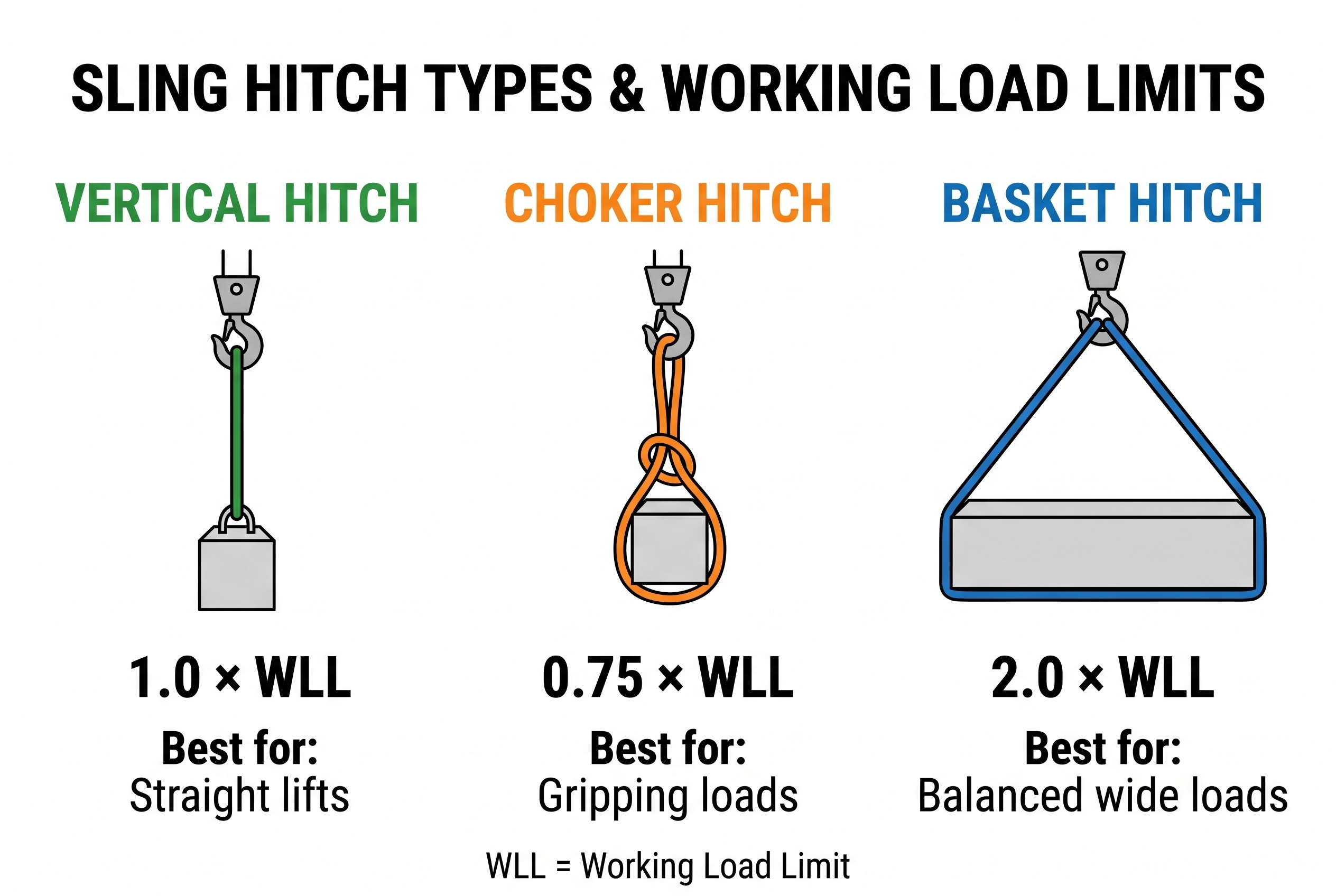
Equipment failure is the most visible rigging hazard because the result is catastrophic and immediate. Slings snap under load, hooks spread open past their throat limit, and shackles fail at the pin when side loading bends the body. The underlying causes are rarely material defects. Most failures trace back to three root causes: overloading, invisible wear, and improper hitch selection.
Overloading is not guesswork. Every rigging component carries a Working Load Limit stamped or tagged on the body. When a rigger uses a single-leg vertical hitch for a load angled through a choker, the effective WLL drops. Crews must calculate the actual load on each leg using sling angle reduction before the lift. For a step-by-step guide on calculating WLL for different hitch types and angles, refer to our post on working load limit calculations.
Invisible wear hides in plain sight. A synthetic fiber sling with internal heat damage from a warm pipe may look intact on the outside. An alloy chain link stretched by shock loading appears normal until measured with calipers. ASME B30.9 requires periodic inspections at documented intervals, with removal criteria for cuts, abrasions, broken stitches, melting, and chemical damage on synthetic slings, and for stretched links, nicks, and deformation on alloy chain. Pre-use visual inspection should be completed by the person performing the lift, every shift, before the first lift of the day.
The wrong hitch accelerates wear. A basket hitch doubles the vertical WLL of a two-leg sling when the load is balanced, but a choker hitch reduces capacity to roughly 75 percent of vertical WLL depending on the choke angle. If a crew does not know the difference, the sling is overloaded before the load leaves the ground.
2. Sling Angle and Load Distribution Errors
Slings do not share load equally unless the hitch and angle are correct. The common mistake is assuming a two-leg bridle at a sixty-degree angle to the horizontal carries half the load on each leg. The actual load per leg is the total load divided by two times the sine of the sling angle to the horizontal. The outcome is that the shallower the angle between the sling leg and the horizontal, the lower the effective capacity. A two-leg bridle rigged at thirty degrees to the horizontal can see sling tension reaching double the actual load weight.
Three additional factors compound angle errors: center of gravity, leg length mismatch, and dynamic side loading. If the center of gravity is not centered below the hook, one leg carries more than its share. If one leg is three inches longer, the shorter leg takes the initial shock. If the load drifts during hoisting, lateral force adds to the vertical tension.
The fix is measurement, not eyeballing. Measure sling angles before the lift. Use a load angle indicator or a simple protractor on the rigging plan. Ensure legs are within manufacturer tolerance for length. Mark the center of gravity on the load documentation. If the load has an offset center of gravity, use a spreader bar or adjust the sling attachment points so the hook is directly above it.
3. Load Instability and Tag Line Mismanagement
A stable load does not rotate, swing, or slide during the lift. Instability starts with the attachment points. If the slings attach above the center of gravity but the load is top-heavy or irregular, rotation is almost guaranteed. Tag lines are the crew's control mechanism, but they create their own hazards when managed poorly.
Tag lines must be long enough to let the handler stay outside the swing radius and the drop zone. A handler pulling straight down on a tag line at a sharp angle to the load creates a sideways force that adds to the sling tension. Tag lines should be controlled with steady lateral pressure, not jerking or pulling against the hoist.
Common tag line hazards include wrapping the line around a wrist or body, standing below the load to pull down, and using tag lines in high wind where the load becomes a sail. Before every lift, the lift director or qualified rigger should verify that the attachment points, tag line routing, and handler position are all stable.
4. Struck-By and Caught-Between Hazards
The heaviest load on a rigging site is not the one on the hook. It is the load that breaks free and drops. Struck-by incidents account for a significant share of rigging-related injuries and fatalities, and they are almost always preventable with a disciplined exclusion zone.
The exclusion zone must be established before the load leaves the ground. It should cover the swing radius, the drop zone directly below the load path, and any landing area where the load could bounce or roll. Workers inside the exclusion zone during a lift have no warning time if a sling fails. No assignment is urgent enough to justify standing under a suspended load.
Caught-between hazards happen when a load is landed against a structure, equipment, or another worker. Tag lines that run across walkways create tripping hazards. Loads with protruding rebar, pipe ends, or sharp edges add piercing and crushing hazards if the landing zone is not cleared. The rigging plan should identify every pinch point and sharp edge before the lift begins.
5. Environmental Triggers — Wind, Weather, Visibility
Environmental conditions can turn a standard lift into an emergency in seconds. Wind is the most common environmental trigger. When wind speed exceeds twenty miles per hour, a suspended load begins to drift. At thirty miles per hour, most loads become uncontrollable regardless of tag line skill. ASME B30.5 recommends stopping lifts in sustained winds above twenty-five miles per hour, and many site-specific lift plans set lower thresholds for loads with large surface areas.
Low visibility creates a different risk. Fog, rain spray, and dust can prevent the operator from seeing the load, the landing zone, or the signal person. If the operator cannot see the load clearly, the lift stops. If the signal person loses sight of the operator, the signal chain is broken and the lift stops. Freezing rain and snow create slick surfaces for handlers, reduce line flexibility, and add ice weight to the load itself.
The prevention action is a go-no-go checklist completed before the first lift of the day. Wind speed, precipitation, temperature, and visibility get recorded. If any parameter exceeds the site-specific limit, the lift is postponed until conditions improve. The checklist should be signed by the lift director and retained with the lift plan documentation.
6. Communication Failures
Rigging operations depend on clear, continuous communication between the operator, the signal person, the rigger, and the tag line handlers. When communication breaks down, the operator makes assumptions. Assumptions cause accidents.
The hierarchy of communication methods is straightforward. The primary method is a dedicated radio channel with continuous monitoring. If radio is not available or reliable, hand signals are the backup, and they must follow the ASME B30.5 standard signal set. Verbal commands from the ground are only acceptable when the operator can see and hear the speaker directly, and even then only for simple commands like stop or lower.
Common communication gaps include a signal person talking on a phone while signaling, multiple people giving conflicting directions, and radio dead zones created by building structures or terrain. Every lift plan should name a single signal person and a backup. No one else directs the operator.
7. Inspection Gaps and Documentation Failures
Knowing the hazards is worthless if the crew doesn't inspect the gear. Daily visual inspection should cover every sling, hook, shackle, and pad eye before use. On synthetic slings, look for cuts, abrasions, broken stitches, melting, and chemical damage. On alloy chain slings, check for stretched links, nicks, gouges, and twisted components. On hooks, measure throat opening and check for cracks, deformation, and worn latch springs. On shackles, inspect the pin, body, and threads for wear and deformation.
ASME B30.9 and B30.10 also require periodic inspections at documented intervals based on frequency of use, severity of service conditions, and nature of lifts handled. A sling used daily in a steel erection yard needs closer inspection intervals than a sling used monthly for light maintenance. Load testing and proof-testing records must be maintained for all rigging components that require them under the applicable standard.
Documentation is the bridge between doing the work and proving it was done. If it's not written down, OSHA or the WCB inspector will assume it didn't happen. Paper checklists get lost, rained on, or filled out in the truck at the end of the week. Safety Evolution's form builder lets crews complete digital inspections on a phone or tablet, with timestamps and photo verification built in. For a printable version of the full inspection procedure, see our full rigging inspection checklist. If your crews need refresher training on technique and compliance, our safety training and certification programs cover rigging fundamentals for both US and Canadian markets.
What to Do After a Rigging Incident
When a rigging incident happens, the first five minutes determine whether it becomes a learning event or a legal disaster. Stop work immediately. Secure the scene. Do not move the load or the equipment until photos and witness statements are collected. If someone is injured, medical response takes priority, but the supervisor must preserve the rigging components that failed or were involved.
Quarantine every piece of equipment used in the lift. Chains, slings, hooks, shackles, and the hoist itself. Tag them out of service and store them where no one can accidentally redeploy them. Document everything. Photos of the rigging configuration, the load, the landing zone, and the surrounding environment. Witness names and statements. Weather conditions at the time of the incident.
Run a root cause analysis within 24 hours. Was the failure equipment, technique, or environment? If a sling broke, was it overloaded or damaged before the lift? If the load swung, was the exclusion zone too small or was the tag line mismanaged? The corrective action must match the root cause. That might mean training refreshers, increased inspection frequency, gear replacement, or a change to the lift plan template. For a full breakdown of the investigation process, refer to our guide on incident investigation procedures.
Canadian Rigging Requirements — How Canada Differs
Canadian rigging standards parallel US requirements but draw from a different regulatory framework. CSA Z150 covers crane safety, with the 2016 edition referenced in Ontario's updated O. Reg. 213/91 amendments that took effect January 2024. CSA Z248 addresses code requirements for rigging, with the 2017 edition current in most provinces. Alberta, Ontario, and British Columbia each layer provincial OHS requirements on top of the CSA standards, so a compliance program built for Texas will not automatically satisfy a WCB inspector in Calgary.
Ontario's IHSA crane safety update from 2024 reflects some of the most significant recent changes in Canadian rigging regulation, including updated operator qualification requirements and equipment inspection intervals. The Canadian Hoisting and Rigging Safety Council has also called for national rigging certification standards that would standardize training across provinces, a gap CHRSC highlights as a current weakness in the Canadian system.
The practical reality is that US standards are better documented in open literature, but the compliance obligations in Canada are equally real and equally enforced. If you operate on both sides of the border, your rigging program needs to reference both OSHA and CSA, and your inspection records need to satisfy both jurisdictions.
Can't Prove Crew Inspections?
When a WCB inspector or OSHA compliance officer shows up, paper logs won't hold up. Start your 30-Day Free Trial and build inspection records that are timestamped, photo-verified, and audit-ready.
Start Your 30-Day Free Trial →
Frequently Asked Questions
What is the most common cause of rigging accidents?
The most common causes are equipment failure and improper technique. Damaged slings, hooks, and shackles that skip pre-use inspection lead to predictable failures. Incorrect hitch selection, knots in synthetic slings, and failure to calculate sling angle reduction are equally common root causes. Most rigging accidents are preventable with daily visual inspections and proper load assessment before every lift.
How often should rigging equipment be inspected?
Rigging equipment must receive a visual inspection before each use or shift according to ASME B30.9 for slings and B30.10 for hooks. Periodic inspections at documented intervals are also required based on frequency of use, severity of service conditions, and nature of lifts handled. Daily visual inspections catch most defects before they cause failure, while periodic in-depth inspections at required intervals address wear patterns that daily checks miss.
What is the minimum safe distance from power lines when rigging?
OSHA 1926.1408 requires a minimum approach distance of 10 feet for power lines carrying less than 50 kilovolts. Higher voltages require greater distances based on the specific voltage level. A qualified person must identify all energized power lines before the crane or rigging operation begins, and a dedicated spotter must monitor clearance if de-energizing the lines is not feasible.
What is the maximum wind speed for safe crane and rigging operations?
ASME B30.5 recommends stopping lifts in sustained winds above 25 miles per hour, and many site-specific lift plans set lower thresholds for loads with large surface areas. When wind speed exceeds 20 miles per hour, a suspended load begins to drift. At 30 miles per hour, most loads become uncontrollable regardless of tag line skill. Freezing rain, snow, and fog that reduce visibility below safe spotting standards also require grounding the lift until conditions improve.
What is the difference between WLL and breaking strength?
Working Load Limit, or WLL, is the maximum load a rigging component is certified to handle in normal use. Breaking strength is the load at which the component will fail. In North America, rigging components are typically designed with a safety factor of 5 to 1, meaning the breaking strength is five times the WLL. You should never rig a load that approaches or exceeds the WLL, and you must apply sling angle reduction factors to determine the effective WLL at the actual angle of use.
Are Canadian rigging regulations different from OSHA?
Canadian rigging regulations follow CSA standards such as Z150 for cranes and Z248 for rigging, supplemented by provincial OHS requirements in Alberta, Ontario, British Columbia, and other provinces. The core safety principles are nearly identical to OSHA's 29 CFR standards, but the specific regulatory references, certification requirements, and inspection documentation rules differ by province. If you operate in both countries, your program must reference both OSHA and CSA.