COR
WCB Premium Discounts: How COR Saves Money
COR-certified contractors earn 10%-20% WCB premium discounts. Province-by-province breakdown with real math at $1M, $5M, $10M payroll.
Rigger certification costs $300–$1,500 and takes 1–5 days. Learn the difference between qualified and certified, plus US and Canada training pathways.
Even if every rigger on your crew carries a NCCCO card, a New York City Department of Buildings inspector can still stop your lift. NYC DOB requires a separate city-specific rigger license on top of national certification, and most employers don't discover this until the inspector is already on site. The gap between federal rules and local requirements trips up construction and industrial teams across the US and Canada every day. This guide explains exactly what type of rigger certification you need, what it costs, how long it takes, and how to keep every credential current, whether you're managing a crew in Texas, Alberta, or anywhere in between.
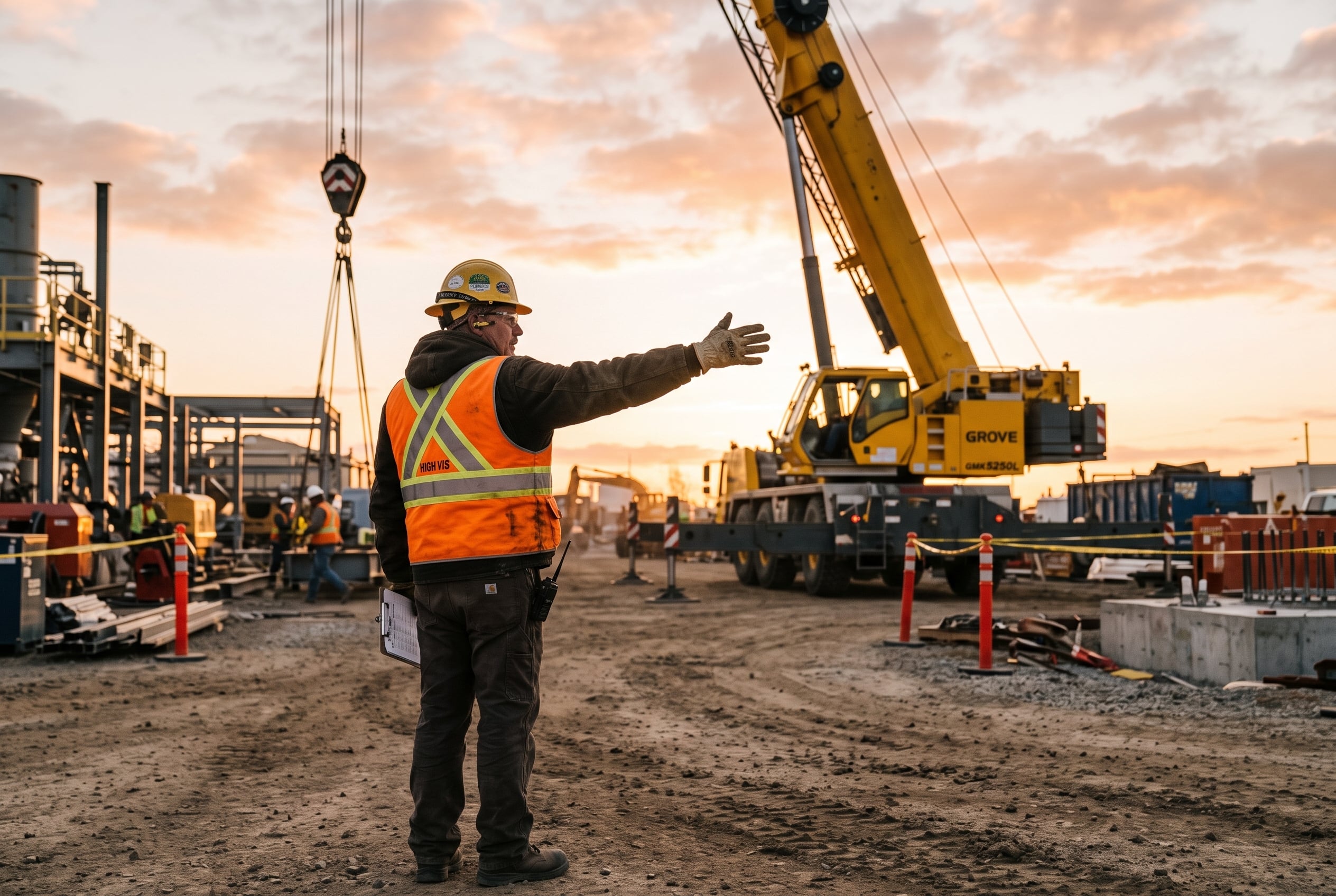
A rigger certification is a third-party credential that verifies a worker can safely select, inspect, and attach rigging hardware to loads for lifting operations. It is not the same thing as being "qualified" under OSHA, and that distinction causes confusion on job sites every day.
OSHA 29 CFR 1926.1401 defines a qualified rigger as:
"A person who possesses a recognized degree, certificate, or professional standing, or has extensive knowledge, training, and experience, and can successfully demonstrate the ability to solve rigging problems."
Notice the key terms: the employer is the one who determines whether a rigger is qualified. A third-party certification from NCCCO or NCCER is one path to demonstrating qualification, but it is not a federal requirement on its own. The employer must still verify that the individual can solve the specific rigging problems required for the lifts they will perform.
| Qualified Rigger | Certified Rigger | |
|---|---|---|
| Who decides | Employer | Third-party body (NCCCO, NCCER, etc.) |
| Meets OSHA federal minimum? | Yes | Yes, as one path |
| Required by contract/insurance? | Sometimes | Often |
| Preferred on bid packages? | Less common | Yes |
| Written/practical exam? | Employer discretion | Standardized testing |
| Renewal cycle | Employer-determined | Typically 5 years |
This definition gap is the source of most compliance confusion. An employer can designate a rigger as "qualified" without a third-party certification, but that internal designation won't satisfy many general contractors, insurance underwriters, or state licensing boards. For most teams working on commercial or industrial projects, third-party certification is the safer and often required path.
If you're also managing rigging hazards on-site, review our complete rigging safety rules for daily inspection checklists.
Not Sure If Your Riggers Meet the Federal Definition?
Tracking who is "qualified" and who is "certified" across multiple crews and job sites gets messy fast. Try Safety Evolution free for 30 days and see every rigger's status, expiry dates, and renewal reminders in one dashboard.
Start Your 30-Day Free Trial →The right credential depends on the complexity of your lifts, your industry's contract requirements, and your location. Here's how the major pathways break down.
The National Commission for the Certification of Crane Operators (NCCCO) is the most widely recognized rigger certifying body in the United States.
Both levels require recertification every five years through a written exam. If certification lapses, the practical exam may also be required.
NCCER offers a performance-based alternative to NCCCO. Rather than a single exam, workers progress through modular training and assessments. The credential covers both rigging and signal person competencies, making it a bundled option for employers who need both roles filled. Because the program is modular, completion timelines vary by provider and trainee experience.
Under federal OSHA, an employer can designate a rigger as qualified without third-party certification if the individual has extensive knowledge, training, and experience, and can demonstrate the ability to solve rigging problems. This approach carries risk: it may not satisfy insurance providers, general contractors, or state licensing boards, making it an unreliable foundation for liability protection. If your projects involve crane operations, crane operator certification requirements often overlap with rigger rules. Review both together.
OSHA 1926.1422 requires a qualified signal person whenever a crane operator's view is obstructed or a signal person is needed to alert the operator and ground workers. Signal person certification is a separate credential, though many training providers bundle it with rigger training. Common options include NCCCO Signal Person (written exam only, valid 5 years) and NCCER Signal Person module.
Rigger requirements in the US operate on three layers: federal minimums, state-plan variations, and local licensing overlays. You need to check all three.
Under OSHA's crane standard (Subpart CC of 29 CFR 1926), a qualified rigger is required whenever assembly or disassembly work occurs, during hooking and unhooking operations, and whenever personnel are in the fall zone. The employer must designate the rigger as qualified and document that designation.
ASME B30.5 (updated in 2025) now explicitly requires qualified riggers for mobile cranes with a capacity greater than 2,000 lbs. This is a consensus standard, not federal law, but many contracts and insurance policies reference it directly. The employer remains the ultimate designator of qualification for a specific task.
Most US states follow federal OSHA minimums. Where it gets complicated:
Canada has no national rigger certification program. Each province sets its own rules, and the patchwork creates real confusion for employers operating across provincial lines. If you're managing rigs in multiple provinces, keeping credentials straight in spreadsheets breaks quickly. Try Safety Evolution free for 30 days to track every rigger's certification in one place.
Under WorkSafeBC's Occupational Health and Safety Regulation Part 15, rigging work must be performed by or under the direct supervision of a qualified worker. The most common credential is the Cranesafe/Fulford Level 1 Rigger Certification, an approximately 8-hour program with a written exam. Valid 5 years; recertification required. Cost: approximately $300–$500 CAD. Level 2 Advanced is available for complex rigging scenarios.
Alberta uses the CRS (Certified Rigger and Signaler) program through the AB Carpenters Training Centre, typically delivered as a 3–4 day course. Advanced programs may reference LEEA (Lifting Equipment Engineers Association) standards through the Alberta Construction Training Institute.
Ontario does not have a dedicated provincial rigger certification. The hoisting engineer is a separate regulated trade, and rigging competency is typically determined by the employer. Employers in Ontario often adopt internal competency programs or accept third-party credentials from training providers. If you're evaluating training options broadly, our overview of construction safety courses includes additional Canadian programs.
| Province | Required Credential | Recertification | Practical Exam | Issuing Body |
|---|---|---|---|---|
| British Columbia | Cranesafe/Fulford Level 1 | 5 years | Yes | Fulford/Cranesafe |
| Alberta | CRS (Certified Rigger and Signaler) | Employer-driven | Yes | AB Carpenters Training Centre |
| Ontario | Employer-determined | Employer-driven | Varies | Various providers |
Total cost depends on the certifying body, level, travel, and whether you need retakes. Use the table below to estimate your budget.
| Provider / Level | Training Cost | Exam Fee | Total Range | Notes |
|---|---|---|---|---|
| NCCCO Rigger Level I | $200–$400 | $100–$200 | $300–$600 | Written + practical; no prerequisite |
| NCCCO Rigger Level II | $250–$500 | $150–$300 | $400–$800 | Requires Level I; written + practical |
| NCCER Rigger / Signal Person | $400–$800 | Included | $400–$800 | Modular; bundled credential available |
| Cranesafe / Fulford (BC) Level 1 | $200–$400 CAD | Included | $300–$500 CAD | 8 hours; 5-year recert |
| Alberta CRS | $300–$500 CAD | Included | $300–$500 CAD | 3–4 days |
Additional costs to budget for: travel to testing centers ($50–$400), retest fees if failed ($100–$200), personal protective equipment, and renewal every 5 years.
Riggers do far more than attach a sling and walk away. The job breaks into three phases:
Before any lift, the rigger inspects all slings, shackles, hooks, eyebolts, and lifting hardware per ASME B30.26. Damaged equipment is removed from service immediately. The rigger calculates sling angles, estimates load weight and center of gravity, and selects hardware with adequate working load limits.
The rigger attaches rigging to the load and crane hook using the correct hitch type for the load geometry. During the lift, the rigger communicates with the crane operator or signal person, monitors for drift, shock loading, or equipment failure, and signals to stop the lift if any hazard develops.
After the lift, the rigger stores rigging to prevent kinking, abrasion, or chemical damage. Inspection findings are documented, and worn equipment is tagged and scheduled for replacement. If you're building an incident investigation process around equipment failures, see our incident investigation guide for documentation templates.
Certification is not a one-time event. Standards evolve, equipment changes, and employers who let credentials lapse open themselves to liability.
A 5-year-old cert does not equal current competency. Equipment and standards evolve. A rigger who hasn't touched a sling angle chart in four years may not be ready for an engineered multi-point lift. Employers should schedule refresher training before recertification deadlines and use a compliance tracking system to flag approaching expiry dates across the entire crew.
Still Tracking Rigger Certs in Spreadsheets?
If you're managing multiple crews, provincial requirements, and overlapping renewal cycles, manual tracking breaks fast. Start your 30-Day Free Trial and see exactly who's current, who's expiring, and what your next audit will look like before the inspector arrives.
Start Your 30-Day Free Trial →OSHA does not require third-party certification. Under 29 CFR 1926.1401, employers must designate riggers as "qualified," meaning they have a recognized degree, certificate, or professional standing, or extensive knowledge, training, and experience, plus demonstrated ability to solve rigging problems. However, most general contractors, insurance providers, and state licensing boards require third-party certification (such as NCCCO or NCCER), making it the practical standard for most commercial and industrial work.
A qualified rigger is designated by the employer as having the knowledge and experience to perform specific rigging tasks. A certified rigger has passed a third-party assessment (such as NCCCO or NCCER) that verifies competency through standardized written and practical exams. Certification is one path to qualification, but the employer remains responsible for verifying that the rigger is qualified for the specific lifts they will perform.
NCCCO Rigger Level I typically costs $300–$600 including training and exam fees. NCCCO Rigger Level II costs $400–$800 and requires Level I as a prerequisite. Additional costs may include travel to a testing center, retest fees ($100–$200), PPE, and recertification every 5 years.
Partially. Many providers offer online modules for the knowledge portion of rigger training, covering regulations, sling angles, and hardware identification. However, OSHA does not accept online-only rigger qualification. All major certifying bodies, including NCCCO and NCCER, require an in-person practical examination where candidates demonstrate hands-on rigging skills under supervision. You'll still need in-person testing. If you're managing a team, Safety Evolution helps track both online learning and hands-on practical completion.
NCCCO rigger certifications are valid for 5 years. Recertification requires passing a written exam; if the certification has lapsed, the practical exam may also be required. Canadian provincial certifications such as Cranesafe/Fulford (British Columbia) also typically carry a 5-year validity period. Alberta CRS renewal is employer-driven.
It depends on your duties. Under OSHA 1926.1422, a qualified signal person is required whenever a crane operator's view is obstructed or a signal person is needed to communicate with the operator and ground workers. Signal person certification is a separate credential, though many training providers bundle it with rigger training. If your role includes signaling crane operations, you need both competencies. Common signal person certifications include NCCCO Signal Person and the NCCER Signal Person module.
COR-certified contractors earn 10%-20% WCB premium discounts. Province-by-province breakdown with real math at $1M, $5M, $10M payroll.
Learn what a Certificate of Recognition (COR) is, who needs it, the benefits, and what it takes to get COR certified. Book a Free Safety Assessment.
COR certification in Nova Scotia costs nothing for CSNS members in year 1. Learn the 5-step process, training, fees, and WCB premium rebate details.