Last updated: April 2026
Fall protection has been OSHA's #1 most-cited violation for 15 consecutive years. In fiscal year 2025, OSHA issued 5,914 fall protection citations, and the maximum penalty for a single willful violation is now $165,514. The OSHA fall protection standard requires employers to protect workers from falls at 6 feet in construction (29 CFR 1926.501), 4 feet in general industry (29 CFR 1910.28), and 5 feet in shipyards. This guide breaks down the specific OSHA standards, what they require, and where contractors most commonly get cited.
⚡ Quick Answer
- Construction trigger: 6 feet (1.8 m) under 29 CFR 1926.501
- General industry trigger: 4 feet (1.2 m) under 29 CFR 1910.28
- FY 2025 citations: 5,914 violations (more than any other standard)
- Serious penalty: Up to $16,550 per violation (Jan 2025)
- Willful penalty: Up to $165,514 per violation (Jan 2025)
Looking for fall protection requirements in Canada? Read our complete fall protection guide covering both Canadian and US regulations.
What Is the OSHA Fall Protection Standard?
There is no single "OSHA fall protection standard." Fall protection requirements are spread across multiple sections of 29 CFR, depending on the type of work. The two primary standards are:
- 29 CFR 1926 Subpart M (Sections 1926.500-503): Fall protection for construction. This is the standard that generates most citations.
- 29 CFR 1910.28-29: Fall protection for general industry. Updated in 2017 with the Walking-Working Surfaces final rule.
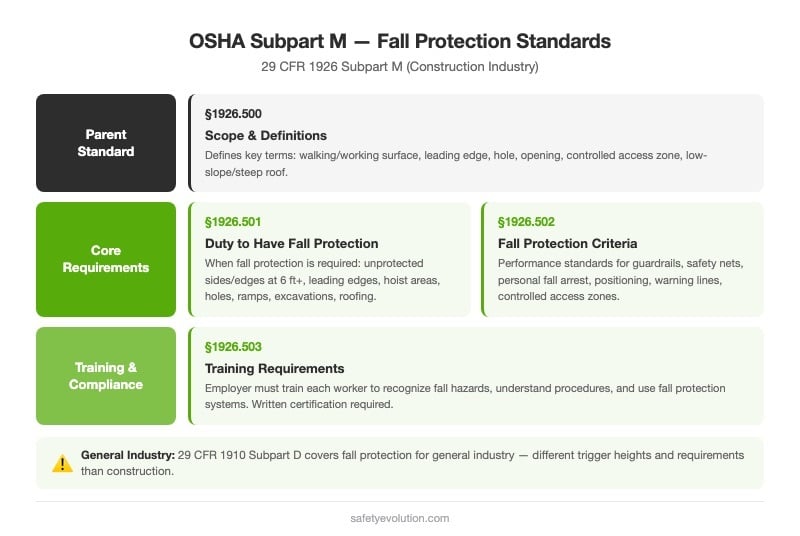
Within construction (Subpart M), the rules are divided into three parts: 1926.501 (when fall protection is required), 1926.502 (what the systems must look like), and 1926.503 (training requirements).
OSHA Fall Protection Trigger Heights
Most contractors know the 6-foot rule. Fewer know the exceptions, and those exceptions are where citations happen.
Construction: 29 CFR 1926.501
The general rule: fall protection is required when a worker is on a walking/working surface with an unprotected side or edge that is 6 feet or more above a lower level. But OSHA specifies different triggers for different situations:
| Situation |
Trigger Height |
Section |
| Unprotected sides and edges |
6 feet |
1926.501(b)(1) |
| Leading edges |
6 feet |
1926.501(b)(2) |
| Holes (including skylights) |
Any height |
1926.501(b)(4) |
| Formwork and reinforcing steel |
6 feet |
1926.501(b)(5) |
| Ramps, runways, walkways |
6 feet |
1926.501(b)(6) |
| Excavations |
6 feet |
1926.501(b)(7) |
| Dangerous equipment below |
Any height |
1926.501(b)(8) |
| Overhand bricklaying |
6 feet |
1926.501(b)(9) |
| Roofing (low-slope) |
6 feet |
1926.501(b)(10) |
| Roofing (steep-slope) |
6 feet |
1926.501(b)(11) |
| Wall openings |
6 feet |
1926.501(b)(14) |
Notice that holes and dangerous equipment have no height threshold. A 3-foot-deep pit with rebar at the bottom requires fall protection. A skylight at floor level requires a cover or guardrail. These are the situations contractors miss.
General Industry: 29 CFR 1910.28
The 1910.28 standard (updated in the 2017 Walking-Working Surfaces final rule) requires fall protection at 4 feet above a lower level for general industry workers. This lower threshold catches manufacturing floors, warehouses, loading docks, and maintenance platforms that construction standards would not cover.
Key difference: general industry allows more flexibility in system selection. Guardrails, safety nets, travel restraint, and personal fall arrest are all acceptable depending on the situation.
OSHA Fall Protection System Requirements
OSHA does not just require that you have fall protection. Section 1926.502 specifies exactly what each system must look like. Here is what most contractors miss: a guardrail that is 38 inches high is a violation, even if it "seems tall enough."
Guardrail Requirements (1926.502(b))
- Top rail height: 42 inches (+/- 3 inches)
- Must withstand a 200-pound force applied in any outward or downward direction
- Mid-rail required at approximately 21 inches
- Surface must be smooth enough to prevent punctures, lacerations, or snagging
Personal Fall Arrest System Requirements (1926.502(d))
- Body belts are NOT permitted as part of a fall arrest system (harness required)
- Maximum arresting force: 1,800 lbf (8 kN) with body harness
- Maximum free fall distance: 6 feet
- Maximum deceleration distance: 3.5 feet
- Worker must not contact any lower level during or after the fall
- Anchor points: capable of supporting 5,000 lbs per worker, or designed by a qualified person with a safety factor of 2
Safety Net Requirements (1926.502(c))
- Maximum mesh opening: 6 by 6 inches
- Border rope minimum breaking strength: 5,000 lbs
- Must be tested with a 400-lb sandbag drop after installation
- Must be installed within 30 feet below the work surface
Not sure where your fall protection program is exposed?
See missing training, inspections, and corrective actions before they become stop-work or audit issues.
Start Your 30-Day Free Trial →OSHA Fall Protection Training (1926.503)
Under 29 CFR 1926.503, every worker exposed to a fall hazard must be trained by a competent person. The training must cover:
- Nature of fall hazards in the work area
- Correct procedures for erecting, maintaining, disassembling, and inspecting fall protection systems
- Use and operation of controlled access zones, guardrails, personal fall arrest systems, safety nets, warning lines, and safety monitoring systems
- Each worker's role in the safety monitoring system (if used)
- Limitations on use of mechanical equipment during roofing work on low-slope roofs
- Correct procedures for equipment and materials handling near holes and edges
- Emergency and rescue procedures
Retraining is required when: a worker does not demonstrate understanding, workplace conditions change, or fall protection systems change. OSHA does not mandate a specific recertification interval, but annual refresher training is standard practice. The employer must maintain written certification records including worker name, training date, and trainer signature.
Safety Evolution offers OSHA-aligned fall protection training through our learning management system, including Click Safety's fall protection course with instant certification and automatic expiry tracking.
State-Plan States With Stricter Rules
Twenty-two states operate their own OSHA-approved state plans, and some have fall protection requirements stricter than federal OSHA. If you work in these states, the state standard applies, not the federal one:
- California (Cal/OSHA): Requires fall protection at height thresholds of 7.5 feet for certain construction activities but has stricter requirements for residential construction and specific equipment standards
- Washington (WA L&I): Stricter requirements for construction and general industry, including specific rules for residential construction
- Oregon (OR-OSHA): Adopts federal standards with additional state-specific interpretations
The rule of thumb: if your state has its own OSHA program, check the state standards before assuming federal rules apply. For the full list of state-plan states, see OSHA's State Plans page.
OSHA Fall Protection Penalties (2025)
As of January 15, 2025, OSHA's penalty schedule sets the following maximums:
| Violation Type |
Maximum Penalty |
| Serious |
$16,550 per violation |
| Willful or repeated |
$165,514 per violation |
| Failure to abate |
$16,550 per day |
These are per-violation penalties. A site with 8 workers at height without harnesses is 8 serious violations: $132,400 before any willful multiplier. A contractor with the same violation found across three projects is looking at repeat classification and potential willful penalties. That is why fall protection tops the citation list every year: the violations are visible, the penalties stack, and OSHA inspectors know exactly where to look.
For fall protection requirements in Canada, see our fall protection height requirements guide covering provincial trigger heights and penalties.
Still chasing fall protection evidence across files and inboxes?
Centralize corrective actions and proof so your next review is predictable.
Start Your 30-Day Free Trial →Frequently Asked Questions
At what height does OSHA require fall protection in construction?
OSHA requires fall protection at 6 feet (1.8 m) above a lower level in construction under 29 CFR 1926.501. However, fall protection is required at any height when workers are near holes, skylights, or dangerous equipment below.
What is the difference between 1926.501 and 1926.502?
Section 1926.501 defines WHEN fall protection is required (the duty to provide it). Section 1926.502 defines HOW the fall protection systems must perform (system criteria: guardrail heights, anchor strengths, net specifications). Section 1926.503 covers training.
Can body belts be used for fall arrest under OSHA?
No. OSHA prohibits body belts as part of a personal fall arrest system (1926.502(d)). A full-body harness is required for fall arrest. Body belts may only be used as part of a positioning device system or travel restraint system.
How much is an OSHA fine for fall protection violations?
As of January 2025, OSHA penalties are $16,550 per serious violation and $165,514 per willful or repeated violation. Penalties are per violation, so a site with multiple unprotected workers multiplies the total. Failure to abate costs $16,550 per day beyond the abatement deadline.
Does OSHA require a written fall protection plan?
OSHA requires a written fall protection plan only when conventional fall protection (guardrails, nets, PFAS) is infeasible or creates a greater hazard (29 CFR 1926.502(k)). The plan must document why conventional methods cannot be used and describe the alternative measures. In practice, a written plan is industry best practice for any work at height.
Get Weekly Safety Insights
Regulation updates, toolbox talk ideas, and compliance tips. One email per week.