Lockout Tagout Violations: OSHA's #5 Most Cited
LOTO violations hit 2,443 citations in FY2024. See the most common failures, real penalty amounts, and how to fix each one before an inspector finds...
Fall protection violations lead OSHA citations for 15 straight years. Common violations, how penalties stack, and how to avoid the 5,914 citations.
Last updated: April 2026
For the 15th consecutive year, fall protection tops OSHA's list of most-cited violations. In fiscal year 2025, OSHA issued 5,914 fall protection citations under 29 CFR 1926.501. That is more than double the next standard on the list. Fall protection violations occur when employers fail to provide required fall protection systems, use defective equipment, skip training, or allow workers at height without proper safeguards. The penalties start at $16,550 per serious violation and reach $165,514 for willful offences. This guide covers the most common violations, how penalties stack, and how to avoid being one of the 5,914.
For the full fall protection overview, read our complete fall protection guide.
Fall protection has led OSHA's Top 10 every year since 2011. It is not because the standards are complicated. It is because violations are easy to see. An OSHA inspector does not need to review documents or test equipment. They can stand on a public road, look at your job site, and see if your workers at height are protected. That visibility, combined with the fact that falls kill more construction workers than any other cause (389 of 1,034 construction fatalities in 2024, per the Bureau of Labor Statistics), means OSHA prioritizes fall protection enforcement.
The violations that generate the most citations are not obscure technicalities. They are fundamental failures.
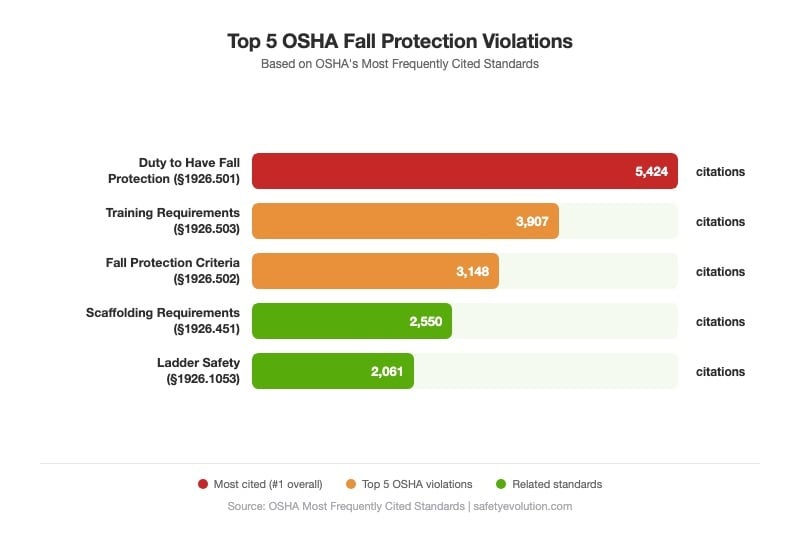
Workers on a walking/working surface with an unprotected side or edge 6 feet or more above a lower level, with no guardrails, no nets, and no personal fall arrest system. This is the most basic violation: the worker is at height and has nothing.
Floor holes and skylights without covers or guardrails. This is a zero-height-threshold violation: it applies regardless of how high the opening is. Skylight falls are particularly deadly because the worker often does not see the hazard. An uncovered skylight on a flat roof looks like a solid surface until you step on it.
Workers at a leading edge (the unprotected side or edge of a floor, roof, or formwork that changes location as work progresses) without fall protection. Common in steel erection, concrete pours, and roofing.
Guardrails that do not meet specifications: top rail not at 42 inches, no mid-rail, rail that cannot withstand 200 lbs of force, or gaps large enough for a worker to fall through. A guardrail that looks installed but does not meet the standard is a violation.
Workers using fall protection equipment without documented training by a competent person. No training records, no documented competent person, or training that does not cover the specific systems on site.
Most contractors underestimate their exposure because they think of penalties as "one fine per inspection." Here is how penalties actually work:
| Scenario | Calculation | Potential Penalty |
|---|---|---|
| 8 workers without fall protection (serious) | 8 x $16,550 | $132,400 |
| Same violation on 3 sites (repeat) | 3 x $165,514 | $496,542 |
| Failure to abate (30 days past deadline) | 30 x $16,550 | $496,500 |
A mid-size contractor with the same fall protection gap across three projects can easily face penalties exceeding $500,000. And if a worker falls and is injured or killed, the criminal and civil liability dwarfs the OSHA fine.
Not sure where your fall protection program is exposed?
See missing training, inspections, and corrective actions before they become stop-work or audit issues.
Start Your 30-Day Free Trial →Canadian provinces enforce fall protection violations through a combination of stop-work orders, administrative penalties, and prosecution:
The fixes are not complicated. They require discipline, not genius.
For detailed training requirements, see our fall protection training guide. For equipment inspection checklists, see our inspection checklist.
Still chasing fall protection evidence across files and inboxes?
Centralize corrective actions and proof so your next review is predictable.
Start Your 30-Day Free Trial →As of January 2025, a serious fall protection violation carries a maximum penalty of $16,550. Willful or repeated violations carry a maximum of $165,514 per violation. Penalties are assessed per violation, per worker, so a single site visit can result in six-figure fines.
Fall protection violations are highly visible (an inspector can spot them from the ground), falls are the leading cause of construction deaths, and the standard applies to nearly every construction site. These three factors combine to make fall protection the most frequently cited standard for 15 consecutive years.
OSHA itself issues civil penalties. However, if a worker dies due to a willful violation of an OSHA standard, the case can be referred for criminal prosecution under Section 17(e) of the OSH Act. A first conviction can result in up to 6 months in prison. Several states also have their own criminal provisions for workplace safety violations resulting in death.
Get Weekly Safety Insights
Regulation updates, toolbox talk ideas, and compliance tips. One email per week.
LOTO violations hit 2,443 citations in FY2024. See the most common failures, real penalty amounts, and how to fix each one before an inspector finds...
Scaffolding fall protection requirements for OSHA and Canadian OHS. Guardrail specs, PFAS rules, inspection, and common violations.
The top 10 OSHA violations in 2025, ranked by frequency, with contractor-friendly fixes for each. Includes HazCom, ladders, LOTO, scaffolding, and...