Last updated: May 2026
Your supervisor asks for a risk assessment, your foreman asks for a JSA, and your crew is waiting at the tailgate. That confusion costs time and increases exposure when conditions shift fast. JSA vs risk assessment is the difference between step-by-step task control and broader risk prioritization across work activities. At Safety Evolution, we see teams stall when they treat these forms as substitutes instead of paired tools.
⚡ Quick Answer
- What changes: Use a JSA for task-level steps and controls. Use a risk assessment to rank and prioritize hazards across jobs or sites.
- JSA method: CCOHS outlines 5 steps, select the job, break into steps, identify hazards, choose controls, communicate results.
- Terminology: CCOHS treats JSA and JHA as alternate terms for the same process.
- US baseline: OSHA 29 CFR 1910.132(d)(1) requires a hazard assessment for PPE, and 1910.132(d)(2) requires written certification.
- Field trigger: If scope, crew, equipment, or site conditions change mid-shift, refresh task-level analysis before work continues.
JSA vs Risk Assessment in One Minute
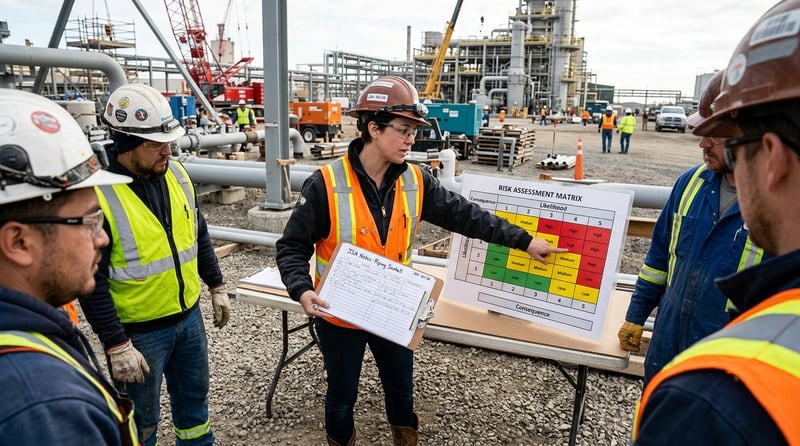
A job safety analysis (JSA) is built around one task. You break that task into steps, identify hazards per step, then define controls the crew will follow in sequence. A risk assessment is broader. It identifies hazards across activities, evaluates likelihood and consequence, then helps leaders prioritize what gets addressed first.
Most teams do not need to pick one forever. They need to pick the right tool for the decision in front of them. If the question is, "How do we do this task safely right now?" use a JSA. If the question is, "Which hazards should we prioritize this month across crews, sites, and jobs?" use a risk assessment.
Blunt truth, crews do not fail because they lacked another form. They fail when the form does not match the decision moment.
| Category |
JSA |
Risk Assessment |
| Scope |
Single task, step by step |
Multiple hazards across work scope |
| Timing |
Before execution, refreshed when work changes |
Planning, periodic review, program-level updates |
| Primary output |
Step controls and crew briefing points |
Risk ranking and control priorities |
| Typical owner |
Supervisor or crew lead |
HSE lead, management, cross-functional team |
What a JSA Does Better Than a Risk Assessment
CCOHS defines JSA as a method that breaks a job into task steps, identifies hazards at each step, and determines the safest way to perform the work. That sequence matters in the field because workers do not perform "a project." They perform step 1, then step 2, then step 3 under real constraints like access, weather, and schedule pressure.
CCOHS also states JSA and JHA are alternate terms for the same procedure, so teams can stop arguing about labels and focus on execution quality. The practical value is control placement at the exact point of exposure, lockout before access, spotter during movement, tie-off before edge approach, not generic reminders buried in a monthly register.
Most people think a risk matrix alone is enough for all work. It is not. For non-routine or permit-linked tasks, you need step sequencing and role clarity, or the highest-risk step gets rushed under production pressure.
Use JSA first when the work has high consequence steps, multiple handoffs, or changing crew composition. If a new operator joins after lunch, the JSA is where you re-brief controls fast and defensibly.
How to conduct a job hazard analysis in construction and activity hazard analysis examples go deeper on building stronger task-level forms.
What a Risk Assessment Does Better Than a JSA
A risk assessment is built for prioritization. CCOHS frames it as a three-part process, identify hazards, analyze or evaluate risk, then determine controls. That gives leadership a way to compare recurring exposures and allocate resources where risk is highest.
This is where likelihood and consequence scoring belongs. You are not just asking, "Can this step hurt someone?" You are asking, "How often can this happen across sites, and what is the potential impact if it does?" That view drives decisions like engineering upgrades, training investment, contractor prequalification rules, and inspection frequency.
A specific messy example, one contractor with 120 field workers had excellent JSAs on paper but repeated struck-by near misses across two projects. The missing piece was program-level risk ranking. Once mobile-equipment interface hazards were scored and elevated, they changed traffic plans and spotter rules across all sites, not just one task card.
If your system only captures task-level forms, you can miss trend risk. If your system only captures strategic risk registers, you can miss control failure at the workface. Use both where they do their best work.
For a practical field-level companion, see this field-level hazard assessment example.
Using the wrong form is slowing your crew down
If supervisors keep switching between disconnected templates, hazards get missed and signoffs become checkbox work. Try Safety Evolution free for 30 days and run one clear JSA plus risk workflow in the field.
Start Your 30-Day Free Trial →
Field Decision Matrix: Which Form Should the Crew Use Today?
Use this rule, pick the form based on decision horizon. If the decision is immediate and task-specific, start with JSA. If the decision is comparative and portfolio-level, start with risk assessment. If both apply, run risk assessment for priority and JSA for execution.
| Scenario |
Tool |
Why |
Accountability |
| Routine repeatable task with stable conditions |
JSA |
Step controls and pre-task briefing are the main need |
Supervisor signs before start; crew acknowledges |
| High-variance work across multiple sites |
Risk assessment + JSA |
Need enterprise prioritization and step-level control |
HSE lead reviews ranking, supervisor owns task controls |
| Permit-required activity (confined space, hot work, critical lift) |
Both |
Permit controls plus sequence-specific hazards |
Permit issuer verifies; field lead re-briefs steps |
| Conditions changed mid-shift |
Refresh JSA immediately, update risk view if recurring |
Exposure changed, old assumptions are invalid |
Supervisor stops work, re-briefs, re-signs |
Need one workflow crews can use without debating forms at the tailgate? Start a 30-Day Free Trial and standardize how JSA and risk assessment are executed in the field.
False belief to kill now, if the crew has "done this task 100 times," they do not need a fresh JSA. They do when conditions change. Experience helps judgment. It does not replace verification.
Canada vs US Compliance Notes (Keep Separate)
In Canada
Use CCOHS guidance as your practical baseline for JSA and risk assessment method, then align your forms to provincial requirements. Alberta and BC both expect employers to identify hazards and control risk, but wording, enforcement, and documentation pathways differ by jurisdiction. Start with CCOHS job safety analysis guidance and CCOHS hazard and risk framework, then verify against the current Alberta OHS Code updates or your provincial regulator equivalent.
For BC operations, WorkSafeBC inspection and prevention obligations make stale documentation a real liability if site conditions evolve and records are not updated in practice.
In the US
OSHA 29 CFR 1910.132(d)(1) requires employers to assess workplace hazards to determine PPE needs, and 1910.132(d)(2) requires written certification that the hazard assessment was performed. That written component is where many organizations under-document. Do not rely on verbal checks alone when your process says assessment is complete.
Use OSHA PPE hazard assessment requirements for compliance baseline and OSHA 3071 for implementation guidance. Keep Canada and US forms separate enough that legal references and wording stay jurisdiction-correct.
How to Switch Mid-Shift When Conditions Change
When conditions shift, speed matters, but sequence matters more. A five-minute reset prevents hours of incident response. Stop the task, validate the new hazard picture, re-brief the crew, then restart with updated controls.
Use this supervisor reset checklist:
- Stop: Pause work at the point of change, scope, equipment, access, weather, adjacent work, or crew makeup.
- Re-scan: Confirm what changed and which task steps are affected.
- Re-brief: Update the JSA controls and communicate changes to every affected worker.
- Re-sign: Capture updated signoff with time stamp and supervisor name before restart.
Minimum defensible documentation is simple, what changed, which controls changed, who was briefed, and when restart was authorized. If this happens repeatedly on the same work type, escalate to a broader risk assessment update so the root issue is prioritized system-wide.
Your forms should help crews decide faster, not create delay
If your team is still debating JSA vs risk assessment at the tailgate, your process is costing you control. Start your 30-Day Free Trial and run one workflow built for real field changes.
Start Your 30-Day Free Trial →
Frequently Asked Questions
Is a JSA the same thing as a risk assessment?
No. A JSA is task-step specific and built for execution controls. A risk assessment is broader and used to evaluate and prioritize risk across activities. They work together, but they are not interchangeable.
Do I need both a JSA and a risk assessment for the same job?
Often yes, especially for higher-risk or variable work. Use risk assessment to rank hazards and allocate controls, then use JSA to apply those controls step by step in the field. That combination improves both planning and execution quality.
When should a supervisor redo a JSA on active work?
Redo or refresh it when scope, equipment, crew, environment, or adjacent work changes. If assumptions behind the original controls are no longer true, the document is stale. Stop, update, re-brief, and re-sign before restart.
What does OSHA require in writing for hazard assessments?
Under 29 CFR 1910.132(d)(2), employers must verify that the required workplace hazard assessment has been performed through written certification. The certification must identify the workplace evaluated and the person certifying completion.
In Canada, does CCOHS require a specific JSA form template?
CCOHS provides method guidance, not one mandatory national template. Employers typically build a form that fits their operations, then align content and process with provincial legal requirements. Consistency and field use quality matter more than template design.
Can one company form work for both Canada and US crews?
You can use a shared structure, but jurisdiction-specific legal references should be separated. Canada and US compliance language differs enough that one blended form often creates audit risk. Keep a common workflow and market-specific compliance fields.
Get Weekly Safety Insights
Regulation updates, toolbox talk ideas, and compliance tips. One email per week.