Safety Orientation Checklist
A complete safety orientation checklist for construction and industrial contractors. Covers all regulatory requirements for Canada and the US.
Safety orientation keeps new workers alive. Requirements for Canada and the US, what to include, and how to build a program that works.
Last updated: April 2026
Your new hire showed up Monday, signed a stack of paperwork, and was on the floor by lunch. Two weeks later, they tripped over material nobody told them was stored differently on this site. That's not bad luck. That's a failed orientation. A safety orientation is a structured training session that introduces new workers to workplace hazards, emergency procedures, PPE requirements, and company safety rules before they start work. Every Canadian province and OSHA in the United States require it. Most contractors do it. Few do it well.
A safety orientation is the first structured safety training a worker receives when they join a company or arrive at a new work site. It covers the hazards they will encounter, the emergency procedures they need to follow, the personal protective equipment they must wear, and the safety rules that apply to their specific role and location.
It is not the same as onboarding. Onboarding is the broader HR process: payroll forms, benefits enrolment, company policies, and team introductions. Orientation is the safety-specific component: the part that keeps your new worker from getting hurt on Day 1. Some companies combine them. That's fine. But the safety content cannot be an afterthought buried between tax forms and parking passes.
The Canadian Centre for Occupational Health and Safety (CCOHS) defines orientation as "the process of introducing new, inexperienced, and transferred workers to the organization, their supervisors, co-workers, work areas, and jobs, and especially to health and safety." That last part is the one most contractors rush through.
New workers get hurt more often. That is not opinion. The U.S. Bureau of Labor Statistics reported 2.3 recordable cases per 100 full-time workers in private industry in 2024, and research consistently shows that workers in their first year on a job are at significantly higher risk of injury than experienced colleagues. In construction, where hazards change with every phase of a project, that risk compounds.
Beyond the human cost, a failed orientation creates legal exposure. In Canada, every province's OHS legislation requires employers to train workers before they begin work. In the US, OSHA's General Duty Clause and construction-specific standards mandate the same. An injury to an untrained worker is not just a tragedy. It is evidence of non-compliance.
Most people think their orientation is adequate because nobody has complained. That is not how it works. Workers sit through a PowerPoint, sign a form, and walk out remembering nothing. The signature proves the orientation happened. It does not prove the worker understood anything. When an inspector asks your new hire what the emergency muster point is and they shrug, that signed form will not save you.
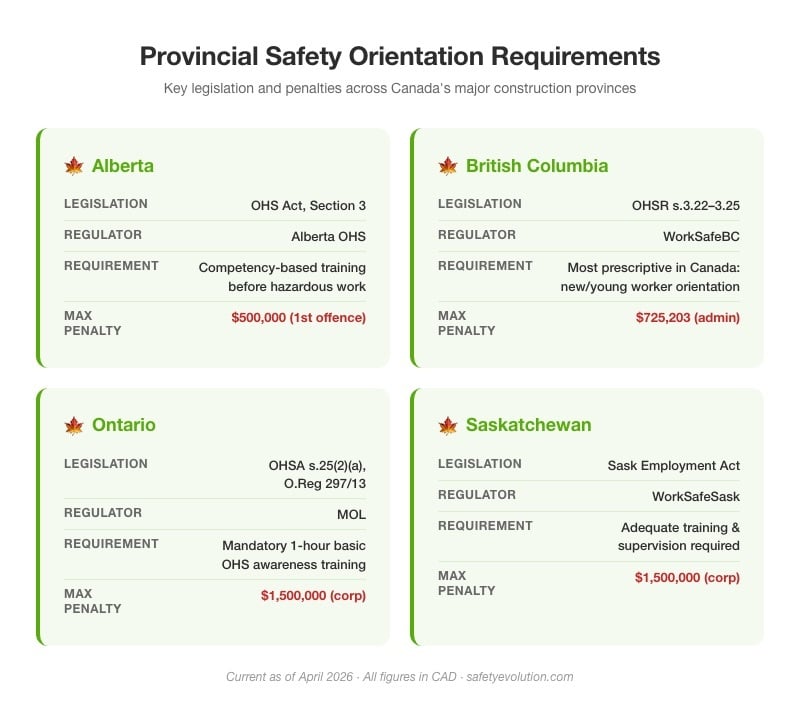
Every Canadian province requires employers to orient and train new workers. The specific legislation varies, but the obligation is universal. Here is what applies in the provinces where most of SE's clients operate.
Under Section 3 of the Alberta OHS Act, employers must ensure workers are trained to perform their work in a healthy and safe manner. Workers may only carry out dangerous work if they are competent or are supervised by a competent worker. The OHS Code (updated March 31, 2025) adds specific competency requirements for hazardous tasks. Penalties under the OHS Act can reach $500,000 for a first offence and $1,000,000 for subsequent offences, with administrative penalties up to $10,000 per day.
BC has the most prescriptive new worker orientation requirements in Canada. WorkSafeBC's OHS Regulation sections 3.22 through 3.25 specifically address "young or new worker" orientation and training. Employers must provide orientation and training specific to the workplace before the worker begins work. The regulation covers workplace-specific hazards, emergency procedures, PPE requirements, and the worker's right to refuse unsafe work.
Ontario's OHSA Section 25(2)(a) requires employers to provide information, instruction, and supervision to protect worker health and safety. Ontario goes further with O.Reg 297/13, which mandates a minimum 1-hour basic occupational health and safety awareness training for all new workers and supervisors. This is the most structured minimum standard in Canada.
The Saskatchewan Employment Act requires employers to ensure workers receive adequate training and supervision. WorkSafeSask provides detailed orientation guidelines and sample checklists that align with the legislative requirements. As in other provinces, the employer must document that orientation occurred.
Unlike Canada's province-specific approach, US requirements come primarily from federal OSHA standards, with state-plan states adding their own layers.
The General Duty Clause requires every employer to provide a workplace "free from recognized hazards." While it does not use the word "orientation," OSHA interprets this as requiring adequate training for new employees. If a worker is injured because they were not trained on a recognized hazard, the General Duty Clause applies.
29 CFR 1926.21(b)(2) is the construction-specific training standard: "The employer shall instruct each employee in the recognition and avoidance of unsafe conditions and the regulations applicable to his work environment to control or eliminate any hazards or other exposure to illness or injury." This is as close to a mandatory orientation standard as OSHA has for construction.
OSHA does not have a single "new employee orientation" standard. Instead, training requirements are scattered across dozens of hazard-specific standards: Hazard Communication (HazCom), PPE, confined space entry, fall protection, powered industrial trucks, and more. Your orientation must cover whichever of these apply to your work site. The OSHA Training Requirements publication (OSHA 2254) lists every standard with a training component.
OSHA penalties as of January 2025: $16,550 per serious violation, $165,514 per willful or repeated violation, and $16,550 per day for failure to abate. Training violations are frequently cited as serious.
Building Your Safety Orientation from Scratch?
Stop starting from a blank page. Download SE's free Construction Safety Orientation Package: a ready-to-customize PowerPoint, checklist, quiz, and answer key built for construction and industrial contractors.
Download the Free Package →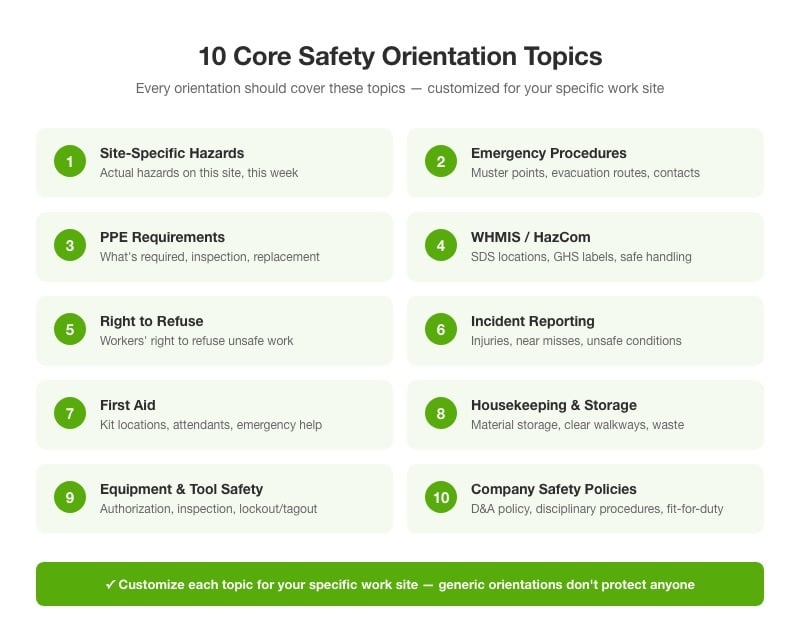
Every orientation is different because every work site is different. But the core topics are consistent across industries and jurisdictions. Here is what yours should cover, at minimum. For a detailed breakdown of each topic, see our safety orientation topics guide. For a printable version, download our safety orientation checklist.
Most companies think covering the generic stuff is enough. It is not. Your downtown office and your fabrication shop have different hazards, different emergency procedures, and different PPE requirements. A generic orientation satisfies the paperwork. A site-specific orientation keeps people alive.
If you are building your program from scratch or rebuilding one that has been running on autopilot, here is the process. For a ready-made starting point, download our safety orientation template.
Step 1: Audit your current hazards and incidents. Pull your last 12 months of incident reports, near misses, and inspection findings. These tell you what your workers actually encounter, not what a textbook says they might.
Step 2: Map your regulatory requirements. Check which jurisdiction your site operates in. Alberta's OHS Act requirements differ from BC's OHSR sections 3.22 through 3.25. OSHA's construction standards differ from general industry. Do not guess. Look it up.
Step 3: Build the content. PowerPoint or video for the core presentation. A checklist for the facilitator to follow. A quiz to verify comprehension. An answer key so your foremen can grade it consistently. SE's Construction Safety Orientation Package includes all four.
Step 4: Train your trainers. The person delivering the orientation matters as much as the content. A foreman who rushes through it in 15 minutes because he has a concrete pour at 10 is worse than no orientation at all, because now you have a signed form and zero actual knowledge transfer.
Step 5: Document everything. Date, attendee name, topics covered, quiz score, facilitator signature. If it is not documented, it did not happen. Every regulator and every plaintiff's lawyer will tell you the same thing.
Step 6: Review and update regularly. Your orientation should change when your hazards change: new equipment, new processes, new chemicals, new site layout, regulatory updates. An orientation built for a project in 2023 does not cover the hazards on your 2026 project.
We have seen orientations run by companies with 20 workers and companies with 2,000. The mistakes are remarkably consistent.
Generic content that is not site-specific. The same PowerPoint used at every site, every project, every year. Your workers are "oriented" to a building that no longer exists.
No documentation trail. The orientation happened. Nobody recorded who attended, what was covered, or whether the worker passed the quiz. When the regulator asks, you have nothing.
One-and-done mentality. The orientation runs on Day 1 and is never revisited. Hazards change. Regulations change. Refresher orientations are not optional, especially when workers transfer between sites.
Death by PowerPoint. A 90-slide deck read aloud in a monotone. Workers check out after slide 5. You have technically delivered the content. Nobody absorbed it.
We worked with a contractor running safety orientations for subcontractors across three active sites. Their orientation was a 45-minute video recorded in 2019 for a completely different project. Different site layout, different hazards, different PPE requirements. Workers were "oriented" but not actually prepared for the site they were walking onto. The signed forms looked great. The incident reports told a different story.
Standardize Your Safety Orientation
Make sure every new hire gets the same critical safety information. Download our Free Construction Safety Orientation Package.
Download the Free Orientation Package →A thorough safety orientation typically takes 1 to 4 hours, depending on the complexity of the work site and the number of hazards. Ontario mandates a minimum 1-hour basic OHS awareness training (O.Reg 297/13). Construction sites with confined spaces, energized equipment, and multiple trades will need longer orientations than a general warehouse.
Safety orientation is the initial introduction to workplace hazards, rules, and emergency procedures that happens before a worker starts. Safety training is ongoing, task-specific instruction: how to operate a forklift, how to enter a confined space, how to use fall protection. Orientation happens once per site. Training is continuous throughout a worker's employment.
Yes. In Canada, every province's OHS legislation requires employers to orient and train new workers. In the US, OSHA's General Duty Clause (Section 5(a)(1)) and construction standard 29 CFR 1926.21(b)(2) require employers to instruct employees on workplace hazards. Failure to comply can result in fines of $16,550 per serious violation (OSHA) or up to $500,000 for first offences under Alberta's OHS Act.
Review and update your safety orientation whenever work site conditions change: new equipment, new chemicals, new processes, regulatory amendments, or after a significant incident. At minimum, review the content annually. Workers transferring between sites should receive a new site-specific orientation even if they completed one at a previous location.
Employers face regulatory penalties, increased liability in injury claims, and higher workers' compensation premiums. OSHA can fine up to $16,550 per serious violation and $165,514 for willful violations. In Canada, penalties vary by province but can reach $500,000 for first offences (Alberta) and include personal liability for directors and officers. An injured worker who was never oriented is strong evidence of employer negligence.
Get Weekly Safety Insights
Regulation updates, toolbox talk ideas, and compliance tips. One email per week.
A complete safety orientation checklist for construction and industrial contractors. Covers all regulatory requirements for Canada and the US.
15 safety orientation topics every employer must cover, with regulatory backing for Canada and the US. Built for construction and industrial...
Free safety orientation template with PPT, checklist, quiz, and answer key. Built for construction and industrial contractors in Canada and the US.