Last updated: July 2026
You don't need a front-row seat to know when a crane lift has gone wrong. You can see it in the inspector's face two days later. The way they flip through a binder of soggy, half-signed signal person certs and stop asking questions. The U.S. averages 42–44 crane-related fatalities per year, and over half of those victims are operators caught in communication failures they never saw coming. Somebody gave a signal. Somebody misunderstood it. Somebody died.
Here's what too many crews still miss: rigging hand signals are standardized visual commands used to direct crane and hoist operators when verbal communication is impossible, unclear, or unsafe. They aren't optional tradition. They're a federally mandated control. And if your signal person documentation won't survive a 30-second audit, you're not managing risk. You're gambling with it.
This guide covers the standard signals, the cross-market qualification rules, and the dangerous myths that keep getting people killed.
Quick Answer
- Definition: Standard visual commands to direct crane/hoist operators when verbal communication is impossible.
- Data: 42–44 crane-related deaths occur annually in the U.S.; over half involve operators, many tied to communication failure.
- Requirement: OSHA 1926.1428 and CSA Z150-22 both mandate a designated, qualified signal person when the operator cannot see the load or its path of travel.
- Standard: ASME B30.5 (U.S.), ISO 16715 (international), and WorkSafeBC Figure 15-1 (Canada) define the same core signals, effectively universal across North America.
- Consequence: Non-standard signals or unqualified signalers can trigger OSHA violations, provincial stop-work orders, and fatal incidents.
- Timeframe: Workers must be evaluated and documented as qualified before their first lift assignment.
What Are Rigging Hand Signals?
Rigging hand signals are the universal language between a signal person and a crane operator. When noise, distance, or blind spots make shouting impossible, a single arm motion communicates exactly what the operator needs to do: hoist, lower, stop, or swing.
These signals evolved from maritime and railway signaling traditions and were codified into the modern ANSI/ASME B30 series. OSHA adopted the ASME standard in 1926 Subpart CC Appendix A, making it the legal baseline for construction crane work. On the international side, ISO 16715:2014 aligns closely with the same set, which means a signal person trained to ASME can walk onto most Canadian or European sites and still be understood.
The design principles are deliberate: every signal must be visible at distance, unambiguous even in peripheral vision, and executable one-handed so the signaler can maintain three points of contact or hold a radio. A sloppy signal is indistinguishable from a fatal one. For more on the broader rigging rules that keep crews safe, see our guide to rigging safety rules.
When Is a Qualified Signal Person Actually Required?
Not every lift needs a designated signal person. But the ones that do are the lifts where judgment matters most. Blind picks, congested sites, and long-radius swings where the operator's view is blocked by scaffolding, other trades, or the load itself.
In Canada, CSA Z150-22 (mobile cranes) and provincial OHS codes apply. WorkSafeBC's OHSR Part 15 requires designated signal persons for hoisting operations and references standard signals in Figure 15-1. Other provinces follow similar logic under their own OHS regulations, with CCOHS providing a national reference point. Provincial inspectors look for signaler designation on the lift plan, and a missing name can trigger a stop-work order on the spot.
In the United States, OSHA 1926.1419–1422 triggers the requirement when the operator cannot see the load, the landing zone, or the path of travel. It also kicks in when distance, obstruction, or ambient noise makes direct communication impossible. The employer must provide a signal person who meets the qualification standard in 1926.1428, not just someone who "knows the signals."
A note on crane types: ASME B30.5 covers mobile cranes, B30.3 covers tower cranes, and B30.2 covers overhead hoists. The core signals remain consistent across all three, though crane-specific standards add nuances for functions like telescoping or luffing.
The Most Dangerous Myths About Crane Communication
Most crane incidents don't start with broken equipment. They start with false confidence. Beliefs that sound reasonable until a 12-ton load is swinging through a blind spot. Here are the three myths that show up on every incident report.
"Can't the operator just use the radio?"
Radios fail. Batteries die. Interference from nearby equipment turns a clear "lower slowly" into static, or worse, into the wrong command entirely. That's why OSHA 1926.1420 requires a backup method when primary signals fail. Hand signals are the failsafe. They don't need batteries, they don't drop calls, and they work in environments where every other channel is saturated with noise. Radio is a supplement, not a replacement.
"Can't workers just watch a YouTube video?"
Awareness is not qualification. OSHA 1926.1428 is explicit: a qualified signal person must pass a written or oral test and a practical exam, evaluated by a qualified evaluator. Watching a video might teach the arm motions, but it doesn't assess whether that worker can read a complex lift, react to an unexpected swing, or execute an emergency stop under pressure.
NCCCO certification is one respected way to substantiate qualification, but here's the blunt truth: federal OSHA does not mandate NCCCO. It mandates qualification plus documentation. A NCCCO card helps. A signed evaluation record from a competent assessor is what OSHA actually asks for.
"Hand signals are the same everywhere, right?"
Almost. And "almost" is where people get hurt. The core signals (stop, emergency stop, hoist, lower, swing, travel, dog everything) are universal per ASME and ISO. But some sites introduce custom signals for unique rigging configurations: tandem picks, personnel platforms, or tagline-controlled rotations. Custom signals are allowed, but they must be documented, taught to every affected worker on that site, and they must never contradict the standard set. Two signalers using different dialects on the same lift is a collision waiting to happen.
Still Tracking Signal Person Qualifications on Paper?
If a crane incident happens tomorrow, can you prove every signal person on site passed a practical evaluation? Try Safety Evolution free for 30 days and replace paper certs with a digital competency trail that holds up in an audit.
Start Your 30-Day Free Trial →
Complete Guide to Standard Crane and Rigging Hand Signals
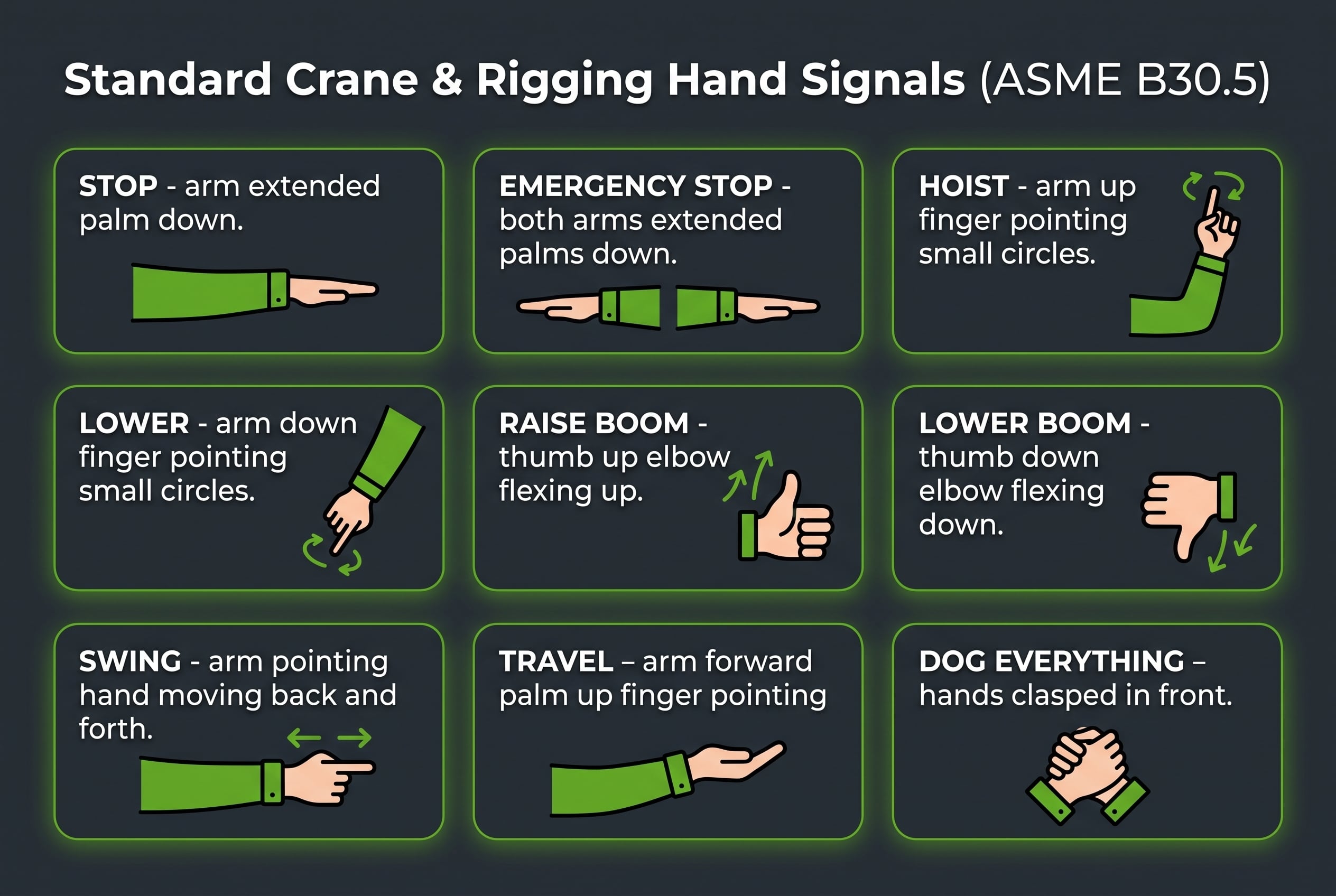
This is the section you can screenshot and tape to the gangbox. Every signal below is drawn from ASME B30.5 and matches the standard adopted by OSHA. Train from this. Quiz from this. If your crew can't reproduce these motions in a blind simulation, they aren't ready for a live lift.
Stop
Arm extended, palm facing down, held stationary. One of the simplest signals and the most important. If the operator sees a flat palm, everything stops. No load movement, no boom adjustment, no travel.
Emergency Stop
Both arms extended, palms down, moving rapidly back and forth. This is the nuclear option. It means freeze every motion immediately. Not just the load, but the crane itself. Everyone on site should know this signal, not just the designated signal person.
Hoist / Raise the Load
Arm extended upward, forefinger pointing, hand moved in small horizontal circles. The motion is continuous. If the circles stop, the hoist stops. Thumb up is not the standard here; the circular motion is.
Lower the Load
Arm extended downward, forefinger pointing, hand moved in small horizontal circles. Keep the motion small and consistent. Exaggerated movements confuse the operator and waste time.
Raise Boom
Arm extended, thumb up, flexing arm at elbow so the forearm moves toward the shoulder. The boom goes up. The signaler must stay visible. If the operator loses sight, the signal stops and the operator holds position.
Lower Boom
Arm extended, thumb down, flexing arm at elbow downward. Same visibility requirement: no sight, no signal, no movement.
Swing
Arm extended, pointing in the direction of the swing, hand moving back and forth horizontally. The direction of the point is the direction of travel. Ambiguity here causes more pinches and strikes than almost any other signal. Be precise.
Travel
Arm extended forward, palm up, forefinger pointing in the direction of travel. Used when the crane itself needs to move while carrying or trailing a load. On rough terrain, this signal is often paired with a spotter on the ground.
Dog Everything
Clasp hands together in front of the body. This means stop all motion and secure everything. Grab the load, set the brake, lock the boom. It's the signal you never want to give, but it's the one that prevents a swing from turning into a pendulum.
Move Slowly / Use Caution
One hand placed on top of the other signal being given. This is a modifier, not a standalone command. It tells the operator to execute the primary signal at reduced speed. Use it when the load is near personnel, power lines, or fragile fixtures.
Tired of Finding Out Workers Are Unqualified After the Lift Starts?
Paper certificates get lost. Expirations get missed. And OSHA doesn't care about your filing cabinet when they ask for proof of qualification. Start your 30-Day Free Trial and see how real-time competency tracking keeps your crane crews audit-ready.
Start Your 30-Day Free Trial →
Frequently Asked Questions
What are the OSHA requirements for a signal person?
OSHA 1926.1428 requires signal persons to be qualified through a written or oral test and a practical exam, evaluated by a qualified evaluator. They must understand the signal types used, know the limitations of the equipment, and be documented as qualified by the employer before directing any lift. Violations can result in citations, fines, and work stoppages during active inspections.
Can radios or phones replace hand signals on a construction site?
No. Radios can supplement hand signals, but OSHA 1926.1420 requires a backup communication method in case the primary system fails. Hand signals serve as the failsafe standard when radios lose battery, encounter interference, or are unusable due to ambient noise. Every signal person must be capable of communicating by hand even when electronic methods are functioning normally.
Do crane hand signals differ between mobile cranes and tower cranes?
The core hand signals are identical across mobile and tower cranes under ASME B30.5 and B30.3 standards. Both use the same stop, hoist, lower, swing, and emergency stop commands. The practical difference is visibility: tower crane signalers often work at height or across longer sightlines, which can require additional spotters or radio backup to maintain clear visual contact with the operator.
How often should signal person training be refreshed?
NCCCO certification is valid for five years. Best practice is an annual refresher with documented re-evaluation, especially when workers change sites, crane types, or signal methods. Provincial OHS regulations in Canada may require more frequent intervals, and some employers enforce refreshers every two years as part of their internal safety programs. Documentation of each refresher must be maintained and available for inspector review.
What is the Canadian standard for crane hand signals?
CSA Z150-22 (mobile cranes) requires designated signal persons for hoisting operations. Provincial OHS codes, such as WorkSafeBC OHSR Part 15 and Figure 15-1, reference standard hand signals. CCOHS provides a comprehensive national reference for signaler competency and standard commands. Employers across all provinces must document signaler designation on lift plans and be prepared to present proof during inspections.
More Like This