Last updated: March 2026
Your crew is on a roof, 4 metres up, and the only thing between them and a life-altering injury is a harness that nobody checked this morning. Or worse: there's no harness at all because "it's just a quick job." That thinking sends more than 40,000 Canadian workers to the hospital every year. Falls are the number one killer on construction sites, and they do not care how experienced your crew is.
At Safety Evolution, we build fall protection programs for contractors across Canada every week. We see the same patterns: good crews, solid work ethic, but gaps in the fall protection plan that would fail an audit or, worse, fail to protect someone when it matters. This guide breaks down what you actually need to know about fall protection and ladder safety to keep your crew safe and your program audit-ready.
⚡ Quick Answer: Fall Protection & Ladder Safety in Canada
- When required: Fall protection is mandatory when working at 3 metres (10 feet) or more, or at any height where a fall could cause serious injury
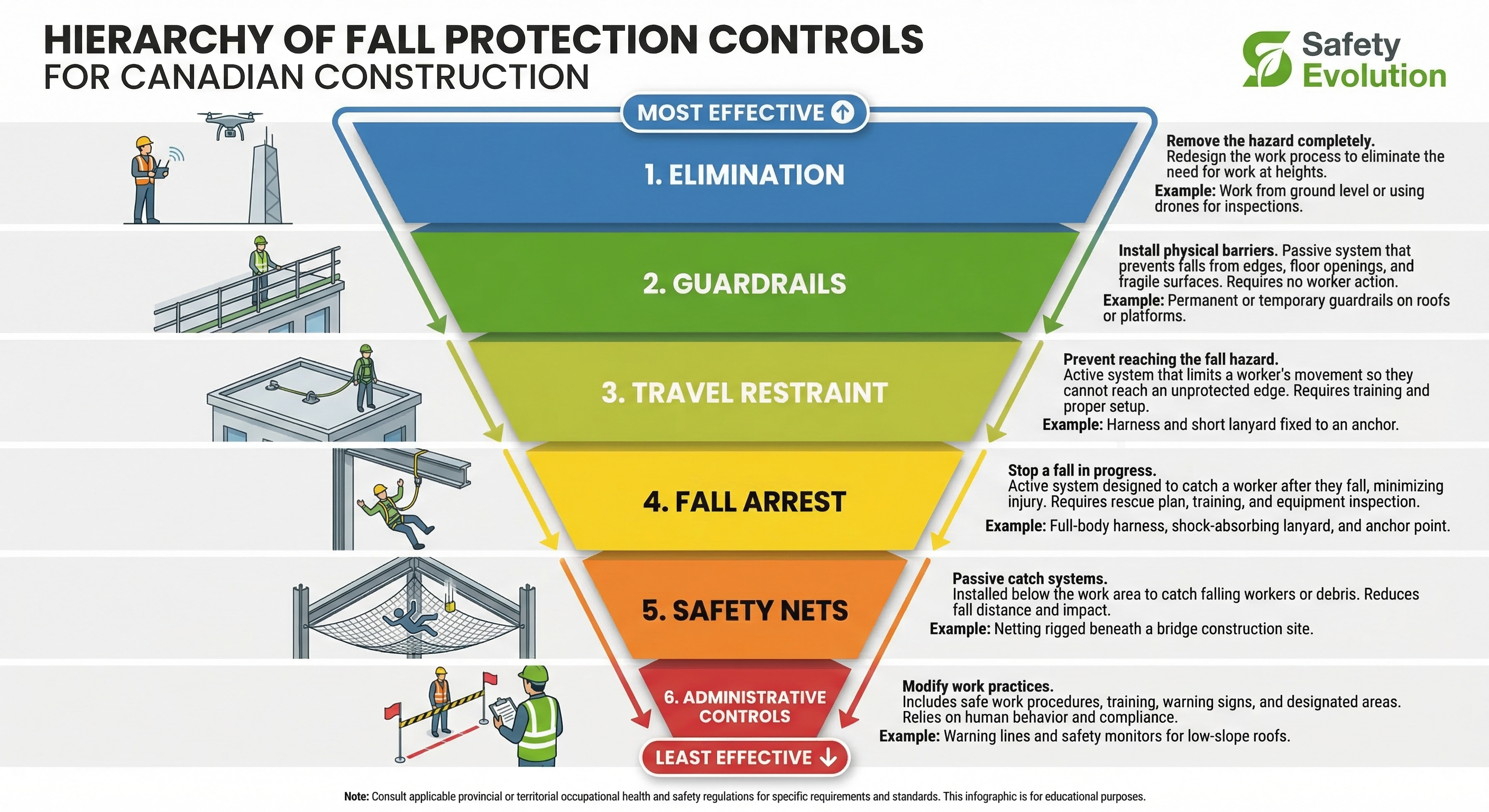
- Hierarchy: Elimination first, then guardrails, travel restraint, fall arrest, safety nets
- Ladder rule: Always maintain 3-point contact; use the 4:1 ratio for extension ladders
- Equipment standard: All fall protection gear must meet CSA Z259 standards; harnesses require annual inspection by a competent person
- Training cost: Typically $55 to $150 per worker depending on format (online vs. classroom with hands-on)
- Why it matters: The construction industry had approximately 872 fatalities in Canada in 2024. WorkSafeBC alone issued 152 administrative penalties totalling over $1 million for fall protection violations that year
What Is Fall Protection and Why Does It Matter on Your Site?
Fall protection is a system of equipment, procedures, and planning designed to prevent workers from falling to a lower level, or to arrest a fall before it causes injury. In Canadian construction, fall protection is not optional once your crew is working at height. Both Alberta (Part 9, OHS Code) and BC (Part 11, OHS Regulation) require fall protection systems when work happens at 3 metres (10 feet) or more above the nearest safe surface, or at any height where a fall could result in serious injury.
Here is the blunt truth most site supervisors will not say out loud: the majority of fall-related incidents happen when workers know the rules but skip steps because the job "only takes five minutes." A 12-person framing crew in Red Deer learned this the hard way last year when a worker stepped off a second-storey joist without clipping in. He did not fall far. Three metres. But three metres onto frozen ground shattered his heel, tore ligaments in both ankles, and kept him off work for seven months. The company got a stop-work order the same afternoon. The total cost, between WCB claims, lost productivity, and the fine, was over $80,000. For a five-minute shortcut.
That story is not unusual. In 2024 alone, falls remained the leading cause of construction fatalities in Canada, contributing to approximately 872 deaths across the industry. Over the past five years, WorkSafeBC accepted 22,044 claims for falls from heights, including 5,703 serious injuries and 88 fatalities in BC alone. These are not just numbers. They are crew members, business owners, and families.
If your fall protection program has gaps, or if your crew treats harnesses like optional accessories, the consequences are real. And they will find you: through an injury, an audit, or an OHS officer on your site. If you are not sure where your fall protection program stands, book a free safety assessment with Safety Evolution. It takes 30 minutes, and you get a 90-day action plan. Not sure what training your crew needs? Check out our safety training courses with instant certificates and expiry tracking.
What Is the Fall Protection Hierarchy of Controls?
Most contractors think fall protection means harnesses. They are wrong.
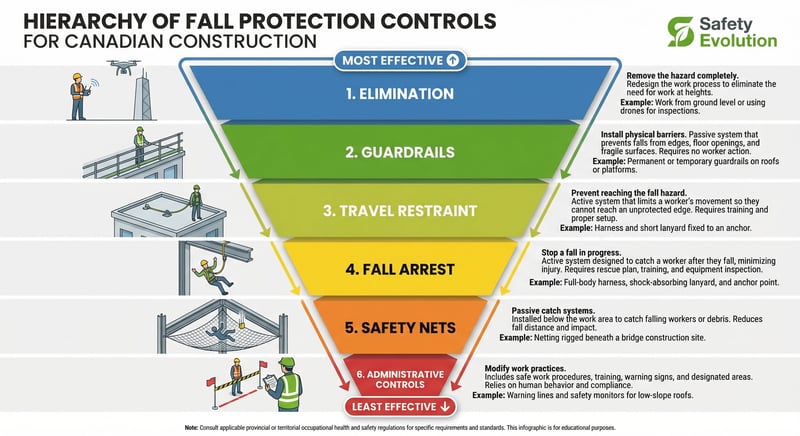
Harnesses are actually one of the last options in the fall protection hierarchy, not the first. Before you ever strap someone into a full-body harness, you should be asking: can we eliminate the need to work at height entirely? Canadian regulations, and your COR auditor, expect you to follow the hierarchy of controls:
- Elimination: Can the work be done from the ground? Prefabrication, ground-level assembly, or using extendable tools can remove the fall hazard completely.
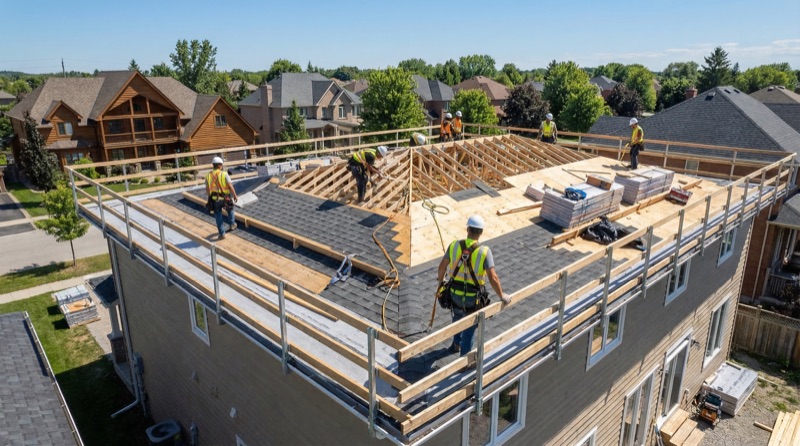
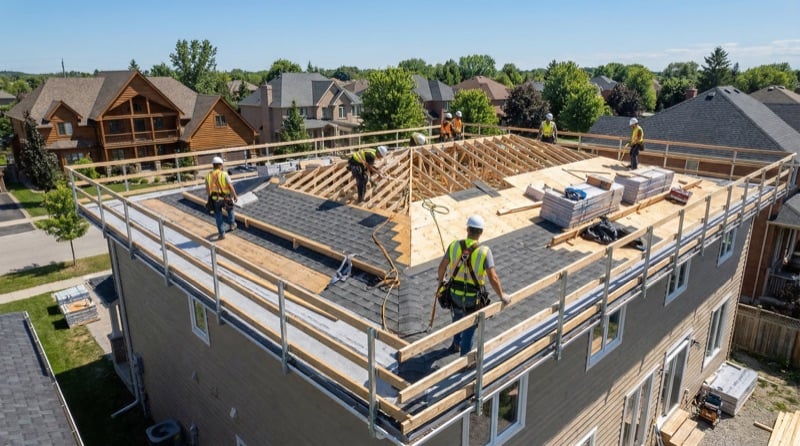
- Guardrails: Physical barriers at edges and openings. This is passive protection: it works without the worker doing anything. Guardrails are always preferred over personal fall protection.
- Travel restraint: A system that physically prevents the worker from reaching the fall edge. The worker is connected to an anchor point with a lanyard short enough that they cannot get to the danger zone.
- Fall arrest: Harness, lanyard with shock absorber, and anchor point. This does not prevent the fall; it stops the fall after it starts. Requires rescue planning because a worker hanging in a harness faces suspension trauma within minutes.
- Safety nets: Passive catch systems installed below the work area.
- Administrative controls: Warning lines, safety monitors, controlled access zones. These are the least reliable and should only be used when engineering controls are not feasible.
The key lesson: if your entire fall protection program is "hand out harnesses," you are missing the most effective layers. A strong program starts by engineering out the hazard. For a deeper dive into building a complete fall protection plan that covers all these layers, check out our safety services, where we build audit-ready programs from the ground up.
Book Your Free Safety Assessment
30-minute review + 90-day action plan. No obligation.
Book Now →
How Do You Set Up Fall Protection on a Construction Site?
Setting up fall protection is not as simple as buying equipment and telling your crew to wear it. That approach fails audits, and it fails workers. Here is what an effective fall protection setup actually looks like, step by step.
Step 1: Identify Every Fall Hazard on Site
Walk the entire site before work begins. Every floor opening, roof edge, scaffold platform, ladder access point, and excavation needs to be identified. This is not a one-time exercise. As the job progresses, new fall hazards appear: the second floor gets framed, roof trusses go up, mechanical rough-in opens ceiling cavities. Your field-level hazard assessment (FLHA) should capture fall hazards every single morning.
Here is where most crews get it wrong: they do a site assessment at the start of the project and never update it. Two weeks later, the site looks completely different, but the fall protection plan still references "ground-level concrete work." That disconnect is what OHS officers look for, and what causes incidents.
Step 2: Write a Site-Specific Fall Protection Plan
Both Alberta and BC require a written fall protection plan when workers are exposed to a fall of 3 metres or more without guardrail protection. The plan must be site-specific. There is no generic template that covers every site.
Your fall protection plan should include:
- A description of every fall hazard on the site (with locations)
- The fall protection system being used for each hazard (guardrail, travel restraint, fall arrest, etc.)
- Anchor point locations and their rated capacities
- Equipment specifications (harness type, lanyard length, shock absorber details)
- Rescue procedures for each scenario, including suspension rescue
- Names of workers trained and competent in each system
- Emergency contact information
In Alberta, the government publishes a fall protection plan template through Alberta OHS. In BC, WorkSafeBC provides a site-specific fall protection plan template. Use them. They are free and they cover what auditors expect to see.
Step 3: Install the Right Systems Before Anyone Goes Up
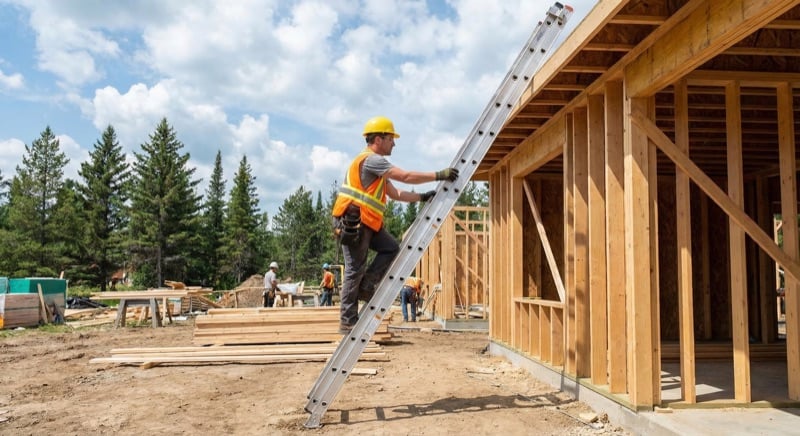
This sounds obvious, but we see it constantly: the crew starts working at height and the fall protection equipment shows up an hour later. Or guardrails get installed on three sides of a roof but the fourth side stays open because "that is where the ladder is."
The fall protection system must be in place before any worker is exposed to the hazard. Period. That means guardrails go up as part of the framing sequence, not as an afterthought. Anchor points get installed and rated before anyone clips in. Harnesses get inspected at the start of the shift, not when someone remembers.
Step 4: Train Your Crew (and Actually Verify Competency)
Every worker who uses fall protection equipment must be trained. Not "watched a video once" trained. Competent. That means they can:
- Inspect their own harness and lanyard before each use
- Identify proper anchor points and understand rated capacities
- Put on a harness correctly and adjust it for a proper fit
- Calculate fall clearance (the total distance needed below them for the system to work)
- Participate in a rescue if a co-worker falls
Fall protection training typically runs $55 to $150 per worker depending on format. Online courses cover theory for around $55. Classroom training with hands-on practice runs closer to $150. For a crew of 15, that is $825 to $2,250. Compare that to a single fall incident: $80,000 or more in direct costs, plus lost time, plus the human cost nobody can put a number on.
Safety Evolution's training platform includes fall protection courses with instant certificates and expiry tracking, so you always know who is current and who needs recertification. If you need a comprehensive onboarding program for new workers joining your crew, our free orientation and onboarding package includes fall protection awareness as part of the new hire safety orientation process.
Step 5: Plan the Rescue Before You Need It
This is the step almost everyone skips. You have harnesses. You have anchor points. Someone falls and the arrest system works perfectly. Now what?
Your worker is hanging 3 metres off the ground in a harness. Suspension trauma (also called harness hang syndrome) can cause serious injury or death within 15 to 30 minutes. That is not a typo. A worker hanging motionless in a properly fitted harness can lose consciousness and die from blood pooling in the legs.
Your fall protection plan must include a rescue procedure for every scenario where a fall arrest system is used. That means trained rescuers, rescue equipment on site (descent devices, retrieval systems), and a rehearsed plan. If your rescue plan is "call 911 and wait," you do not have a rescue plan.
How Do You Use Ladders Safely on a Construction Site?
Ladders are the most commonly misused piece of equipment on any construction site. They are so familiar that crews stop thinking about them as a fall hazard. That is exactly why ladder falls account for thousands of injuries every year in Canadian construction.
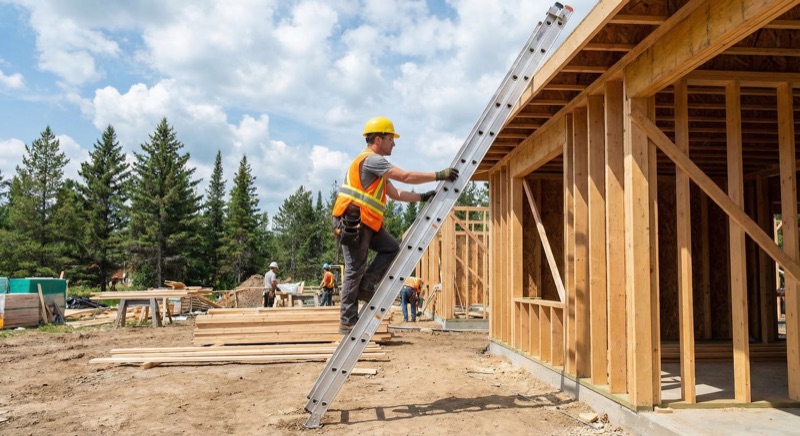
Canadian portable ladders must meet CSA Z11-18 (R2022) standards. For construction, you need heavy-duty (Grade 1) or extra-heavy-duty (Grade 1A) ladders. Using a household ladder on a construction site is a violation, full stop. Here is what your crew needs to know, and what you need to enforce.
The 4:1 Rule for Extension Ladders
For every 4 feet (1.2 metres) of height, the base of the ladder should be 1 foot (0.3 metres) away from the structure. This gives you the correct 75-degree angle. Too steep and the ladder tips backward. Too shallow and the base kicks out. Both scenarios end the same way.
Quick field check: stand at the base of the ladder with your feet touching it. Extend your arms straight out. Your palms should rest on the rung at shoulder height. If you have to reach forward or backward, the angle is wrong.
The 3-Point Contact Rule
Always maintain three points of contact with the ladder: two hands and one foot, or two feet and one hand. This means you never carry tools, materials, or anything else while climbing. Use a tool belt, tool pouch, or rope and bucket to get materials up and down.
Most ladder falls happen when a worker breaks 3-point contact to reach for something. They lean, shift their weight, and the ladder shifts with them. Every toolbox talk about ladder safety should reinforce this rule. If you need fresh toolbox talk topics for your crew, we offer a free package with 50+ topics, including fall protection and ladder safety.
Pre-Use Inspection: Every Time, No Exceptions
Before anyone climbs a ladder, inspect it. Every time. Check for:
- Cracked, bent, or missing rungs and rails
- Loose hardware, bolts, or rivets
- Damaged feet or safety shoes (the rubber pads on the bottom)
- Corrosion on metal ladders
- Damaged ropes or pulleys on extension ladders
- Missing or illegible labels (duty rating, manufacturer info)
If a ladder fails inspection, take it out of service immediately. Tag it, remove it from the work area, and replace it. Do not lean it against a wall and "deal with it later." Someone will use it.
Ladder Setup Rules That Save Lives
- Extension ladders must extend at least 1 metre (3 feet) above the landing surface. This gives the worker something to hold onto when stepping on and off the ladder at the top.
- Secure the top and bottom. Tie off the top of the ladder to the structure. If you cannot tie it off, have someone foot the base.
- Set up on firm, level ground. Never set a ladder on loose material, mud, ice, or uneven surfaces. Use leg levellers on uneven ground, not scrap wood or bricks.
- One person on the ladder at a time. Unless the ladder is specifically rated for two-person use (most are not).
- Never use a ladder near overhead power lines. Check above before you set up. Use non-conductive (fibreglass) ladders on any site with electrical hazards.
How Often Should Fall Protection Equipment Be Inspected?
There are two levels of inspection required, and most contractors only do one of them (if that).
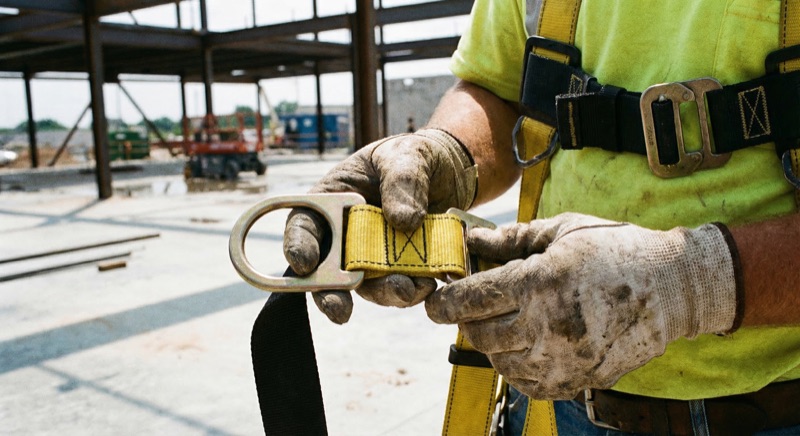
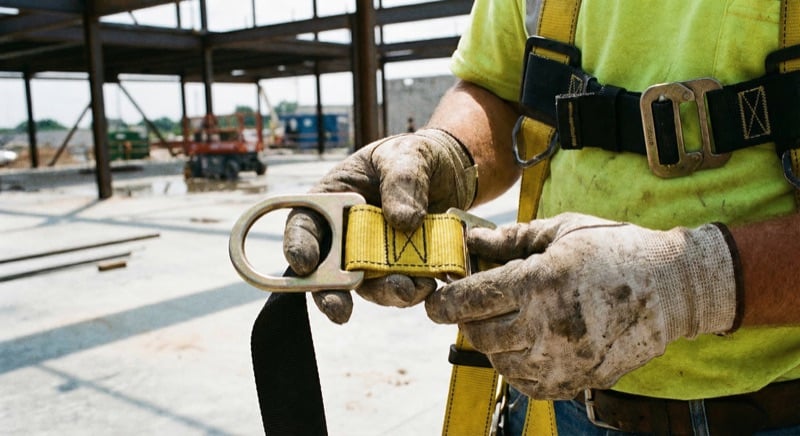
Pre-use inspection (every shift): Before a worker puts on a harness, they should check the webbing for cuts, fraying, chemical damage, or UV degradation. Check all buckles, D-rings, and stitching. Inspect lanyards and shock absorbers for damage. This takes two minutes and should be non-negotiable.
Formal inspection (at least annually): CSA Z259.10-18 recommends that a trained and competent person conduct a thorough inspection of all fall protection equipment at least once per year. Many jurisdictions, including Alberta, require this. The competent person should document the inspection, including serial numbers, inspection date, and pass/fail status for each component.
Any equipment that has arrested a fall must be removed from service immediately and inspected by a competent person before reuse. Most manufacturers recommend retiring harnesses and lanyards after an arrest event, even if no visible damage is found. The forces involved in a fall arrest can cause internal damage that is not visible.
If your fall protection equipment inspection process is informal or inconsistent, that is a gap a COR auditor will find. Safety Evolution helps contractors build safety programs with built-in inspection schedules and tracking, so nothing slips through the cracks.
What Are the Province-Specific Requirements You Need to Know?
While the 3-metre threshold is consistent across Alberta and BC, there are differences in how each province enforces and documents fall protection requirements.
Alberta
- Legislation: Part 9 of the Alberta OHS Code governs fall protection
- Threshold: Fall protection required at 3 metres or more, or at any height where a fall poses a risk of injury (e.g., above hazardous materials, open tanks)
- Fall protection plan: Written plan required when workers are exposed to a 3m+ fall without guardrails
- Equipment standards: Must meet CSA Z259 series; personal fall arrest systems must include full-body harness with shock-absorbing lanyard
- Enforcement: Alberta OHS issues administrative penalties, violation tickets, and can lay charges. Penalties for fall protection violations typically range from $2,000 to $10,000+ per occurrence
British Columbia
- Legislation: Part 11 of the BC OHS Regulation governs fall protection
- Threshold: Same 3 metres, with the same "lesser height with greater risk" provision
- Fall protection plan: Written, site-specific plan required; WorkSafeBC provides a template
- Equipment standards: Same CSA Z259 requirements apply
- Enforcement: In 2024 alone, WorkSafeBC issued 152 administrative penalties for inadequate fall protection, totalling over $1 million. Over the past five years, WorkSafeBC accepted 22,044 fall-from-height claims, 5,703 of which were serious injuries and 88 were fatalities
- Resources: BCCSA provides a Working at Heights resource catalogue specifically for BC construction employers
Regardless of your province, the message is the same: fall protection is not something regulators take lightly. If an OHS officer walks onto your site and finds workers at height without protection, expect a stop-work order at minimum. The fine is the cheap part; the lost production and reputational damage cost more.
What Mistakes Do Contractors Make With Fall Protection?
After working with dozens of contractors on their safety programs, here are the patterns we see over and over:
- "We have never had a fall, so our program is fine." This is survivorship bias. The absence of incidents does not mean the presence of safety. It means you have been lucky. Auditors and regulators do not accept luck as a control measure.
- Buying equipment but skipping training. A harness in a truck toolbox is not fall protection. It becomes fall protection when the worker knows how to inspect it, wear it correctly, identify anchor points, and participate in rescue. Equipment without competency is a liability, not protection.
- No rescue plan. We mentioned this above, but it bears repeating. The number of contractors who have fall arrest systems in place but zero rescue planning is staggering. Your worker is hanging in the air. What is your plan? If you do not have one, you are putting their life at risk even after the arrest system works.
- Generic fall protection plan for every site. Your plan must be site-specific. The fall hazards on a two-storey residential frame are completely different from a mechanical room retrofit. If your plan does not name specific locations, specific systems, and specific anchor points for this site, it is not a plan.
- Treating ladders as "just ladders." Ladders are fall protection equipment. They need to be inspected, rated for the job, set up correctly, and used by trained workers. The casualness with which most crews treat ladders is the single biggest gap we see.
If any of those hit close to home, you are not alone. These are the most common gaps across the industry. The good news: they are all fixable. Safety Evolution builds audit-ready fall protection programs for contractors. We handle the documentation, the training matrix, the inspection schedules, and the site-specific planning so your crew can focus on the work.
Your Fall Protection Checklist: What to Do This Week
You do not need to overhaul everything at once. Start here:
- Review your fall protection plan. Is it site-specific and current? Does it cover rescue? If not, rewrite it using the Alberta or BC template linked above.
- Inspect every ladder on your site. Tag and remove any that fail. Replace with CSA Z11-rated, Grade 1 or 1A ladders.
- Check training records. Does every worker who uses fall protection have documented training? Is it current? If not, schedule a training day.
- Do a harness inspection. Formal, documented, every harness and lanyard. Remove from service anything that has arrested a fall or shows damage.
- Run a fall protection toolbox talk. Reinforce the rules. Cover 3-point contact, the 4:1 rule, pre-use inspection, and rescue procedures. Need a ready-to-go toolbox talk on falls? Download our Ultimate Guide to Toolbox Talks with 365 topics for the entire year, including fall protection.
If you are tracking training, inspections, and incidents on paper, this is also a good time to look at going digital. Safety Evolution's digital safety forms let your crew complete FLHAs, inspections, and incident reports from their phones, and everything syncs to one dashboard. No more chasing paper at the end of the week.
The Bottom Line
Fall protection and ladder safety are not glamorous topics. Nobody gets into construction because they love filling out fall protection plans. But the stakes are real: lives, livelihoods, and your ability to keep winning work. A solid fall protection program protects your crew, keeps regulators off your site, and shows GCs that you are serious about safety. For a broader look at what a complete safety program includes, see our construction safety management guide.
The work is not complicated. But it does require intention, documentation, and follow-through. If you want help getting your fall protection program audit-ready, or if you are not sure where the gaps are, that is exactly what we do. Book your free safety assessment. It takes 30 minutes, you get a 90-day action plan, and there is zero obligation. We will tell you where you stand and what needs to happen next.
Want Expert Eyes on Your Safety Program?
Book a free 30-minute assessment with a safety consultant. You’ll get a 90-day action plan, whether you work with us or not.
Get Your Free Assessment →
Frequently Asked Questions
At what height is fall protection required in Canada?
In most Canadian provinces, including Alberta and BC, fall protection is required when workers are at 3 metres (10 feet) or more above the nearest safe surface. Fall protection is also required at any height where a fall could result in serious injury, such as above hazardous materials, open tanks, or operating machinery. Always check your province's specific OHS regulations for exact requirements.
How much does fall protection training cost in Canada?
Fall protection training typically costs between $55 and $150 per worker in Canada. Online theory courses run around $55, while classroom training with hands-on practice costs closer to $150 per person. Train-the-trainer certification courses start around $199. Group rates are often available for crews of 10 or more.
What is the 3-point contact rule for ladder safety?
The 3-point contact rule means always maintaining three points of contact with the ladder while climbing or descending: two hands and one foot, or two feet and one hand. This keeps your centre of gravity stable and reduces the risk of falling. Never carry tools or materials while climbing; use a tool belt or hoist line instead.
How often should fall protection harnesses be inspected?
Fall protection harnesses should be inspected at two levels: a pre-use visual inspection by the worker before every shift, and a formal documented inspection by a trained and competent person at least once per year (per CSA Z259.10-18). Any harness that has arrested a fall must be removed from service immediately and inspected before reuse. Most manufacturers recommend replacing harnesses after a fall arrest event.
What should a fall protection plan include?
A fall protection plan must be site-specific and should include: identification of all fall hazards on site, the fall protection system being used for each hazard, anchor point locations and rated capacities, equipment specifications, rescue procedures for each fall arrest scenario, names of trained workers, and emergency contact information. Both Alberta and BC provide free templates through their respective OHS agencies.
What are the fines for fall protection violations in Canada?
Fines for fall protection violations vary by province and severity. In Alberta, administrative penalties typically range from $2,000 to $10,000 or more per occurrence, with the possibility of criminal charges for serious violations. In BC, WorkSafeBC issued 152 administrative penalties totalling over $1 million for fall protection violations in 2024 alone. Beyond fines, expect stop-work orders, increased WCB premiums, and reputational damage with GCs.