Safety Orientation Checklist
A complete safety orientation checklist for construction and industrial contractors. Covers all regulatory requirements for Canada and the US.
Contractor safety orientation requirements for GCs and prime contractors. Legal requirements, what to cover, and how to scale for large projects.
Last updated: April 2026
Your GC just told you every subcontractor needs to complete a site-specific safety orientation before anyone steps foot on the project. You have 40 workers showing up Monday from three different trades. A contractor safety orientation is a structured training session that introduces contractors and subcontractors to site-specific hazards, emergency procedures, PPE requirements, and the prime contractor's safety rules before they begin work on a project. It is not the same as the orientation your own employees receive. Contractors bring their own safety programs, their own training, and their own assumptions about how things work. The orientation bridges the gap between what they know and what this site requires.
When you hire a new employee, you control their training from Day 1. You know what they have been taught and what they have not. Contractors are different. They arrive with certifications, safety tickets, and experience from dozens of other sites. The problem is that none of that experience is specific to your site.
A journeyman electrician with 15 years of experience knows electrical safety. He does not know that your site has a live 4160V line running under the access road to Pad 3. A crane operator with a Red Seal certification knows rigging. She does not know that the wind gusts on your coastal site shut down lifts above 40 km/h, not the standard 35 km/h her last project used.
Contractor orientation is not remedial training. It is site-specific intelligence. And in a multi-employer work site, it is legally required.
In Alberta, the concept of "prime contractor" under the OHS Act places specific coordination duties on whoever controls the work site. The prime contractor must ensure that all employers (including subcontractors) coordinate their safety activities and that all workers on site are trained on the hazards they will encounter. This includes subcontractor orientation.
In BC, OHSR sections 3.22 through 3.25 require orientation for all "new workers," which includes contractors who are new to the specific work site, regardless of their experience level. The regulation does not distinguish between employees and contractors.
Ontario requires basic OHS awareness training (O.Reg 297/13) for all workers, including contract workers. The employer at the workplace is responsible for ensuring contractors meet this requirement before starting work.
Under OSHA's multi-employer worksite policy, the controlling employer (typically the GC) has a duty to ensure that subcontractors are trained on site-specific hazards. 29 CFR 1926.21(b)(2) requires instruction for "each employee," and OSHA interprets this to include contract workers on multi-employer sites. The controlling employer can be cited for hazards affecting subcontractor employees if they failed to take reasonable steps to prevent the exposure. A contractor orientation is one of those reasonable steps.
OSHA penalties as of January 2025: $16,550 per serious violation, $165,514 per willful or repeated violation. On multi-employer sites, both the controlling employer and the subcontractor can be cited.
Managing Subcontractor Orientations Across Multiple Sites?
Tracking which subs have been oriented on which sites gets complicated fast when you are running 3 projects with 15 trades. Download SE's free Construction Safety Orientation Package to standardize your process.
Download the Free Package →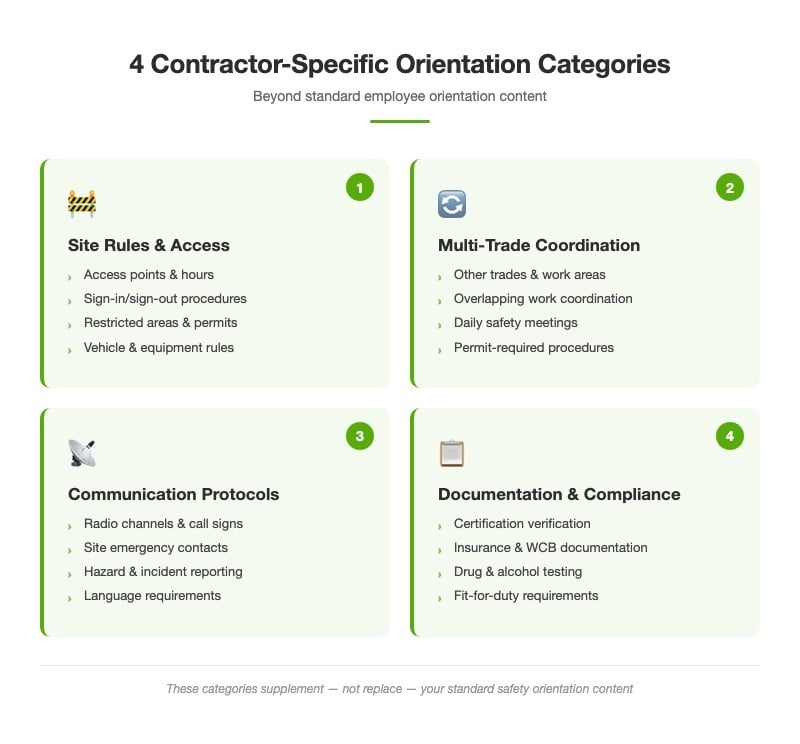
Everything from the standard safety orientation checklist, plus the following contractor-specific items:
Assuming experienced contractors do not need orientation. This is the most common and most dangerous mistake. A 20-year veteran pipe fitter knows his trade. He does not know your site. Experience does not replace site-specific knowledge. The orientation is about this site, not about general safety competency.
Running the same orientation for employees and contractors. Employees need onboarding context (company policies, benefits, HR). Contractors need project context (site rules, multi-trade coordination, communication protocols). Running a combined orientation wastes time for both groups and misses contractor-specific items.
No documentation for short-term contractors. The framer who is on site for two days gets the same orientation as the electrician who is there for six months. If he gets hurt on Day 1, the investigation does not care that he was "only here for a couple of days." Document every contractor orientation regardless of duration.
We worked with a GC running a 200-person turnaround at a petrochemical facility. Subcontractors were arriving daily from four provinces. The orientation was a generic 45-minute video that referenced a different facility layout, different emergency muster points, and PPE requirements that did not match the site. Workers were "oriented" to a plant they were not working in. The GC's signed forms looked compliant. Their incident rate told a different story.
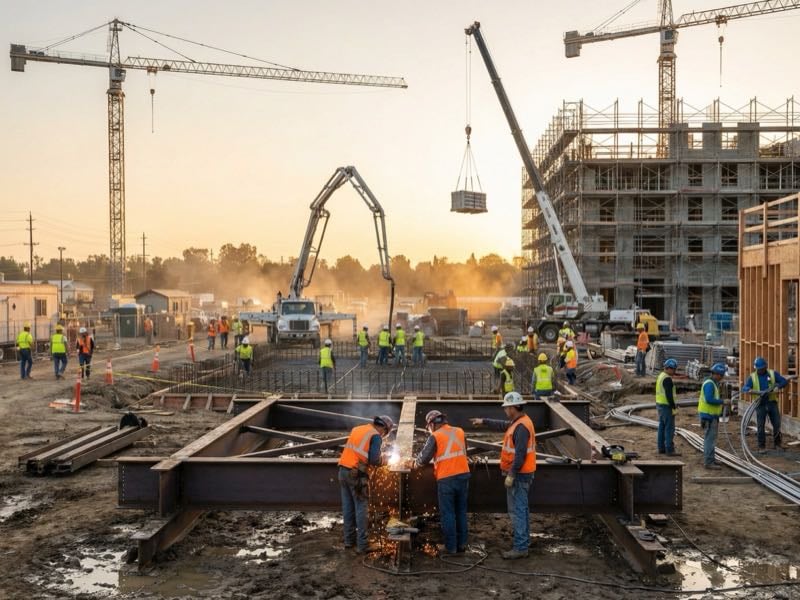
Large projects with hundreds of contractors rotating through create a logistical challenge. Here is how to manage it:
Standardize the base content. Create a site-specific orientation template that covers everything every contractor needs to know. Update it when conditions change.
Add trade-specific modules. The ironworker needs fall protection and rigging content. The electrician needs LOTO content. The pipe fitter needs confined space content. Add these as short modules after the base orientation.
Track completion digitally. Paper sign-in sheets work for 10 workers. They do not work for 200. Digital tracking lets you verify in real time who has been oriented and who has not. It also generates audit-ready reports when the inspector arrives.
Schedule multiple sessions. Do not try to orient 40 people at once. Run smaller sessions (10 to 15 workers) so the facilitator can answer questions and the orientation is interactive, not a lecture.
Onboarding Dozens of Subcontractors Every Week?
Manually tracking which subs completed orientation on which site is a full-time job nobody signed up for. SE AI automates contractor orientation tracking, generates site-specific content, and flags compliance gaps before the inspector does.
Get Early Access to SE AI →Yes. In Canada, provincial OHS Acts require all workers (including contractors) to be oriented to site-specific hazards. In the US, OSHA's multi-employer worksite policy holds the controlling employer responsible for ensuring subcontractors are trained on site hazards. Both the GC and the subcontractor can be cited for non-compliance.
Yes. Contractor orientation is about site-specific knowledge, not general safety competency. A 20-year veteran knows their trade but does not know your site's specific hazards, emergency procedures, or communication protocols. Every contractor new to a site needs orientation regardless of experience level.
The prime contractor or controlling employer (typically the GC) is responsible for ensuring all contractors on a multi-employer work site are oriented to site-specific hazards. Individual subcontractors are also responsible for their own workers' safety training. Both parties share the obligation.
Typically 1 to 3 hours, depending on site complexity and the number of hazards. High-risk sites (petrochemical facilities, confined space work, multi-trade construction) need longer orientations than low-risk sites. The orientation should include a physical site walk, not just a classroom presentation.
Yes. Every new work site requires a new site-specific orientation, even if the contractor has worked for the same GC before. Different sites have different hazards, different emergency procedures, and different layouts. A contractor oriented to Site A is not oriented to Site B.
Get Weekly Safety Insights
Regulation updates, toolbox talk ideas, and compliance tips. One email per week.
A complete safety orientation checklist for construction and industrial contractors. Covers all regulatory requirements for Canada and the US.
WorkSafeBC Part 9 confined space requirements for BC contractors. Atmosphere classifications, 20-minute testing rule, rescue, penalties up to $600K+.
Ontario Regulation 632/05 explained for contractors. Confined space definition, entry permits, atmospheric testing, rescue requirements, and...