Heat Stress Prevention: Complete Guide
55 workers died from heat in 2023. Learn the 5 controls every employer needs, OSHA requirements, and Canadian regulations for heat stress prevention.
Federal OSHA doesn't require safety meetings, but 14+ states do. State-by-state requirements, Cal/OSHA's 10-day rule, and why you need them anyway.
Last updated: April 2026
Ask ten contractors whether OSHA requires safety meetings, and at least eight will say yes. They are wrong. Federal OSHA does not explicitly require safety meetings for private-sector employers. The General Duty Clause requires a workplace "free from recognized hazards," but it never mentions the words "safety meeting." The confusion comes from state-plan states: at least 14 states have their own safety meeting or safety committee mandates that go well beyond anything federal OSHA requires.
No. Federal OSHA does not have a standard that requires safety meetings. This surprises most people in construction and general industry because safety meetings are so deeply embedded in industry practice that everyone assumes they are a legal requirement.
Here is what OSHA actually says:
The practical reality is different from the legal requirement. OSHA inspectors look favorably on documented safety meetings during inspections. Companies in OSHA's Voluntary Protection Program (VPP) are all expected to run active safety meetings and committees. And if you are bidding on contracts that require ISNetworld or Avetta prequalification, your safety program will be scored partly on whether you conduct and document regular safety meetings.
So while OSHA does not legally require safety meetings, the entire safety ecosystem operates as if they do. For a complete overview of safety meetings including types, documentation, and Canadian requirements, see our full guide.
At least 14 states have their own safety committee or safety meeting requirements. These state-plan states have OSHA-approved programs that meet or exceed federal standards.
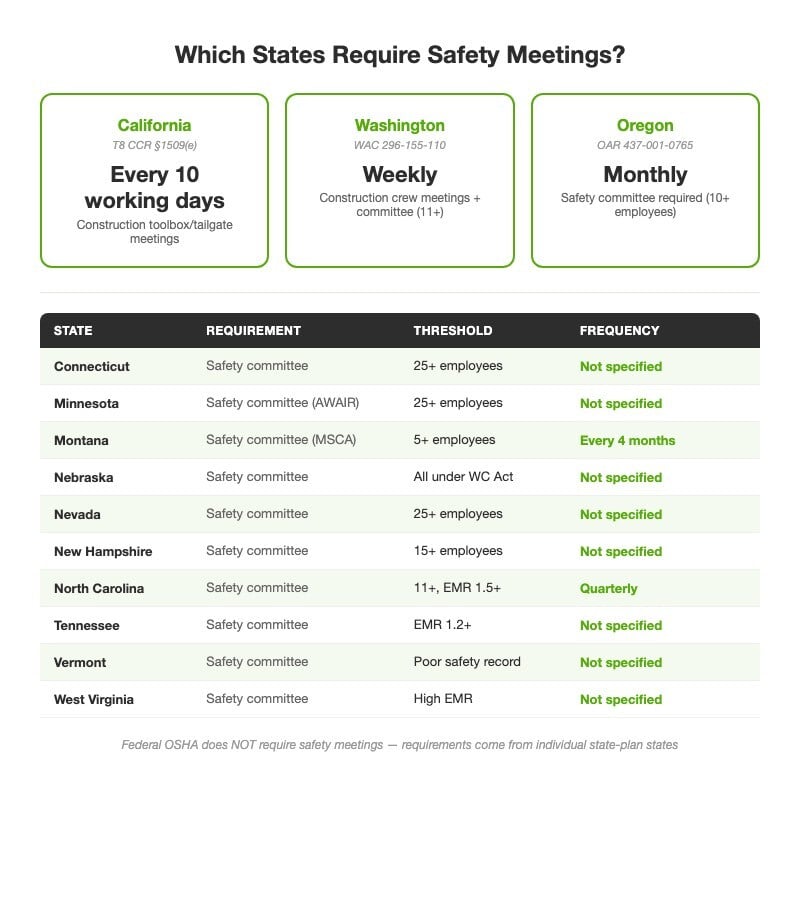
California has the most specific safety meeting requirements in the country.
Cal/OSHA penalties for IIPP violations can reach $25,000 per violation for serious violations. Not having documented safety meetings when your IIPP says you will is a straightforward citation.
Washington's Department of Labor and Industries (L&I) requires safety committees or safety meetings based on employer size:
Oregon OSHA requires all employers with 10 or more employees to establish a safety committee or hold safety meetings under OAR 437-001-0765. Safety committees must meet monthly. Employers with fewer than 10 employees may use safety meetings as an alternative.
| State | Requirement | Threshold | Meeting Frequency |
|---|---|---|---|
| Connecticut | Safety committee required | 25+ employees | Not specified |
| Minnesota | Safety committee required (AWAIR) | 25+ employees | Not specified |
| Montana | Safety committee required (MSCA) | 5+ employees | Every 4 months minimum |
| Nebraska | Safety committee required | All employers under WC Act | Not specified |
| Nevada | Safety committee required | 25+ employees | Not specified |
| New Hampshire | Safety committee required | 15+ employees | Not specified |
| North Carolina | Safety committee required | 11+ employees with EMR 1.5+ | Quarterly minimum |
| Tennessee | Safety committee required | Employers with EMR 1.2+ | Not specified |
| Vermont | Safety committee required | Poor safety record | Not specified |
| West Virginia | Safety committee required | High EMR employers | Not specified |
Note that some states tie the requirement to your Experience Modification Rate (EMR). If your EMR is above the state threshold, you must form a safety committee. If your EMR is low, the requirement may not apply. This creates a perverse incentive: the companies that most need safety meetings are the ones required to have them, while companies with good records can skip them.
Not Sure Which State Requirements Apply to You?
SE AI maps your operating states, workforce size, and industry to the exact meeting requirements you need to follow.
30-Day Free TrialEven if your state does not require safety meetings, here is why you should hold them anyway:
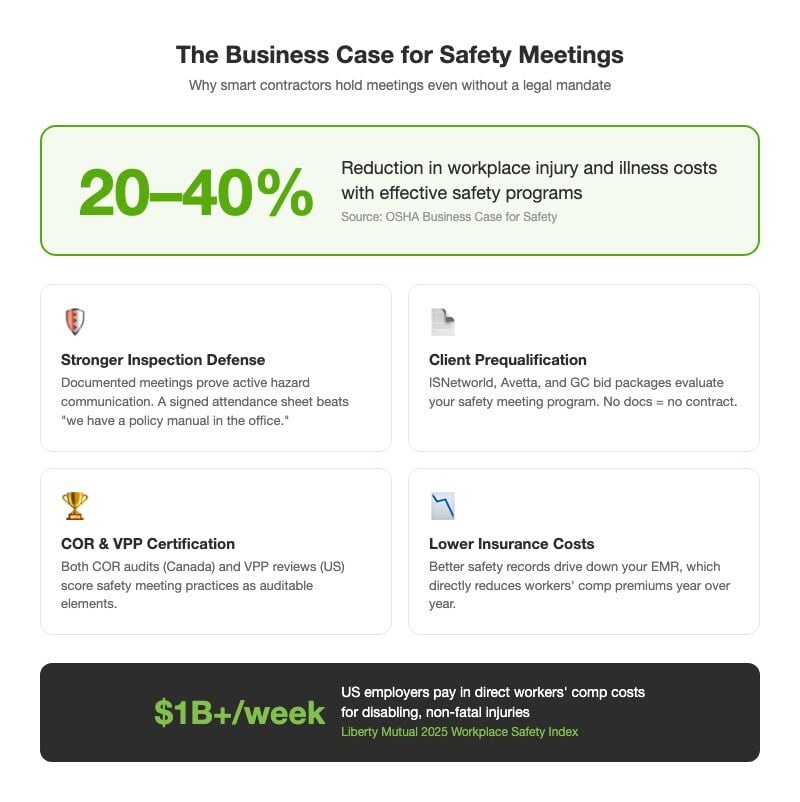
They reduce injuries and save money. OSHA estimates that companies with effective safety and health management systems reduce workplace injury and illness costs by 20 to 40 percent. The Liberty Mutual 2025 Workplace Safety Index found that employers pay more than $1 billion per week in direct workers' compensation costs for disabling, non-fatal injuries. Safety meetings are the lowest-cost intervention in your safety program.
They strengthen your defense during inspections. When OSHA shows up after an incident, documented safety meetings prove you were actively communicating hazards to your workforce. "We told them about fall protection in last Tuesday's toolbox talk" backed by a signed attendance sheet is a stronger defense than "we have a safety policy manual in the office."
They are required by your clients even if not by law. ISNetworld, Avetta, ComplyWorks, and other contractor prequalification platforms all evaluate your safety meeting program. General contractors reviewing your bid package will ask for meeting documentation. If you do not have it, you do not get the contract.
They count toward your COR or VPP certification. Both Canada's Certificate of Recognition (COR) program and OSHA's Voluntary Protection Program (VPP) evaluate safety meeting practices. In COR audits, documented meetings are a scored element. Missing or inadequate meeting records will cost you points.
The answer depends on the type of meeting and your jurisdiction:
Track Meeting Compliance Automatically
SE AI monitors your meeting frequency against your state and provincial requirements. When you fall behind schedule, it tells you before an auditor does.
30-Day Free TrialFederal OSHA does not require weekly safety meetings. However, some state-plan states do mandate regular meetings. Cal/OSHA requires construction toolbox talks every 10 working days (biweekly). Washington requires weekly construction crew meetings. Check your specific state requirements, as they may exceed the federal standard.
Federal OSHA cannot fine you specifically for not holding safety meetings, since there is no federal meeting requirement. However, state-plan states like California can and do issue citations for failure to hold required meetings. Cal/OSHA IIPP violations can carry penalties up to $25,000 per serious violation. Federal OSHA may also cite inadequate employee training or communication as a General Duty Clause violation if the lack of meetings contributed to a hazard.
OSHA's VPP recognizes employers with exemplary safety and health management systems. VPP participants demonstrate low injury rates and strong safety cultures, including regular safety meetings and active worker participation. VPP sites are exempt from routine OSHA inspections. While safety meetings are not a formal VPP requirement, all VPP sites conduct them as part of their safety management system.
A tailgate safety meeting is the US construction term for what is commonly called a toolbox talk. It is a short (5-15 minute), informal safety briefing held at the start of a work shift, typically at the tailgate of a truck or in the field. The term is used primarily in US construction, particularly in California, where Cal/OSHA requires these meetings at least every 10 working days under T8 CCR §1509.
No. Only about 14 states have mandatory safety committee requirements, and the specifics vary widely. Some states like Montana require committees for employers with just 5 or more employees, while others like Connecticut set the threshold at 25. Several states only require committees for employers with high Experience Modification Rates (EMR). The remaining states follow federal OSHA, which does not mandate safety committees for private-sector employers.
Get Weekly Safety Insights
Regulation updates, toolbox talk ideas, and compliance tips. One email per week.
55 workers died from heat in 2023. Learn the 5 controls every employer needs, OSHA requirements, and Canadian regulations for heat stress prevention.
OSHA ladder requirements for 2026, including 4-to-1 setup, 3-foot extension, fixed ladder rules, stairway standards, inspections, and training proof.
OSHA forklift training requirements under 29 CFR 1910.178. 3-part training format, 3-year re-evaluation rules, penalties up to $16,550, and...